

Galmed Pharmaceuticals: A 20-Year Focus on a Single Pipeline Leads to Promising Phase III Results in NASH

Galmed Pharmaceuticals
Disease Treatment Drug Developer
Since the second half of 2022, there has been a steady stream of positive news regarding breakthroughs in the treatment of non-alcoholic steatohepatitis (NASH):
Akero TherapeuticsThe investigational drug efruxifermin (EFX) has achieved significant progress in clinical trials. In a 24-week trial, it significantly improved liver fibrosis in patients with nonalcoholic steatohepatitis (NASH), with an effect size twice that of the control group. Based on these data, efruxifermin for the treatment of NASH has been granted Breakthrough Therapy Designation (BTD) by the U.S. FDA;
Axcella TherapeuticsThe investigational drug AXA1125 achieved positive interim results in the Phase IIb EMMPACT clinical trial in patients with NASH;
Madrigal PharmaceuticalsThe investigational drug resmetirom achieved positive results in Phase III clinical trials for the treatment of NASH, emerging as a potential first-in-class novel therapy;
PoxelRelease of the latest clinical data for the investigational drug PXL065: PXL065 significantly improves hepatic fibrosis in patients without worsening NASH symptoms, and may offer benefits in glycemic control. Based on these data, Poxel will begin preparing to submit a New Drug Application (NDA) to the U.S. FDA;
Intercept PharmaceuticalsThe NDA for the new drug obeticholic acid in the treatment of NASH has been accepted for review by the U.S. FDA, with a review decision expected by June 22 this year.
Positive results achieved by multiple pharmaceutical companies in the treatment of non-alcoholic steatohepatitis (NASH) have not only reinvigorated the long-dormant NASH therapeutic landscape, but also paved the way for the potential approval of the first novel NASH therapy in 2023.
In 2023, the NASH pipeline continued to deliver positive developments,Galmed Pharmaceuticals, an Israeli pharmaceutical company, announced the efficacy data from its Phase III clinical trial of Aramchol for the treatment of NASH., data shows thatAfter 48 weeks of treatment, Aramchol significantly improved the degree of liver fibrosis in patients with NASH, and these patients exhibited significant reductions in multiple biomarkers of liver injury, cirrhosis, and fibrosis.
Galmed is a clinical-stage biopharmaceutical company focused on drug development, specializing inLiver Diseases, Metabolic Disorders, and Chronic Inflammatory DiseasesDrug Development,ItsAramchol, a product under development, holds significant potential in the treatment of NASH and fibrosis, and has currently entered Phase III registration studies.
The founding of Galmed originated from a pivotal discovery by one of its co-founders, Professor Tuvia Gilat. In 1998, Professor Gilat identified novel synthetic fatty acid-bile acid conjugates (FABACs) capable of dissolving biliary cholesterol, thereby revealing their therapeutic potential in the treatment of metabolic and liver diseases. This insight inspired him to establish a company, leading to the co-founding of Galmed in 2000 with Allen Baharaff and initiating the drug development journey for Aramchol.
To date, Galmed has assembled a team with extensive experience spanning from research and development to commercialization. In terms of corporate management and operations, CEO Allen Baharaff, who holds a B.Sc. from the London School of Economics and Political Science (University of London) as well as LL.B. and LL.M. degrees from the University of Cambridge, has served as Chief Executive Officer since 2012 and as President since 2015 in his capacity as a co-founder of Galmed.

Galmed CEO, Allen Baharaff
In drug development, Chief Scientist Liat Hayardeny-Brueck holds a Ph.D. in life sciences, with a focus on the immune system and autoimmune diseases, and brings 21 years of experience in drug development. Prior to joining Galmed Pharmaceuticals, she served as Senior Global Scientific Director at Teva Pharmaceuticals.

Galmed Chief Scientist, Liat Hayardeny-Brueck
Galmed has experienced many important historical development milestones during its 21 years of growth:
In 2002, team members Friedman and James M. Ntambi discovered an enzyme called SCD1, which acts as a “metabolic switch” in the human body, influencing whether fat is stored or burned. These findings provided critical insights into the mechanisms by which leptin regulates body weight and metabolism, and, serendipitously, paved the way for the subsequent development of Aramchol.
In 2009, a team of researchers led by Gilat discovered that Aramchol achieved desirable hepatic metabolic effects by inhibiting SCD1 activity without causing significant side effects. This finding reaffirmed the research team’s development strategy for Aramchol: to develop it as an oral therapeutic agent for NASH and fibrosis through the creation of a liver-targeted SCD1 modulator.
Merely focusing on new drug development is insufficient to drive corporate growth.2014 was a milestone year for Galmed, as the company completed its initial public offering and successfully listed on the NASDAQ in the United States. Additionally, Aramchol’s treatment for NASH and liver fibrosis entered the U.S. FDA’s Fast Track designation.
In 2018, Galmed announced positive results from the global Phase IIb ARREST 52-Week study, with data supporting the advancement of Aramchol 600 mg into Phase III clinical trials.
In 2020, Galmed initiated the ARMOR Phase III pivotal clinical trial for the treatment of NASH and liver fibrosis. In the same year, it added a new product pipeline by launching the first-in-human clinical trial of Amilo 5MER, its compound targeting inflammatory diseases.
In 2021, the FDA approved Galmed’s plan to use 300 mg of Aramchol Meglumine in the ARMOR Phase III pivotal registration study, with Galmed poised to enhance efficacy while reducing the Aramchol dosage.
Aramchol is an innovative, small-molecule, oral therapy for the treatment of NASH and liver fibrosis, functioning as a liver-targeted SCD1 modulator.In animal models and subsequent human clinical trials, it demonstrated the ability to downregulate the three key pathological features of NASH: steatosis, inflammation, and fibrosis. Specifically, Aramchol’s effect on fibrosis is mediated through the downregulation of steatosis and direct action on human collagen-producing cells.
In a 52-week Phase IIb clinical study, Aramchol demonstrated dose-dependent efficacy in treating NASH and liver fibrosis, with an excellent safety and tolerability profile. When the dosage of Aramchol was adjusted from 600 mg twice daily to 300 mg, hepatic tissue exposure increased by 53%. Given that this higher exposure is expected to enhance therapeutic efficacy, Galmed Pharmaceuticals has selected the 300 mg dose of Aramchol for its Phase III clinical trials in patients with NASH and fibrosis.
To this end, Galmed has launched a multicenter Phase III clinical trial named ARMOR, designed to evaluate the efficacy and safety of Aramchol in adults with NASH and liver fibrosis. The study spans 12 countries and 250 sites, with an expected enrollment of 2,000 adult patients.
In the latest clinical data for ARMOR released by Galmed in 2023, a total of 157 patients with biopsy-confirmed NASH were enrolled and treated with Aramchol at a dose of 300 mg twice daily. Data analysis showed that, based on AI-assisted digital pathology readings for liver histology using the NASH CRN scoring system and stage assessment, 39% and 61% of patients, respectively, achieved histological improvement in fibrosis by more than one stage. Patients demonstrated statistically significant reductions in both the degree of cirrhosis and liver injury biomarkers ALT and AST. Furthermore, at Week 24, patients exhibited significant decreases in key liver fibrosis biomarkers. Meanwhile, Aramchol demonstrated a favorable safety profile, with a low discontinuation rate due to adverse events of only 4.5%.
"Strong clinical efficacy has brought Galmed numerous R&D collaborations."
In 2020, Galmed entered into a research and development agreement with the microbiome startup MyBiotics Pharmaceutics, under which the two parties will jointly develop gut microbiota associated with Aramchol response and related modulation methods.Meanwhile, microbiome-based therapeutic regimens for NASH and liver fibrosis will also be developed.
In addition,Galmed has also entered into an R&D collaboration with Ganlai Pharmaceutical, a subsidiary of the Chinese biotech company Ascletis Pharma. The two parties have agreed to conduct joint research on the combination of ASC41 (a THR-β agonist) and Aramchol for the treatment of NASH, thereby expanding their respective R&D pipelines.
According to the data, Ganlai Pharmaceuticals’ ASC41 can selectively activate THR-β, thereby improving steatosis/lipotoxicity, inflammation, ballooning degeneration, and fibrosis through both direct and indirect mechanisms. In two NASH animal models, ASC41 achieved comparable improvements in hepatic steatosis, inflammation, and fibrosis at one-tenth the dose of Resmetirom, a new NASH therapeutic agent.
Due to their distinct mechanisms of action, the combination of ASC41 and Aramchol offers complementary therapeutic benefits. ASC41 improves hepatic steatosis, inflammation, and liver fibrosis, while Aramchol reduces blood glucose levels and liver fibrosis. Therefore, the combined use of these two compounds for the treatment of NASH can produce a synergistic effect, further helping patients control disease progression.
In 2021, the Investigational New Drug (IND) application for the global Phase III ARMOR trial of Aramchol for the treatment of non-alcoholic steatohepatitis (NASH) and liver fibrosis was approved in China, further laying the foundation for the drug’s market launch in the country.
After more than a decade of drug development for Aramchol,Galmed finally added a new pipeline, Amilo-5MER, in 2018.This pipeline is a collaborative research and development effort between Galmed and the Hebrew University, and they are developing it asOral Treatment for Mild to Moderate Ulcerative Colitis。
Galmed is no longer relying solely on its single NASH pipeline to address metabolic and chronic inflammatory diseases; it has begun exploring and expanding into other indications within these therapeutic areas.
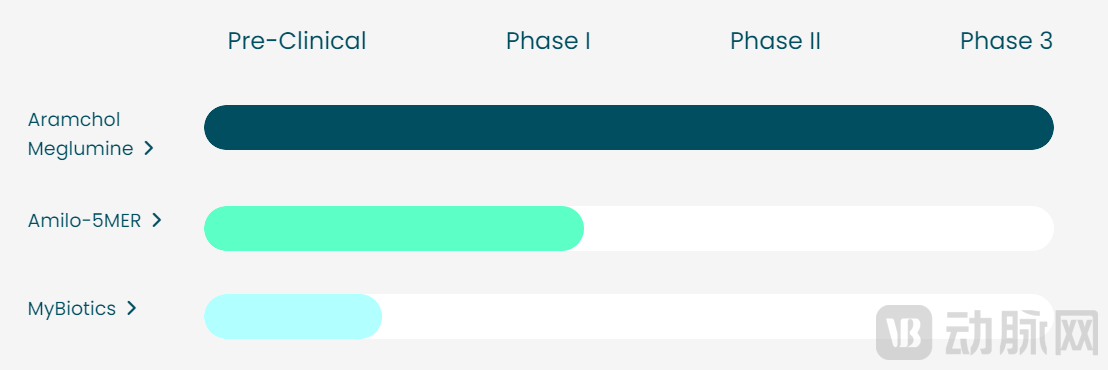
Galmed Product Pipeline
Amilo-5MER is a novel pentapeptide that targets serum amyloid A (SAA) and binds with high affinity to three pro-inflammatory amyloid proteins: SAA, transthyretin, and apolipoprotein B. In previous studies using LPS-induced murine inflammation models, Amilo-5MER reduced serum levels of the pro-inflammatory cytokines IL-6, TNF-α, IFN-γ, and IL-1β. Currently, Amilo-5MER has entered Phase I clinical trials to evaluate its safety, tolerability, and pharmacokinetics.
Over its 21-year development journey, Galmed has evolved from a company with only one product to beginning its strategic expansion into a broader portfolio.Related FieldsThis approach to pipeline development in biotech offers strategic insights and replicable experience for biotech companies with single-asset pipelines that face substantial risks. Meanwhile, we look forward to Aramchol’s continued release of updated clinical data, paving the way for its eventual regulatory approval and market launch.