

Why Has Madrigal’s Stock Remained Resilient Amid NASH Drug Development Volatility?

HighTide Therapeutics
Developer of Novel Drugs in the Field of Digestive System and Metabolic Diseases

Eccogene
Small Molecule Drug Developer

Madrigal Pharmaceuticals
Developer of Fatty Liver Disease Treatment Drugs

Oriza Holdings
Early-stage Equity Investment Management Institution
At the close of U.S. trading on December 19, 2022, Madrigal Pharmaceuticals’ stock price surged 268% to $234.83, bringing its total market capitalization to $4.016 billion; by the following day, the gain had exceeded 300%.
What ignited the stock market was Madrigal Pharmaceuticals’ star drug, resmetirom (MGL-3196; VIA-3196), a selective thyroid hormone receptor beta (THR-β) agonist, which yielded positive results in Phase III clinical trials for the treatment of non-alcoholic steatohepatitis (NASH), meeting both the primary endpoint and key secondary endpoints.
The NASH field was once regarded by the pharmaceutical industry as an R&D “black hole.” With the pathogenesis of this disease still inconclusive, the first wave of companies to venture into this space repeatedly hit walls, and multinational corporations (MNCs) also suffered repeated setbacks. Clinical failures were quickly reflected in sensitive stock prices, affecting not only the companies announcing the news but also related firms, with fluctuations becoming almost the norm. However, Madrigal’s stock price has remained distinct.“About one or two years ago, we observed that Madrigal’s stock price was not significantly affected when clinical development of FXR-targeted therapies encountered setbacks.“Zhao Qun, a partner at Oriza Holdings, told VCBeat New Medicine, ‘It seems that investors are still very professional.’”
Another interesting point is—market capitalization.Among the companies with leading clinical-stage NASH drug candidates, as of February 13, 2023, Galmed Pharmaceuticals had a market capitalization of $16.38 million, Intercept Pharmaceuticals stood at $864 million, while Madrigal Pharmaceuticals reached a total market capitalization of $4.415 billion. Despite being essentially a single-asset pipeline company, it has drawn high expectations from both primary and secondary markets.
What kind of company is this exactly? How has it managed to stand out among numerous MNCs and biotech firms? And what insights can its exploratory efforts offer for NASH drug development?VBInsight interviewed several investors and corporate representatives who have long focused on the NASH field, exploring the subject from the perspectives of team composition and clinical trial design.

From Roche: Dr. Taub’s 21-Year Journey with Resmetirom
Dr. Rebecca Taub began this research when NASH had not yet garnered attention.
According to Life Science Leader, around 2002, Rebecca Taub, the founder of Madrigal, was already leading a team at Roche’s metabolic research group to investigate THR-β agonists. Taub was already an industry veteran at the time and gradually developed the idea of starting her own company while working at Roche.
In 2008, VIA Pharmaceuticals entered into a collaborative development agreement with Roche for the drug Resmetirom. Subsequently, Dr. Taub left Roche and secured the license for the drug from Roche, assigning it to the small publicly traded company VIA Pharmaceuticals.
During the era of “Pre-NASH” research, Dr. Taub’s project struggled to secure funding and went through several lean years. After undergoing multiple changes in ownership,In 2011, Dr. Taub founded Madrigal Pharmaceuticals, and resmetirom initiated Phase I clinical trials at the company.
In 2013, Madrigal successfully listed on the NASDAQ. Later, in 2016, it merged with Synta Pharmaceuticals, bringing in key management talent: Dr. Rebecca Taub served as Chief Medical Officer and Head of R&D, leading research and development efforts, while Paul Friedman, M.D., joined the company as Chairman and Chief Executive Officer. Resmetirom commenced Phase II clinical trials for NASH.

Paul Friedman and Rebecca Taub (Image source: Life Science Leader)
“Prior to the completion of the reverse merger, Dr. Taub and I invested in a private equity firm to accelerate drug development while simultaneously initiating two studies,” said Friedman. Taub added that her research team at Roche employed a novel assay to evaluate the functional activity of their test molecules on the THR-β receptor: “This is not a simple binding assay; it demonstrates the compound’s ability to interact with the receptor and modulate THR-β hormonal signaling in the liver. From laboratory studies to animal models and human clinical trials, our molecule has been shown to be unique in its activity at the THR-β receptor.”
Over the past two decades, Dr. Taub has undergone multiple professional transitions, yet her unwavering commitment to advancing research on the THR-β target has remained constant, regardless of the level of attention it received.
She previously served as Senior Vice President of Research and Development at VIA Pharmaceuticals, Vice President of Metabolic Disease Research at Hoffmann-La Roche, and held leadership positions at Bristol Myers Squibb and DuPont Pharmaceuticals. Additionally, she is a Tenured Professor of Genetics and Medicine at the University of Pennsylvania and a Howard Hughes Investigator.
Dr. Friedman brings over 40 years of experience in the commercial pharmaceutical industry. He previously served as Chief Executive Officer of Incyte Pharmaceuticals, President of DuPont Pharmaceuticals, and Associate Professor of Medicine and Pharmacology at Harvard Medical School. Currently, Dr. Friedman is a Diplomate of the American Board of Internal Medicine and serves on the Board of Directors of Prelude Therapeutics (NASDAQ: PRLD).
With like-minded partners and a team in place, Dr. Taub quickly achieved positive Phase II clinical results for resmetirom in NASH during 2017–2018, and launched Phase III clinical trials in 2019. Over the next two years, Madrigal appointed Remy Sukhija as Chief Business Officer and began building its commercial team, while also expanding its executive leadership by recruiting several seasoned leaders. These team changes signaled that Madrigal was already laying the groundwork for the late-stage development of resmetirom.
In the first half of this year, Madrigal plans to submit a New Drug Application (NDA) for Resmetirom to the FDA, and the NASH market, with its potential worth billions of dollars, is likely to witness a highlight moment.
Liver Fibrosis Endpoint: Decreased from 20% to 14% in the Placebo Group
Laymen watch the spectacle; experts see the strategy. The stock market’s boom may reflect investor enthusiasm, but more importantly, why has Madrigal Pharmaceuticals succeeded?For industry competitors, although target selection has its pros and cons, examining Madrigal’s clinical data alone can also provide new insights for the NASH landscape.
Resmetirom is an oral, liver-targeted, selective thyroid hormone receptor beta (THR-β) agonist developed by Madrigal Pharmaceuticals. It is designed to treat NASH by reducing or eliminating hepatic steatosis (liver fat), as well as mitigating liver inflammation, hepatocyte ballooning (hepatocyte death), and liver fibrosis that can lead to cirrhosis.
The drug is currently undergoing four Phase III clinical trials to demonstrate its safety and efficacy in the treatment of NASH, including MAESTRO-NASH, MAESTRO-NAFLD-1, MAESTRO-NAFLD-OLE, and MAESTRO-NASH-OUTCOMES.
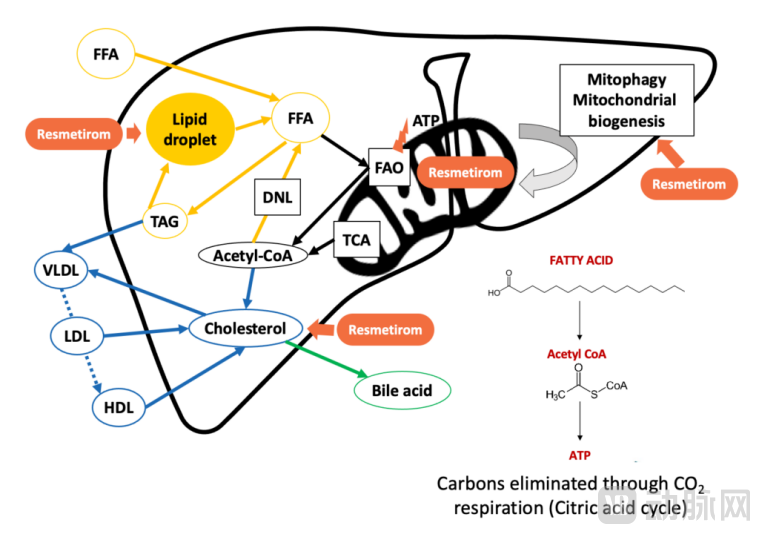 Mechanism of Action of Resmetirom (Image source: Madrigal Pharmaceuticals website)
Among them, MAESTRO-NASH is the pivotal Phase III study evaluating the safety and efficacy of Resmetirom in patients with NASH confirmed by liver biopsy. Initiated in February 2019, the trial assessed the efficacy of the THR-β agonist Resmetirom at doses of 80 mg and 100 mg, as well as placebo, in patients with NASH.
In this Phase III clinical study involving more than 950 patients, resmetirom administered at once-daily oral doses of 80 mg and 100 mg met both primary endpoints compared with placebo, and was safe and well tolerated.

Table 1. Dual Primary Endpoints (52 Weeks) – Primary Analysis (Source: Madrigal Pharmaceuticals website)

Table 2. Dual Primary Endpoints (52 Weeks) – Supportive Analysis by Consensus Reading (Source: Madrigal Pharmaceuticals Website)
In terms of the NASH resolution endpoint, resmetirom demonstrated significantly superior efficacy compared to both the placebo group and its Phase II clinical trial data.The liver fibrosis endpoint data yielded unexpected results—significantly superior to those of the placebo group.
An analysis of the clinical performance of numerous NASH drugs reveals that THR-β is one of the few targets effective in achieving both NASH resolution and improvement in liver fibrosis, with a more pronounced effect on NASH resolution. However, in actual clinical trials, many patients also adopt lifestyle improvements; consequently, a portion of patients in the placebo group typically also exhibit NASH resolution and improvement in liver fibrosis.
Dr. Zhou Jingye, CEO of Eccogene, sharedTheir statistical analysis of multiple NASH clinical trials showed that the average rate of liver fibrosis improvement in the placebo group was approximately 20%.The mechanism, the intrinsic potency of the drug itself, and the design of the corresponding clinical trials all significantly influence trial outcomes.
Surprisingly, in the Phase III clinical trial of Madrigal Pharmaceuticals’ resmetirom, the placebo group showed only a 12%–14% improvement in liver fibrosis, while the drug group demonstrated significantly superior outcomes compared to the placebo. What did Madrigal get right in its clinical trial design?
Experts have analyzed that, in addition to the significant gaps in understanding the pathogenesis, disease subtype classification, and patient heterogeneity of NASH within both academic and industrial circles, the adoption of “non-precision” enrollment strategies in the vast majority of NASH clinical trials has also been a major factor contributing to their failure.
Dr. Zhou Jingye told VCBeat New Medicine,Madrigal Adjusted the Proportion of Patients with Severe Liver Fibrosis During Phase III Clinical TrialsDuring its Phase II clinical trials, Madrigal Pharmaceuticals enrolled a greater proportion of patients with stage F1 and F2 liver fibrosis, whereas in the Phase III trial, the majority of enrolled patients had stage F3 liver fibrosis, among whom the placebo effect was markedly attenuated.
On the other hand,The clinical trials designed by Madrigal Pharmaceuticals also hold significant reference value for non-invasive testing strategies.On June 25, 2022, the double-blind results from the MAESTRO-NAFLD-1 safety study were released, demonstrating that resmetirom had a favorable safety and tolerability profile. Imaging data from FibroScan and magnetic resonance elastography (MRE) showed reductions in hepatic steatosis, liver fibrosis, liver enzymes, and multiple atherogenic lipids. “Madrigal Pharmaceuticals met clinical endpoints in both liver biopsy and imaging assessments, which is highly encouraging for the industry and aligns well with FDA review standards,” said an executive from HighTide.
Of course, there are still more pressing unresolved issues: despite optimizations in its clinical trial design, Madrigal Pharmaceuticals still saw over 70% of patients fail to achieve significant improvement on the primary endpoint, indicating substantial room for enhancing drug efficacy.
“Both THR-β and GLP-1 mechanisms demonstrate considerable efficacy in achieving NASH resolution. For patients with more advanced fibrosis, it is critical to halt disease progression to cirrhosis within a shorter timeframe,” said Dr. Zhou Jingye.When single-target drugs struggle to address all issues, identifying complementary mechanisms becomes crucial, making combination therapy a superior option.Eccogene has already embarked on explorations in this direction.
A re-analysis of clinical trials from companies that initially ventured into the NASH field may reveal new opportunities. Dr. Zhou Jingye emphasizes that significant challenges remain in translating findings from current animal models of NASH to clinical applications. If the industry can develop NASH animal models with greater predictive value for clinical translation, the success rate of clinical trials is likely to improve substantially.