

Virta Health Files for IPO: Pioneering Non-Pharmaceutical Reversal of Type 2 Diabetes Through Ketogenic Nutrition and Digital Care

Virta
Online Professional Medical Service Provider
Diabetes is irreversible and incurable, a near-universal consensus in global disease research. However, diabetes management companies in the United States claim that blood glucose control and diabetes reversal can be achieved solely through dietary changes, without insulin or medication, and have announced their goal to reverse diabetes in 100 million patients by 2025.
This may seem somewhat “far-fetched.” Nevertheless, since its inception, the company has been highly sought after by major venture capital firms. In addition to Sequoia Capital, Founders Fund, and SciFi VC, its shareholders include Venrock from the Rockefeller family and technology companies such as PayPal. Since its establishment in 2011, Virta Health has raised a total of $363 million in funding, and its team includes researchers and graduates from prestigious institutions such as Stanford University, the Massachusetts Institute of Technology, and Harvard University.
Furthermore, a clinical trial by Virta Health also demonstrated the value of its solution in managing type 2 diabetes: 7% of patients reduced their insulin dosage, 56% achieved healthy levels of glycated hemoglobin (HbA1c), and 75% lost at least 5% of their body weight.
How Exactly Did Virta Health Turn Magic into Reality?
The initiating factor in the pathogenesis of diabetes is abnormal blood glucose levels resulting from pancreatic dysfunction. Upon exposure to dietary carbohydrates, the body either fails to secrete adequate insulin or the secreted insulin cannot be effectively utilized by the body, leading to elevated blood glucose levels. Chronic hyperglycemia results in progressive damage and functional impairment of various tissues, particularly the eyes, kidneys, heart, blood vessels, and nerves.
Although there are numerous oral and injectable diabetes medications available on the market, these drugs only provide temporary blood glucose control and fail to address the root cause of the disease. In light of this, Virta Health advocates for strict carbohydrate restriction in diabetic patients (less than 30 grams per day) to suppress hyperglycemia by limiting carbohydrate intake. This dietary approach is widely known as the ketogenic diet.
The normal sequence of energy supply in humans is: carbohydrates, fats, and proteins. The principle behind using a "ketogenic diet" to treat diabetes lies in its ability to first reduce patients' carbohydrate intake, thereby controlling blood sugar levels at the source. Secondly, fat metabolism can enhance insulin sensitivity. Due to the minimal intake of sugars, the patient's body primarily relies on the extensive breakdown of fats for energy.
In other words, the theoretically optimal scenario for this treatment regimen is to consume the minimum amount of carbohydrates required by the human body, with energy derived primarily from fats. This approach ultimately aims to enhance insulin sensitivity by promoting fat oxidation while maintaining controlled blood glucose levels. In doing so, it not only restricts carbohydrate intake at the source but also provides an additional mechanism for lowering blood glucose.
Sami Inkinen, the founder and CEO of Virta Health, is a serial entrepreneur, while the other two co-founders, Dr. Stephen Phinney and Dr. Jeff Volek, come from academia. Dr. Stephen Phinney holds a Ph.D. in Nutritional Biochemistry from the Massachusetts Institute of Technology (MIT), an M.D. from Stanford University, and is Professor Emeritus of Medicine at the University of California, Davis. Dr. Jeff Volek, who earned his degree from the University of Pennsylvania, is a professor at The Ohio State University.
Sami Inkinen himself is a patient with type 2 diabetes. Before founding Virta Health, he was the founder and former president of Trulia, a real estate search engine that was eventually sold to Zillow. He is also a venture partner at the prominent venture capital firm Obvious Ventures, where he advises its healthcare and IT investment portfolios. Additionally, he is a top competitor in the Ironman World Championship. However, it was in 2011, when he won the age-group title at the Ironman World Championship, that he was diagnosed with type 2 diabetes.
Like most people, Sami Inkinen believed that diabetes was caused by obesity resulting from poor dietary habits and insufficient physical activity. How could a world-class athlete with a robust physique develop diabetes? Puzzled by this question, he began extensively reviewing cutting-edge academic literature to find answers.
During this process, he met two highly respected doctors in the field of diabetes research: Stephen Phinney and Jeff Volek.
Dr. Stephen Phinney is a Professor Emeritus at the University of California, Davis. He has held clinical faculty positions at the Massachusetts Institute of Technology, the University of Vermont, the University of Minnesota, and the University of California, Davis, and has served in leadership roles at Monsanto, Galileo Laboratories, and Eficacia. With over 40 years of experience in internal medicine and industry, he is an internationally recognized expert in obesity, carbohydrate restriction and ketogenic diets, diet and performance, and essential fatty acid metabolism. He also pioneered the world’s first clinically validated method for safely and sustainably reversing type 2 diabetes without medication or surgery.
Dr. Jeff Volek is a registered dietitian and professor at The Ohio State University. Over the past three decades, he has conducted extensive pioneering research on human adaptation to carbohydrate restriction, published more than 300 peer-reviewed scientific manuscripts and five best-selling books, and made significant contributions to the existing science of ketones and ketogenic diets, the use of ketones as a tool for treating insulin resistance, and the potential of ketones to enhance human resilience.
Currently, Dr. Jeff Volek’s team at The Ohio State University is focused on achieving new discoveries and pioneering novel applications in the field of nutritional ketosis. These studies are investigating the effects of nutritional ketosis on cardiometabolic status, ectopic fat accumulation in various tissues (liver, muscle, and heart), tumor metabolism and health outcomes in patients with advanced breast cancer, as well as physical and cognitive performance in military personnel.
The two doctors’ research findings coincided. Through long-term medical studies, they both concluded that controlling carbohydrate intake and strictly adhering to a ketogenic diet can safely reverse type 2 diabetes. This greatly surprised Sami Inkinen.
Under the guidance of Dr. Stephen Phinney and Dr. Jeff Volek, Sami Inkinen’s diabetes was brought under control. In 2014, he and his wife, Meredith, completed a two-person crossing from California to Hawaii in 45 days, breaking the previous record. Throughout the challenge, they did not rely on traditional carbohydrate supplementation for energy; instead, they fueled their bodies with fat, protein, and small amounts of carbohydrates derived from vegetables.
The change in dietary habits not only improved Stephen Phinney’s life but also laid the groundwork for the founding of Virta Health. Driven by his innate business acumen, Sami Inkinen began to consider whether these research findings could be commercialized.
According to his information, there are approximately 29 million people with type 2 diabetes in the United States. If diabetes could be treated through dietary control, the market would undergo a transformative shift. However, strictly managing patients’ diets requires a fundamental change in current treatment philosophies and the traditional model of periodic physician visits, shifting instead toward a patient-centric, highly customized solution.
Thus, in 2014, Sami Inkinen partnered with Dr. Stephen Phinney and Dr. Jeff Volek to establish Virta Health, aiming to leverage artificial intelligence and mobile health technologies to create a patient-centered, highly customized solution.
Patients with diabetes typically return to the hospital for follow-up visits every three to six months. For physicians, monitoring patients’ health status has consistently been a challenge.
“If patients have any questions about their condition, we encourage them to proactively contact their primary care physician. Even so, few patients actually do so,” said Marina Basina, an endocrinologist at Stanford Health Care, with a sense of resignation. “In the management of diabetes, it is not that patients rely on us; rather, we rely on patients.”
Moreover, it is widely recognized in clinical practice that bariatric surgery is the only method capable of reversing type 2 diabetes. However, due to its high cost, significant risks, and high probability of postoperative recurrence, this procedure is not suitable for every patient.
Virta Health is attempting to leverage telemedicine and artificial intelligence to transform the current landscape.
Upon registering as a Virta Health member, patients receive a kit of FDA-cleared medical devices for daily monitoring of physiological metrics such as blood glucose, blood pressure, and body weight. Based on the collected data, physicians leverage artificial intelligence to formulate personalized dietary plans for each patient.
Virta Health has also established the position of health coach to provide one-on-one counseling services to patients. During non-business hours, voice bots can answer medical questions with high standardization for patients.
Additionally, patients can choose to join online communities to share treatment experiences with fellow patients and provide mutual encouragement.
In addition to individual services, Virta Health also prioritizes its enterprise offerings. Upon signing a contract, companies are required to prepay an annual fee based on the number of enrolled employees. If, at the end of the one-year treatment period, employees with type 2 diabetes fail to meet the specified health benchmarks across key indicators, Virta Health will provide a full refund. This model is highly attractive to companies seeking to offer diabetes management tools as part of their employee benefits package.
For individuals, Virta Health offers two payment options: annual and monthly billing. Additionally, for patients facing financial hardship, Virta Health provides fee reductions ranging from $2,000 to $4,950, contingent upon the submission of their most recent tax return.
Virta Health’s founding team exemplifies the classic “scientist-plus-partner” model. Sami Inkinen leads corporate management and business development, while Dr. Stephen Phinney and Dr. Jeff Volek oversee the scientific aspects. They have leveraged their personal influence to promote and popularize the nutritional ketosis diet worldwide, while also conducting extensive research to demonstrate the rationale and safety of the ketogenic diet.
First, Dr. Stephen Phinney and Dr. Jeff Volek are themselves “spokespersons” for the ketogenic diet. Stephen Phinney has adhered to a ketogenic diet for over 40 years, and Dr. Jeff Volek has followed a low-carbohydrate diet for more than 20 years. The two professors’ robust mental well-being and agile thinking undoubtedly serve as further testament to the safety and value of the ketogenic diet.
About 50 years ago, Stephen Phinney was actually an advocate of high-carbohydrate diets. His personal shift from a “high-carb” to a “low-carb ketogenic” philosophy has also served as a compelling story for Virta Health’s market education efforts.
Of course, this is only one aspect. The extensive research and trial data accumulated by the two PhDs and the company in this field provide the strongest support for Virta Health’s philosophy.
Critics of the ketogenic diet primarily challenge the theory on two grounds: first, given that the human brain consumes 600 kilocalories per day, they argue this necessitates a daily intake of 150 grams of glucose to meet cerebral demands; second, they contend that long-term adherence to the ketogenic diet is unfeasible for anyone.
In response, Dr. Stephen Phinney and Dr. Jeff Volek cited prominent experiments and data from over a decade ago to demonstrate that the brain does not depend on carbohydrates and can function effectively on ketones. Meanwhile, they also conducted small-scale studies examining the effects of low-carbohydrate diets on athletes to illustrate how a low-carbohydrate ketogenic dietary pattern influences muscle glycogen levels.
Of course, the most prominent and significant development is Virta Health’s launch of a clinical study in West Lafayette, Indiana. Peer-reviewed studies have demonstrated that patients can safely improve health outcomes associated with type 2 diabetes, obesity, atherogenic dyslipidemia, hypertension, and inflammation through the program provided by Virta Health.
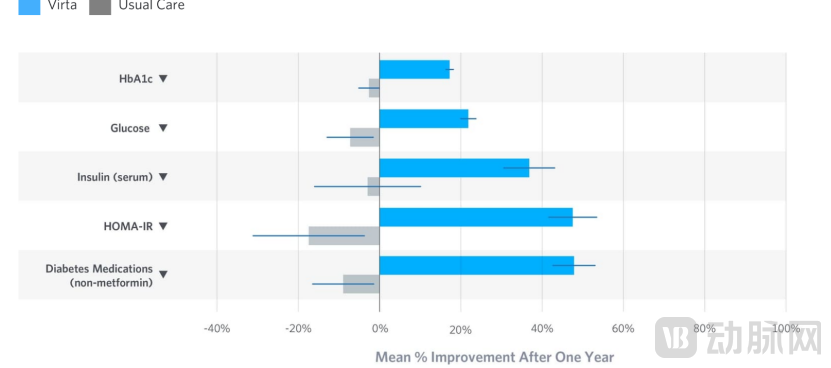 Virta Health: Data on Type 2 Diabetes from the Clinical Study Launched in West Lafayette, Indiana
Image source: Virta Health official website
This two-year trial enrolled 262 patients with type 2 diabetes, and encouraging therapeutic outcomes were observed within the first ten weeks. Eighty-seven percent of patients reduced their insulin dosage, 56% achieved glycated hemoglobin (HbA1c) levels within the healthy range, and 75% experienced a weight loss of at least 5%.
Undoubtedly, this trial has laid the scientific foundation for Virta Health’s claim of reversing type 2 diabetes.
Concurrently, extensive public science education efforts are underway. In addition to hundreds of blogs and lectures, the two doctors have published popular science books to educate the public on the benefits and value of a low-carbohydrate ketogenic diet. These include The Art and Science of Low Carbohydrate Living, The Art and Science of Low Carbohydrate Performance, and two co-authored foundational texts on the science of low-carbohydrate nutrition and nutritional ketosis.
Sami Inkinen is a cross-industry entrepreneur. Essentially, Virta Health was founded during the internet boom. Against that backdrop, the company sought to leverage mobile technology and artificial intelligence to achieve “anywhere, anytime” disease management.
Virta Health’s success is attributable not only to its professional and academic expertise but also to the theoretical foundation derived from clinical research. In essence, academic research provided Virta Health with its core offering: a novel, disruptive solution for diabetes management. Mobile and internet technologies equipped Virta Health with the tools to implement this solution, enabling the establishment of a patient-centric service loop. Finally, support from evidence-based medicine has distinguished Virta Health from earlier internet companies, establishing it as a true digital health company with genuine medical attributes.
It is reported that the American Diabetes Association (ADA) Standards of Medical Care in Diabetes cited Virta Health’s research for three consecutive years—in 2019, 2020, and 2021—recognizing low-carbohydrate nutrition as a first-line therapy for diabetes management. Backed by theoretical foundations, practical applications, and robust evidence, Virta Health, despite its seemingly unconventional approach, has managed to sustain long-term viability in the highly competitive healthcare sector and attract top-tier investors.
Note: “Low-carb ketogenic” is Virta Health’s concept for diabetes management and does not represent the views of VCBeat or VCBeat Orange Bureau. “Low-carb ketogenic” should be undertaken only under the guidance of qualified professionals; do not attempt it blindly. In this article, “diabetes” refers exclusively to “type 2 diabetes.”