

Akero Therapeutics: A NASH 'Fast Fish' Backed by Hillhouse Capital — From IPO in 2.5 Years to a Potential Best-in-Class Drug in 4

Akero Therapeutics
Developer of Therapeutic Drugs for Metabolic Diseases
Akero Therapeutics is a “fast mover” in the NASH space: it went from founding to IPO in just two and a half years, rapidly demonstrating the value of its pipeline candidate efruxifermin, and has become a biotech company that enjoys significant market attention and favor.
Akero was founded in January 2017. The following year, Akero announced the completion of a $65 million Series A financing round, co-led by prominent investment firms including Apple Tree Partners (ATP), Atlas Venture, and venBio Partners, to advance the clinical development of its core program, AKR-001—originally AMG876 developed by Amgen, later known as Efruxifermin (EFX)—for the treatment of NASH. In June 2019, the company went public on the Nasdaq. Notably, Hillhouse Capital was also an investor in Akero and held shares after the IPO.
EFX is a long-acting FGF21 analog based on a fusion peptide of the Fc fragment of human immunoglobulin G1 and fibroblast growth factor 21 (FGF21), capable of mimicking the balanced potency of endogenous FGF21 on its co-receptor complex with β-Klotho and one of the three FGF receptors (FGFR1c, FGFR2c, FGFR3c).
In December last year, Akero announced that the FDA had granted Breakthrough Therapy Designation to EFX for the treatment of NASH, based on positive results from its Phase IIb HARMONY study. The histological improvements achieved in this study were the best among all disclosed data for new NASH drugs. If approved for marketing, it is expected to become a best-in-class drug for the treatment of NASH.
This article summarizes Akero’s impressive pipeline progress, the reasons for its market appeal, and the key milestones to watch in the near future.
From Pipelines “Abandoned” by Giants to NASH Milestones
In May 2018, Akero licensed AMG876 from Amgen, a long-acting FGF21 analog fused with an Fc fragment, marking Akero’s entry into the NASH field. In fact, AMG876 was a shelved pipeline asset; Amgen had terminated its development after completing Phase I clinical trials in patients with diabetes in 2014. Tim Rolph, one of Akero’s founders, had studied FGF21 while working at Pfizer and recognized its therapeutic potential in metabolic diseases. He planned to initiate Phase II studies in patients with NASH, and the program was designated AKR-001.

Tim Rolph, Source: Akero Official Website
FGF21 is a critical hormone regulating glucose and lipid metabolism, acting on multiple organ systems including the liver. It is naturally released to protect organs from stress and restore metabolic balance to maintain health. When Akero Therapeutics incorporated FGF21 into its pipeline, FGF21 had not yet become mainstream in the NASH field; at that time, Bristol Myers Squibb (BMS) was the primary company conducting clinical studies of FGF21 analogs with NASH as the indication.
Akero has made rapid progress. In March 2020, Akero disclosed the results of the BALANCED study, a Phase IIa clinical trial of AKR-001. At Week 12 of treatment, patients in all efxusiran dose groups (28 mg, 50 mg, and 70 mg) demonstrated significant reductions in absolute hepatic fat content from baseline, thereby meeting the primary endpoint of the trial.
In June, Akero continued to disclose the 16-week analysis results of secondary and exploratory endpoints from the Phase IIa BALANCED study of efruxifermin (EFX; now renamed). Among the 40 subjects who completed post-treatment liver biopsies, 48% of treatment responders achieved at least a one-stage improvement in liver fibrosis without worsening of the NAFLD Activity Score, while 28% of treatment responders achieved at least a two-stage improvement in fibrosis.
The simultaneous achievement of NASH resolution and fibrosis reversal, coupled with the design of EFX to extend the hormone’s half-life to 3–3.5 days—enabling once-weekly subcutaneous administration—reinvigorated the NASH field, which had been languishing in 2020.Since then, Akero’s EFX has become the best-in-class investigational drug in the NASH field for many people.
In 2021, Akero conducted two parallel Phase IIb clinical trials. One was the HARMONY study, conducted in adult patients with NASH and F2/F3 fibrosis, and the other was the SYMMETRY study, conducted in adult patients with NASH and advanced cirrhosis (F4).
The 24-week HARMONY study, with improvement in fibrosis as its primary endpoint, has once again generated high expectations within the industry.First, the 24-week duration is indeed short; second, if efficacy can be achieved, it will meet the three key endpoint recommendations set by the U.S. FDA for NASH drug development:Resolution of steatohepatitis with no worsening of liver fibrosis; improvement in liver fibrosis by at least one stage with no worsening of steatohepatitis; and concurrent resolution of steatohepatitis and improvement in fibrosis.
In September 2022, Akero announced positive data for efxusiran (EFX) from the Phase IIb HARMONY study. Both the 28 mg and 50 mg dose groups of EFX met the primary endpoint of improving liver fibrosis as well as multiple secondary endpoints. Specifically, 39% and 41% of patients, respectively, achieved at least a one-stage improvement in liver fibrosis without worsening of NASH, compared with only 20% in the control group.
The study also met a key secondary endpoint, with 47% and 76% of patients receiving EFX 28 mg and 50 mg, respectively, achieving NASH resolution without worsening of liver fibrosis. Furthermore, 29% and 41% of patients, respectively, achieved both endpoints of improved liver fibrosis and NASH resolution.
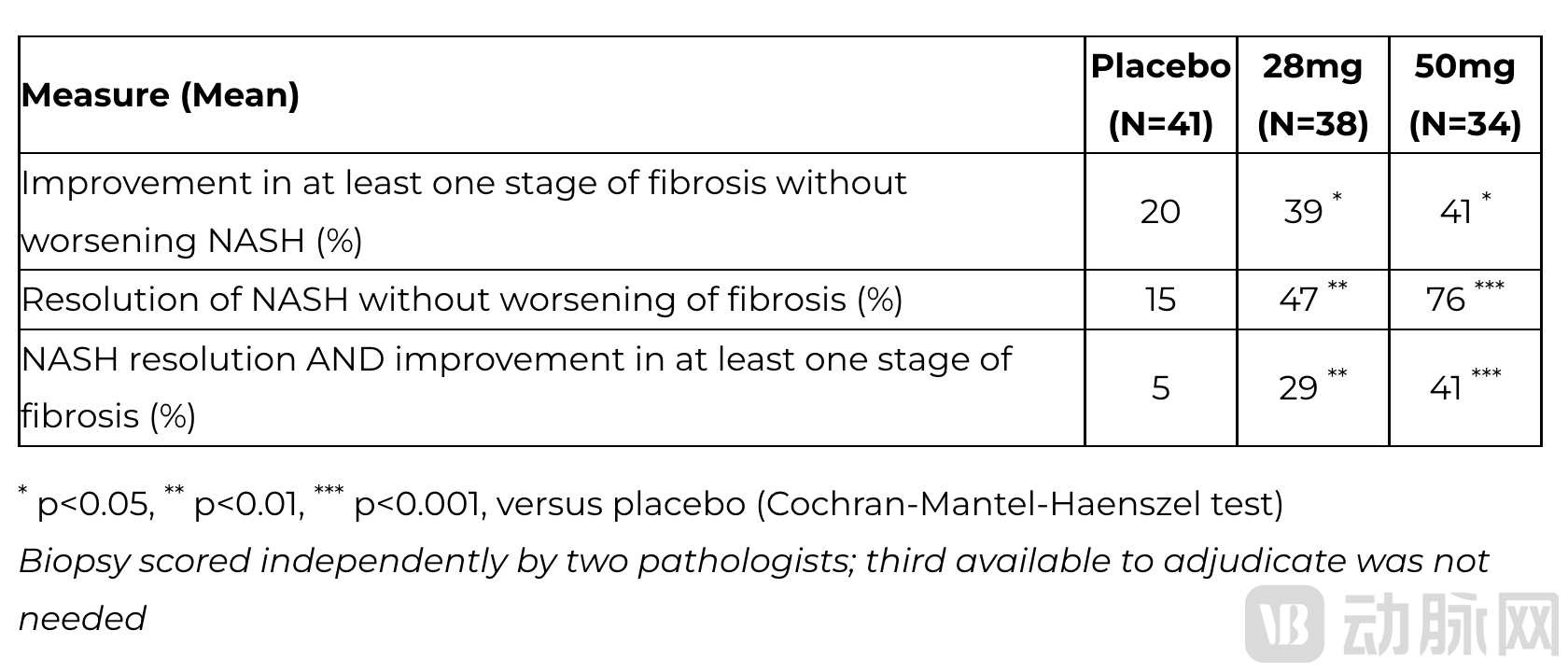
Data from the Phase IIb HARMONY study, source: Akero official website
It took effect in less than six months, with an improvement magnitude twice that of the control group; many industry insiders have hailed this as a “milestone” in the field of NASH.If these findings are further validated in the future, they are expected to bring about a historic transformation for NASH patients worldwide. Last December, EFX became the first investigational NASH therapy to be granted Fast Track designation and Breakthrough Therapy designation by the U.S. FDA, as well as Priority Medicines (PRIME) status by the European Medicines Agency (EMA).
Former Gilead CMO Brings Outstanding Clinical Trial Capabilities
The rapid advancement of EFX is inextricably linked to the operational capabilities of its management team. Akero’s management team can be described as impressive, boasting a comprehensive structure and high-caliber talent. The company was originally founded by Tim Rolph and Jonathan Young. The former served at Pfizer and GlaxoSmithKline for a combined total of over 30 years, while the latter is a typical example of an investor transitioning into entrepreneurship, with extensive familiarity with biotech product development and regulatory compliance. Andrew Cheng, the company’s CEO, joined Akero after the introduction of AKR-001. This executive, who had nearly 20 years of experience at Gilead Sciences, sparked considerable discussion upon his departure, as he had become Gilead’s Chief Medical Officer just six months prior to joining Akero.
According to his public statements at the time, Andrew Cheng joined Akero because he saw significant potential in innovative therapies for NASH and noted that Akero was in a strong financial position.

Andrew Cheng, Source: Akero Official Website
Andrew Cheng joined Gilead in 1999, where he led the clinical development of Gilead’s HIV program and provided clinical research support across multiple therapeutic areas, including oncology, inflammation, respiratory and cardiovascular indications, as well as HIV and liver diseases.
As it stands, Akero and Andrew Cheng have been mutually beneficial to each other; one of Akero’s distinguishing features is its excellence in clinical trial design.For instance, during the Phase IIa clinical trial, biopsies were performed on enrolled patients. At week 12, a subset of patients who demonstrated a particularly significant reduction in hepatic fat was selected, and these patients underwent repeat biopsies at week 16. Thus, biopsy data were obtained from what was originally a 12-week Phase IIa trial.
Subsequently, Akero expanded its research with Cohort C to evaluate the efficacy of treatment in NASH patients with advanced cirrhosis (F4). Reversing disease progression after it has advanced to cirrhosis is extremely difficult, making F4 clinical trials highly challenging. Results from Cohort C showed that 33% of patients achieved a one-stage improvement in fibrosis without worsening of NASH, while an additional 25% attained NASH resolution. Although Cohort C had a small sample size and significant side effects, Akero obtained unprecedented, defensible data. This distinguishes EFX from competing pipelines, provides new insights for future trial design, and potentially accelerates the drug’s path to market.
This is also why Akero has remained a market favorite. In the four years since its IPO, although Akero’s stock performance has not been as impressive as that of Madrigal, it has still demonstrated relatively strong overall momentum. The two recent surges were primarily driven by the financing transaction in June last year and the release of Phase IIb HARMONY study results in September. Last June, Pfizer’s Breakthrough Growth Initiative (PBGI), which aims to support biotechnology companies developing transformative therapies for diseases aligned with Pfizer’s core focus areas, made a $25 million equity investment in Akero. In September, Akero’s share price soared 136% on the day it announced the data. As of last November, Hillhouse Capital still held its position in Akero, and the stock’s rise in the third quarter generated substantial returns for Hillhouse, increasing the market value of its Akero holdings to over $23 million. Currently, Akero’s total market capitalization stands at approximately $2.1 billion.
Continue Moving Forward
The race for the first approved NASH drug continues. Although Akero is young, dynamic, and promising, with ample cash flow, new drug development is always fraught with uncertainties. Going forward, Akero’s latest developments warrant close attention, including:
In January, the company appointed Patrick Lamy as Senior Vice President of Commercial Strategy, marking the beginning of Akero’s commercialization rollout. The new commercial leader also hails from Gilead, where he played a leadership role in commercial planning for its liver disease portfolio, and has extensive commercialization experience at multiple biotech firms.
In March, Akero will meet with the FDA to review the results of the Phase IIb HARMONY study and obtain feedback on its Phase III clinical trial plan.
In the second quarter, results from the expanded Cohort D study will be announced; this is a trial evaluating EFX in combination with GLP-1 for the treatment of patients with pre-cirrhotic NASH.
In the second half of the year, the trial results for SYMMETRY are also expected to be announced. Akero plans to engage in further discussions with regulatory authorities after completing this trial.
The market widely considers Madrigal’s MGL3196 to be one of EFX’s biggest competitors. MGL3196 has achieved positive results in Phase III clinical trials, meeting both the primary endpoint and key secondary endpoints. Akero needs to continue addressing safety and tolerability issues on its current foundation and successfully navigate more rigorous Phase III trials.
In any case, we look forward to the success of Akero, the success of FGF21, and humanity’s success in combating NASH.
References:
1. Akero Therapeutics Official Website
2. TheBusinessSideOfDrug