

Which Chronic Diseases Are China's Digital Therapeutics Companies Targeting? 'Red Ocean' and 'Blue Ocean' Are Not Absolute

DOBOSO
Intelligent Medical Platform Provider
Recently, a case of “a 19-year-old boy diagnosed with Alzheimer’s disease” has shocked the world, setting a new record for the youngest age at onset of Alzheimer’s. The trend toward younger onset of chronic diseases is becoming increasingly evident, and coupled with an aging population, the outlook for chronic disease prevention and control remains grim.
The digitalization and intelligent transformation of chronic disease management through the introduction of emerging digital technologies has become a trend. For instance, not long ago, the National Center for Chronic and Non-communicable Disease Control and Prevention of the Chinese Center for Disease Control and Prevention released the Catalogue of Typical Digital Products (Services) for Chronic Disease Prevention and Control. This catalogue includes numerous digital therapeutics products.
So, which chronic diseases are domestic digital therapeutics companies currently focusing on? And which chronic diseases still have room for growth? VCBeat has compiled statistics on over a hundred active digital therapeutics companies in China, hoping to provide a reference for the industry.
Chronic diseases, short for chronic non-communicable diseases, are characterized by the “three highs and three lows”: high incidence, high mortality, and high disability rates, coupled with low awareness, treatment, and control rates.
In terms of mortality rates and the disease burden they impose, China’s four major chronic diseases are cardiovascular and cerebrovascular diseases, cancer, chronic respiratory diseases, and diabetes.In 2019, deaths attributable to chronic diseases accounted for 88.5% of all deaths in China, with cardiovascular and cerebrovascular diseases, cancer, and chronic respiratory diseases alone responsible for 80.7% of total deaths. The burden of chronic diseases constituted more than 70% of the total disease burden.
In 2017, China released the Medium- and Long-Term Plan for the Prevention and Control of Chronic Diseases in China (2017–2025). In 2019, the State Council issued the Opinions of the State Council on Implementing the Healthy China Action, and launched the Healthy China Action (2019–2030) at the national level, explicitly specifying special prevention and control initiatives targeting four major chronic diseases: cardiovascular and cerebrovascular diseases, cancer, chronic respiratory diseases, and diabetes.
In addition to these four major chronic diseases, some emerging chronic conditions have also been on the rise in recent years. For example, in 2019,Chronic kidney disease has joined cardiovascular disease, cancer, and diabetes as one of the chronic conditions with the highest mortality rates among individuals aged 30–69 in China.
Due to the compounding effects of social pressure and the pandemic,The incidence rates of mental disorders such as depression and anxiety, along with associated psychological health issues and even sleep disorders, have been soaring in recent years.. From a broader perspective, this still falls under the category of chronic diseases.
In addition,"Although chronic pediatric eye conditions such as myopia, amblyopia, and strabismus pose relatively minor threats to individual health, they have a significant impact on the overall quality of the population.". In particular, the prevalence of myopia among children and adolescents in China reached as high as 52.7% in 2020, drawing increasing social attention.
According to WHO statistics, at least 60% of chronic diseases are associated with unhealthy lifestyles. By adopting a strategy of early prevention (lifestyle modifications), early detection (regular monitoring and screening), and early treatment (prompt and standardized therapy), chronic diseases can be effectively prevented, controlled, and treated.
It is evident that the characteristics of chronic disease prevention and control are particularly well-aligned with digital therapeutics—based on their underlying principles,Diseases most suitable for digital therapeutics generally exhibit the following characteristics: long-term management requirements, a wide range of interventions, well-defined clinical guidelines, low patient adherence and self-management capabilities, and a predominance of internal medicine conditions with surgical conditions playing a secondary role.
Digital therapeutics can help patients adopt healthier lifestyles, delaying disease progression and reducing complications through self-management. They also improve the accessibility of healthcare services, particularly by digitizing screening methods to enable early detection of chronic diseases. Furthermore, they enhance medication adherence and facilitate personalized dosing for patients.
Nevertheless, digital therapeutics also hold substantial value for healthcare providers, payers, and pharmaceutical companies. For instance, they can provide reference information to aid physicians in diagnosis and improve service efficiency; help payers control costs and supply data for insurance product design; and assist pharmaceutical companies in enhancing medication adherence and therapeutic efficacy, while providing real-world evidence for subsequent product improvements.
So, which chronic disease areas are currently saturated with domestic digital therapeutics companies, forming a “red ocean”? And which chronic disease areas represent hidden “blue oceans”? Based on publicly available information, VCBeat has analyzed the business focuses of more than 140 active domestic companies involved in digital therapeutics. This analysis may offer some insights.
It should be noted that all statistical data are sourced from public information and may not fully reflect the actual conditions of the respective companies. A small number of companies that could not be categorized into specific disease areas based on public information (e.g., those without a clear business focus or those primarily providing platform services) were excluded from the statistics. Finally, due to limitations in our understanding and research methodology, the classification of diseases and the categorization of corporate business activities may not be entirely rigorous. We welcome readers’ corrections and feedback on any imperfections.
Digital Therapeutics Companies in China Focusing on Chronic Diseases (Chart by VCBeat)
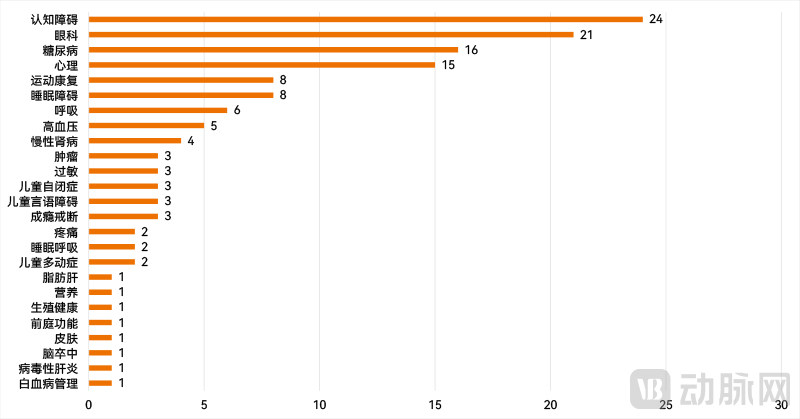
According to public records,Cognitive impairment is currently the most popular field in digital therapeutics, with 24 digital therapeutic companies involved in this area. Ophthalmology ranks second, with 21 digital therapeutic companies engaged in this field.The number of digital therapeutics companies operating in these two fields has each exceeded 20. Together, companies in just these two areas account for as much as 30% of the total number of active digital therapeutics firms.
It is hardly surprising that digital therapeutics have gained favor in the field of cognitive impairment. Cognitive impairment often serves as a precursor to many severe brain disorders, such as Alzheimer’s disease and Parkinson’s disease. To date, there are still no effective treatments for these conditions; thus, early screening and diagnosis remain the only means to identify risks in advance and implement preventive measures. However, China still faces significant shortcomings in cognitive impairment screening. Although Shanghai ranks among the leading regions nationwide in the diagnosis and treatment of cognitive disorders, the rate of early medical consultation remains low, at only 20%.
In this context, digital therapeutics can facilitate rapid, large-scale, and standardized disease screening. Currently, some regions have begun leveraging digital therapeutics to screen for cognitive impairment in the elderly. For instance, the Shanghai Mental Health Center and the Alzheimer’s Disease Diagnosis and Treatment Center at Shanghai Jiao Tong University have focused on cognitive disorders, developing a set of precise and efficient Shanghai assessment standards through an electronic game-style screening tool known as the “Golden Three-Minute Cognitive Impairment” test.
Other regions across China are also rapidly following suit. Hainan Province, which has been relatively supportive of digital therapeutics, explicitly stated early this year that it would continue to implement cognitive impairment screening for the elderly and launch a pilot program on digital therapeutic interventions for cognitive rehabilitation targeting high-risk populations identified during the 2022 pilot screening initiative.
Digital therapeutics in the field of ophthalmology are primarily focused on the prevention and restoration of visual function in children. Within this domain, training for the treatment of amblyopia and strabismus accounts for the vast majority of applications. Digital therapeutics have gained favor in the management of pediatric strabismus and amblyopia because the treatments are based on well-defined principles and methodologies, while also addressing the significant challenge of poor patient adherence.
Currently, rehabilitation treatments for pediatric strabismus and amblyopia in China are outdated, involving lengthy and monotonous processes. Patients often struggle to adhere to repetitive training regimens lasting 3–6 months or engage perfunctorily during treatment, thereby failing to achieve therapeutic efficacy. Digital therapeutics can integrate various photostimulation therapies and enhance patient compliance through user-friendly, highly engaging gamified designs, enabling children to complete strabismus and amblyopia rehabilitation training while playing.
Ophthalmic digital therapeutics can also leverage data-driven advantages to achieve refined, personalized, and intelligent care by intelligently matching the optimal training difficulty based on pediatric patients’ performance and providing smart reminders for correct training posture. Meanwhile, home-based vision assessments and follow-up rehabilitation management via software have improved the efficiency and accessibility of medical services.
Diabetes, one of the four major chronic diseases, has attracted 16 companies, ranking third.The "Healthy China Action (2019–2030)" emphasizes the need to alert residents to monitor their blood glucose levels, guide individuals with prediabetes in scientifically reducing their risk of developing the disease, and instruct patients with diabetes to strengthen health management to delay or prevent the onset and progression of diabetes. It also calls for enhanced health management for diabetic patients and high-risk populations, promoting the standardization of screening and the normalization of diagnosis and treatment for diabetes and its complications at the primary care level. In these areas, digital therapeutics can play a significant role. Indeed, diabetes was one of the earliest fields where digital therapeutics were applied.
Followed byFifteen companies have ventured into the field of mental health disorders.Similar to diabetes, mental health is one of the first areas where digital therapeutics have begun to be implemented, particularly in online cognitive behavioral therapy (CBT) for mental health conditions such as depression and anxiety. It enables the low-cost, standardized dissemination of CBT, becoming an essential component of treatment regimens amid the growing demand for mental health care.
Meanwhile, cognitive behavioral therapy has further expanded into additional domains, such as those ranked after mental health.Sleep disorders are also a popular focus, with eight digital therapeutics companies entering the field.It is worth noting that, due to the statistical methodology employed, we only accounted for each company’s primary business focus. In reality, some digital therapeutics companies specializing in mental health are also venturing into the sleep domain; even those without immediate plans can relatively easily enter the sleep market by leveraging CBT-I (Cognitive Behavioral Therapy for Insomnia) interventions. Therefore, the actual number of digital therapeutics companies focusing on sleep exceeds the reported statistics.
Exercise rehabilitation is an emerging field within digital therapeutics, with eight companies also active in this space.Such digital therapeutics often employ rehabilitation guidance for patients as the primary intervention. Furthermore, with the integration of IoT hardware and artificial intelligence, the rehabilitative guidance provided by these digital therapeutics has become increasingly refined and precise, thereby ensuring improved rehabilitation outcomes.
It is worth noting that digital therapeutics for sports rehabilitation in China are gradually showing a trend toward specialization. In addition to cardiopulmonary function, companies have already entered niche segments such as musculoskeletal rehabilitation and pelvic floor recovery.
Interestingly,Following sleep disorders are several major chronic diseases: respiratory conditions (6 companies), hypertension (5 companies), and chronic kidney disease (4 companies).Their current intervention approaches are fundamentally similar in principle, namely conducting early screening through the detection of vital sign indicators and improving medication adherence through long-term management.
Among these, chronic respiratory diseases are somewhat unique in that they cannot achieve significant therapeutic effects through dietary adjustments alone, as is often possible with other common chronic conditions; instead, they require close coordination with the correct use of medications. Currently, digital therapeutics for chronic respiratory diseases primarily focus on improving patients’ medication adherence and administration skills, as well as assisting physicians in making precise medication adjustments.
By integrating wearable devices, digital therapeutics can capture patients' medication adherence data, including dosing time, number of actuations, dose delivered, pulmonary function parameters, and blood oxygen levels. Algorithms then assess whether the medication is administered correctly, evaluating factors such as hand-mouth coordination and adequate drug delivery to the lungs.
Furthermore,Three companies have also entered the oncology sector.Based on intervention methods, digital therapeutics are currently primarily involved in the management of adverse reactions in oncology. This involves constructing artificial intelligence analysis models based on authoritative oncology diagnosis and treatment guidelines, patient clinical data, and machine learning algorithms. These models rapidly identify patients with acute or severe conditions and predict adverse events using symptom data collected from electronic Patient-Reported Outcomes (ePROs). Additionally, some companies provide psychological support to cancer patients by leveraging cognitive behavioral therapy principles and gamification.
It is worth noting that digital therapeutics (DTx) for oncology management hold substantial value for pharmaceutical companies. They not only effectively reduce discontinuation rates of anticancer drugs and improve patients’ quality of life, but also enable the collection of detailed real-world patient data to facilitate drug development. Consequently, this area has become a key focus in the digital transformation strategies of multinational pharmaceutical companies. Overseas, most oncology-related DTx initiatives adopt a business model centered on collaborative development with pharmaceutical companies, creating DTx products tailored to specific cancer types or for managing adverse reactions to particular drugs. Multiple multinational pharmaceutical companies have already engaged in such collaborations. According to our statistics, however, China’s domestic DTx sector has not yet moved in this direction.
In addition to the aforementioned fields,Multiple companies are also involved in areas such as allergies, childhood autism, pediatric speech disorders, addiction withdrawal, pain management, sleep-disordered breathing, and attention deficit hyperactivity disorder (ADHD) in children.
In previous years, VCBeat also conducted statistics on the types of diseases involved in digital therapeutics. Interestingly, compared to our previous statistics, some previously less popular fields have gradually seen companies entering them. Among these, some have already completed corresponding products; others are still in the conceptualization or development stages. Although it remains difficult to predict the future development of digital therapeutics in these areas, we believe such attempts deserve encouragement.
Despite ongoing debates, the industry is increasingly inclined to view digital therapeutics (DTx) as a category of medical devices, specifically falling under software as a medical device (SaMD). Therefore, we have compiled statistics on SaMD products approved by the National Medical Products Administration (NMPA) that meet our definition of “digital therapeutics.” To some extent, these data also reflect the current maturity of digital therapeutics across various disease areas.
NMPA-Approved Medical Devices in the Chronic Disease Sector That Meet the Definition of “Digital Therapeutics”
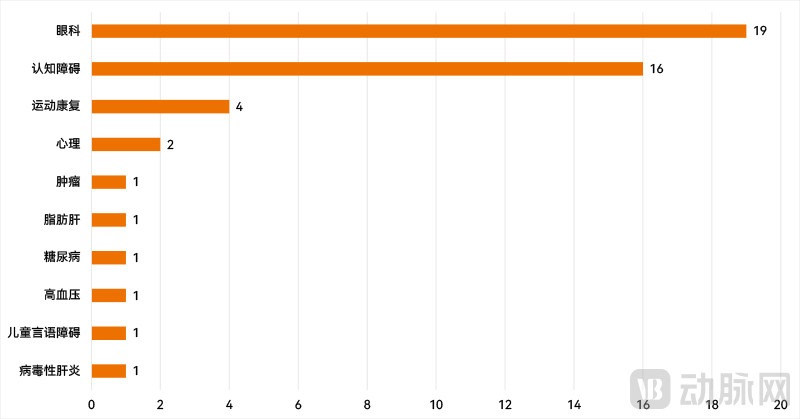
Ophthalmology and cognitive impairment are the disease categories with the highest number of approved digital therapeutics. Among them,A total of 19 Class II certificates meet the definition of ophthalmic digital therapeutics.Among these, ophthalmic digital therapeutics are easier to approve due to their relatively simple mechanisms. However, the majority of such products focus on amblyopia and strabismus in children, while only a few companies are addressing myopia, a condition that could benefit a much larger population.
In the field of cognitive impairment, there are 16 Class II digital therapeutics certificates, primarily concentrated in screening and training.Unlike ophthalmology, the limitations facing digital therapeutics for cognitive impairment stem primarily from the disease itself—there are currently no effective treatments for cognitive impairment.
Beyond this, in addition to sports rehabilitation (4 certificates) and psychology (2 certificates), which each have more than one Class II certificate approved, oncology, fatty liver disease, diabetes, hypertension, pediatric speech disorders, and viral hepatitis each have only one Class II certificate approved.
Based on the NMPA approval landscape, digital therapeutics remain in an early stage of development. Even in seemingly saturated “red ocean” sectors such as cognitive impairment and ophthalmology, numerous unmet clinical needs persist. In fields with substantial corporate participation, such as diabetes and mental health, the proportion of products obtaining regulatory clearance remains notably low. Conversely, some relatively niche areas have gained regulatory recognition.
Although obtaining certification does not represent the entirety of success, it is inevitably a significant milestone for companies moving toward further development. Digital therapeutics still need to further enhance their product capabilities and demonstrate their value to all stakeholders in the healthcare ecosystem. On the other hand, with the continued refinement of standards and regulations for digital therapeutics that began in the second half of last year, the sector is poised to gain new momentum for growth.
It is not difficult to see that, given the current situation, there are still gaps between the development status of digital therapeutics in China and the capabilities required for chronic disease management, necessitating further improvement. Of course, this is not unique to China; globally, the application of digital therapeutics is still in its early stages of rapid growth, with many areas remaining unexplored. These gaps represent significant opportunities.
Moreover, even in sectors that currently appear relatively concentrated, there remain substantial unmet pain points. By effectively addressing these critical challenges and achieving differentiated competition, there is still significant opportunity to stand out.
It must be acknowledged that in VCBeat’s communications with enterprises, there is no shortage of promising ideas capable of filling current market gaps. However, it remains to be verified whether the product logic is truly sound and whether it can deliver tangible benefits to both patients and physicians.
After all, so-called digital therapeutics must first and foremost be a “therapy.” While it may not be limited in terms of the types of diseases it addresses, current technological constraints impose certain limitations on diagnostic and treatment processes as well as intervention methods, resulting in significant variability in efficacy across different diseases.
We will continue to monitor the progress of digital therapeutics in 2023 and welcome exchanges with our readers.
References:
Zhang Wenkang, Health界: "Three Departments Issue Document: Medical Prevention and Control Are the Focus of Chronic Disease Management for the Elderly and Children"
Zuo Yan, Xinmin Evening News: “Alzheimer’s Day | The ‘Shanghai Model’ for Cognitive Impairment Prevention and Control, Addressing the Challenge of Early Diagnosis of Alzheimer’s Disease”
“Report on the Nutrition and Chronic Disease Status of Chinese Residents (2020)”