

Longwell Medical Launches Global First Full-Procedure Robotic-Assisted Total Hip Arthroplasty System, Aiming to Democratize Precision Joint Replacement Surgery

Longwell Medical
Developer and Manufacturer of Joint Replacement Surgical Robots
Recently,Shanghai Longwell Medical Technologies Co., Ltd. (hereinafter referred to as “Longwell Medical”)Announce, OfficialLaunch of the Standardized Surgical Procedure Project for Full-Process Robot-Assisted Hip Arthroplasty。
This project will fully leverage the technical advantages of joint replacement surgical robots. By establishing standardized surgical procedures, providing training, and promoting standardized practices in surgical techniques, it aims to rapidly cultivate a cohort of orthopedic surgeons in China who are proficient in advanced surgical robot technology. This initiative will enable surgeons who are not yet skilled in hip replacement techniques to quickly acquire competence, while allowing those already adept at manual procedures to perform traditional and complex total hip arthroplasty with greater precision. Consequently, this will drive the development of orthopedic surgery in China in terms of both scale and quality precision.Filling the International Gap in Robotic Femoral-Side Surgery, enabling leapfrog development and rapid entry into the international forefront of joint surgery.
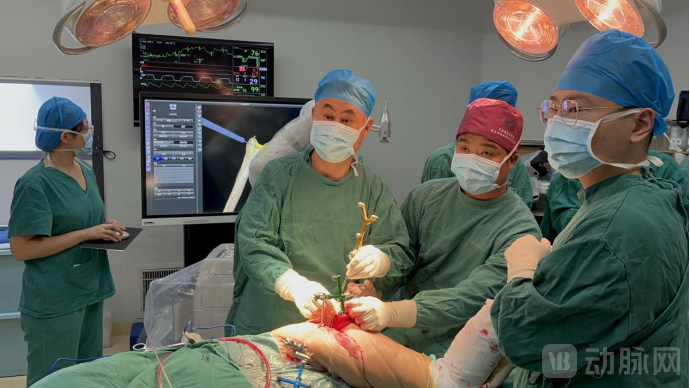
Currently, hip replacement robots available on the market, whether imported or domestically produced brands, have robotic arms that can only operate on the acetabular side. There are no robots yet capable of using robotic arm assistance for femoral medullary cavity preparation. The emergence of the Shanghai Longwell robot makesFull-Process (Femoral Side + Acetabular Side) Robot-Assisted THA Surgerybecome a reality, filling an international gap.
According to Dai Xiangdong, General Manager of Longwell Medical, for total hip arthroplasty, since the acetabular cup is axially symmetric, the robotic system only needs to control five spatial degrees of freedom for operation. However, for asymmetric components such as the femoral stem and femoral broach, which lack symmetry in all directions, control over six spatial degrees of freedom is required to achieve precise manipulation. Furthermore, given the significant range of motion of the femur during surgery, real-time tracking and positioning of the femur have become a global industry challenge. Therefore, for total hip arthroplasty, robotic arm assistance is typically employed only on the acetabular side.
However, the hip joint is a complete system composed of two parts: the acetabular side and the femoral side, forming an organic whole. The precision of total hip arthroplasty is achieved through the cumulative accuracy of both components. If only one side is accurately positioned, it is difficult to achieve overall systemic precision. Therefore, the learning curve for surgeons performing this type of surgery is very long. Improper technique can easily lead to complications such as varus or valgus malalignment of the femoral stem, proximal femoral fracture, postoperative thigh pain, leg length discrepancy, and postoperative dislocation.
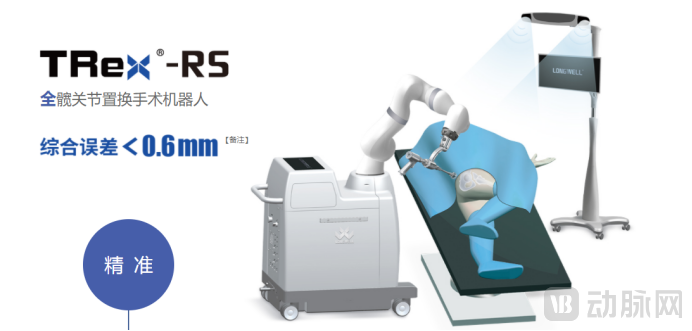
Based on the above understanding,Shanghai Longwell Medical innovatively achieved control over the six spatial degrees of freedom of its robotic arm,andReal-time tracking of the six spatial degrees of freedom of the robotic arm, comprehensively empowering physicians. Like a Sidewinder missile, when the patient moves during surgery, the entire robotic system automatically tracks the movement, ensuring real-time precision throughout the procedure and avoiding surgical errors caused by motion.
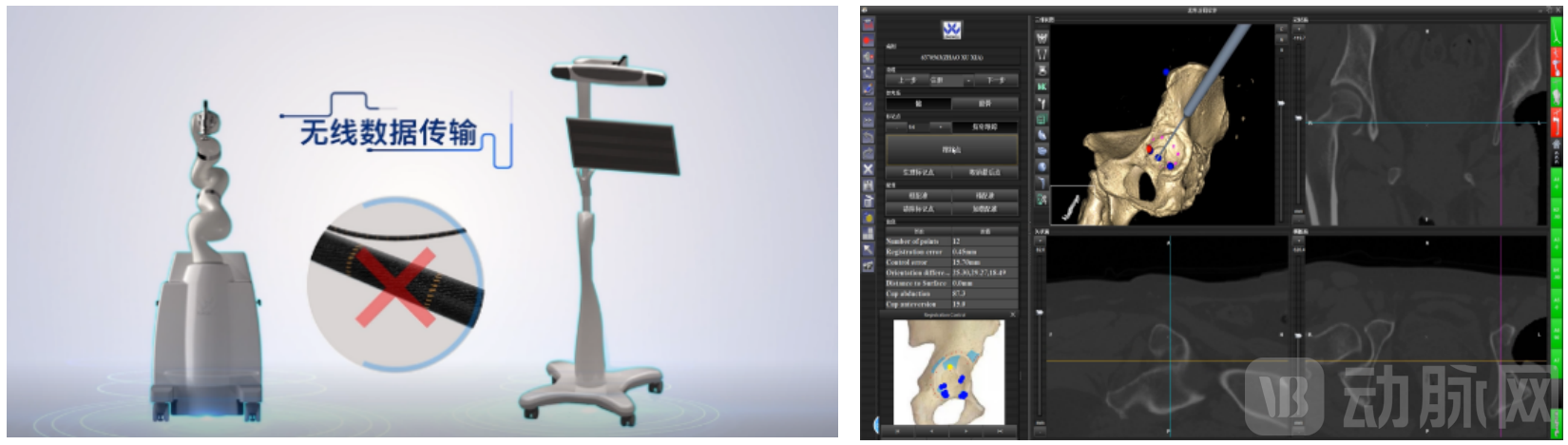
Furthermore, Longwell Medical’s total hip arthroplasty (THA) surgical robot employs free-point selection and real-time registration technologies, significantly reducing registration time to just a few minutes and markedly decreasing the number of registration points. This advancement also enables robotic assistance for complex procedures such as revision surgeries and developmental dysplasia of the hip (DDH).
In terms of industrial design, Longwell Medical has abandoned the traditional three-piece structure and adoptedTwo-Piece Fully Wireless Design. This not only results in a smaller footprint, allowing for greater adaptability to various operating rooms and easier placement; more importantly, it fully returns surgical control to the physician,Doctors can directly operate the robotic arm with seamless hand-eye coordination,No need for manufacturer MPS personnel to be present during surgery, significantly improving surgical outcomes and efficiency while avoiding communication errors, alsoTo reduce costs and improve efficiency for hospitals.
Considering surgeons' operational habits and the complexity of procedures, Longwell Medical has adopted a clean and intuitive UI design that offers a user-friendly interactive experience, smooth workflow, and ease of learning. Surgeons can perform procedures from their standard standing position without altering their usual operational habits. General physicians can fully master the control of the robotic arm after approximately five cases.
Currently, Longwell Medical's hip replacement surgical robot has completed patient enrollment and follow-up for its registration clinical trials.
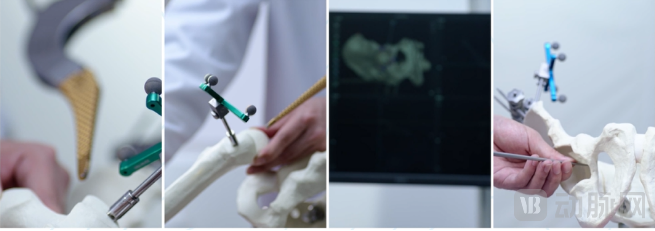
Longwell Medical defines the entire process of robot-assisted total hip arthroplasty (THA) as comprising eight steps: robotic arm–assisted femoral neck osteotomy, robotic arm–assisted acetabular reaming, robotic arm–assisted acetabular component implantation, robotic arm–assisted femoral canal entry, robotic arm–assisted proximal femoral broaching, robotic arm–assisted distal femoral broaching, robotic arm–assisted femoral stem implantation, and prosthetic position verification. Corresponding robotic assistance protocols have been developed for each of these eight steps to achieve truly comprehensive procedural assistance.
It is reported that this technology has already beenThe Affiliated Hospital of Qingdao University, Anhui Provincial Hospital Affiliated to University of Science and Technology of China, Weifang People's Hospital in Shandong Province, and the 920th Hospital of the Chinese People's Liberation Army...has been clinically used in multiple hospitals, with preliminary conclusions indicating high accuracy and reproducibility, ease of operation, and flexible usage.
Relevant studies were also published in the journal International Orthopaedics, pointing out thatCompared with manual freehand surgery, fully robotic-assisted total hip arthroplasty (THA) achieves a certain improvement in acetabular accuracy and a substantial increase of nearly 30% in femoral accuracy, demonstrating significant clinical value.

The clinical value of fully robotic-assisted total hip arthroplasty (THA) has begun to emerge, yet standardized and normative operational protocols remain lacking. In response, Longwell Medical plans to launch a standardized surgical procedure project, establishing approximately ten training centers across China. These facilities will also serve as research and academic hubs for fully robotic-assisted THA, laying a solid foundation for the widespread adoption of precise joint replacement surgery.
According to Persistence Market Research, the number of robot-assisted joint replacement surgeries in the United States reached 100,000 in 2020, with a penetration rate of 7.6%, while the penetration rate for such procedures in China was less than 0.1%. The penetration rate of orthopedic joint replacement surgeries in China is significantly lower than that in developed markets.
Driven by rising patient expectations for surgical quality, the growing need to strengthen capabilities at primary-care hospitals, the widespread adoption of precision medicine and intelligent surgical concepts, and population aging, robotic surgery has become an inevitable trend in joint replacement procedures.
Since its inception in 2017, Longwell Medical has focused on the field of robotic-assisted orthopedic joint replacement surgery. After six years of dedicated development, the company is committed to popularizing precise joint replacement procedures.

The company’s core team is a multidisciplinary group composed of physicians, technical experts, and marketing professionals who have long been active in the research, development, manufacturing, and application of medical devices. Team members have previously served at numerous multinational medical companies, bringing extensive and comprehensive experience across the entire value chain—from identifying clinical needs and driving R&D innovation in specific system technologies to managing commercial operations.
The company has receivedShanlan Capital, Jianyi Capital, Zhangjiang Sci-Tech Investmentand other professional institutions.
As core technologies for surgical robots are gradually mastered and favorable industry policies are introduced, Longwell Medical is poised to leverage its robust R&D capabilities and differentiated product strategy. By delivering innovative, accessible products that meet clinical needs, the company aims to fill the market gap for hip surgery robotic systems and benefit patients worldwide.