

The Rise of ChatGPT in China's Healthcare Sector: Applications, Insights, and Strategic Implications
For industry insiders, ChatGPT’s breakout success may have come as a surprise.
First, the NLP (Natural Language Processing) technology that underpins ChatGPT has been around for a long time; second, the milestones marking the leapfrog development of this technology were not ChatGPT itself, but rather related technologies such as Transformer and GPT.
Why has this particular technology ignited such widespread enthusiasm, reinvigorating the long-quiet AI community? The reasons may be multifaceted, but one undeniable fact is that ChatGPT can accomplish tasks beyond human capability. It engages in continuous, real-time conversations that mimic human logical thinking and expression patterns, while simultaneously performing high-accuracy automated writing, decision support, intelligent diagnosis, smart search, personalized recommendations, and analytical forecasting with remarkable speed. Through ongoing deep learning and data training, it further refines its capabilities, accelerating the path toward truth.
It can be said that ChatGPT has brought about a comprehensive enhancement of human productivity. But what deserves more attention is,The AI interaction capabilities embedded in this technology, which serve as the foundational support for this technological revolution.
In fact, the tasks accomplished by this technology could also be achieved using earlier AI technologies. However, ChatGPT has integrated this technology into human life through an interactive mode—a feat that entails significant technical challenges—thereby shattering the wall of distrust between technology and humans, teaching people how to interact with machines, and enabling a fundamental shift in user identity. This explains why ChatGPT rapidly gained mainstream traction and launched its subscription plan just three months after its release, embarking on its monetization journey.
Medical AI has long struggled with the challenge of commercialization. For medical AI, which has also experienced such peaks, the success of ChatGPT is undoubtedly an opportunity.
From a technical perspective, ChatGPT is a chat system based on OpenAI’s GPT-3 language model (Generative Pre-trained Transformer-3), capable of understanding, responding to, and generating text.The authors from the Human-Machine and Cognition Laboratory attribute the superior performance of ChatGPT to three factors: the strong expressive power of the machine learning models employed, the massive volume of data used for training, and the advanced nature of the training methodologies.
These three points may seem easy, but truly achieving them is no simple feat.
For startups seeking to develop this technology, building an equivalent model would inevitably burn through substantial funds. In the report “How Much Computing Power Does ChatGPT Need?” published by Guosheng Securities, it is estimated that the initial investment cost is approximately $800 million, with daily electricity costs around $50,000. In addition, the cost of a single training run for GPT-3 is about $1.4 million; for some larger large language models (LLMs), training costs range from approximately $2 million to $12 million.
Even when leveraging open-source frameworks, building and training a large model of comparable scale requires substantial capital investment, which is beyond the reach of most ordinary enterprises. Chinese companies benefit from the advantage of mobilizing concentrated resources to tackle major initiatives, yet they still require policy support. Measures such as establishing joint laboratories can help accelerate the research and development of related technologies.
Released by the Beijing Municipal Bureau of Economy and Information Technology on February 13“White Paper on the Development of Beijing’s Artificial Intelligence Industry in 2022” ((hereinafter referred to as the “White Paper”) encourages this technological development direction. The White Paper states that Beijing will guide enterprises, universities, research institutes, new-type R&D institutions, open-source communities, and other stakeholders to carry out collaborative breakthroughs centered on key core technology innovations in artificial intelligence, thereby comprehensively strengthening the foundation for the development of the AI industry.Support leading enterprises in developing large models comparable to ChatGPT, and focus on building an application ecosystem for open-source frameworks and general-purpose large models.Strengthen the layout of artificial intelligence computing infrastructure and accelerate the supply of foundational data for artificial intelligence.
Beijing has demonstrated a clear and supportive stance toward this emerging technology. As artificial intelligence policies are successively introduced across various regions, collaboration among enterprises, universities, research institutes, new-type R&D institutions, and open-source communities will accelerate. This synergy will not only shorten the R&D and iteration cycles for AI-related technologies but also lead to continuous optimization of algorithmic models, while significantly enhancing both data volume and accuracy. At that point, AI technology will generate greater value in healthcare and other sectors alike, creating expanded development opportunities and market space within the artificial intelligence landscape.
ChatGPT is the culmination of advancements in technologies such as Transformer, RLHF, and GPT. It can be understood as the crystallization of natural language processing (NLP), or as an artificial intelligence model that leverages deep learning to comprehend text and generate human-like written content.
It is precisely for this reason that when discussing the application of this technology in the healthcare sector, people’s immediate response is typically internet hospitals or medical science popularization scenarios. If you were to ask ChatGPT, it might well provide a similar answer.
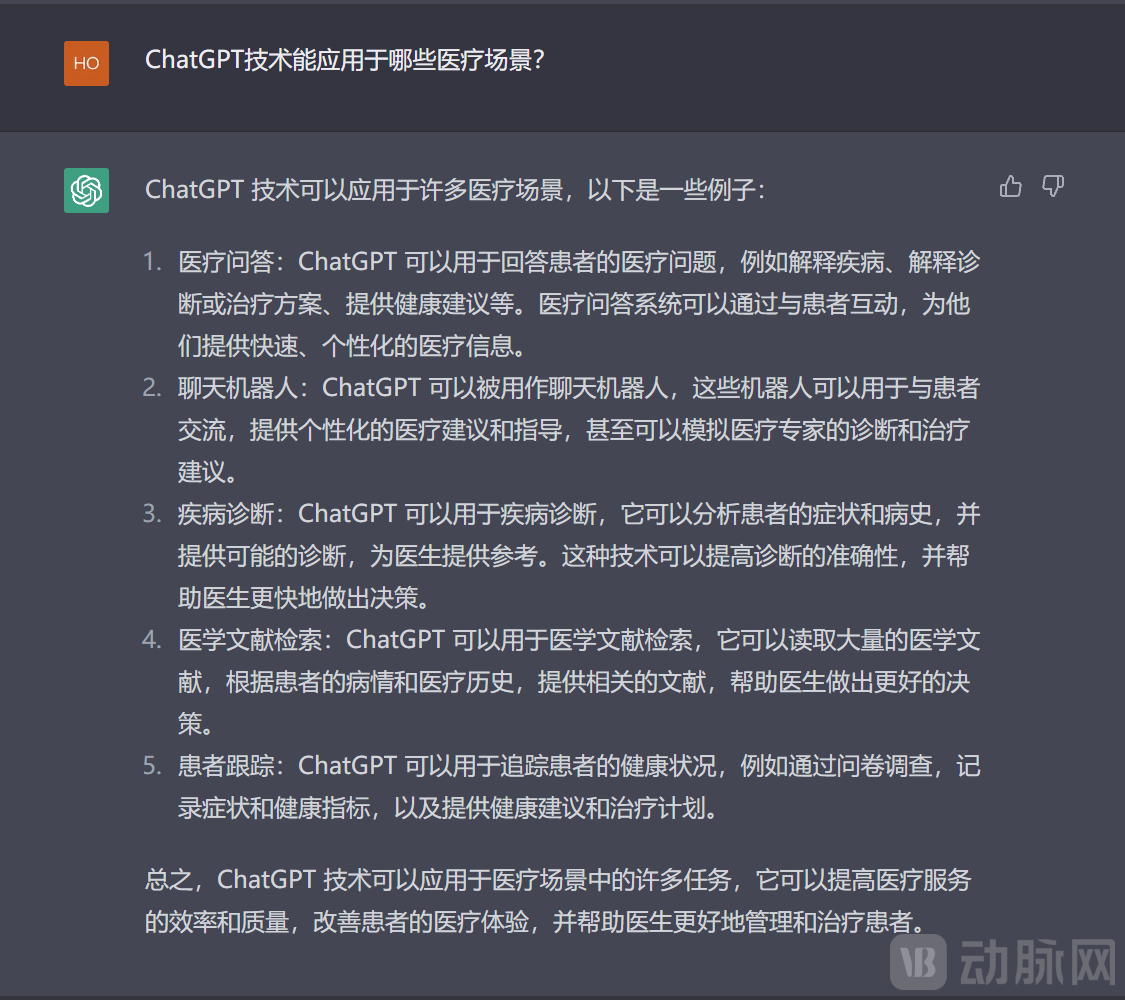
Conversation 1 with ChatGPT
As a result, the ultimate value that ChatGPT brings to healthcare scenarios is not significant.
Moreover, it is important to recognize that ChatGPT can also produce plausible-sounding but entirely fabricated information. This is because the essence of this technology lies in continuously generating data by maximizing probability, rather than employing algorithmic models that answer questions through rigorous logical reasoning. Malicious attacks on this technology may further steer its outputs in erroneous directions. Meanwhile, if based on consistent logic, the issues currently plaguing search engines will persist. The updates released by ChatGPT this year to address algorithmic errors have explicitly acknowledged the existence of this problem. If this technology were directly deployed in internet hospitals without adequate safeguards, the consequences would be dire.
To consider the application of GPT technology in medical scenarios, it is necessary to think outside the box.
In fact,GPT is a highly resilient technology with a wide range of applications. With minor modifications, it can be adapted to other domains while still delivering strong results.Although ChatGPT is currently primarily applied in the field of text-based dialogue, multimodal interaction technologies that integrate voice, text, and image signals are still likely to become a focal point for future industry research.Stable Diffusion, the world’s fastest image-generation application, is a successful case in point. It can generate images from text descriptions, achieving output in just one second.
Returning to AI in medical imaging, the application of GPT-like technologies (including CLIP) to establish connections between text and images, thereby converting key visual information into accurate textual descriptions, can also enhance physicians' diagnostic efficiency and capabilities.
It is understood that JF HEALTHCARE, a domestic enterprise in the field of medical imaging AI, has long been engaged in related artificial intelligence applications and explorations. Since November 2021, JF HEALTHCARE has deployed over 1,000 AI workstations in township health centers across more than 100 counties within 11 prefecture-level cities in Jiangxi Province.
The AI training module of this system provides teaching data (imaging films, annotations, imaging signs, and diagnostic suggestions) for radiologists at the primary care level.Physicians can access DR images from the question bank or upload imaging films from their daily practice to the system, enabling them to delineate lesions and draft imaging reports in simulated real-world scenarios. This allows for real-time review of AI-generated results, followed by the AI providing a consistency score. If physicians disagree with the AI’s conclusions, they can raise diagnostic queries through the system, which then provides explanations and clarifications. Built on this platform, physicians enhance their professional expertise through a three-stage learning process, undoubtedly yielding beneficial effects for practical application in their clinical work.
This project leveraged artificial intelligence (AI) technology to effectively enhance the imaging service capabilities and diagnostic proficiency of radiologists at primary healthcare facilities. Over the course of a 90-day AI-based medical imaging training program, a total of 929 township health centers participated. The completion rate among trainees (including both the pre-training baseline assessment and the post-training final examination) reached 87%. Data analysis revealed that the overall pass rate in the baseline assessment was 65%, which increased to 90% in the final examination, demonstrating a significant improvement in the participants’ diagnostic capabilities compared to their pre-training performance.
It is evident that this AI training approach based on human-computer interaction demonstrates significant efficacy in empowering primary care physicians.Although JF HEALTHCARE does not employ large language models such as GPT, it focuses on small-scale models tailored to the medical vertical. The technologies underlying its AI products—including automated lesion delineation, automated generation of imaging reports, and algorithm optimization mechanisms based on user feedback—are consistent with the Transformer architecture and Reinforcement Learning from Human Feedback (RLHF) techniques that power ChatGPT. This approach may represent a primary model for deploying enterprise-grade GPT-like technologies within specialized vertical domains.
ChatGPT has made history. Within just five days of its launch, the product surpassed one million users. In contrast, medical AI has long struggled with limited trust among physicians and patients in artificial intelligence technologies, facing significant barriers to clinical implementation.
ChatGPT was like a flash of lightning, prompting people to reevaluate AI technology and learn how to engage in dialogue with it.It also provides directional guidance for medical AI, helping to cultivate user habits. Turning our attention back to medical AI, the success of ChatGPT makes it clear thatThe first step in applying AI technology to medical scenarios is to make this technology a friend of doctors.
Li Jian, CTO of JF Healthcare, believes that in the medical field,The imagined application scenario for ChatGPT involves interacting with patients to conduct medical consultations. This was also the focus of IBM Watson’s earlier efforts. However, there are significant differences between medical consultations and general question-answering tasks. In addition to requiring specialized domain knowledge, medical consultations demand highly detailed patient information. Mere question-and-answer exchanges and text input are far from sufficient; typically, multimodal data such as precise medical history, imaging studies, and biochemical tests are also required.JF HEALTHCARE has also developed related consultation products for application in primary care settings, but it does not consider clinical decision support for patient interviewing to be the optimal use case for GPT-like technologies. Based on experience from previous intelligent training projects,Drawing inspiration from the surge in ChatGPT’s popularity, JF HEALTHCARE has identified two key areas for increased future investment: enhancing the capabilities of primary-care physicians through professional interactive tools, and improving algorithm performance via more effective feedback mechanisms.
Dr. Sun Zongji, Algorithm Director at JF HEALTHCARE, stated: “In the future, JF HEALTHCARE may incorporate more interactive features into its AI products to build trust with doctors and patients, rather than simply providing blunt image analysis results.This also addresses a major pain point in the past application of AI in medical imaging, namely that physicians focus on multidimensional information and require more data to be incorporated into the models.JF Healthcare previously developed a multimodal data model. However, we now aim for it to provide more than just an answer; by interacting with physicians and incorporating their feedback, the model can further refine diagnostic outcomes.”
In fact, what ChatGPT offers to artificial intelligence enterprises is not merely a technology, but also a mindset and a strategic direction. Guided by this direction, AI companies are certain to go further. For users, it enhances their understanding and acceptance of AI technology.Although artificial intelligence technology can interact with humans to some extent by mimicking human logical thinking and expression patterns, there is still room for improvement. After all, no AI technology worldwide has truly passed the Turing Test to date. To optimize product performance, users need to become familiar with how to converse with AI and recognize its expressive errors. When AI fails to fully comprehend the logic of human language, humans must adjust their mode of expression to facilitate better understanding by the AI, thereby yielding the desired results.
One of ChatGPT’s profound values lies in its ability to train ordinary people in the art of asking questions, thereby enabling humans to better understand AI.And the future of artificial intelligence will undoubtedly be a process of mutual engagement.
Unlike other application scenarios, the healthcare setting is relatively serious and does not allow for unlimited creative freedom. It may currently be unrealistic to develop a large language model (LLM) specifically for the medical field or to completely disrupt all existing product forms. However, LLMs have already demonstrated sufficient capability to be easily extended and applied across various domains. Moreover, they can serve as an effective front-end interface for natural language understanding. In the future, the emergence of small-scale, controllable models in the healthcare sector remains a promising prospect.
A review of the evolution of artificial intelligence is inseparable from several landmark events. ChatGPT has undoubtedly sounded the prelude to the evolution of AI.
Over the past eight years, JF HEALTHCARE has achieved remarkable success by leveraging artificial intelligence technologies. The company not only established a training platform for thousands of grassroots township health centers in Jiangxi Province but also implemented commercial practices across twelve provinces and municipalities nationwide. During its commercialization efforts, the company secured China’s first Class III medical device certificate for AI-based tuberculosis diagnosis and obtained a license to operate a Remote Medical Imaging Center.。In an application project in Jiangxi Province, JF HEALTHCARE used artificial intelligence to randomly audit historical reports from 19 township health centers. After review and confirmation by third-party hospitals, it was found that JF AI identified 240 additional suspected cases of active pulmonary tuberculosis compared to traditional physicians.Helped township health centers double their detection rate.
We believe that this technology will continue to be applied in the field of AI, giving rise to more valuable solutions.
How to Define the Success of ChatGPT? It Responds as Follows:
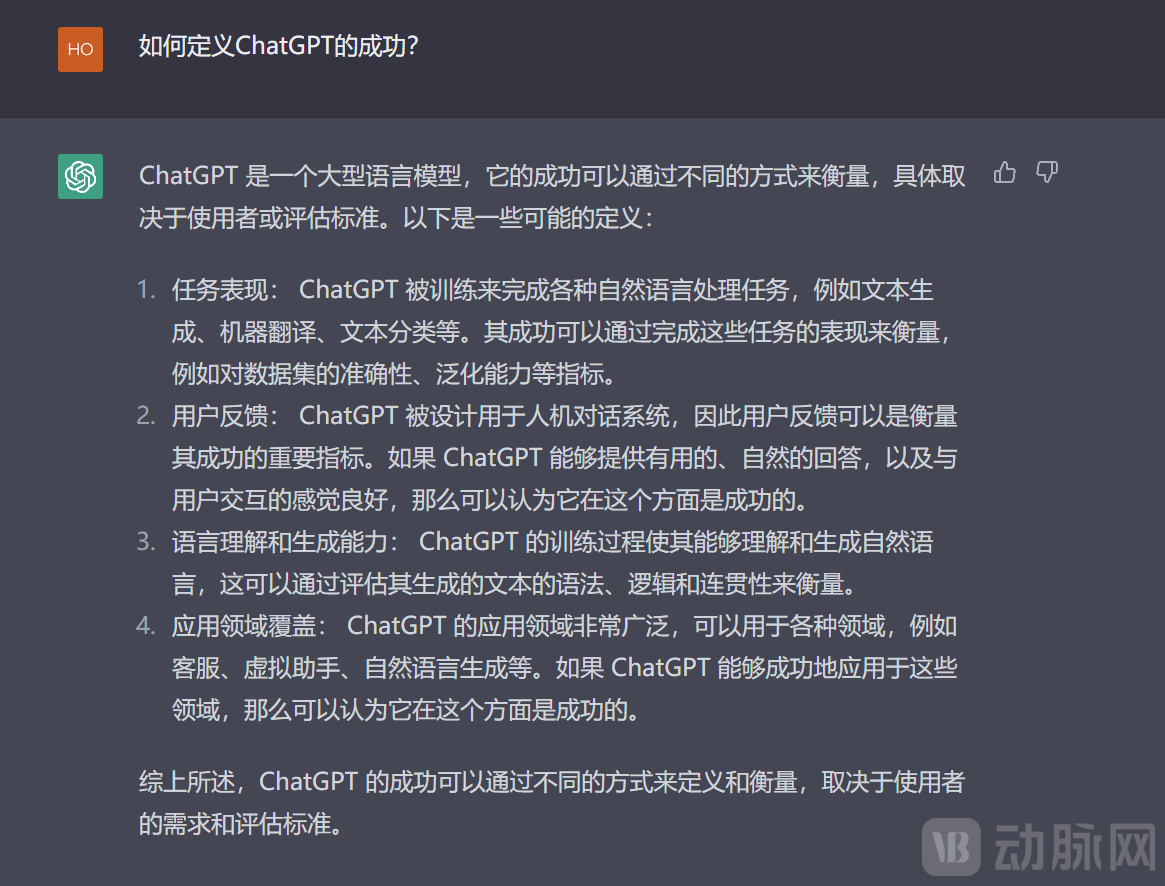
Conversation with ChatGPT 2
Reference Article:
1. ChatGPT Special | Why Is ChatGPT So Powerful? — Understanding the Principles of ChatGPT in One Article!
2. The Economics Behind ChatGPT