

Chinese Universities Embrace Venture Capital: A New Wave of Academic-Backed Investment in Biotech and Beyond

ZJUITI
High-tech Achievements Incubation and Scientific Research & Development Company
In January 2023, Bangshun Pharmaceutical, an innovative biopharmaceutical company specializing in novel drug development, completed its Series B financing round led by Shenzhen Capital Group. The company focuses on the development of small-molecule targeted therapies and antibody-based drugs, having established more than ten innovative drug pipelines. Several key candidates and indications have advanced into pivotal registration-enabling clinical trials and Phase II clinical studies.
Interestingly, while reviewing the investors in this funding round, VCBeat’s attention was drawn to “West Lake Innovation Investment.” Although relatively new to the healthcare investment sector, this firm boasts an impressive pedigree.
As is well known, Westlake University, founded by Professor Shi Yigong, pioneered the establishment of new-type research universities in China driven by social forces. Since its inception, the university has been imbued with a mission to facilitate the commercialization of scientific and technological achievements and an investment-oriented DNA. Backed by Westlake University, Westlake Innovation Investment serves as an investment vehicle dedicated to safeguarding and accelerating the industrialization of scientists’ technological innovations.
Bangshun Pharmaceutical, the company favored by West Lake Innovation Investment, is backed by a team of scientist-entrepreneurs. In 2020, Dr. Lü Yubin and Dr. Yin Jianming co-founded Bangshun Pharmaceutical, both bringing over 20 years of experience in new drug development and management.
Westlake Innovation Investment, approaching its third anniversary, has invested in or incubated enterprises such as Westlake Biopharmaceuticals, Westlake Omics, Westlake Vitae, Drug Farm, Ruiao Biology, Haosi Biology, and Nuoyi Mai'er. These companies are either led by scientists from Westlake University or maintain deep ties with the university. “Scientists” have thus become a distinctive investment hallmark of Westlake Innovation Investment.
Within the broader venture capital community, Westlake Innovation Investment, with its university background, is not an isolated case. Tsinghua-affiliated entities such as TusStar and Tsinghua Holdings, along with Zhejiang University Institute of Technology Innovation Co., Ltd. (hereinafter referred to as “ZJUITI”), have been established for many years and already have mature investment portfolios. The relatively “young” Peking University Technology Transfer Fund has also been actively making investments. In 2022, Wuhan University, Peking University, and Central South University successively initiated or established technology transfer funds. Unbeknownst to many, this wave of innovation driven by university-affiliated VCs has already mapped out a significant landscape in healthcare investment.
In Beijing, “technology transfer” is not a new term. As early as 1980, Tsinghua University established the first technology-based company among Chinese universities—Tsinghua Technical Service Company. Subsequently, with deepening reforms and gradual market opening, Tsinghua University witnessed an entrepreneurial boom, with entities ranging from academic departments to student groups and the Communist Youth League organizations actively founding enterprises.
On August 20, 1999, the Tsinghua Science Park was established, tasked with incubating high-tech enterprises spun off from Tsinghua University. Subsequently, TusStar and Tsinghua Holdings were founded. Over the past two decades, numerous investment firms and incubators have emerged and become active in China’s venture capital market, including Hetang Venture Capital (formerly TusVenture), TusSeed, Shuimu Ventures, Qingyuan Defeng, Qingkong Ginkgo Venture Capital, Huakong Fund, and the Tsinghua X-lab Entrepreneurial DNA Fund.
In the 2021 Annual Report on the Transformation of Scientific and Technological Achievements in China, compiled by institutions such as the National Center for Science and Technology Evaluation, Tsinghua University ranked first among all Chinese universities in terms of the total value of transformed scientific research achievements. This accomplishment is attributable to Tsinghua University’s decades-long, step-by-step accumulation in research capacity, policy refinement, technology transfer systems, and industrialization investment and financing.
In April 2021, on the Peking University campus, located approximately 1.5 kilometers from Tsinghua University, the newly established Peking University Technology Transfer Fund—just one month old—rapidly made its first investment in Jinyu New Energy, a company founded by a Peking University Ph.D. graduate in materials science. This swift and decisive action reflected Peking University’s confidence and determination to promote original innovation and the commercialization of research achievements.
High expectations have been placed on this fund. As Peking University’s first technology transfer and commercialization fund, also known as the “Yuanpei Fund,” it serves both to honor Mr. Cai Yuanpei, former president of Peking University, and to embody the mission of “fostering original innovation.” Examining its limited partner (LP) portfolio, the fund brings together high-quality stakeholders, including the Beijing Science and Technology Innovation Fund led by the Beijing Municipal Government, the Peking University Education Foundation, Founder Hesheng, and other renowned venture capital firms, jointly supporting early-stage projects in original innovation within the advanced “hard tech” sector.
Over the past two years, the Peking University Technology Transfer Fund has demonstrated significant effectiveness. In the healthcare sector alone, it has led or participated in investments in high-growth-potential ventures such as Xueji Biotech, ImmuneOnco, Tai’a Tech, Danxu Biotech, Chaomu Tech, Shize Biotech, and Jinjing Tech, supporting a cohort of scientists in taking their first steps toward commercializing their research achievements.
Following the Beijing-Hangzhou Grand Canal southward from Beijing to Hangzhou, a seed for the commercialization of scientific and technological achievements was sown at Zhejiang University ten years ago.
In 2023, ZJUITI, the technology achievement investment and commercialization platform under Zhejiang University, ushered in the beginning of its “second decade.” Over the past ten years, ZJUITI has achieved remarkable success. Its healthcare portfolio features not only a cohort of high-potential tech enterprises—including Rouling Technology, Shengshi Technology, Lingnao Technology, Bitai Medical, Pu’ang Medical, and Kaishi Biotech—but also listed companies such as Minfound Medical Systems, Endovastec, LC Bio, and MicroTech Medical.
ZJUITI has grown into a comprehensive sci-tech innovation platform for early-stage technology projects under Zhejiang University Holdings, integrating technological innovation, business model innovation, commercialization of scientific and technological achievements, market investment, talent development, and enterprise incubation, by leveraging Zhejiang University’s research strength, technological achievements, and talent advantages.
Continuing southward, the momentum of translating scientific and technological achievements has reached the Guangdong-Hong Kong-Macao Greater Bay Area. Universities such as Shenzhen University, Southern University of Science and Technology, and Jinan University have successively established venture capital funds, building a bridge between “academia” and “industry” from an investment perspective to help scientists grow from “0” to 1, and then to positive infinity.
An era belonging to scientists is on the rise. Consequently, a growing number of university-affiliated venture capital firms are stepping onto China’s VC stage.
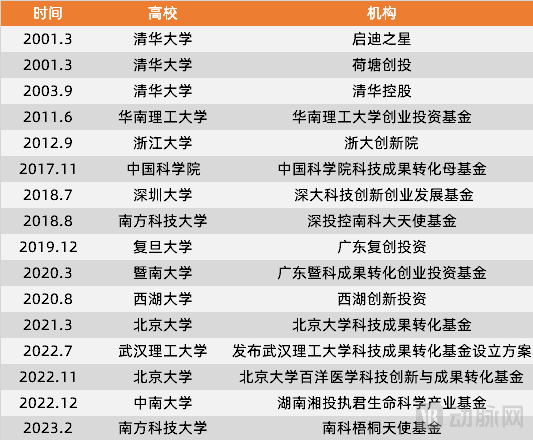
Capital serves as the ammunition for investment institutions and is a fundamental driver of technology transfer. Given the diverse institutional backgrounds of universities, their respective venture capital arms exhibit distinct portfolio compositions and investment strategies.
A rich portfolio of LP resources provides university-affiliated VCs with diverse industrial assets, including financial support, technical assistance, and market channels.
University-affiliated venture capital firms have diverse fundraising channels. In addition to their own “capital pools,” they receive support from government guidance funds and can also raise capital from the market. Government funding aims to attract invested projects to localize in the region, thereby generating tax revenue and employment opportunities, while listed companies seek synergy between the invested projects and their existing businesses.
Established in 2018, the Shenzhen University Science and Technology Innovation and Entrepreneurship Fund pioneered an innovative model of “university + government + listed companies + alumni enterprises.” It introduced four listed companies as industrial strategic investors, leveraged the locational advantages of Shenzhen University and Longgang District, integrated a series of market, technological, and production resources, and invested in or incubated alumni enterprises to support their sustainable development.
The Chinese Academy of Sciences’ Fund of Funds for the Commercialization of Scientific and Technological Achievements, the Hunan Xiangtou Zhijun Life Science Industry Fund (Central South University), and the Shenzhen Capital Group–Southern University of Science and Technology Angel Fund (Southern University of Science and Technology), among other university-affiliated venture capital firms, all possess diverse portfolios of limited partner (LP) resources. In addition, corporate donations and contributions from university alumni funds are also common fundraising channels for university-affiliated VCs.
In terms of investment preferences, university-affiliated venture capital firms favor "in-house" hard-tech startups and primarily enter at the stage of original innovation.SuperVision Technology, co-founded by Professor Wang Lejin from the Department of Ophthalmology at Peking University People’s Hospital and several professors from Tsinghua University, Beijing University of Technology, and the Technical Institute of Physics and Chemistry of the Chinese Academy of Sciences, has secured investments from prominent institutions such as Tsinghua Shuimu Venture Capital and the Peking University Achievement Transformation Fund. More than one-third of Hetang Venture’s portfolio consists of projects commercialized from universities like Tsinghua or incubated by hospitals. Among the medical investment projects backed by ZJUITI, 80% were founded by Zhejiang University professors or alumni, covering high-potential fields such as biotechnology, pharmaceuticals, high-value consumables, medical devices, and brain science, with most investments made during the angel or Series A rounds.
In terms of project selection and empowerment, each institution has its own focus, ranging from comprehensive VCs with broad investment portfolios to vertical VCs that concentrate on specific industries or regions.
For universities with rich and well-established academic disciplines, their affiliated venture capital (VC) firms tend to have broad investment scopes, covering areas such as healthcare, intelligent manufacturing, semiconductors, and next-generation information technology. However, some universities have established healthcare-focused vertical VCs to promote the commercialization of medical research achievements. For instance, the Peking University Baiyang Technology Transfer Fund focuses on innovative outcomes from Peking University’s medical sector; similarly, the Hunan Xiangtou Zhijun Life Science Industry Fund of Central South University prioritizes and invests in projects related to the translation of medical research achievements at Central South University.
In specific regions, Fudan University’s Fuchuang Investment has established operations in Hengqin, Zhuhai, aiming to facilitate the local implementation and commercialization of related technology projects in Zhuhai; Southern University of Science and Technology’s Shenzhen Capital Holdings Nankex Angel Fund focuses on promoting the industrialization of scientific and technological achievements from basic research in Shenzhen; Jinan University’s Guangdong Jike Scientific and Technological Achievement Transformation Venture Capital Fund prioritizes investments in high-quality projects that transform scientific research outcomes from universities and research institutes in the Guangdong-Hong Kong-Macao Greater Bay Area.
Furthermore, university-affiliated venture capital (VC) funds vary in terms of fund size, organizational structure (corporate or limited partnership), and management model (managed by external fund managers or by in-house teams established by the universities).
Behind the deep involvement of universities in the venture capital industry, a trinity is taking shape at the national, industrial capital, and basic research levels, aiming toOriginal Innovation in Core Technologies.
First, universities are a significant source of scientific research achievements and an essential component in implementing the innovation-driven development strategy.Technological innovation has become the top priority of China’s 14th Five-Year Plan. In alignment with this goal, China has successively introduced a series of key policies across three dimensions—national strategy, laws and regulations, and industry guidance—thereby completing the “trilogy” of policy support for the translation of scientific and technological achievements. Against the backdrop of continuous issuance of macro-level policies and supporting documents encouraging the commercialization of technological innovations, universities, as a critical source of such innovations, have been steadily improving their internal mechanisms and systems for technology transfer. With the gradual refinement of the policy framework, efforts to translate medical innovations have evolved from national-level policy advocacy into proactive initiatives undertaken by local governments, universities, and healthcare institutions.
Technological transformation has brought about tremendous industrial opportunities, and the era of scientists launching startups in the medical field is upon us. As2010-2020During this period, the mobile internet experienced significant growth, with internet healthcare and medicalAIand other fields have given rise to numerous industry giants. At this time,China is at a tipping point in its transition from “business-model innovation” to “technological innovation,” shifting from factor-driven and investment-driven growth to innovation-driven growth, from demographic dividends to innovation dividends, and from a worker dividend to an engineer dividend.Enter2021In the years that followed, downstream industries gradually matured,“Low-Hanging Fruit”When talent is scarce, scientists with pioneering innovation capabilities are in fierce demand from capital markets. Competition among scientist-led startups is intensifying, market enthusiasm remains high, and an increasing number of scientists and professors are stepping out of the ivory tower—either proactively or reactively—to launch ventures.
Scientist-led startups require robust support from professional incubation investment and angel investment.. Scientists-turned-entrepreneurs often face the challenge of having “exceptionally strong strengths but significant weaknesses.” They require incubators and angel investment firms with deep industry resources and extensive experience to help them address managerial and operational gaps, including team building, identifying co-founders, exploring commercial applications, and handling operations and business development. Such support accompanies scientist entrepreneurs through the critical early-stage period, enabling them to achieve rapid growth.
University-affiliated venture capital firms leverage their disciplinary strengths, medical resources, scientific research capabilities, and industrial networks to better support scientists during the “first mile” of their entrepreneurial journey.
Unlike relatively mature, market-validated mid-to-late-stage projects, early-stage medical ventures exhibit high unpredictability and involve more complex, multidimensional evaluation criteria. Outstanding original innovation projects are often highly obscure and carry elevated risks.
On the one hand, universities are relatively insular, leading to an underestimation of the original innovative capacity of their research projects. Professors devote most of their time and energy to laboratory work and teaching, lacking bridges and opportunities for communication with industry. This results in information asymmetry between projects and market demands, creating significant uncertainty in commercialization. On the other hand, the instability of project teams—such as researchers holding concurrent positions—and the lack of coordination with teams specializing in manufacturing, corporate operations, and business development, cause many projects to encounter repeated setbacks, resulting in a relatively low success rate. Moreover, not all disruptive innovations are suitable for commercial translation.
University-affiliated venture capital firms, leveraging their inherent connections with professors and alumni, are better positioned to identify and screen early-stage innovative projects that align with clinical needs and possess high potential for growth.Furthermore, beyond providing financial support, university-affiliated venture capital firms leverage their institutions’ talent development and scientific research resources to offer innovative technical solution designs for project teams. By conducting market and clinical needs assessments, they guide the close alignment of scientific research commercialization with actual demands, thereby enhancing the practicality, novelty, and translational value of scientific achievements and improving the success rate of project industrialization.
In industries with high knowledge barriers, maintaining technical confidentiality is of paramount importance. Scientists who have long been immersed in research environments may struggle to distinguish between investment institutions that are genuinely committed to substantive work and those merely seeking quick profits. A professor at Peking University stated in an interview, “Some scientist-entrepreneurs find it difficult to steer their companies’ development according to their own vision after bringing in investment firms. Some capital providers demand rapid profitability, which deviates from the original intentions of scientists when they embark on entrepreneurial ventures.”
University-affiliated venture capital firms align the interests of the university with those of scientific teams, thereby earning scientists’ trust and gaining priority access to technical information. This enables them to help scientists explore commercial value, identify market positioning, and more. In terms of project sourcing, for example, the Technology Development Department of Peking University has issued a long-term call for reserve projects, achieving comprehensive coverage of innovative teams and projects across its main campus, Health Science Center, affiliated hospitals, Shenzhen Graduate School, and various industry-academia-research platforms under the Peking University umbrella.
The patent approval process for managing scientific and technological achievements in universities is complex, and the commercialization of patents involves long cycles and slow progress. For instance, in some projects, both universities and hospitals hold certain proportions of intellectual property rights; during the commercialization process, these assets must undergo evaluation by two different departments with distinct assessment frameworks, making the procedure considerably complex.As a VC originating from universities, we are well-versed in the technology transfer processes of academic institutions, thereby reducing communication costs with relevant departments such as technology transfer offices. We efficiently address issues related to patent applications, policy consultations, investment negotiations, and team building for scientists, ultimately enhancing the success rate of project commercialization.
For instance, Tsinghua University has established a work system for the transfer and commercialization of technological achievements, comprising the Office of Technology Licensing (OTL), the Office of Technology Transfer (OTT), the Academy of Sciences, the Office of University-Local Government Cooperation, the Institute of Technology Transfer, and investment institutions. This structure fosters a virtuous cycle among its policy framework, technology transfer system, and scientific research and innovation ecosystem.
In light of this, for universities with abundant scientific and technological achievements, establishing an early-stage equity investment fund characterized by high execution efficiency, strong capability in identifying major early-stage original innovations, deep trust from scientists, and patient long-term support is of great significance to promoting original innovation and the translation of scientific and technological achievements within the institution.
In the post-investment phase, university-affiliated venture capital firms do not passively follow enterprise development. Instead, they leverage their deep accumulation within universities, clinical hospitals, and the medical industry to proactively build a multi-party resource integration platform encompassing technology, clinical practice, and the medical industry. They foster growth through in-depth post-investment management and strategic resource infusion. Moving forward, these university-affiliated VCs must also actively collaborate with various stakeholders across government, industry, academia, research, and healthcare sectors to promote deep integration of industry, academia, and research, thereby facilitating the commercialization of scientific and technological achievements from the laboratory to the market.
However, university-affiliated venture capital (VC) firms also have areas that need improvement. A senior investor from a university VC firm noted that early-stage medical projects are highly unpredictable, and the commercialization of scientific and technological achievements involves multiple aspects, including technology, law, and finance. This requires investors to possess more diversified capabilities in project screening, due diligence, and support services. However, China has not yet established a high-level professional training system; the cultivation of talent for technology transfer services relies mainly on short-term training programs, resulting in an acute shortage of specialized professionals, andSome university-affiliated venture capital firms operate under mechanisms that differ from market norms, particularly in decision-making processes, team building, profit distribution, and the development of investment talent pipelines.There will inevitably be some difficulties.
Overall, university-affiliated venture capital has become an indispensable force in the broader trend of technological innovation. In this era of rapid advancement in medical innovation, they have ridden the waves of the times, revealing grandeur through meticulous detail.