

Three IPOs Emerge as MedTech CDMO Sector Heats Up: VCs Focus on Three Core Capabilities

Hitachi
Manufacturer and seller of medical imaging equipment and electronic products
In the consumer electronics sector, Apple has built a global “Apple supply chain,” with Foxconn being the most renowned company within it. The Apple supply chain is widely praised because Apple provides contract manufacturers with equipment and technical guidance, helping them master the latest technologies.
In fact, even before Apple, medical device giants had already built supply chains in a manner similar to Apple.
In the IVD sector, Hitachi has served as a CDMO partner to Roche, the global diagnostics giant, for over four decades. Rather than merely providing Hitachi with technology in a single area, Roche has collaborated with Hitachi to jointly develop diagnostic equipment and automated instruments.
The partnership between Roche and Hitachi is not an isolated case; similar global examples include JEOL developing and manufacturing instruments for Siemens, and Canon Medical Systems developing and manufacturing instruments for Abbott.
In China, the CDMO sector for medical devices has historically experienced slow growth. However, this trend has begun to shift in recent years, with medical device CDMOs quietly emerging as significant players.
Multiple medical device CDMO companies have successfully completed their initial public offerings (IPOs). In the in vitro diagnostics (IVD) sector, Quaero Life Science Co., Ltd., a CDMO, has passed the review by the ChiNext board. Meihao Medical, a CDMO specializing in ventilators and cochlear implants, listed on the ChiNext board in 2022. Earlier, Haitai Xin Guang, which provided R&D and contract manufacturing services for Stryker’s endoscopes, was listed on the STAR Market.
Unlike pharmaceutical CXOs, which have been a hot concept in the secondary market, the medical device CDMO industry has been perceived as having low entry barriers and a limited growth ceiling. However, the investment logic for this sector is continuously evolving. Multiple institutions have told VCBeat (WeChat ID: vcbeat) that they are beginning to focus on the medical device CDMO track, with several astute investors already making moves. For instance, Legend Capital, which invested in Pharmaron in the pharmaceutical CDMO space, has already positioned itself in two companies within the medical device CDMO sector.
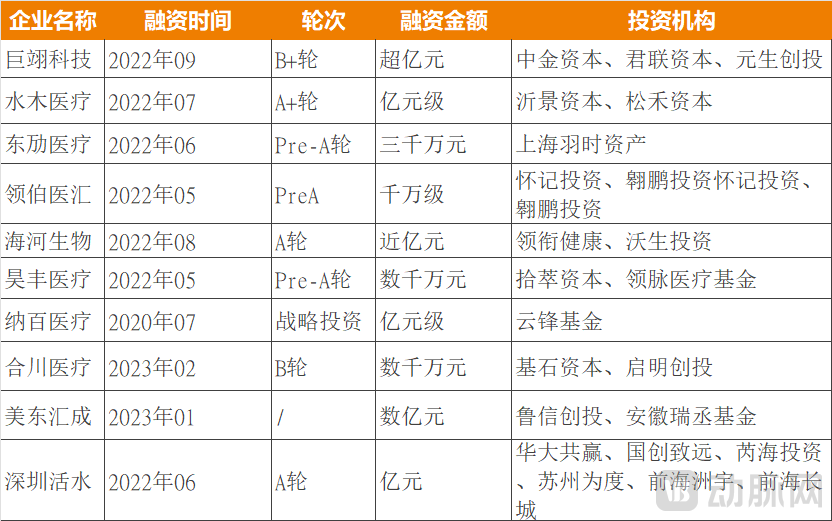
Recent Financing in the Medical Device CDMO Sector
CDMO stands for Contract Development and Manufacturing Organization. Unlike simple contract manufacturing, CDMO involves contracted custom R&D and production, primarily providing pharmaceutical and biotechnology companies with services such as process development and preparation for innovative products, process optimization, production of registration and validation batches, and commercial-scale custom R&D and manufacturing.
In the pharmaceutical market, characterized by high R&D costs, long development cycles, and high peak sales, several Chinese CDMO companies have emerged as listed entities, including Pharmaron, WuXi Biologics, and Porton Bio. However, medical device products differ from pharmaceuticals; they feature diverse product categories and rapid iteration cycles, making it difficult for the sales revenue of any single product to surpass that of pharmaceutical drugs.
In the past, China had no shortage of contract manufacturing enterprises, but they were mostly small in scale, with few involved in processing Class III medical devices, which carry higher value-added.
The small scale has long been an inherent perception of the medical device CDMO sector. Why has attention toward medical device CDMOs increased recently?
Fundamentally, the emergence of the “Apple supply chain” in the consumer electronics sector and the cultivation of multiple CDMO companies by giants in the IVD industry are both inevitable outcomes of highly specialized industrial division of labor.Within the medical device industry chain, the core value of the CDMO sector lies in enhancing R&D efficiency and reducing R&D costs. In the post-commercialization phase, CDMOs can lower costs and boost production efficiency through process optimization, while ensuring product quality and supply chain stability.
In recent years, the acceleration of the industry has been driven by the maturation of the Medical Device Registrant System.The Marketing Authorization Holder (MAH) system was officially implemented in China in 2017. In 2018, the pilot program for the MAH system was expanded to 21 provinces and municipalities. In 2021, the revised Regulations on the Supervision and Administration of Medical Devices newly issued also incorporated the Medical Device Marketing Authorization Holder system.
Following the introduction of the Marketing Authorization Holder (MAH) system, holders of medical device registration certificates can engage in R&D and manufacturing by commissioning medical device manufacturers with robust quality management systems, thereby laying the institutional foundation for the widespread adoption of the CDMO model in China.
Prior to the introduction of the Marketing Authorization Holder (MAH) system, medical device registration certificates were required to be held exclusively by medical device manufacturers. This necessitated substantial capital investment in factory construction and the procurement of production and inspection equipment, while also demanding robust production management capabilities and rigorous quality system oversight. Consequently, the barriers to entry for holding a medical device registration certificate were significantly high.
Under the Medical Device Registrant System, entities such as research institutions, universities, hospitals, and researchers are permitted to develop products and conduct post-market production through outsourcing arrangements. This has introduced new participants into the downstream market of the medical device R&D outsourcing industry, driving increased demand for services such as research and development and clinical trials. This third-party R&D and manufacturing model, characterized by greater integration and customization, not only meets the needs of clients but also alleviates pressure on in vitro diagnostic (IVD) companies, thereby enabling a clearer division of labor within the industry chain.
Dr. Chen Tao, founder of Dongmai Medical, stated, “The introduction of the Marketing Authorization Holder (MAH) system did not immediately bring substantial benefits to the medical device CDMO industry. As early-stage CDMO enterprises gradually refined their business models and expanded their scale under the new regulations, their capital requirements increased accordingly. Consequently, many companies began seeking external financing, leading to a rise in financing activities within the industry.”
In addition to the closely related policies for medical device registrants, events such as volume-based procurement (VBP) and the pandemic have accelerated the development of the contract development and manufacturing organization (CDMO) industry for medical devices over the past few years. VBP in the field of high-value consumables has prompted some distributors to transform into manufacturers, entering this sector; meanwhile, the pandemic spurred the growth of the in vitro diagnostics (IVD) industry, with a significant spillover of orders driving the expansion of domestic IVD CDMO companies. The convergence of these multiple factors has ushered in a period of opportunity for the medical device CDMO industry.
Notably, while interest in medical device CDMOs is rising and there are many participants, the sector still lacks high-quality investment targets. Although numerous third-party manufacturing service providers exist, few companies offer end-to-end services spanning from R&D to production; most are concentrated in small-scale pilot production and post-market commercial manufacturing.
Which Medical Device CDMO Segment Is Poised to Foster Large-Scale Enterprises? Undoubtedly, among medical device CDMOs, those in the IVD sector have attracted the most attention.
In Vitro Diagnostic CDMOs had already developed mature business models prior to the introduction of the Marketing Authorization Holder system.The primary reason is that the in vitro diagnostics (IVD) field involves two product categories—reagents and instruments—with vastly different technological scopes. Significant technical barriers exist between these two domains, rendering them incompatible. The development and commercialization of IVD instruments constitute a complex systems engineering endeavor characterized by high technology intensity, high risk, substantial capital investment, and long development cycles. Consequently, only a few companies in the industry have achieved high technical proficiency in both reagents and instruments.
Therefore, even global IVD giants such as Roche, Abbott, Beckman, and Siemens, in order to concentrate their resource advantages, have chosen to collaborate with third parties for the majority of their diagnostic instrument products, outsourcing the R&D and manufacturing of these instruments. This demonstrates that professional CDMO service providers play a crucial role throughout the entire lifecycle of diagnostic instruments, from R&D and manufacturing to market launch.
In China, due to the relatively short history of industry development and limitations in technological capabilities, companies operating in the in vitro diagnostics (IVD) sector have primarily been reagent manufacturers, with few engaged in the independent research, development, and production of diagnostic instruments. In the early stages, there was heavy reliance on imported instruments. As domestic R&D and manufacturing capabilities for diagnostic instruments have improved, large Chinese reagent manufacturers have begun to independently develop and produce compatible instruments. However, most small and medium-sized reagent manufacturers lack both the technical expertise to independently develop compatible diagnostic instruments and the financial resources to build and sustain a professional R&D team or establish independent production lines. Consequently, their demand for Contract Development and Manufacturing Organization (CDMO) services for diagnostic instruments has become increasingly urgent, giving rise to the diagnostic instrument CDMO model.
Currently, several leading diagnostic CDMO companies in China have secured financing. Quaero Life Science has passed the listing review for the ChiNext board; Nabo Medical has completed a round of financing; and Hechuan Medical has obtained a new round of financing.
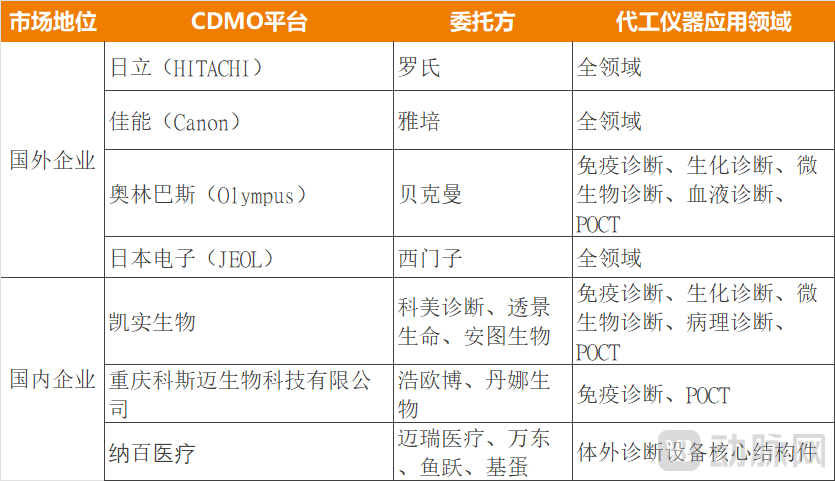
Major CDMO Companies in the Global IVD Sector
In the investment logic for drug CDMOs, pharmaceutical companies have varying demands for CDMO capabilities across different R&D stages. During the R&D phase, emphasis is placed on rapid response capabilities and small-scale production capacity, whereas in the manufacturing phase, priority is given to process optimization capabilities and a robust quality management system.
Among the many medical device CDMO companies, why have some secured financing exceeding RMB 100 million? What core competencies do investment firms prioritize when investing in medical device CDMOs?
In the interview, VCBeat found that end-to-end service capabilities spanning R&D to production, the number of key accounts, and intellectual property protection have become the focal points of attention for industry insiders.
First is the service capability spanning from R&D to production. Unlike contract manufacturers, CDMO companies must possess extensive experience in product research and development, engineering technology development, and manufacturing.
An industry insider stated, “CDMO stands for Contract Development and Manufacturing Organization; both development and manufacturing must be executed effectively.”
Huang Yiling, Managing Director at CPE Capital, also stated, “The market for medical device CXO services is relatively small. If companies aim to achieve significant scale, they must engage in clients’ R&D processes from the conceptualization stage. This approach enables them to reach a broader customer base, drive downstream production volume, and identify among multiple front-end R&D designs those products with the greatest potential for large-scale industrialization.”
The second core competitive advantage is the accumulated customer base, particularly whether the company has stable key accounts.In the medical device CDMO sector, customer quality is prioritized over customer quantity. CDMOs with sustained orders from major brands typically enjoy consistent and ample order volumes. Conversely, if a CDMO’s downstream business relies on a large number of small clients, it not only results in smaller order sizes but also leads to a wide variety of products. Given that component parts are inherently non-standard, this increases the workload for mold development, as well as the frequency of production line debugging and product changeovers, thereby raising operational costs.
Huang Yiling stated, “In terms of mass production capabilities, we place particular emphasis on quality for key clients. On one hand, securing major overseas customers validates that the company meets both domestic and international production standards and has established a comprehensive quality management system. On the other hand, having stable, large-scale overseas clients significantly enhances the potential for future commercial expansion.”
Among the currently listed medical device CDMO companies, most have stable major clients. For Meihao Medical, a CDMO specializing in ventilators and cochlear implants, sales revenue from “Customer A” amounted to RMB 758 million in 2021, accounting for 66.66% of the company’s total operating revenue. “Customer A” is highly likely to be ResMed, a global leader in market share within the ventilator sector. In 2021, Stryker, the largest customer of Haitai XinGuang, accounted for 56.99% of its annual total sales. From 2019 to 2020, Kaishi Bio’s largest customer was Kemeng Diagnostics, with sales to this customer representing 38.66% and 25.12% of its total sales, respectively.
Huang Yiling added, “At the same time, we will evaluate the company’s product selection. If the end-product market is already a ‘red ocean’ with intense competition and low profit margins, the value that CDMOs can capture across the entire industry chain will be limited.”We will also focus on the value contribution of CDMO enterprises within the industrial chain. While there are abundant opportunities in the CDMO sector, certain products in the medical device industry involve complex manufacturing processes, prolonged R&D cycles, and stringent process requirements for mass production. Enterprises with these characteristics tend to wield greater bargaining power within the industrial chain.
Taking Hechuan Medical as an example, IVD represents a promising segment within the CDMO sector. Hechuan Medical’s core business focuses on the development of microfluidic processes. In the fields of POCT and microfluidics, the decentralization trend in the IVD market has become particularly pronounced due to the impact of the pandemic, accelerating growth in the POCT market. The domestic POCT market lags behind overseas markets and is currently still in its nascent stage. Therefore, we believe that CDMOs in the microfluidics sector hold significant development potential.
Third is intellectual property protection capabilityWithin China’s medical device ecosystem, companies tend to vertically integrate their supply chains to retain control over core technologies and component manufacturing capabilities. Even for those opting for Contract Development and Manufacturing Organization (CDMO) services, intellectual property (IP) protection remains a critical factor in vendor selection. Consequently, how CDMOs leverage their IP protection capabilities to build client trust poses a significant challenge. Standardizing and streamlining IP protection systems within the third-party R&D and manufacturing sector would enable faster conversion of potential clients into stable order sources. To address client concerns regarding IP rights, Dongmai Medical, a domestic medical device CDMO, has announced its service principle of “never holding regulatory registration certificates.” As a contracted manufacturer, Dongmai Medical has successfully facilitated the approval of medical device registration certificates for clients’ products, which were supported by self-inspection reports issued through its own testing and validation center.
In recent years, driven by policy support, the medical device CDMO sector has heated up, attracting numerous companies. However, an industry veteran offered a sober perspective: CDMO is not an easy field, nor is it one capable of achieving rapid growth in a short period. Medical device CDMOs typically handle high-mix, low-volume, and high-specification products. Therefore, the greatest challenge lies in execution—addressing the critical pain points of implementation and ensuring true delivery is the key priority.
References:
Outsourcing R&D and Manufacturing of In Vitro Diagnostic Instruments: Can China Produce Its Own “Hitachi”? — Li Xiaobai’s Struggle in the Medical Device Industry
[Exclusive Interview] The Growth Path of China’s First CDMO Platform Company for Interventional Medical Devices—An Exclusive Interview with Liu Chunjie, Chairman of Haofeng Medical—Lingang Lanwan
Quaero Life Science IPO Prospectus
Shenzhen Meihao Chuangyi Medical IPO Prospectus