

Aligos Therapeutics Refocuses on NASH and COVID-19 Pipelines Amid Strategic Restructuring and Merck Collaboration
Aligos Therapeutics
Oligonucleotide and Small Molecule Drug Developer
Aligos Therapeutics, Inc. (Nasdaq: ALGS) announced a reprioritization of its pipeline assets and a workforce reduction of approximately 10% more than ten days ago. Following the restructuring, the company’s primary focus is to rapidly advance its clinical programs for NASH (ALG-055009, a THR-β agonist) and COVID-19 (ALG-097558, a 3CLpro inhibitor), while maintaining its ongoing collaboration with Merck & Co. on NASH oligonucleotide research.
Founded in 2018, Aligos focuses on developing targeted antiviral therapies for chronic hepatitis B (CHB) and coronaviruses, leveraging its expertise in liver diseases to develop targeted therapies for non-alcoholic steatohepatitis (NASH). However, consecutive setbacks in the development of novel hepatitis B drugs have cast a shadow over the company’s prospects. Nevertheless, Aligos has still garnered favor from multinational corporations (MNCs) by virtue of its oligonucleotide platform technology.
However, with its stock price plummeting due to the clinical failure of its hepatitis B program, Aligos now has only about $140 million left on its balance sheet. Will 2023 bring a turnaround for the company? Can it achieve new progress in the NASH field in the near future?
Starting Anew from Johnson & Johnson: Five Years of Dramatic Ups and Downs
The Aligos team has over two decades of collaborative experience.In 2002, Lawrence Blatt joined InterMune. Later, his team followed him to co-found Alios BioPharma. After Alios was acquired in 2014, Blatt and his team joined Johnson & Johnson. In 2018, Blatt led the establishment of Aligos Therapeutics, an innovative pharmaceutical company focused on hepatitis B therapies.
The team’s long-standing reputation and network in the industry secured Aligos Therapeutics its first round of financing and several collaborative projects.
Aligos Therapeutics had previously delivered multi-fold returns to venture capital firms such as Novo Holdings and the Roche Venture Fund. Consequently, when Aligos was founded, Novo Holdings, Roche, along with previously undisclosed healthcare funds Versant Ventures and Vivo Capital, were all willing to reinvest. In early 2018, Aligos secured $100 million in its Series A financing round.
Subsequently, they successfully secured technology licenses from Luxna, a company controlled by Osaka University in Japan. This technology enabled the Aligos team to obtain genomic data for certain families of respiratory viruses, including coronaviruses such as SARS-CoV-2, the virus responsible for the 2019 COVID-19 pandemic.
Blatt believes that Aligos’ team of more than 40 people is as efficient as a 200-person team at other companies.Aligos has achieved rapid growth, driven by a cohesive team and extensive industry experience, reaching the level that Alios had attained four years earlier within just 18 months. Aligos went public in October 2020.
To date, Aligos has completed $100 million in Series A financing, $125 million in Series B financing, and $150 million through its IPO. At this stage, Aligos’s core asset is its hepatitis B combination therapy, although it also has other liver disease products targeting conditions such as NASH and HCC.
Aligos employs a cocktail therapy strategy to control hepatitis B, a common approach in the antiviral field where combination therapies are used to manage hepatitis B, hepatitis C, and HIV. Aligos’s first drug to enter clinical trials, ALG-010133, is an oligonucleotide polymer that inhibits the transport of the viral S antigen (STOP). This drug is an analog of REP2165, a nucleic acid polymer (NAP) developed by the Canadian company Replicor.
However, Aligos subsequently encountered numerous challenges in the development of its hepatitis B drugs. On January 6, 2022,Aligos Announces Termination of Clinical Development of Its Lead Product, the Hepatitis B Surface Antigen (HBsAg)-Lowering Nucleic Acid Drug ALG-010133ALG-010133 demonstrated suboptimal efficacy in Phase I clinical trials. Although Aligos claims to have several other drug candidates, such as ASO, siRNA, CAM I, CAM-2, and a PD-L1 inhibitor, ALG-010133 is its flagship product. The day after the announcement of this unfavorable news, Aligos’ stock price plummeted by nearly 70%.
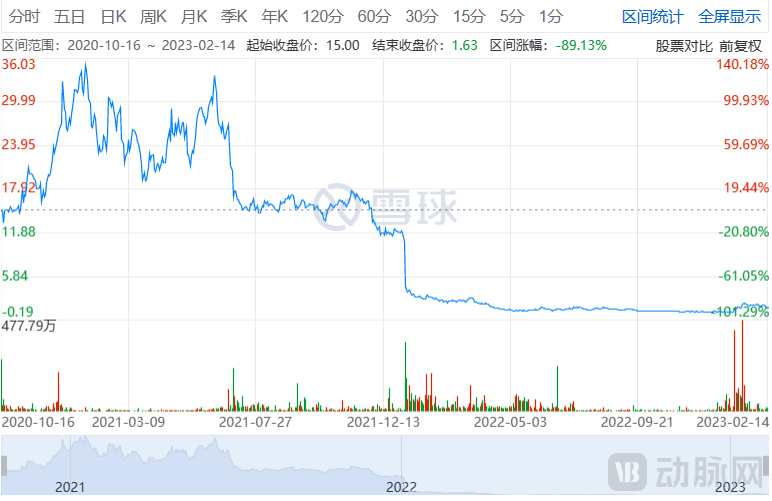
Aligos Therapeutics Stock Price Volatility (Image Source: Xueqiu)
Following that, Aligos Therapeutics attempted to adjust its product pipeline and corporate structure. In February of this year, Aligos Therapeutics announced a restructuring of its pipeline, prioritizing the advancement of its NASH (ALG-055009, a THR-β agonist) and COVID-19 (ALG-097558, a 3CLpro inhibitor) programs.
Aligos Pivots from Hepatitis B to NASH, MNCs Bullish on Oligonucleotide Therapies
Although its hepatitis B program suffered a setback, Aligos Therapeutics’ oligonucleotide technology for chronic liver disease therapies remains worthy of attention.
They have also developed new perspectives on drug development and corporate operations. Aligos is dedicated to discovering and developing novel molecules that interact with disease-causing agents, such as virus-encoded proteins and nucleic acids, as well as oncogenes and their expressed proteins. “One lesson from our virology research is that many diseases require combination therapy,” said Dr. Blatt. He found that long-term monotherapy often leads to drug resistance and struggles to address complex diseases. This insight has shaped Aligos’ subsequent R&D projects and underscores the company’s need for greater external collaboration and support.
Aligos Therapeutics has proposed an siRNA + ASO therapy, as previously described in the context of developing innovative oligonucleotide-based treatments for chronic hepatitis B and C. Multi-oligonucleotide regimens have been proposed as potential components for achieving a functional cure for chronic hepatitis B. In preclinical animal studies, the in vitro combination of ALG-125755 and unconjugated ALG-020572 demonstrated synergistic effects without cytotoxicity.
Although Aligos Therapeutics has discontinued the development of its antisense oligonucleotide ALG-020572 and its hepatitis B surface antigen (HBsAg) transport inhibitor oligonucleotide polymer ALG-010133, the company continues to research and advance other hepatitis B drug candidates targeting similar mechanisms. Drawing on lessons learned from past experiences, Aligos Therapeutics believes that improved preclinical models are needed to reliably predict the safety of newly developed antisense oligonucleotides and the efficacy of newly developed HBsAg transport inhibitor oligonucleotide polymers.
Oligonucleotide strategies are being validated step by step. Multinational corporations (MNCs) value new oligonucleotide therapies, viewing their collaboration with Aligos Therapeutics as an alternative approach to portfolio investment.
In the month when the termination of the hepatitis B project ALG-010133 was announced (January 2022),Aligos Announces Continued Expansion of Ongoing Collaboration Agreement with MerckUnder the initial agreement, Merck applied Aligos’ oligonucleotide platform technology to discover, research, optimize, and develop an undisclosed NASH program. The expanded agreement indicates that Aligos will receive payments from Merck for a second undisclosed NASH program; additionally, Aligos will receive further payments upon achievement of the third designated collaborative target. For programs under the collaboration, Aligos is eligible to receive up to approximately $460 million in development and commercialization milestones, as well as tiered royalties on net sales.
As early as 2020, when Aligos Therapeutics went public, it officially announced a collaboration with Merck on its NASH pipeline. Under the agreement, Merck will leverage Aligos’ oligonucleotide platform technology to develop oligonucleotide drugs targeting NASH. Although the upfront payment amount was not disclosed, Aligos is eligible to receive up to $458 million in development and commercialization milestones upon achievement of specified second-tier collaboration targets, as well as tiered royalties on net sales.
Will 2023 See a Turning Point After Pipeline Restructuring?
Aligos, which went public on the Nasdaq at a valuation of $548 million, now has a market capitalization of only $70 million following the termination of its hepatitis B program. Since early January 2022, Aligos Therapeutics has laid off approximately 25% of its workforce.
However, there is no shortage of positive news, such as the continued collaboration with Merck on ongoing NASH oligonucleotide research, and the promising data demonstrated by NASH drugs in clinical trials.Aligos Therapeutics’ NASH drug candidate, ALG-055009, is a small-molecule THR-β agonist. In a report released on its official website this February, Aligos Therapeutics presented a series of clinical data, stating that ALG-055009 demonstrated favorable efficacy and safety profiles in Phase I clinical trials, with potency more than 50 times greater than that of Madrigal Pharmaceuticals’ resmetirom. The Phase II clinical trial for this drug candidate is currently under preparation.
Beyond this core drug pipeline, leveraging its expertise in hepatology and virology, the Aligos team has also developed ALG-097558, a coronavirus protease inhibitor targeting COVID-19, as well as several therapies for chronic hepatitis B (CHB). Currently, the COVID-19 drug is poised to enter Phase I clinical trials, while the two CHB programs are already in Phase I. Both the NASH and COVID-19 drug programs are scheduled to advance to Phase II clinical trials in 2023.
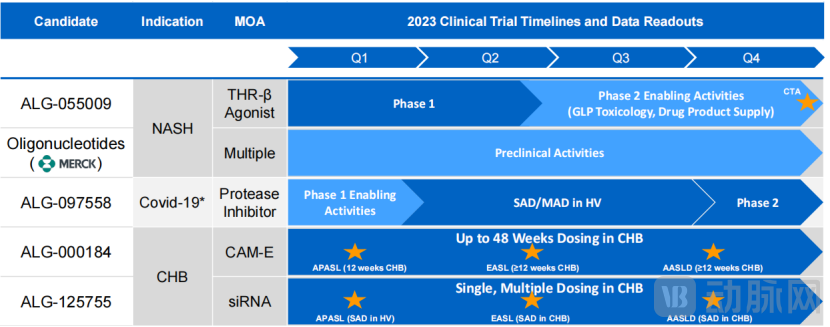
2023 Pipeline Planned Progress (Image Source: Aligos Therapeutics Official Website)
As of September 30, 2022, Aligos Therapeutics, Inc. had a cash balance of $142.3 million. Due to pipeline adjustments and reductions in personnel costs, the company expects its current cash reserves to last through the end of 2024. Dr. Blatt publicly stated that the financial results for the first quarter of 2023 are expected to be announced in mid-March 2023.
Aligos is focusing on advancing its NASH and COVID-19 pipelines, while continuing to seek additional collaborations with multinational corporations (MNCs) through innovative therapies. Whether it can successfully navigate its current funding challenges remains highly uncertain.