

30 Hospitals, 12 Directions: National Demonstration Program Poised to Elevate Clinical Nutrition Departments
(Authors: Zhou Mengya, Shen Yuting, Shi Yi)
On February 20, the Hospital Management Institute of the National Health Commission released the first list of demonstration units for the construction of clinical nutrition departments.
This list can be traced back toJune 2022In order to implement the "Guidelines for the Construction and Management of Clinical Nutrition Departments (Trial)", the Hospital Management Institute of the National Health Commission organized pilot work on the construction of clinical nutrition departments and selected a batch of pilot units. On February 3, 2023, the Hospital Management Institute of the National Health Commission once again released171 companiesThe institution has been added as a pilot unit for the development of clinical nutrition departments. To date, the Hospital Management Research Institute has announced a total of378 companies。
This appears to be the first time that clinical nutrition departments have received such high-level attention since the Department of Medical Administration of the Ministry of Health proposed launching pilot programs for the establishment of clinical nutrition departments in 2009.
The Department of Clinical Nutrition is a clinical department that conducts nutritional diagnosis through nutritional screening and assessment, and provides nutritional therapy using various enteral nutrition formulations, parenteral nutrition formulations, therapeutic diets, functional foods, foods for special dietary uses, and foods for special medical purposes. However, in practice,Over the past few decades, the Department of Clinical Nutrition has remained a relatively marginalized specialty.“Our department used to be located next to the morgue,” and “After five years of medical training, doctors were assigned to cook in the cafeteria.” These darkly humorous quips once reflected the reality of nutrition departments in some hospitals.
“Is it necessary to have a Department of Clinical Nutrition?” and “How should a Department of Clinical Nutrition be established?” are perhaps the most frequently discussed topics within the department. The recent announcement of pilot and demonstration units may be officially sending two signals:First, the necessity of establishing a Department of Clinical Nutrition; second, from the perspective of pilot initiatives, the potential directions for developing clinical nutrition departments seem to be emerging.
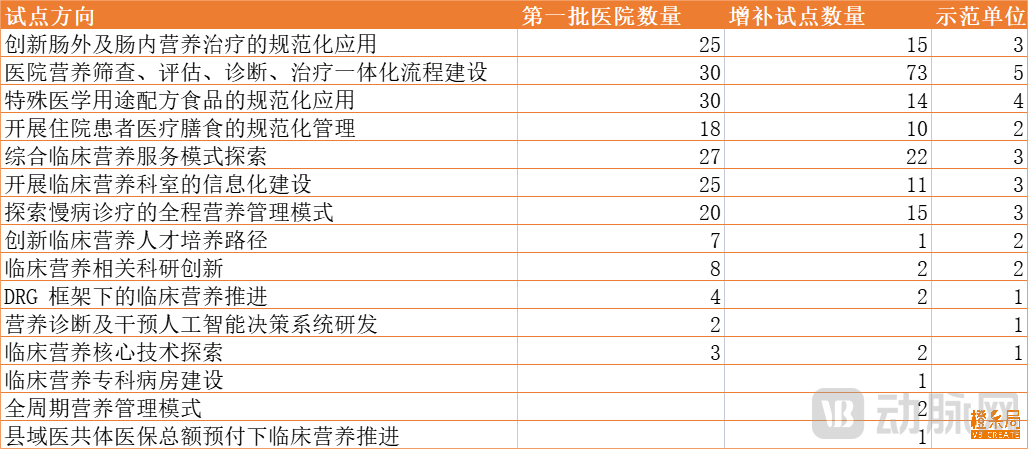 Pilot Areas and Number of Demonstration Units
Combining the first and second supplementary lists, the Hospital Management Institute of the National Health Commission has cumulatively announced370Hospital Pilot List, Covering15 Directions. Ultimately, a total of these hospitals had30 companiesRecognized as a demonstration unit, covering12 DirectionsTo some extent, these pilot initiatives also represent key areas for exploration and innovation in the development of clinical nutrition departments.
For example,“Advancing Clinical Nutrition Under the DRG Framework”DRG/DIP payment implements bundled payments based on historical cost calculations and equal pricing for the same conditions, shifting the health insurance payment logic to a model where hospitals earn “work points” to share the “cake.” Theoretically, this payment reform compels hospitals to transform their development models, genuinely focus on and control their own costs, and reduce inappropriate medical care and waste. Meanwhile, DRG reform creates opportunities for collaborative work, facilitating greater involvement of the Nutrition Department in clinical diagnosis and treatment. As the reform of health insurance payment methods advances, the Clinical Nutrition Department is ushering in new opportunities.
For example,“Standardized Application of Innovative Parenteral and Enteral Nutrition Therapy”. Due to the absence of a standardized and compliant solution, some enteral preparations with food-grade approval can only be used on a self-pay basis, creating challenges for billing by the Department of Clinical Nutrition. Consequently, in certain hospitals, this responsibility has even been assigned to the cafeteria.
For instance, the standardized application of foods for special medical purposes (FSMP), the standardized management of medical diets for hospitalized patients, talent development, and scientific research innovation all appear to be attempts to explore the future prospects of clinical nutrition departments from various perspectives, including management, standardization, service models, talent cultivation, core technologies, and research innovation.
Guidelines for Construction and Management Released, with Policies Leading the Way
Not only that, but policy measures had already been implemented three months before the release of the first batch of pilot lists. In March 2022, the National Health Commission issued the “Guidelines for the Construction and Management of Clinical Nutrition Departments (Trial)” (hereinafter referred to as the “Guidelines”). The “Guidelines” set forth clear requirements for the establishment and management of clinical nutrition departments, covering aspects such as departmental setup, scope of functional responsibilities, and standardized procedures for nutritional screening and assessment.
As a concrete policy implementing the "Healthy China Action (2019–2030)" and the "National Nutrition Plan," the release of these guidelines sends a clear signal: nutritional screening, assessment, and guidance for patients requiring standardized and enhanced medical services must be strengthened. Clinical nutrition departments should be established to leverage the role of specialized nutrition teams. Patients should also attach importance to their own nutritional status, elevate nutritional support to a critical component of treatment, and cooperate with hospital-based nutritional assessments and therapies, thereby working together to achieve better therapeutic outcomes.
1. Strengthen Construction
“Where is the hospital’s Department of Nutrition?” This is perhaps a question rarely raised or noticed in hospitals. Compared with other critical care or popular departments, the Department of Nutrition has a very low profile in most hospitals. Despite years of efforts and public education, nutritional concepts have gained wider acceptance and recognition; however, the development of clinical nutrition departments falls far short of expectations. Some physicians working in these departments even believe that their existence is meaningless.
The release of the “Guidelines for the Construction and Management of Clinical Nutrition Departments (Trial)” undoubtedlyPolicy-level support has provided a significant boost to clinical nutrition departments.
“The Guidelines” encourage other qualified medical institutions to establish, construct, and manage clinical nutrition departments in accordance with relevant regulations, while also clarifying that the clinical nutrition department may operate as an independent unit to provide clinical nutrition diagnosis and treatment services within the medical institution. Qualified medical institutions may set up inpatient wards for clinical nutrition departments to deliver clinical nutrition diagnosis and treatment services to hospitalized patients.
2. Clear Responsibilities
Next is the clarification of responsibilities. Moreover, in terms of specific functions, the Department of Clinical Nutrition has also transitioned fromSimple Nutritional Support and Adjuvant TherapyEvolve intoClinical Treatment。
Theoretically, nutrition is closely related to all diseases. By studying the relationship between nutrition and disease, clinical nutrition departments can reduce complications, lower mortality rates, shorten hospital stays, and save treatment costs through reasonable nutritional support. However, in reality, the involvement of clinical nutrition departments in the diagnosis and treatment process of most patients is very low. Typically, clinical nutrition departments play a supportive role in the disease diagnosis and treatment process. The lack of exclusive patients and independent diagnostic and therapeutic content for this discipline has also significantly hindered the development of clinical nutrition departments.
“The Guidelines” propose participating in consultations for patients undergoing specialized, complex, critical, or major surgical procedures, or joining multidisciplinary team (MDT) groups, based on clinical needs. Furthermore, the “Guidelines” clearly stipulate that general hospitals at Level II and above, as well as specialized hospitals in oncology, pediatrics, and psychiatry, shall establish clinical nutrition departments and conduct their construction and management in accordance with relevant regulations.
At this level, it is an affirmation of the status and value of the Department of Clinical Nutrition.
3. Standardization is a Prerequisite for Development
Healthcare is a field that places significant emphasis on standardization. Therefore, for the long-term and healthy development of clinical nutrition departments, standardized management and technical practices are of paramount importance.
First,Personnel Management Standards. In addition to ensuring the hierarchy of professionals and clarifying division of labor, the “Guidelines” also specify the roles of specialist physicians and nutrition technicians.
Secondly,Standardization of the Diagnosis and Treatment Process. Variations in nutritional interventions received by patients may exist across different hospitals and departments; therefore, standardizing quality control of key nutritional technologies, as well as diagnostic and treatment standards and overall medical quality, is a prerequisite for the optimization and development of clinical nutrition.
Finally,Standard Operating Procedures for Nutritional Screening and Assessment“The Guidelines” stipulate that the clinical nutrition departments of medical institutions shall conduct nutritional screening and assessment in a standardized manner in accordance with relevant regulations, specifically covering industry standards, professional practice norms, operational workflows, screening indicators, and medical record management used for such screening and assessment.
Strengthening infrastructure, clarifying functions, and standardizing the management of down-regulation protocols—these previously ambiguous boundaries have been explicitly defined and emphasized. This undoubtedly represents the construction and formation of the superstructure for the innovative development of clinical nutrition departments. But has the springtime for clinical nutrition departments truly arrived?
Clinical Nutrition Still Craves More Substantive Policies
After the list was released,Deng Yuhong, Director of the Department of Clinical Nutrition, The Second Affiliated Hospital of Guangzhou Medical UniversityWe soon received congratulations from our colleagues in the Department of Clinical Nutrition. From being initially designated as a pilot unit to now becoming a demonstration unit, Director Deng has clearly perceived that the hospital’s stance toward the development of the Department of Clinical Nutrition has shifted from indifference to active support. The elevated status of the Department of Clinical Nutrition not only reflects an enhancement in the hospital’s professional standards but also provides the hospital administration with a clear vision for the department’s future development—The Department of Clinical Nutrition is not a dispensable “marginal department,” but a clinical department with certain therapeutic capabilities.
Furthermore, at the national level, Director Deng believes that the selection of demonstration units has sent a signal, namelyThe State's Emphasis on the Development of Nutrition Science and Clinical Practice.Director Deng stated in an interview with VCBeat’s “Chengguo Bureau”: “In recent years, reducing healthcare costs has been the top livelihood concern for the state. In addition to improving medical processes and optimizing medical service pricing, enhancing the overall health level of the population is the most effective approach. Whether in prevention or treatment, the Department of Nutrition plays a critical role.”
Although the selection policy has provided us with “directional indicators,” clinical nutrition still yearns for more substantive policy implementation.
Yuan Binwen, General Manager of Dongze Special Medical Purpose FoodIn an interview with VCBeat, it was stated that enterprises currently show relatively low enthusiasm for participating in the development of clinical nutrition departments. On one hand, the primary impact of this policy is to elevate the status of clinical nutrition departments within hospitals. The pilot and demonstration units are all based on the actual conditions of clinical nutrition departments in various hospitals, exploring different development models at the academic level, whileAs profit-driven entities, enterprises are more inclined to focus on the specific projects and formats of various models.
On the other hand,Most FSMP companies struggle to effectively co-develop clinical nutrition departments.This is because the lack of standardized regulations for foods for special medical purposes (FSMP) has led to significant issues in hospital tendering, pricing, and prescription models, preventing companies from establishing a virtuous cycle of return on investment. Struggling to sustain their own R&D, sales, and operations, these enterprises lack the surplus capital and capacity to support the advancement of clinical nutrition departments.
Deng Yuhong, Director of the Department of Clinical Nutrition at the Second Affiliated Hospital of Guangzhou Medical University—the only institution approved as a demonstration site for the “Exploration of Core Technologies in Clinical Nutrition”—stated, “The Department of Clinical Nutrition must increase its investment in the exploration of core technologies. Only by possessing the tangible capability to address clinical challenges and enabling patients to perceive the benefits of nutritional therapy can the department justify its existence and establish a solid foundation for sustainable development.” She also called on manufacturers of foods for special medical purposes (FSMP) to prioritize the research and development of new products and technologies, while urging the state to innovate regulatory and approval frameworks for nutrition-related products (such as FSMP) at the policy level, thereby providing the Department of Clinical Nutrition with more safe and effective products.
Enhancing capabilities stems from replenishing talent; prioritizing the development of nutrition science and improving the employment environment for nutrition professionals may be the key to fundamentally raising China’s professional standards in nutrition. Furthermore, many diagnostic and therapeutic techniques and products offered by nutrition departments are currently not covered by medical insurance, and their effects manifest slowly. This results in low patient willingness to pay out-of-pocket, leading to financial deficits in nutrition departments and limiting their capacity to invest in further development.
In summary, while introducing policies to elevate the status of clinical nutrition departments marks our first step, addressing deeper-rooted issues requires the engagement of all stakeholders to remove systemic bottlenecks, allowing us to patiently await positive outcomes.