

Second NDA Submission Brings Obeticholic Acid One Step Closer to Becoming First Approved Therapy for NASH

Intercept Pharmaceuticals
Biopharmaceutical Manufacturer
In January 2023, the U.S. FDA accepted Intercept Pharmaceuticals’ New Drug Application (NDA) for obeticholic acid (Ocaliva, OCA) for the treatment of NASH-related liver fibrosis, bringing a milestone breakthrough in the NASH therapeutic field within close reach.
For Intercept and obeticholic acid, which have weathered many twists and turns, this also marks a significant milestone—Obeticholic acid is poised to become the first new drug approved globally for the treatment of NASH, and once approved, it will gain a first-mover advantage in this multi-billion-dollar market.
In the treatment of NASH, Intercept is currently the only company that has submitted a New Drug Application (NDA) to the FDA, making it a bellwether for the NASH sector. Whether its application is approved or not has drawn intense focus from the industry. Although Intercept is closest to succeeding in launching a new NASH drug, its R&D journey has been far from smooth, reflecting and underscoring many of the challenges inherent in new drug development within the NASH field.

Endorsed by Executives from Multiple Renowned Pharmaceutical Companies, AchievementsFXRRepresentative Agonists
Intercept was founded in 2002 and is dedicated to the research, development, and commercialization of novel therapies for chronic liver diseases. Dr. Mark Pruzanski, the company’s founder, established Intercept in a small New York apartment, building upon his own research achievements in bile acids and the FXR receptor. He has since grown it into a publicly traded biopharmaceutical company with more than 300 employees. Prior to its initial public offering (IPO) in 2012, Intercept completed eight rounds of financing totaling $567.1 million. Excluding debt financing and post-IPO funding, Intercept secured Series A and Series B rounds led by Genextra, as well as a Series C round led by OrbiMed.
Centered on Dr. Pruzanski’s research, Intercept’s strategy for developing new NASH therapeutics focuses on targeting bile acids and the FXR receptor.Bile acids play a crucial role in lipid metabolism and are primarily present in the liver and intestine. FXR is a nuclear receptor expressed in the liver and intestine, serving as a key regulator of bile acid, inflammation, fibrosis, and glucose and lipid metabolic pathways. Among these functions, the regulation of bile acids is considered the most important physiological function of the FXR receptor.
Current scientific research indicates that excessively high levels of bile acids in the liver can lead to injury and inflammation, which may progress to hepatic fibrosis and cirrhosis. When bile acids bind to the farnesoid X receptor (FXR), FXR is activated, thereby reducing hepatic lipogenesis and enhancing the clearance of low-density lipoprotein (LDL) in peripheral tissues. Consequently, FXR is regarded as a key therapeutic target for the treatment of non-alcoholic steatohepatitis (NASH).
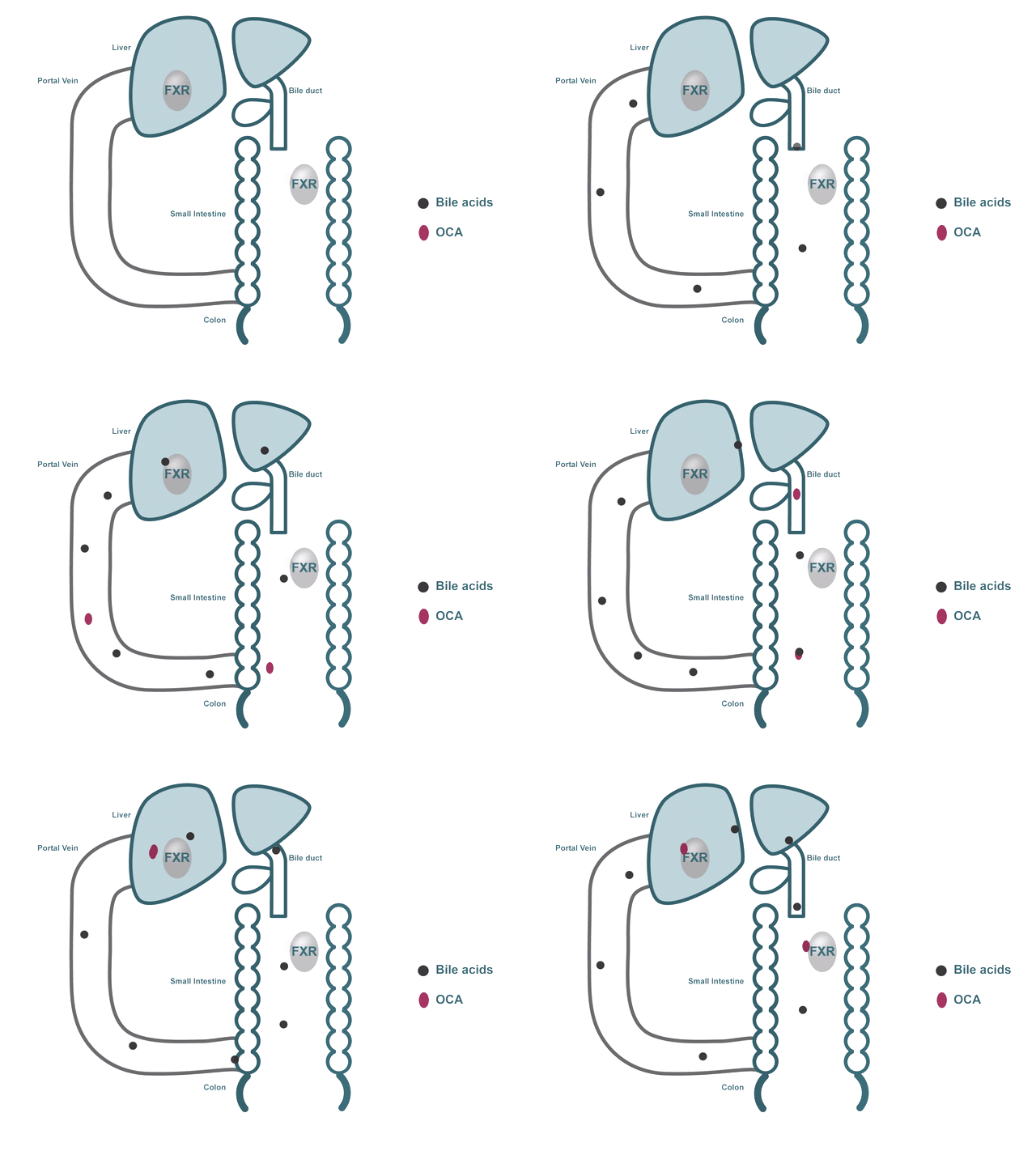
Mechanism of Action Between Bile Acids and the FXR Receptor, Image Source: Intercept Official Website
Based on these scientific theories,Intercept has been dedicated to the development of FXR agonists, and its core product, obeticholic acid, emerged from this R&D journey, becoming a representative FXR agonist globally.Currently, obeticholic acid continues to lead the development of FXR agonists. In China, Chia Tai Tianqing and Zelixir Biopharmaceuticals are developing generic versions of obeticholic acid, while Ascletis Pharma and TopAlliance Biosciences are pursuing innovative FXR agonist therapies. Abroad, major pharmaceutical companies such as Novartis, Eli Lilly, and Gilead Sciences continue to advance their R&D pipelines for FXR agonists.
Obeticholic acid’s significant impact in the NASH field is inextricably linked to Intercept Pharmaceuticals’ core team.
After founder Mark Pruzanski stepped down as CEO of Intercept Pharmaceuticals in 2021, he was succeeded by Jerome Durso. With over 25 years of experience in business operations, Durso spent the majority of his career at the multinational pharmaceutical company Sanofi before joining Intercept in 2017. He held various leadership positions at Sanofi, including Senior Vice President and Chief Commercial Officer of Sanofi US, Chief Commercial Officer of Sanofi’s Global Diabetes Division, and Senior Executive Vice President of Sanofi Global. This background has equipped Durso not only with extensive expertise in business operations and marketing but also with in-depth knowledge of metabolic diseases.
Jerome Durso, President and CEO of Intercept. Image source: Intercept official website
Dr. M. Michelle Berrey, Chief Medical Officer of Intercept, possesses profound expertise in the field of liver disease. She previously served as Vice President of Viral Infections, Clinical Pharmacology, and Drug Discovery at GSK, a multinational pharmaceutical company, where she oversaw early-stage research and development for drugs targeting hepatitis viruses, liver fibrosis, and HIV. After leaving GSK, she joined Pharmasset as Chief Medical Officer, playing a pivotal role in the development of the hepatitis C drug Sovaldi. During her tenure, Pharmasset was acquired by Gilead in 2011, and Sovaldi was launched in 2013, achieving first-year sales exceeding $10 billion and becoming a blockbuster therapy for hepatitis C. Dr. Berrey’s appointment will not only significantly bolster the R&D of Intercept’s current pipeline but also lay the foundation for its future portfolio strategy.

M. Michelle Berrey, Intercept CMO. Image source: Intercept official website
In addition to drug R&D and commercial operations, late-stage process development is also of significant importance. Chief Quality Officer Kathleen Munster previously held key quality and supply chain roles at prominent multinational corporations (MNCs) such as Merck and Bristol Myers Squibb (BMS). She later joined Catalent, a leading CDMO, as Vice President, overseeing quality assurance for biologics, cell, and gene therapies. This experience enables her to provide robust support to Intercept Pharmaceuticals in areas including biologics manufacturing, drug production, and product quality control.

Kathleen Munster, Intercept CQO. Image source: Intercept official website
Obeticholic Acid TherapyPBCSuccessfully Listed,NASHBecoming a New Challenge
Currently, Intercept has one successfully marketed product, obeticholic acid, and three pipelines in development. However, the company’s overall R&D focus remains centered on advancing the clinical development of obeticholic acid for the treatment of NASH.
2016 was a historic milestone for Intercept. In that year,U.S. FDA Grants Accelerated Approval to Obeticholic Acid for the Treatment of Patients with Primary Biliary Cholangitis (PBC), Marking a Milestone Victory in Liver Disease Therapy, which also bolstered confidence in Intercept’s expansion into the NASH field.
Primary Biliary Cholangitis (PBC) is a rare liver disease caused by an autoimmune response, leading to intrahepatic cholestasis and subsequent liver damage. Its progressive nature means that the damage worsens over time. Without timely treatment, the liver undergoes a pathological progression from inflammation to fibrosis, then to cirrhosis, ultimately resulting in liver failure.
This pathological process bears some resemblance to NASH. The successful market approval of obeticholic acid for the treatment of PBC has provided valuable insights for NASH therapy; however, the more complex pathogenesis of NASH has resulted in greater challenges for obeticholic acid throughout drug development, clinical trials, and regulatory approval processes.
The following are key milestones in the development history of obeticholic acid:
In March 2011, the FLINT clinical trial, sponsored by the U.S. National Institute of Diabetes and Digestive and Kidney Diseases (NIDDK), was announced to commence, aiming to investigate the efficacy of obeticholic acid in the treatment of NASH.
January 2015,FDA Grants Intercept’s Obeticholic Acid Breakthrough Therapy Designation for NASH-related Liver Fibrosis, obeticholic acid became the only new NASH drug to receive this designation for a long period of time.
In December 2015, Intercept announced the initiation of a prospective clinical trial evaluating the combination of obeticholic acid and statins for the treatment of NASH, aimed at assessing its efficacy in improving lipid metabolism in patients with NASH.
September 2019,Intercept Submits NDA to the U.S. FDA for Obeticholic Acid in the Treatment of NASH-related Liver FibrosisThe application is based on the positive interim analysis results from the pivotal Phase III REGENERATE clinical trial. The study demonstrated that obeticholic acid at a 25 mg dose achieved the primary endpoint, showing robust improvement in liver fibrosis without worsening after 18 months.
In November 2019, the U.S. FDA accepted Intercept’s NDA application and granted it priority review.
June 2020,Obeticholic Acid Denied FDA Accelerated Approval for NASH-Related Liver Fibrosis Due to Uncertain Benefits from Interim Histological Endpoint Data, the FDA recommended that Intercept submit additional interim efficacy and safety data from the REGENERATE Phase III clinical study.
In December 2021, Intercept formally notified the European Medicines Agency (EMA) of the withdrawal of its Marketing Authorization Application (MAA) for obeticholic acid in the treatment of NASH-related liver fibrosis. This decision was made because the Committee for Medicinal Products for Human Use (CHMP), based on the data submitted by Intercept, could not determine a positive benefit-risk balance for obeticholic acid in the treatment of NASH, indicating that additional statistical data remained to be submitted.
In September 2022, Intercept announced that the REVERSE Phase 3 clinical trial, which evaluated the safety and efficacy of obeticholic acid in patients with compensated cirrhosis caused by NASH, failed to meet its primary endpoint. Although histological improvement in liver fibrosis was observed and disease progression was halted after up to 18 months of treatment, no new safety signals for obeticholic acid were identified in these patients with cirrhosis.
In November 2022, Intercept presented the latest data from the Phase III REGENERATE trial on obeticholic acid for the treatment of NASH-related liver fibrosis at the AASLD Liver Meeting. The results were positive: the response rate for reduction in liver fibrosis with obeticholic acid 25 mg was twice that of placebo, without worsening of NASH symptoms. Obeticholic acid 25 mg demonstrated more robust anti-fibrotic efficacy in patients with advanced fibrosis but without cirrhosis. Regarding safety, Intercept conducted a robust safety assessment in 2,777 patients, including 1,000 patients who received the drug for up to four years, supporting the safety profile and potential for long-term use of obeticholic acid.
December 2022,Intercept Resubmits NDA for Obeticholic Acid in the Treatment of NASH-related Liver Fibrosis to the FDA, based on the two positive interim analysis datasets from the pivotal Phase III REGENERATE clinical trial, which were recently released in November.
January 2023,FDA Reaccepts NDA for Obeticholic Acid in the Treatment of NASH-related Liver Fibrosis, Intercept stated that positive data from two cohorts in the Phase III REGENERATE clinical trial showed that none of the three histological components used to assess the clinical manifestations of NASH worsened after patients received a 25 mg dose of obeticholic acid. This endpoint is consistent with the FDA’s draft guidance, and the treatment demonstrated a favorable safety profile.
From a timeline perspective, Intercept’s research on obeticholic acid for the treatment of NASH has spanned more than a decade. Regardless of the successes or setbacks encountered along the way, this journey offers valuable lessons for the entire NASH field.
On one hand, Intercept’s decision to resubmit its New Drug Application (NDA) to the FDA represents a second attempt in the NASH arena, serving as a validation of the therapeutic potential of FXR-targeted therapies.;
On the other hand,Although the continuous setbacks have cost Intercept Pharmaceuticals more time to address the pitfalls it encountered, they have also provided drug developers in the NASH field with new insights into drug development and clinical trial design.For instance, although obeticholic acid demonstrates significant efficacy, its safety profile has been widely criticized. Due to severe side effects, the FDA even required Intercept Pharmaceuticals to include a black box warning in the drug’s labeling, which will incentivize other pharmaceutical companies developing investigational drugs to create safer alternatives. The case of obeticholic acid’s initial failure to gain approval illustrates that, when facing NASH—a multifactorial, progressive, and complex disease—regulatory authorities impose stricter requirements and controls on clinical trial endpoints. Consequently, this has not only fostered a diverse array of drug target selections in the NASH therapeutic landscape but also enhanced the rigor of clinical trial design by pharmaceutical companies.
withFXRTarget-Centric, with Indications Continuously Expanding
While prioritizing the development of obeticholic acid for the treatment of NASH, Intercept has not abandoned its expansion into other hepatic indications. The company has conducted multiple exploratory and validation studies, leading to the appearance of certain clinical trials or pipeline candidates in news reports, only for them to subsequently disappear from its product pipeline roadmap. For instance, in 2013, Intercept announced positive Phase IIa clinical results for obeticholic acid in the treatment of chronic bile acid diarrhea, but no further updates have been reported to date. In 2015, Intercept initiated Phase I clinical studies of INT-767, a dual FXR and TGR5 agonist that can be regarded as a second-generation, iteratively upgraded version of obeticholic acid; however, there has been no subsequent development news on this candidate either.
Nevertheless, none of these projects have deviated from Intercept’s core theoretical foundation—targeting the FXR receptor. The company aims to continue making significant strides in the field of chronic liver diseases by iteratively updating its FXR agonists.
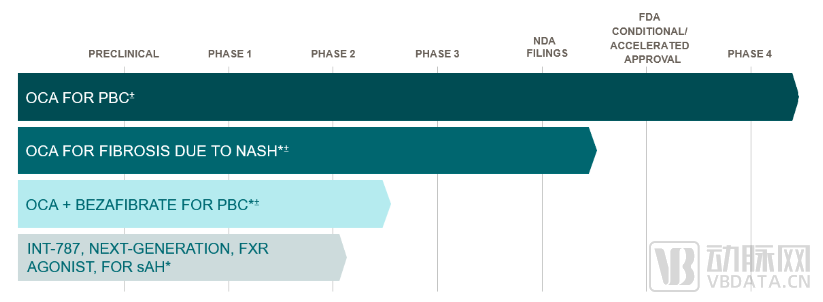
Intercept’s Product Pipeline. Image source: Intercept official website
In 2022, Intercept Pharmaceuticals announced a new pipeline candidate, TNT-787, which the company positions as a next-generation FXR agonist for the treatment of severe alcohol-associated hepatitis (sAH). Currently, no drugs have been approved for the treatment of sAH; however, the patient population in the United States is not only becoming younger but also growing in number.
Addressing this unmet clinical need, Intercept stated that INT-787 has 16-fold greater water solubility than obeticholic acid and modulates a larger number of genes in preclinical liver disease models. According to Phase I clinical data presented at the AASLD Liver Meeting in November 2022, INT-787 demonstrated favorable safety and tolerability in healthy adults, with mild side effects and no serious adverse events; the Phase I trial is scheduled for completion in the first quarter of 2023. Meanwhile, Intercept has initiated the FRESH Phase II clinical study to evaluate the safety, tolerability, efficacy, and pharmacokinetics of INT-787 in patients with severe alcoholic hepatitis (sAH).
Intercept’s exploration in the field of chronic liver disease will continue, with the greatest current challenge being the breakthrough of obeticholic acid in the NASH arena. If 2016 marked a minor peak for Intercept’s development, 2023 may well witness a historic leap forward for both Intercept and the entire NASH field.Obeticholic acid’s PDUFA date is June 22, 2023; let us await the favorable news.