

Year of Disruption: Da Vinci Faces Fierce Competition as Intuitive Surgical Commits $5 Billion to Reinvent Itself

Intuitive
Surgical Robot Developer
Since receiving FDA approval for market launch in 2000, Intuitive Surgical’s da Vinci robotic system has remained the dominant force in the field of surgical robotics. Although companies such as CMR Surgical, Medtronic, and Titan Medical have entered the market, none have challenged Intuitive Surgical’s leading position.
In recent years, however, the da Vinci Surgical System has faced challenges. Impacted by the pandemic, Intuitive Surgical experienced a slowdown in revenue growth. Gary Guthart, CEO of Intuitive Surgical, announced that the company would make substantial R&D investments in 2023 to support clinical trials, expand into new categories of surgical robots, and operate new systems. In 2022, Intuitive Surgical’s annual R&D expenditure reached $879 million, representing a 31% increase from 2021. This indicates that Intuitive Surgical will continue to commit significant additional funds to innovate in surgical robotics.
In addition to sluggish organic growth, the surgical robotics sector is seeing an influx of stronger competitors. Johnson & Johnson’s natural orifice surgical robot has demonstrated strong performance, with a new surgical robotics platform poised for launch. Meanwhile, in the primary market, the landscape once dominated by laparoscopic surgical robots is shifting; microsurgical robots, soft-tissue surgical robots, and natural orifice surgical robots are emerging as the leading contenders securing major financing rounds.
In what direction is the next generation of surgical robots developing, and how will Intuitive Surgical improve its long-established da Vinci Surgical System? Do new types of surgical robots have the potential to become blockbuster products comparable to laparoscopic surgical robots? VCBeat (WeChat ID: vcbeat) has compiled an analysis.
The da Vinci Surgical System represents the pinnacle of medical technology, yet it is actually a product of the last century.
In 1998, the second-generation surgical robot system, the ZEUS System, was introduced. A key feature of the ZEUS System is that its robotic arms integrate both surgical arms and an endoscopic arm. Compared with camera-holding surgical robots, the ZEUS System offers the advantage of allowing surgeons to perform laparoscopic procedures while seated. The da Vinci Surgical Robot was successfully developed by Intuitive Surgical in 1999. Following a prolonged patent dispute, the ZEUS and da Vinci surgical robot systems were ultimately consolidated under a single company.
In the 1920s, the Zeus and da Vinci surgical robots were consolidated into a single company following a protracted patent battle, establishing the design paradigm of robotic arms, a console, and a cart as the model for laparoscopic surgical robots over the next two decades.
In 2016, with the expiration of the Da Vinci surgical robot’s patents, laparoscopic surgical robots such as CMR Surgical from the UK and Medtronic’s Hugo gradually entered the market. Unlike the Da Vinci system, these laparoscopic surgical robots adopt a modular design, with each cart equipped with a separate robotic arm.
From the evolution of the da Vinci Surgical System, although there has been no revolutionary change between the current model and that of twenty years ago, Intuitive Surgical has actually implemented three major innovations. The directions of these innovations have also become the primary focus for the improvement of the da Vinci Surgical System.
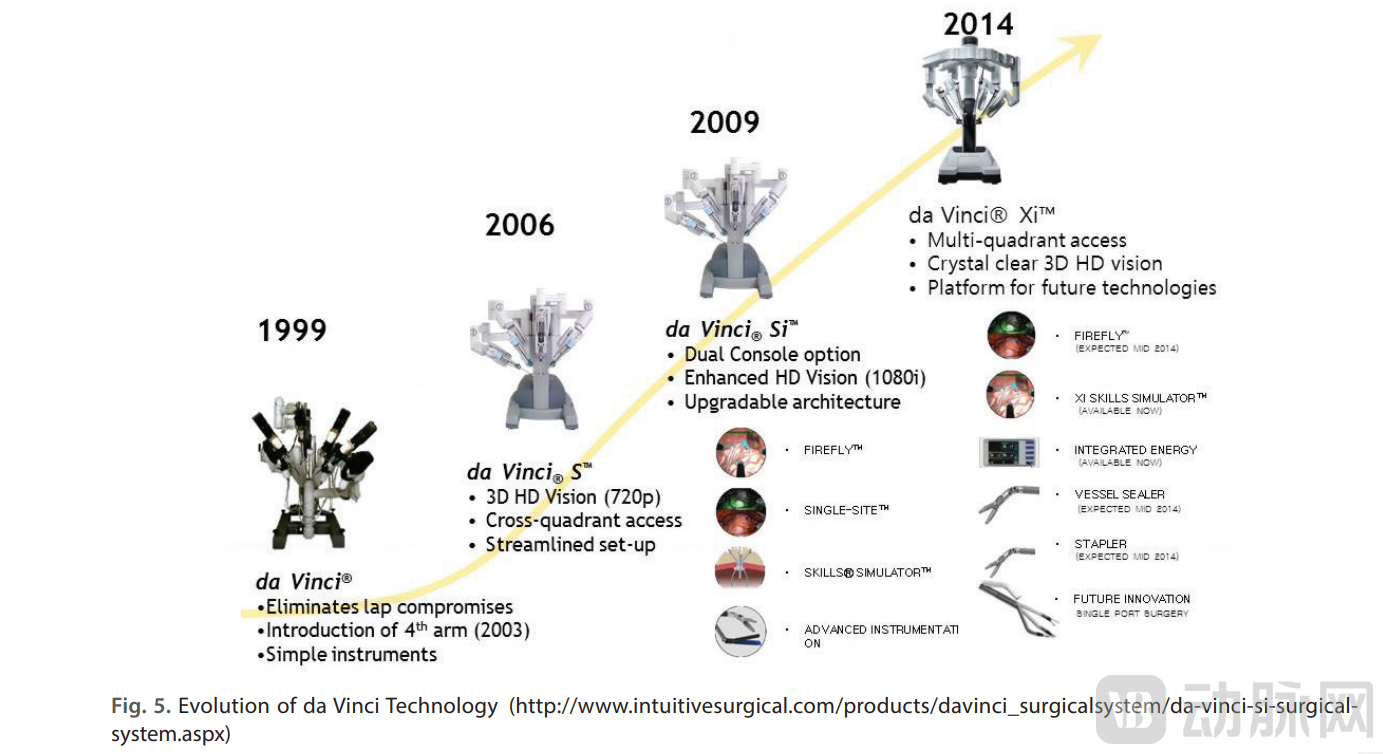
The first-generation da Vinci surgical robot, launched in 1999, featured four robotic arms. Compared with its predecessor, the second-generation da Vinci surgical robot, introduced in 2006, incorporated 3D high-definition vision, with improvements primarily reflected in enhanced intraoperative visual field quality.
In 2009, Intuitive Surgical launched its third-generation surgical robot system, featuring a dual-console design that was more compact and efficient; the third-generation da Vinci Surgical System entered the Chinese market in 2011.
The da Vinci Xi system (fourth generation) was released in 2014, and entered the Chinese market in 2018. Compared with the third-generation da Vinci surgical robot, the da Vinci Xi system offers improvements in imaging and flexibility. It utilizes a ceiling-mounted installation and a mobile platform, enabling the surgical instruments to access operative fields from various directions. The surgical arms are smaller and thinner than those of previous generations.
The da Vinci Surgical System introduced superior real-time 3D imaging with natural depth perception in its 2014 upgrade.. The significance of this technology lies in the fact that during laparoscopic surgery, surgeons typically view two-dimensional images but must think in three dimensions. 3D imaging restores the true three-dimensional stereoscopic surgical field as seen in natural vision, facilitating the identification of pathological sites and enabling precise resection and reconstruction. This enhances hand-eye coordination for surgeons during procedures and significantly improves surgical efficiency.
The innovation directions for the da Vinci Surgical Robot also include advancements in minimally invasive surgical instruments. Although Intuitive Surgical is a surgical robotics company, it has consistently aligned its research and development efforts in minimally invasive surgical instruments with industry leaders such as Medtronic and Johnson & Johnson. Taking staplers as an example, Intuitive’s staplers, similar to Medtronic’s intelligent stapler products, can reduce damage to soft tissues through intelligent tissue thickness recognition.
In China, in terms of installed base, the currently installed da Vinci Surgical Systems are predominantly third-generation models, with only a small number of fourth-generation Xi systems installed. Domestic surgeons are more proficient in operating the third-generation systems.
In 2018, the da Vinci Surgical System also introduced a transformative single-port surgical robot. The FDA approved the da Vinci SP® System (Single-Port) for use in adult single-port urological surgeries; however, this product has not yet entered the Chinese market. The da Vinci SP utilizes 8.5 mm pre-bent instruments. Nevertheless, the da Vinci single-port surgical robot still fails to resolve the challenges of limited operating space and instrument interference, known as the “chopstick effect,” associated with single-port surgery, and its current surgical indications remain narrow.
Based on the aforementioned improvements, it is evident that the Da Vinci Surgical System has primarily focused on three key areas: enhancing image quality, improving operational precision, and expanding indications. These remain the core directions for the continuous improvement of the Da Vinci Surgical System.
In terms of enhancing image quality, a major innovation by Intuitive Surgical in recent years has been the adoption of fluorescence imaging technology, which provides surgeons with intraoperative visuals that are invisible to the naked eye.
In 2019, Intuitive launched the Firefly near-infrared fluorescence feature, leveraging its years of expertise in optics and imaging technology.The fluorescence imaging system operates within a spectral range of 400–900 nm. In addition to providing images of superficial human tissues, it enables simultaneous fluorescence visualization of sub-surface structures, such as the cystic duct, lymphatic vessels, and blood vessels. This capability plays a critical role in precise intraoperative localization and reducing surgical risks. Currently, this technology is also widely applied in endoscopy.
Intuitive is continuing to explore fluorescence imaging systems. By investigating fluorescent agents that can target key anatomical structures or abnormal tissues (such as the ureters or prostate cancer), the Intuitive team aims to help surgeons improve surgical outcomes by reducing injury to critical structures, while providing enhanced visualization to enable more reliable performance of complex procedures.
The second core issue is enhancing haptic feedback.The da Vinci robotic surgical system still faces many unresolved challenges. The most prominent issue is the lack of haptic feedback, which can lead to suture breakage during initial knot-tying by surgeons and tissue damage during grasping. Surgeons must continuously learn to compensate for this limitation through tactile experience and visual feedback. Advances in sensor technology and artificial intelligence are enhancing the precision, grip strength, feedback capabilities, and autonomy of robotic surgical systems.
In terms of clinical applications, the focus of the da Vinci Surgical System is on expanding its indications., particularly single-port surgical robots. Globally, urology is the specialty with the highest adoption of robotic surgery, especially for radical prostatectomy and partial nephrectomy. However, many departments remain largely untapped by robotic systems, such as otolaryngology (ENT), which has become a key focus for the expansion of the da Vinci Surgical System. In 2019, the FDA approved the da Vinci SP Surgical System for transoral otolaryngologic procedures in the oropharynx, limited to adult patients with T1 and T2 benign and malignant tumors.
Other areas for improvement include enhancing surgical training methods, transforming traditional surgeon mentorship models, and reducing the learning curve for physicians, particularly in managing complex surgeries.
Overall, Intuitive’s primary direction for improvement is to leverage advanced hardware, software, and digital intelligence to enhance surgeons’ sensory capabilities.
In the past, the surgical robotics market was defined by Intuitive Surgical. However, with the expiration of a batch of patents for the da Vinci surgical system, more formidable players have emerged in the field. Medtronic and Johnson & Johnson are poised to capture a share of the expanding surgical robotics market.
In the natural orifice surgical robot sector, where both Intuitive Surgical and Johnson & Johnson have product portfolios, Johnson & Johnson’s Monarch leads in indication expansion, currently approved for use in pulmonary and urological surgeries.. To date, Monarch has been utilized in over 20,000 cases for the diagnosis and treatment of lung cancer. The next key indication for Monarch is kidney stones, with the first robot-assisted kidney stone surgery already completed.
In the field of orthopedic surgical robots, Johnson & Johnson has also expanded into orthopedics through its VELYS platform. Designed for use in knee replacement surgeries to improve the accuracy of bone cuts, VELYS has already received FDA approval.
In addition to the Monarch platform for natural orifice procedures and the VELYS digital orthopedics system, Johnson & Johnson has another high-potential soft-tissue surgical robotics product: Ottava. Based on currently available information, Johnson & Johnson’s Ottava soft-tissue surgical robot differs significantly from the da Vinci Surgical System.
The Ottava soft-tissue surgical robot features six robotic arms integrated into the operating table to reduce its footprint. However, it remains unclear how to prevent mutual interference among the instruments when all six arms are used simultaneously.
The advantage of the Ottava surgical platform lies in its integration with Johnson & Johnson’s Ethicon platform. As a global leader in energy-based surgical devices, Ethicon is better positioned to enhance the performance of surgical instruments in the future.
Another major advantage of Ottava is its integration capability. Currently, most surgical robots worldwide are standalone products, such as laparoscopic robots and vascular interventional robots. Ottava is poised to become a platform that integrates both vascular interventional and laparoscopic robotic systems.
The development and launch of Ottava were previously impacted by the pandemic. As pandemic conditions have gradually become normalized, Johnson & Johnson is set to add another product to its surgical robotics portfolio.
In contrast to the bulky da Vinci surgical robot, Johnson & Johnson’s Ottava development trajectory indicates that surgical robots are evolving toward modularization.
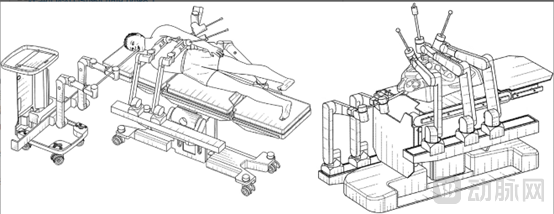
Ottava Design Drawing
The surgical robot market is witnessing fierce competition among industry giants, while some major players have yet to enter this sector. Although the da Vinci Surgical System is widely used and highly proficient in laparoscopic procedures, it has not yet been adopted on a large scale for reconstructive, lymphatic, and ophthalmic surgeries.These sectors, which demand more precise operation of surgical robots, have become fertile ground for the growth of innovative enterprises.
Taking microsurgical robots as an example, traditional microsurgery relies on optical systems and precision surgical instruments to be performed. Surgeons must manually operate under optical magnification ranging from 5x to 40x of the surgical field. Microsurgery typically involves anastomosing lymphatic vessels, blood vessels, or nerves with diameters of 0.3–0.8 mm, addressing substantial unmet clinical needs across multiple specialties, including otolaryngology, lymphatic surgery, neurosurgery, and plastic surgery.
Taking ophthalmic surgery as an example, in this field, instruments move around the scleral entry point, which can easily cause tearing of the incision tissue in patients and affect postoperative healing. Moreover, ophthalmic surgeries demand extremely high operational precision, with an ideal accuracy of 10 micrometers. However, the natural tremor of the human hand is approximately 100 micrometers, which can easily lead to retinal damage and impair visual recovery.
This market, overlooked by industry giants, is witnessing a breakthrough as multiple innovative companies begin developing novel products. These include the Symani System developed by the Italian company Medical Micro Instruments, and the MUSA System developed by the Dutch company MicroSure.
The working principle of Microsure’s microsurgical robot is to stabilize hand movements by scaling down motions and filtering out tremors, thereby enhancing surgeons’ ability to repair anatomical structures during microsurgery. MUSA is applicable in procedures such as lymphovenous anastomosis, distal nerve repair, vascularized tissue transplantation, and many other complex microsurgical operations. MUSA has been proven safe and effective in suturing blood vessels to reduce lymphedema. Microsure has currently secured €2.7 million in financing.
Symani is designed to enhance surgeons’ natural dexterity and range of motion, enabling them to operate beyond the limitations of the human hand—for example, suturing veins, arteries, nerves, and lymphatic vessels as small as 0.3 millimeters in diameter. Medical Micro Instruments has also secured $27 million in financing.
Currently, two Chinese companies active in this sector, Angtai Jingwei and Dishiyiliao, have secured financing. Angtai Jingwei offers a portfolio of products including a general-purpose microsurgical robot, an ophthalmic surgical robot, and a transgastrointestinal endoscopic robot. Dishiyiliao entered the market through ophthalmic surgery and has since expanded deeply into the field of microsurgery. Its ophthalmic surgical robot has completed type testing.
The field of surgical robotics has long represented the pinnacle of medical technological innovation. After two decades of development, surgical robots have reached new heights in both technology and clinical recognition, signaling that the market is poised for transformative change. We anticipate more groundbreaking innovations in the field of surgical robotics.
References:
Advances in Pediatric Surgery | Current Status and Prospects of Pediatric da Vinci Robotic Surgery—Tang Shaotao
Past, present and future of surgical robotics——trend in urology & men health