

Can Viking Therapeutics Capture a Share of the NASH Market Amid Legal Battle with Ascletis Pharma?
Viking Therapeutics
Innovative Therapy Developer
No new drugs have yet emerged in the NASH field, but competition has already escalated to the level of patent litigation. Late last year, Viking Therapeutics, a U.S. biotech company focused on metabolic diseases, filed a lawsuit against Ascletis Pharma, one of the Chinese companies with the most advanced NASH pipeline.
Viking Therapeutics alleged that Ascletis Pharma’s drug candidates ASC41 and ASC43F infringed upon the trade secrets of its own candidate, VK2809. In early 2023, Ascletis Pharma issued an announcement to actively defend against these claims. On February 3, the U.S. International Trade Commission (ITC) initiated a Section 337 investigation into the matter, thrusting both companies into the center of public controversy over allegations of trade secret misappropriation.
Viking is another pioneer in the international NASH field, besides Madrigal, developing THR-β agonist therapies.Influenced by the news of Madrigal’s successful Phase III clinical trial for resmetirom last year, Viking’s stock price began to rise from around $4. On January 9, 2023, Viking announced that patient enrollment for the Phase IIb clinical trial of its NASH drug VK2809 had been completed. Currently, the company’s stock price has risen to $11.29.
Unlike Madrigal, which relies on a single pipeline, Viking Therapeutics boasts a diverse portfolio of therapies targeting metabolic diseases and endocrine disorders. Its three lead candidates—VK2809, VK2735, and VK0214—have all entered clinical trials, with the NASH drug VK2809 advancing most rapidly and reaching Phase II clinical trials earlier this year.
The outcome of this patent litigation remains uncertain, but Viking Therapeutics warrants close attention. How is the company positioning itself in the hotly contested NASH arena? Can it capture a share of the NASH market pie? VBInsight will take you on a deep dive to find out.

Keen Eye on Pharma: Taking the NASH “Baton” from Ligand
Ligand Pharmaceuticals is a biopharmaceutical company based in San Diego, California. Founded in 1987 as Progenix Inc., it went public for the first time in 1992. Initially focused on internal drug development, Ligand underwent a turbulent period in the early 2000s and subsequently embarked on an extensive path of acquisitions and partnerships.
Viking Therapeutics was born out of Ligand’s divestiture of its assets. In 2012, when Ligand sought to spin off several businesses, one of them—Metabasis—caught the attention of Brian Lian, a Managing Director and Senior Research Analyst at the investment bank SunTrust Robinson Humphrey.
Metabasis has independently developed novel therapeutics for metabolic diseases by leveraging its proprietary technologies and scientific expertise in intrahepatic physiological pathways. Its product pipeline includes clinical-stage candidates for the treatment of metabolic disorders such as diabetes and hyperlipidemia, as well as products targeting liver diseases including hepatitis and primary liver cancer, all supported by an advanced R&D infrastructure.
Brian Lian decided to embark on a new path by acquiring certain assets from Metabasis and establishing Viking Therapeutics. Over the next few years, Lian secured licenses for five drugs from Ligand Pharmaceuticals, two of which were in Phase II clinical trials and three in Phase III. Ligand also provided an additional $2.5 million in investment.
Viking promptly prioritized the development of its muscle atrophy and liver disease programs. Both studies yielded the best-ever data for this class of compounds in these indications, and based on these successful trials, Viking secured several equity financing rounds to continue supporting the advancement of these projects.
Metabolic and endocrine diseases still have many gray areas. Viking Therapeutics is targeting a challenging problem in the pharmaceutical industry: the complex pathogenesis of nonalcoholic steatohepatitis (NASH), in which hepatic fat accumulation can lead to other conditions, such as inflammation, hepatocyte injury, and fibrosis. Metabasis is developing VK2809, a drug designed to lower low-density lipoprotein cholesterol. Preliminary trials have shown that it significantly reduces liver fat, supporting the rationale for another Phase IIb study in NASH.
Why Did VK2809 Successfully Advance to Phase II? Brian Lian believes that the NASH patient population is highly diverse, including individuals with diabetes, obesity, metabolic syndrome, or dyslipidemia, yet many therapeutic approaches target only a single symptom. However, THR-β, the target selected by Viking Therapeutics, is one of the few targets effective against both inflammation and liver fibrosis. VK2809 activates thyroid hormone receptor beta (THR-β) in the liver, serving as a key regulator of lipid metabolism; reducing hepatic fat may thereby neutralize lipotoxicity. Viking Therapeutics has demonstrated expertise in developing THR-β-related drugs. In addition to VK2809, VK0214, a treatment for the rare metabolic disorder X-linked adrenoleukodystrophy (X-ALD), is also a THR-β agonist.
6 Public Pipeline Assets, 3 in Phase II Clinical Trials
Viking has established a robust pipeline targeting diseases such as NASH and hypercholesterolemia.
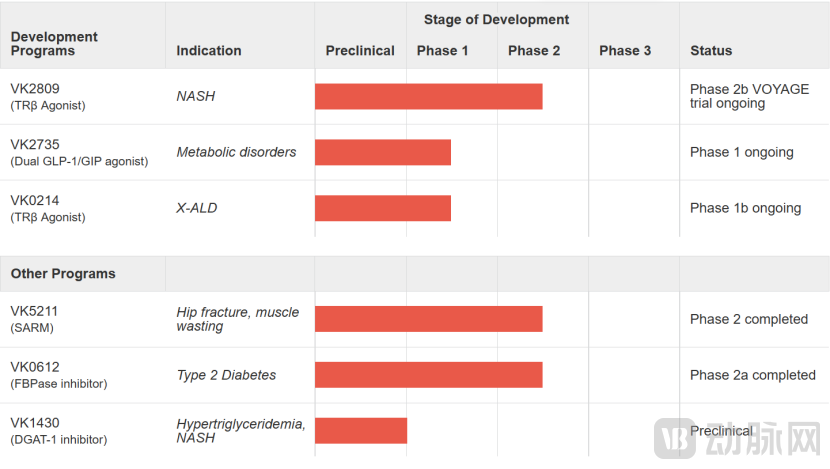
Viking Therapeutics’ Pipeline (Source: Viking Therapeutics Official Website)
VK2809, the core clinical product currently under development, is a novel oral small-molecule selective thyroid hormone receptor beta (THR-β) agonist for the treatment of nonalcoholic steatohepatitis (NASH) and liver fibrosis. The Phase IIb clinical trial for this program was initiated in November 2019. Prior to this, the program demonstrated favorable outcomes in Phase IIa clinical trials for treating nonalcoholic fatty liver disease (NAFLD) and elevated low-density lipoprotein cholesterol (LDL-C). Patients treated with VK2809 showed significant reductions in LDL-C levels and hepatic fat content compared to those receiving placebo. Based on Viking’s Phase IIa data, VK2809 appears to have a slightly stronger effect in reducing hepatic fat than Madrigal Pharmaceuticals’ resmetirom, although further trials are required to confirm this finding.
Furthermore, Viking Therapeutics has another drug candidate for the treatment of metabolic disorders such as hypertriglyceridemia, NASH, obesity, and dyslipidemia—VK1430, a DGAT-1 inhibitor, which is currently in the preclinical stage.
The company is also developing VK2735, a novel dual agonist of the glucagon-like peptide-1 (GLP-1) and glucose-dependent insulinotropic polypeptide (GIP) receptors, for the potential treatment of various metabolic disorders. The Phase I clinical trial of VK2735 commenced in January 2022.
In the field of rare diseases, Viking Therapeutics is developing VK0214, a novel oral small-molecule THR-β agonist, for the potential treatment of adrenoleukodystrophy. In June 2021, VK0214 entered Phase Ib clinical trials in patients with X-ALD. The study was previously placed on clinical hold by the FDA due to multiple injections administered to patients but has since had the hold lifted and is proceeding normally.
Meanwhile, two other projects, VK5211 and VK0612, are advancing rapidly. VK5211, an oral non-steroidal selective androgen receptor modulator (SARM), is indicated as an adjunctive therapy for hip fracture and muscle atrophy. VK0612 is a first-in-class oral drug for type 2 diabetes. Both drugs have entered Phase II clinical trials.
Stock Rating Upgraded: What’s Next for Viking?
Many prominent equity research analysts have shared their views on Viking Therapeutics in recent months. Two weeks ago, an equity research analyst at StockNews.com upgraded Viking Therapeutics’ rating from “Sell” to “Hold,” while another equity research analyst assigned the company a “Beat Expectations” rating.
Some major investors chose to increase their shareholdings. The Swiss National Bank increased its stake by 7.2% in the first quarter of 2023; JPMorgan Chase increased its holdings by 20.5% in the first quarter; and BNY Mellon increased its shareholding by 26.3% in the first quarter.
Viking Therapeutics’ Phase II trial data for its NASH drug candidate VK2809 were slightly superior to those of Madrigal Pharmaceuticals’ resmetirom. With three pipeline assets already in Phase II clinical trials, investors are highly optimistic about Viking’s potential. The heightened attention on Viking also signals a renewed market enthusiasm for NASH therapeutics. Meanwhile, Viking’s strategic decisions regarding its future development path exemplify the typical challenges faced by biotechnology companies.
Viking Therapeutics was named by Fierce Biotech as one of the “Top 10 Potential M&A Targets in Biotechnology for 2023” due to its robust pipeline assets.Despite a robust pipeline and positive clinical trial data, its current market capitalization stands at only $865 million. In the NASH arena, Viking Therapeutics is undoubtedly another leading contender targeting THR-β; however, its clinical progress has lagged slightly behind that of Madrigal, and pursuing independent development would pose significant challenges.
It remains to be seen whether a merger or acquisition will be pursued.Viking Therapeutics’ Plan A is currently to partner with one or more multinational corporations (MNCs) to advance the subsequent commercialization of its products.Of course, there are still many unpredictable risks in the mid-to-late stages of clinical development, and other competitors in the NASH field are also quite strong. Viking Therapeutics expects to obtain the Phase IIb clinical trial results for VK2809 in the first half of this year, after which we may see further developments.