

Intel Capital Leads $20M Series A in MDI Health for AI-Powered Drug Management Platform

Fresh.Fund
Venture Capital Firms
Intel Capital
Venture Capital Firms

Basad Ventures
Digital Health Investment Firms

Arc Impact
Venture Capital Firms

Welltech Ventures
Healthcare Investment Firm

Jumpspeed Ventures
Early-stage Investment Firms
Maverick Ventures Israel
Investment Institutions
MDI Health
Artificial Intelligence Platform Provider

Hanaco Ventures
--
Over the past year, concepts such as the metaverse and ChatGPT have exploded in popularity.
As 5G, big data, and artificial intelligence (AI) send shockwaves through society, people are both watching from the sidelines and stirring with momentum amid the ongoing debates.
The reach of technologies such as artificial intelligence and machine learning has naturally extended into the healthcare industry. From medical imaging to drug development, and even niche areas like medical prescribing, all are dancing with AI.
In January 2023, MDI Health, a newly founded startup based in Los Angeles, raised $20 million (approximately RMB 130 million) in its first round of financing, leveraging its AI-powered optimized medication management platform.
The funding round was led by Intel Capital, with participation from Maverick Ventures Israel, Hanaco Ventures, Well-Tech Ventures, Arc Impact, Basad Ventures, Fresh.Fund, Jumpspeed Ventures, and Richard Montwill, former Senior Vice President of Optum. As part of the financing, Yoni Greifman of Intel Capital joined the company’s board of directors. The company stated that its platform is designed to prevent adverse drug reactions.
“A fence needs three stakes”
At MDI Health, you can see that the growth of an emerging company is inseparable from a well-suited founding team.
The company’s three founders hail from diverse sectors, bringing together their years of accumulated expertise in medicine, technology, and operations to uniquely establish an AI-driven healthcare services company.
MDI Health, founded in 2019 and headquartered in Tel Aviv, Israel, has established teams in both the United States and Israel, with a workforce of 40 employees. The company’s flagship product, the MDI Medication Management Platform, is designed to assist physicians and pharmacists in delivering optimal medication management and analysis, thereby mitigating the adverse effects of adverse drug reactions.
MDI technology is backed by co-founder Dorit Dil Nahalieli’s more than 15 years of expertise in medication therapy and drug safety.
Nahalieli, who holds a Ph.D. in Clinical Pharmacy from the Hebrew University, previously served as the Director of the Drug Safety and Drug Information Department at the Israeli Ministry of Health, addressing issues related to drug safety. He later established his own clinic, providing personalized medication therapy management for patients.
As Nahalieli’s friend, co-founder Avishai Ben Tovim learned from her about the challenges she faced at work: 70% of patients had consulted her regarding adverse drug reactions. In reality, doctors have less than 20 minutes to collect information on patients’ medication history, making it impossible to comprehensively compile their complete medication records and thus prevent adverse drug reactions.
Over the past 15 years, Tovim has worked at high-tech companies such as Google and Roundforest, handling a substantial volume of AI-related business. After hearing her description, Tovim suggested that technology could be leveraged to achieve statistical and analytical objectives.
“I tried to convince her that what she was doing could have been accomplished with technology from the start. She said it was impossible, citing too many parameters. But now she will tell you that there is nothing technology cannot achieve.”
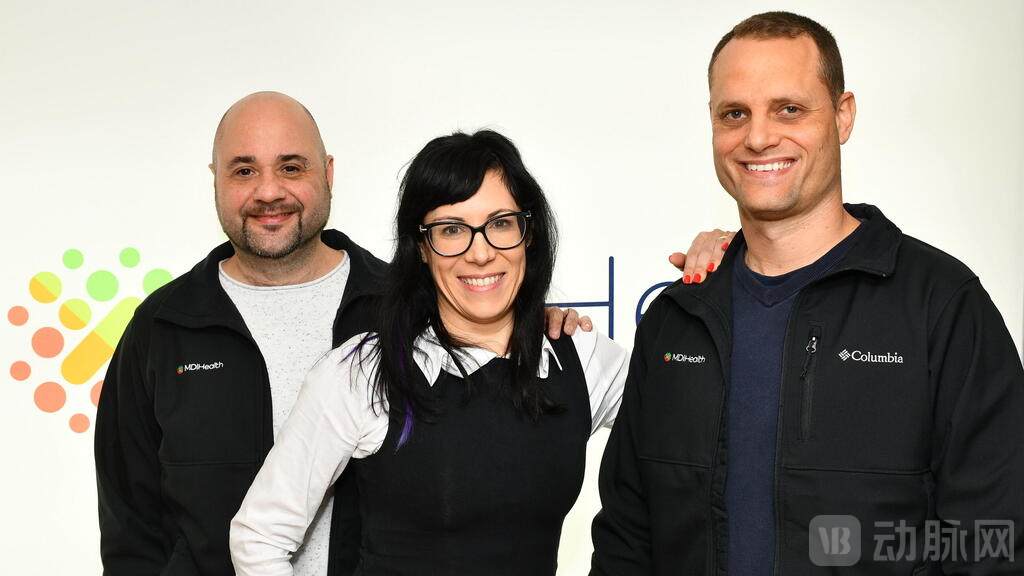
MDI Health founders Ben-Tovim, Dr. Dorit Dil Nahalieli, and Yuval Kalev (Image credit: Israel Hadari)
The two joined forces with another founder, Yuval Kalev, to establish MDI Health. Kalev brings over a decade of experience in technology development, having served as a software engineer at companies such as Jajah and Leverate.
Shortly after its founding, MDI Health secured a pre-seed funding round led by Jumpspeed VC and Freshfund, becoming the only international company to join Hartford Healthcare’s Digital Health Initiative in the United States.
In 2021, the company secured $6 million in seed financing. The round was led by Hanaco Ventures, with participation from FreshFund, Jumpspeed VC, Basad Ventures, and Arc Impact.
Many patients require five or more medications to treat one or multiple conditions; such patients are referred to as those on polypharmacy.
Typically, these medications help alleviate one or two symptoms but also lead to a range of new side effects. The more medications an individual takes, the higher the likelihood of experiencing Adverse Drug Reactions (ADR). ADR refers to unintended and harmful events resulting from medication use.
However, the average consultation time per patient is only 5 to 7 minutes, which is clearly insufficient for physicians to obtain a comprehensive understanding of patients’ medical histories, thereby precluding assurance that prescribed medications are both maximally effective and free of adverse effects for each individual patient.
According to estimates by the U.S. Food and Drug Administration, preventable adverse drug reactions (ADRs) cause an average of 270,000 deaths annually in the United States, resulting in a total annual economic loss of $528 billion.
The MDI platform, developed by MDI Health, is dedicated to addressing the issue of adverse drug reactions (ADRs). Leveraging advanced artificial intelligence algorithms and machine learning models, the MDI platform not only provides physicians with an overview of patients’ medication histories but also predicts and prevents ADR-related issues.
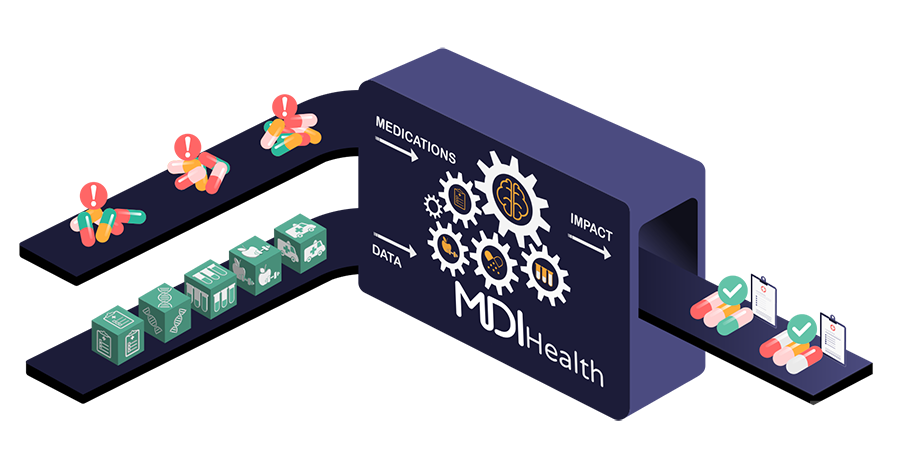
MDI Platform Workflow (Source: MDI Health Official Website)
Personalized Care to Reduce the Risk of Adverse Drug Reactions (ADRs)
Each patient is unique, with distinct health conditions, allergies, medication-related issues, and other pharmaceutical needs.
Addressing the complexity and uniqueness of patient medication regimens, the MDI platform aims to provide decision support for physicians and deliver differentiated care to patients. The system integrates various medical databases to comprehensively analyze patients’ personal medical information—including medical history, genetic testing results, and medication data—thereby establishing a multidimensional data profile for each patient. When physicians prescribe medications, the MDI platform analyzes the proposed pharmaceutical prescriptions based on drug-drug interactions, individual medical history, lifestyle, and other key factors, offering prescribing recommendations to assist clinicians.
MDI Health can also conduct comprehensive risk assessments for each patient, detect and predict the areas of highest risk, automatically generate recommendations, and highlight the three to five most significant risks facing the patient. Clinicians can then take prompt action based on the final analysis to identify safer alternative pharmacotherapies.
Automated execution, reducing time and labor costs
Comprehensive Medication Reviews (CMRs) are consultations conducted between patients and physicians, either in person or via telephone. During these sessions, physicians gather patient-specific information to identify medication-related problems and collaborate with patients to develop plans for resolving them. CMRs are regarded as a form of personalized therapy.
CMRs differ from targeted interventions addressing single medication issues; they are comprehensive and time-intensive. Thoroughly conducting a CMR, which involves evaluating all medications taken by the patient and their related medical conditions, may take 45 minutes to an hour.
In contrast, MDI Health’s proprietary automated, machine-assisted analysis can generate comprehensive medication evaluations and recommendations, along with a report, in just a few minutes. This report is then directly communicated to the patient’s physician and clinical team. The AI solution enables clinicians to rapidly identify optimal interventions, thereby reducing the likelihood of post-discharge readmissions and minimizing the time physicians spend on medication reconciliation.
Furthermore, after patients are discharged from the hospital, the MDI platform can monitor in real time, via a patient-facing application, their risk of experiencing adverse drug events. By continuously evaluating patients’ medical conditions and medication regimens, the platform can also alert physicians to changes in risk levels and care gaps, thereby preventing adverse outcomes.
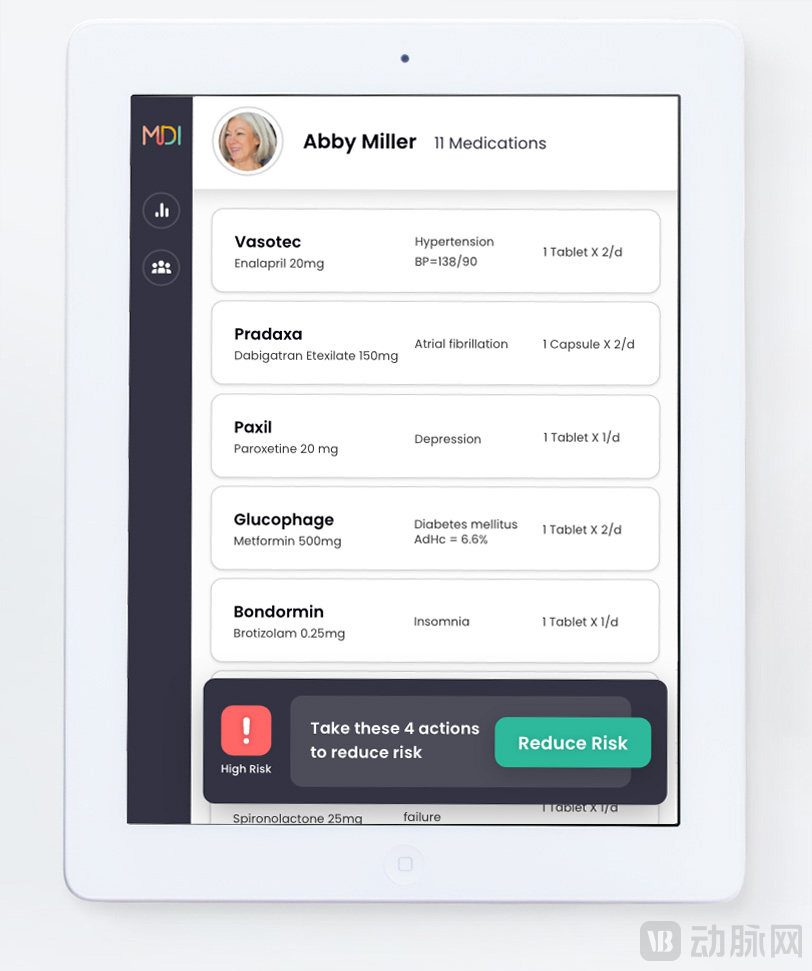
MDI App (Source: MDI Health Official Website)
Startups Graduated from Microsoft Accelerator with Promising Prospects
Microsoft’s AI for Good Acceleration Program is an initiative designed to help Israeli companies advance their artificial intelligence solutions. The program’s expert-led curriculum covers a range of topics, from technical guidance to business development.
MDI Health received funding from the program at its inception and was selected by Microsoft Accelerator as an outstanding “graduate.” With the technical, networking, and financial support provided through the program, MDI Health operated smoothly during its startup phase.
In addition to being selected for the Microsoft Accelerator, MID Health also stood out in the Hadassah and IBM's Jerusalem Medtech Accelerator. This accelerator features a six-month program for seed-stage and early-stage medical technology startups, providing participating companies with clinical and research resources from Hadassah Hospital, free office space, and entrepreneurial mentorship.
The commercialization prospects of MDI Health’s platforms have played a significant role in securing support from two major accelerators.
Long before MDI Health was founded, similar companies had already introduced “new innovations” in the ADR medication management sector.
Looking ahead, Synapse Medicine, founded in 2017, stands out as a leader in this sector. The company’s Synapse platform leverages “drug masking” technology to automatically encode drug side effect signals into standardized international terminology and rank them by severity, thereby enabling real-time management of these signals.
In addition to its proprietary technology, the company has developed a mobile application called Goodmed specifically for patients. The app integrates medical professional solutions from the Synapse platform, enabling valuable remote symptom reporting. With this application, patients can easily manage their treatment progress, stay connected with their care teams, and report adverse drug reaction (ADR) events.
To date, Synapse Medicine has completed three rounds of financing, raising a total of $38.7 million, which remains a strong performance in the capital market.
Arine, founded in the same year as MDI Health, is no less impressive than its predecessor.
This San Francisco-based startup raised $40 million through five rounds of financing in just three years.
Arine’s ability to attract a large number of investors is closely tied to the comprehensive functionality of its platform. In addition to leveraging AI to automate patient assessments, generate care plans, and produce reports, Arine’s modular platform supports personalized configuration of workflows and reporting, allowing hospitals to select features based on their specific needs. Furthermore, Arine provides clients with real-time data on program performance and collaborates with them to establish KPI and ROI frameworks.
The RMB 130 million raised by MDI Health in its first round of financing is just the beginning; in the face of platform innovations by peer companies, MDI Health needs to reveal more of its strategic advantages.