

60 Million RMB Mega Deal Kickstarts Revival of Healthcare IT Sector: Insights from CHINC 2023
After a full year of silence, healthcare IT regains its "vitality."
The CHINC conference held in spring 2023 rarely brought together major and minor vendors in healthcare informatics, with surging crowds marking a scene unseen in the medical IT sector for nearly two years.
In contrast to the near-uniform pace of exhibits from major manufacturers in previous years, this year’s exhibition area, while guided by the macro concept of “high-quality hospital development,” saw vendors adopting different entry points, resulting in significant differentiation in their flagship products and a lack of focused hotspots.
Among established health IT vendors, H3C defined “high-quality hospital development” by innovating hardware sales, showcasing 8K displays at the conference. Major players such as Winning Health, B-Soft, Neusoft, and Donghua Medical Information focused on promoting their distinctive hospital-wide management systems, with cloud migration and intelligent transformation as key priorities. Huawei, China Telecom, China Unicom, and China Mobile presented numerous case studies of hospital public health infrastructure centered on “connectivity,” aiming to secure more multimillion-yuan contracts.
Among startups, data and network security has maintained the momentum seen since 2020, with exhibition space continuing to expand; meanwhile, digital health companies are leveraging big data and specialty department development to further segment offerings within the smart hospital concept.
What’s interesting is what was missing from this year’s conference. First, evaluation/rating services: in contrast to the overwhelming case-study promotions seen in previous years, only a handful of companies showcased their offerings this year. Second, the construction and operation/maintenance of internet hospitals: companies offering these services did not feature them prominently, and those whose core business revolved around such services were notably absent.
What Trends Lie Behind the Various Displays at the Exhibition? VCBeat Communicated with Over 20 Companies at the Conference, Exploring Six Key Areas to Identify the Development Trends of the Medical IT Industry in 2023.
I. Orders Worth Tens of Millions Continue to Rise, Widening Performance Divergence Among Listed Medical IT Companies
II. Hospitals Need High-Quality Development, and Regional Healthcare Also Requires High-Quality Development
III. Smart Specialization Construction: A Key Driver for Departmental “Efficiency Enhancement”
IV. Efficiency of Medical Big Data Applications Still Needs Improvement, as Medical AI Companies Enter the Market
V. Revocation of First-Visit Rights, and Withdrawal from the Construction and Operation of Internet Hospitals
VI. ChatGPT’s Capabilities Questioned; At Least Three More Years Needed for Healthcare Implementation
In recent years, both the average transaction value and the volume of medical IT orders have increased year over year. Bidding data compiled by Guotai Securities shows that in January 2023, while the total value of medical IT orders remained nearly flat compared to the same period last year, there were a total of 12 contracts valued at over RMB 10 million each (nine for hospitals and three for public health). The highest bid was for the Luanchuan County People’s Hospital upgrade and renovation project, with a winning bid amounting to RMB 59.3498 million, marking a strong start to 2023.
Meanwhile, as the impact of the COVID-19 pandemic gradually wanes and hospital operations return to normal, the digital transformation of entire hospitals is gaining renewed momentum. Consequently, listed healthcare IT companies such as Winning Health, B-Soft, Neusoft Group, and DHC Software are vying for high-value, hospital-wide management systems. While the exhibits showcased few innovations compared to previous years, they remained highly practical.
More changes are evident at the performance level. Even in January, typically considered a slow season, Winning Health delivered RMB 186 million in revenue, securing five of the twelve orders valued at over RMB 10 million each (including the Luanchuan County project), with hospital construction projects in central and western regions driving the majority of its revenue. Neusoft followed closely behind, with public health orders worth RMB 54 million—far surpassing its peers—and total medical IT orders approaching RMB 100 million.
However, monthly order performance alone cannot accurately reflect the competitiveness of healthcare IT companies. On the other hand, the delivery of healthcare informatization orders is cyclical, with the first half of the year typically being a slow season and the second half revealing the true picture.
Overall, the medical IT market this year is poised for promising developments. With policy support remaining consistent—including the Action Plan for Promoting High-Quality Development of Public Hospitals (2021–2025), the Work Plan for Enhancing the Comprehensive Capabilities of County Hospitals under the “Thousand Counties Project” (2021–2025), and the Guiding Opinions on Advancing Urbanization with County Towns as Key Carriers—the pent-up demand for healthcare infrastructure construction accumulated during the pandemic is expected to be released once public hospitals’ cash flows stabilize. This trend may drive a new wave of growth in both the volume and unit price of multimillion-yuan orders.
Faced with the vast market for hospital and public health informatization dominated by listed companies, startups naturally seek to capture a share. However, competing head-on with listed companies in the traditional, strongly entrenched hospital management and public health sectors is not advisable. Instead, many enterprises are seizing the opportunity presented by cloud migration, launching “cloud-based” systems for hospitals and even entire regions, and focusing their efforts on this emerging market.
At this year’s CHINC, companies such as Northern Health and Zhongyang Health showcased their cloud-based services. Among them, Huazhuo Technology’s “HaaS Platform” concept stood out as highly representative, aiming to pioneer a new model that connects government entities, platforms, and life sciences enterprises, thereby extending the focus from “high-quality hospital development” to “high-quality regional healthcare development.”
HaaS, short for “Health as a Service,” refers to empowering local governments to build a comprehensive healthcare operating system centered on hospitals, people, and healthcare services. This system delivers full-scenario, whole-lifecycle medical and health services to the public, while also providing a medical data service platform that supports data application scenarios such as scientific research and artificial intelligence, thereby establishing new digital healthcare infrastructure.
In practical applications, the distinctive features of Huazhuo Technology’s HaaS can be summarized as “three ones” and “two ecosystems.” The two ecosystems refer to the hospital data and application ecosystem and the medical informatics software application marketplace, which bears some resemblance to Apple’s App Store, serving as a bridge between smart hospital applications and physicians in clinical departments.
The “Three Ones” refer to one cloud, one system, and one platform. Li Tanwei, CEO of Huazhuo Technology, summarized the significance of this design as being centered on hospitals’ needs: “In previous healthcare informatization initiatives, different hospital departments might procure multiple systems with identical functions at different times to meet specific needs. This not only resulted in financial waste for hospitals but also created barriers to data interoperability. To avoid similar issues in the construction of regional medical platforms, we must ensure that the development of regional healthcare software applications and data infrastructure consistently revolves around the ‘Three Ones.’”
Furthermore, to ensure the realization of the “Three Ones,” we need to establish a medical data and application ecosystem tailored for health commissions, as well as a healthcare IT software application marketplace oriented toward medical institutions. This will ensure that our systems and platforms remain compatible with various applications in future use, eliminating the need to procure separate software systems.
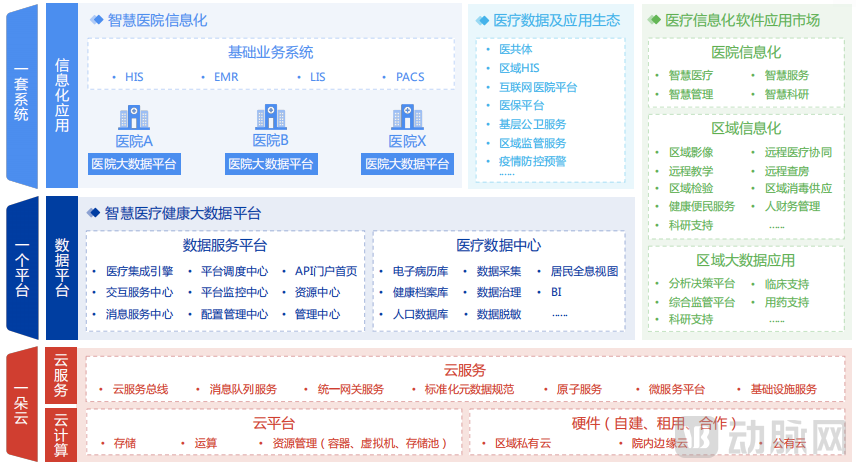 Huazhuo HaaS Platform: Overall Architecture Diagram of “Three Ones” and “Two Ecosystems”
In actual operation, to ensure smooth platform operations, it is essential to attract a sufficient number of applications to join the platform and secure government endorsement, thereby playing a key “connecting” role.
Li Tanwei stated, “The logic of the ‘Three Ones’ aligns with the government’s objective of breaking down data silos between hospitals; therefore, the government has a strong incentive to lead the initiative to ‘connect’ hospitals.”
Meanwhile, with the establishment of regional medical data service platforms, previously fragmented data is being transformed into assets with potential value, enabling the region to attract life sciences companies. In this process, government expenditures are gradually shifting toward investments, and all stakeholders—including the government, platform developers, life sciences enterprises, and local residents—benefit from ecosystem development, achieving a multi-party win-win outcome.
Beyond innovation in business models, medical AI companies are also focusing on application-level innovation. The key difference from the past is that companies dedicated to building specialized smart healthcare solutions emphasize not only improving medical quality but also helping hospital departments “enhance efficiency.”
The integrated DRG/DIP clinical pathway solution based on “CDSS 3.0” was a key product showcased by Huimei Technology at this conference. Compared with the previous generation of CDSS, the new-generation clinical decision support system not only expands its application coverage across specialized clinical scenarios but also introduces an “Intelligent Accounting” feature. While providing physicians with optimized and personalized clinical pathway options, the system calculates in real time the cost consumption associated with each pathway and estimates the profit or loss under DRG settlement. For instance, when a patient enrolled in a clinical pathway presents with complex conditions that render the standard pathway unsuitable, the system automatically recommends alternative branch pathways. Upon physician confirmation, the system adjusts the predicted case-mix group assignment in real time, forecasts the DRG/DIP profit or loss, and modifies the attributes of medical orders (categorizing them as optional, mandatory, or additional) accordingly. This assists physicians in implementing rational and scientific cost control, minimizing insurance settlement losses caused by anomalous case grouping while ensuring quality and safety.
Huimei Technology’s CTO, Wang Shi, told VCBeat that traditional clinical pathways are overly standardized and fail to meet patients’ individualized diagnosis and treatment needs. Moreover, they rely on physicians’ proactive selection, as the system itself cannot provide intelligent recommendations, leading to issues such as low pathway enrollment rates and high exit rates. Huimei CDSS 3.0 leverages historical data analysis to automatically generate various branch pathway options for physicians to review and optimize. While providing decision support and quality control, it offers real-time alerts on mandatory, optional, and unreasonable costs associated with the pathway, assisting physicians in selecting the optimal clinical pathway. Its value lies in shifting the analytical process upstream, thereby enabling dynamic pathway adjustments through CDSS assistance during the diagnosis and treatment process to achieve the dual goals of improving healthcare quality and controlling medical costs.
Jianhai Technology’s “Post-Consultation Disease Management Center” shares similar principles. To achieve high-quality development in hospital services, it is essential to provide high-quality care across the pre-consultation, intra-consultation, and post-consultation phases. However, due to constraints imposed by the DRG payment model and limited medical staff resources, the effective implementation of high-quality post-consultation management has remained challenging.
Driven by this demand, Jianhai Technology, as one of the earliest healthcare IT companies in China to pivot into the post-diagnosis sector, has successively developed a smart post-diagnosis patient service platform, Internet-plus outsourced follow-up services, Internet-plus precision medication management, and refined post-diagnosis disease management services. By truly adopting a patient-centric approach, it assists hospitals in managing patients after diagnosis.
For hospitals, establishing smart post-diagnosis patient service platforms and outsourcing services such as “Internet + follow-up” carries multiple significances. First, patient readmission rate is an indicator in the performance assessment of tertiary public hospitals. While hospitals aim to provide more comprehensive diagnosis and treatment services, they are constrained by limited medical and nursing resources, with their core focus remaining on the intra-diagnosis phase. This makes it difficult to ensure high-quality post-diagnosis management, thereby creating a willingness to seek assistance from specialized enterprises for post-diagnosis management.
Second, the “Post-Consultation Disease Precision Management Prescription” issued by physicians can provide multidisciplinary, integrated, and personalized post-consultation disease management services tailored to patients’ clinical conditions. This approach not only meets patients’ strong demand for rehabilitation promotion after discharge but also offers hospitals new pathways and measures to enhance service delivery, thereby substantively empowering high-quality hospital development.
There are many other similar innovations in smart applications. In today’s healthcare landscape, where cost containment and efficiency are paramount, collaborating with hospitals to explore service models and assist in departmental development and operations may accelerate the construction and innovation of smart hospitals more effectively than traditional one-time software delivery.
Despite years of discourse on data governance, many hospitals have long achieved interoperability and adopted standardized data tools. Consequently, there is strong demand for the application of big data in clinical care, hospital operations, and population health; however, the actual conversion efficiency remains low.
Therefore, enterprises across various sectors are exploring new governance models to help physicians leverage richer multimodal datasets with lower costs, higher efficiency, and greater operational simplicity.
Compared with previous years, AI companies that originated in medical imaging, such as Deepwise and Shukun Technology, have conducted more in-depth research in the field of big data. Starting from PACS, they are reshaping imaging data governance and accelerating the translation of scientific research achievements.
Taking Deepwise Medical’s newly launched Deepwise MetAI Intelligent Imaging & Data Platform as an example, this platform leverages AI technologies such as computer vision, natural language processing (NLP), and deep learning to achieve one-stop, full-cycle intelligent management for radiology departments, covering image reconstruction after scanning, printing, diagnosis, consultation, teaching, and research. Throughout this process, Deepwise Medical helps hospitals generate efficient and accurate structured data, gradually accumulating high-quality data assets for radiology departments.
Meanwhile, Deepwise Medical is leveraging its big data platform to establish an innovation-driven closed-loop model oriented toward scientific research and applications, facilitating the transition from data to outcomes and then to practical implementation. This approach accelerates the translation of scientific achievements and supports high-level disciplinary development. Currently, Deepwise Medical has collaborated with numerous medical institutions across China, including West China Hospital of Sichuan University, Nanjing Hospital of Traditional Chinese Medicine, and The Children's Hospital of Zhejiang University School of Medicine. By relying on hospital-wide scientific research data centers, these partnerships aim to explore new models for intelligent disease diagnosis and treatment, generate high-quality outcomes, and comprehensively promote the translation of research findings into clinical practice.
It is worth noting that the boom in healthcare big data has simultaneously driven growth in the data security sector. At this year’s CHINC, more than ten data security companies exhibited, closely eyeing the high-potential data security market.
The years-long hype around the construction and operation of internet hospitals has vanished from CHINC, with little surprise.
During the COVID-19 pandemic, internet hospitals experienced a surge in development, with nearly 1,800 hospitals establishing such platforms. During periods of contactless care, their functions—including online consultations, initial diagnoses, prescription renewals, and medication purchases—rendered them indispensable.
Now that the pandemic has been declared over, many provinces and cities have already lifted restrictions on initial online consultations as of February. Coupled with limited revenue from online diagnosis and treatment and low physician retention, a large number of internet hospitals remain underutilized, and the enthusiasm for building such facilities has vanished.
Overall, unless business modules and business models undergo a qualitative transformation, the construction and operation of internet hospitals will maintain steady growth, but it is unlikely to regain the fervor seen in earlier years. In any case, as a supplement to post-diagnosis care, this product has fundamentally and enduringly changed our lives.
Similar to internet hospital-related businesses, rating and accreditation services also show signs of absence, but this appears more akin to a trough in the normal business cycle.
At the conference, companies told VCBeat that over the three days of CHINC, there were more clients inquiring about accreditation services than usual, with many secondary hospitals showing strong interest, while rating-related business remained relatively sluggish. The reason is that hospitals, having just emerged from the pandemic, need time to plan their investments for the new year; thus, attention paid to ratings at the beginning of the year was lower compared to accreditations. However, high-quality hospital development and performance assessments both require hospitals to undergo rating processes. Therefore, businesses have adjusted their offerings in line with the changing cycles of hospital development, and demand for ratings in the second half of the year will be much higher than it is now. Related exhibitions will also feature more content on ratings.
In the discussions surrounding ChatGPT over the past two weeks, many experts expressed anticipation for its applications in healthcare informatics. Regrettably, the vast majority of ChatGPT-related topics were confined to face-to-face interactions at conferences, with nearly no companies showcasing medical IT products associated with this concept.
Regarding this phenomenon, Dr. Xu Juan, Vice President of Shenzhou Medical and Executive Deputy Director of its Research Institute, stated: “Compared with AI applications in sectors such as entertainment, transportation, and education, the healthcare field is characterized by higher complexity and unique features. First, medical data is diverse, comprising multi-scale heterogeneous data ranging from macroscopic to microscopic levels; while the volume of data is large, high-quality data is scarce, and the data exhibits imbalance and long-tail distribution. Second, diagnostic and treatment decisions require interpretability, and there is significant individual variability, often manifesting as different treatments for the same disease or similar treatments for different diseases. Third, medical reasoning demands accuracy and rigor, emphasizing interpretable, evidence-based decision-making. Therefore, the integration of ChatGPT into the healthcare sector poses greater challenges than its adoption in other fields.”
However, she also stated: “Due to its breakthroughs in semantic understanding, knowledge integration, and logical reasoning, ChatGPT holds greater potential than conventional AI. Currently, single-modality AI products driven by various types of data—such as imaging, pathology, electrocardiogram (ECG), and electroencephalogram (EEG)—in medical technology departments have gradually matured and been applied in the market. ChatGPT has the capability to integrate these diverse data dimensions into a multimodal product.”
On the other hand, many hospital experts remain cautious about ChatGPT’s practical applicability. One of them stated, “Given the current pace of development in large language models (LLMs), models like ChatGPT are only capable of distinguishing basic logical knowledge. To achieve true understanding of medical contexts and process multimodal data, LLMs will require at least three more years of development.”
Overall, technological transformations in healthcare informatics will continue to evolve. Although there is a time lag in hospitals’ cognitive acceptance and adoption processes, over the long term, valuable technologies will inevitably find their way into practical applications, thereby transforming the entire healthcare delivery process.
For medical IT companies, technological change means opportunity; but for hospital administrators, it may elicit a wry smile. After all, mastering the new knowledge and technologies requires adding a few more books to their reading list.