AMD Launches Vitis™ Medical Imaging Libraries to Accelerate AI-Driven, High-Performance Medical Imaging Solutions

Low-Latency, High-Quality Imaging and AI Inference
What Role Does Semiconductor Technology Play in the Development of Medical Imaging Equipment?
How to Acquire High-Quality 3D/4D Images and Achieve Scanning Rates of Thousands of Frames per Second?
AMD Vitis™Medical Imaging Library: Accelerating the Development of Next-Generation Medical Imaging Solutions
In current ultrasound technology, the number of channels directly translates into higher-resolution images and greater penetration depth, both of which are critical for detection and diagnosis. However, expanding the channel count is becoming increasingly challenging. How can semiconductor and AI technologies be leveraged to drive next-generation ultrasound design solutions, whether in cardiacon any imaging equipment, from cardiac imaging and abdominal imaging to small-part imagingObtain higher-quality images?
At the U.S. CES exhibition in January this year, AMD officially released its first Medical Imaging Library for the Vitis™ 2022.2 unified software environment. This library offers a range of options spanning from module construction in Level 1 libraries to complete ultrasound beamformer designs included in Level 3 libraries, thereby helping medical diagnostic equipment manufacturers bring their medical imaging products to market more rapidly. If you are developing next-generation medical ultrasound devices, the functions and examples provided in the Level 2 library toolkit on how to build custom high-performance ultrasound beamformers can help you quickly deploy your own algorithms using high-level software programming languages such as C++ or Python.
AMD will provide a detailed introduction to this newly released medical imaging library during its live streaming event on March 23, and demonstrate how to leverage the Versal™ adaptive computing acceleration platform with AI engines to develop such design solutions through reference designs.
Scan the QR code on the poster below to register for the live stream.
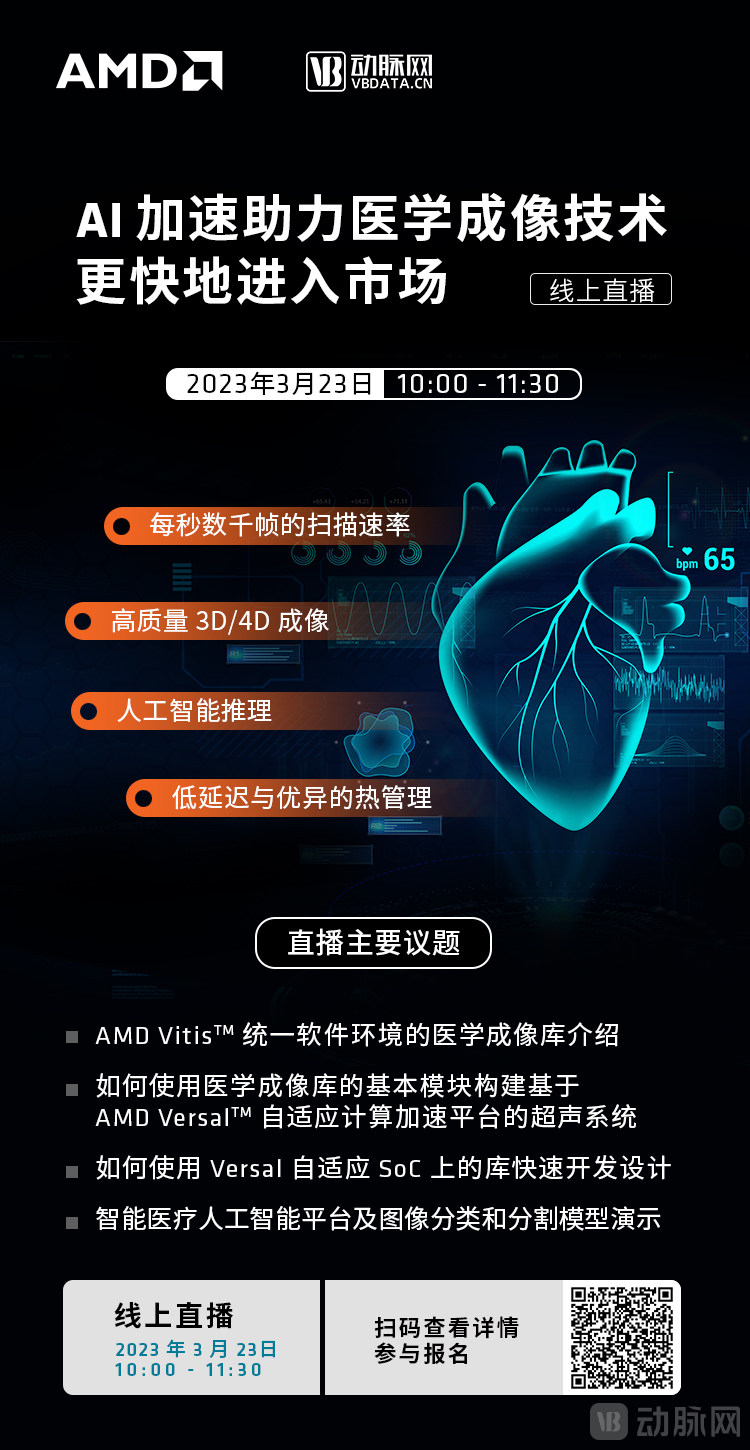
1. How to Build an Ultrasound System Based on the AMD Versal™ Adaptive Computing Acceleration Platform Using Basic Modules of the Ultrasound Library
2. How to Rapidly Develop Your Designs Using Libraries on Versal Adaptive SoCs – From Partner MK Labs
3. “Intelligent Medical AI Platform,” along with demonstrations of image classification and segmentation models – Partner: Spline.ai
Ultrasound Beamforming
CT Image Reconstruction
MRI Image Reconstruction Using 2D-FFT
Control of the Gradient Processor for MRI Magnets
Image Processing of Sampled/Digitized Data from X-ray Input
ECG, etc.
Weng Yuxiang (Trevor) Weng)
AMD Industrial and Vision Systems Architect
Weng Yuxiang (Trevor Weng)Currently a System Architect at AMD, responsible for market strategy, business development, and system solutions in the industrial and vision sectors across Greater China. He has over 16 years of experience in the medical, communications, video, embedded, and semiconductor industries.。

Scan or recognize the QR code below to register for this event.