

Backed by OrbiMed and RA Capital, Can 89bio Become the FGF21 Leader in NASH?

89bio
Developer of Candidate Drugs for the Treatment of Nonalcoholic Steatohepatitis
In the NASH therapeutic landscape, where no drugs have yet received marketing approval, target selection is highly diverse. Beyond the classic FXR, potential candidate targets include THR-β, PPAR, GLP-1, and FGF21. Among these, FGF21 has garnered significant expectations for the treatment of NASH.
FGF21 is an endogenous metabolic hormone secreted by the liver. Recent studies have confirmed that FGF21 has become one of the effective targets for the prevention and recovery of metabolic diseases. In the treatment of NASH, it can increase hepatic insulin sensitivity, stimulate fatty acid oxidation, and inhibit de novo lipogenesis. These benefits have prompted many companies to invest in the development of FGF21-based therapies.
Currently,Among companies developing new drugs for NASH targeting FGF21, Akero Therapeutics is the most advanced, followed closely by 89bio., In addition, Novo Nordisk's novel FGF21 drug has also entered the clinical stage.
While the industry holds high expectations for Akero, it also believes that 89bio’s product can compete head-to-head with Akero’s efruxifermin. This has made 89bio one of the most watched biotech companies in the NASH arena.

NASH Drug Developer Backed by Orbimed and RA Capital Goes Public Just One Year After Founding
In the NASH sector, small biotech companies focused on R&D have diverged into two categories. One category comprises companies founded around 2000 that have specialized in treating chronic liver diseases for over two decades, leveraging their founders’ academic achievements in hepatology and metabolism, with more than ten years of history in new drug development for NASH. The other category consists of newer companies established in recent years that have gone public at a faster pace; most of them pursue development by acquiring product pipelines from other pharmaceutical companies or obtaining technology licenses from research institutions, with 89bio being a representative example.
89bio was founded in 2018 and is dedicated to developing and commercializing innovative therapies for patients with liver and cardiometabolic diseases. Currently, non-alcoholic steatohepatitis (NASH) and severe hypertriglyceridemia (SHTG) are its key focus areas for new drug development. The company has only one product candidate in its pipeline: BIO89-100 (pegozafermin).89bio has deep ties with the Israeli generic drug manufacturer Teva Pharmaceuticals; the two executives who initially founded the company both came from Teva, and BIO89-100 was also acquired by the company from Teva.
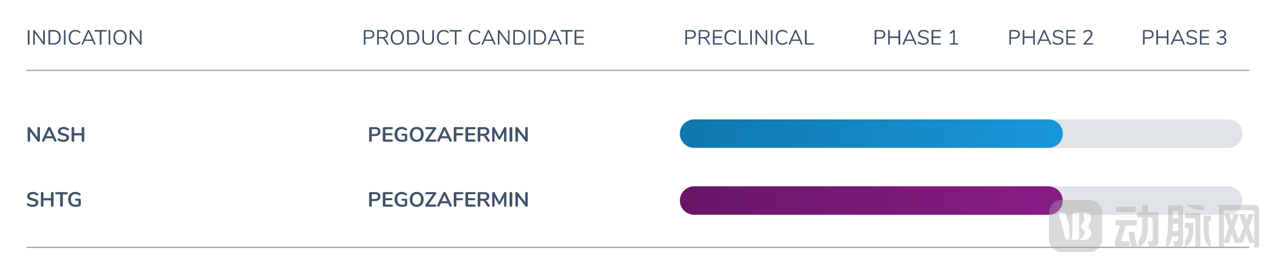
89bio’s Current Product Pipeline, Source: 89bio Official Website
Strong capital support fueled 89bio’s rapid growth. The company was initially founded by the investment firms OrbiMed Israel and OrbiMed US, completed its Series A financing in its inaugural year, and achieved a swift public listing just one year later. In October 2018, 89bio closed a $60 million Series A round led by OrbiMed Israel, OrbiMed US, and Longitude Capital, with participation from RA Capital and Pontifax. Backed by these prominent investment institutions, 89bio emerged as a rising star in the NASH field and successfully listed on the Nasdaq in November 2019.
Since its inception, 89bio’s product pipeline has advanced to Phase II clinical trials. This rapid progress is underpinned by the dedicated efforts of its founding team:
CEO Rohan Palekar boasts over 25 years of experience in operational management. During his 16-year tenure at Johnson & Johnson, he served as Vice President of Global Immunology, where he amassed extensive expertise in commercialization and strategic management. After leaving Johnson & Johnson, he joined Medivation, a renowned biotech company specializing in oncology, as Chief Commercial Officer (CCO), overseeing business development (BD), chemistry, manufacturing, and controls (CMC), and manufacturing operations. Medivation was subsequently acquired by Pfizer for $14 billion. Later, Rohan became President and CEO of Avanir, a company focused on central nervous system (CNS) diseases, leading it through a period of sustained dynamic growth until its acquisition by Otsuka Pharmaceutical in 2015. Although Rohan’s earlier career did not directly involve chronic liver diseases, his accumulated experience in the distinct therapeutic areas of oncology and CNS disorders laid a solid foundation for his transition into the field of chronic liver disease management and his leadership role at 89bio.

89bio CEO Rohan Palekar, Source: 89bio Official Website
Chief Medical Officer Hank Mansbach brings over 20 years of clinical experience. He previously served as the Head of Global Clinical Development for Metabolism and Neurology at Ultragenyx, an emerging biopharmaceutical company specializing in rare diseases. At Ultragenyx, he led the clinical development of novel therapies for rare inherited metabolic disorders, including liver diseases. Prior to joining Ultragenyx, Mr. Mansbach held key roles in new drug clinical development at several prominent pharmaceutical companies, such as Medivation, Valeant, and Cortex. Leveraging his extensive clinical experience in liver disease therapeutics gained at Ultragenyx, he plays a pivotal role in new drug design and clinical development at 89bio.

Hank Mansbach, Chief Medical Officer of 89bio. Source: 89bio official website
The team composition at 89bio resembles a group of like-minded old friends embarking on an entrepreneurial venture together. Its management team can be described as being anchored by Rohan Palekar and Hank Mansbach, with most members having previously worked alongside them. For instance, Paul Shin, Senior Vice President and Head of R&D Operations, held key positions at Valeant and Avanir; more importantly, he served as Vice President of Global Operations at Intercept Pharmaceuticals, a renowned NASH-focused biopharmaceutical company, where he oversaw the execution of Intercept’s global clinical programs. Ryan Martins, the Company’s CFO, previously served as Vice President at Ultragenyx. Melissa Abel, Vice President of Business Development, led the launch and commercialization of the blockbuster drug XTANDI during her tenure at Medivation.
As the team was formed by former colleagues, 89bio does not need to worry about internal friction and can instead improve efficiency by focusing on the development of new drugs for NASH.
Close on Akero’s Heels: The Runner-Up in FGF21
Discussions surrounding 89bio in the NASH landscape largely focus on comparing its product, pegozafermin, with Akero’s efruxifermin. If efruxifermin is considered the frontrunner among novel NASH therapies targeting FGF21, then pegozafermin is the runner-up for this target.
Pegozafermin utilizes proprietary glycoPEGylation technology to extend the biological activity of FGF21 while preserving the efficacy of native FGF21. Current clinical data demonstrate significant therapeutic efficacy, along with a marked improvement in safety—a longstanding concern for novel NASH therapies.
In May 2019, 89bio reported positive top-line data from the Phase I single ascending dose trial of pegozafermin. Pegozafermin demonstrated a favorable safety and tolerability profile in 58 healthy adult volunteers, with the most common adverse events being injection site reactions and headache, all of which were mild. The pharmacokinetic (PK) profile of pegozafermin was proportional to the dose, with a half-life of approximately 53–100 hours. At single doses of 9.1 mg and above, pegozafermin significantly improved key lipid parameters measured on Day 8 and Day 15 compared to baseline.
In September 2020, 89bio announced positive clinical results from the Phase 1b/2a study of pegozafermin. Measurements using magnetic resonance imaging–proton density fat fraction (MRI-PDFF) demonstrated significant reductions in liver fat at Week 13 across all dose groups, with decreases of up to 60% from baseline and up to 70% compared with placebo. Notably, pegozafermin is the first novel FGF21 therapeutic administered biweekly that elicits a patient response. Furthermore, pegozafermin was well tolerated at all doses.
In December 2022, 89bio published the latest results from its Phase 1b/2a study on pegozafermin for the treatment of NASH in The Lancet Gastroenterology & Hepatology. The data showed that, compared with the placebo group, weekly or biweekly administration of pegozafermin resulted in a statistically significant absolute reduction in liver fat content at Week 13. Up to 88% of patients achieved at least a 30% reduction in liver fat content. Furthermore, improvements in liver transaminases, liver fibrosis, and lipid parameters were observed with pegozafermin compared with placebo. In this study, pegozafermin was well tolerated, with no serious adverse events reported; the most common treatment-related adverse events were mild increased appetite, diarrhea, and headache.
Currently disclosed clinical study results indicate that pegozafermin significantly reduces hepatic fat content in patients, with a substantial proportion of patients achieving clinically meaningful responses, and robust outcomes observed in key liver biomarkers associated with NASH. In addition to demonstrating strong efficacy, pegozafermin has also shown good tolerability.
These positive clinical data have sparked multiple discussions within the industry on whether pegozafermin can surpass Akero’s efruxifermin. Currently,Efruxifermin’s clinical development is more than six months ahead of that of pegozafermin. Clinical results indicate that efruxifermin can simultaneously achieve hepatic steatosis resolution and fibrosis reversal, although this efficacy remains to be verified for pegozafermin.
However, in terms of dosing frequency and safety, pegozafermin appears poised to surpass competitors., Currently, the primary challenge for FGF21 is to extend its drug half-life. Efruxifermin extends its half-life through Fc fusion, enabling once-weekly subcutaneous administration, whereas pegozafermin leverages technological innovations to allow for once-weekly or even once-every-two-weeks dosing, while demonstrating a better safety profile than efruxifermin.
In June 2021, 89bio initiated the Phase 2b clinical trial of pegozafermin for the treatment of NASH, named ENLIVEN. This trial will evaluate the efficacy of pegozafermin on liver fibrosis in patients with biopsy-confirmed NASH.
Simultaneous Development in NASH and SHTG
Currently, 89bio’s pegozafermin is not limited to the treatment of NASH but is also being developed for the treatment of severe hypertriglyceridemia (SHTG).
Severe hypertriglyceridemia (SHTG) primarily refers to elevated levels of triglycerides, a type of non-cholesterol fat, which is associated with non-alcoholic steatohepatitis (NASH), cardiovascular disease, and acute pancreatitis. It is estimated that there are up to 4 million patients with SHTG in the United States. Among these patients, up to 56% have excessive hepatic fat, and up to 70% present with hypercholesterolemia or type 2 diabetes. Currently, although some therapies can lower triglyceride levels, they lack broader metabolic benefits.
For the new drug development targeting NASH and SHTG, 89bio has chosen to conduct clinical trials concurrently. However, the clinical trial progress for SHTG is expected to be faster.
In 2022, 89bio announced positive clinical results from the ENTRIGUE Phase II trial of pegozafermin for the treatment of severe hypertriglyceridemia (SHTG). Treatment with pegozafermin led to statistically significant improvements in key markers of cardiovascular risk, hepatic fat, and glycemic control.
In 2023, 89bio will reach two milestones. The company will announce the top-line results from its ENLIVEN Phase IIb clinical trial of pegozafermin for the treatment of NASH in the first quarter. Meanwhile, it will advance the Phase III clinical trial of pegozafermin for severe hypertriglyceridemia (SHTG), incorporating feedback from the FDA. Anticipation is high for the latest clinical data on 89bio’s novel NASH therapy.