

FDA Breakthrough Devices Program: Insights from Sub-10% Approval Rate and Dominance of Five Therapeutic Areas

EarliTec Diagnostics
Developer of Digital Diagnostics and Treatment Products

TransMedics
Portable Warm Blood Perfusion System Developer
Ankon
R&D and Manufacturing of Medical Devices

Fujirebio Diagnostics
A company specializing in in vitro diagnostics and biomarker production

United Imaging
High-end Medical Device Developer
In recent years, driven by policy support and capital investment, the overall level of China’s medical device industry has continued to improve. The industry has evolved from a nascent stage to comprehensive growth across all sectors, gradually achieving breakthroughs in core areas and key technologies, and even reaching internationally advanced levels in certain fields.
Of course, this does not mean that China’s medical device industry can rest on its laurels and expect smooth sailing ahead. Due to its late start, there remains a considerable gap between China and global leaders in innovation within the high-end medical device sector. Clearly recognizing this gap may better facilitate targeted remedies in the future.
Recently, the FDA and the NMPA successively released summaries of medical device innovation in 2022. VCBeat (WeChat ID: VCBeat) has compiled this information to clarify the differences between China and global leaders in the direction of medical device innovation, providing a reference for the industry.
After years of development, the United States maintains an unshakable position in medical device innovation. On one hand, the U.S. is home to the vast majority of the world’s leading medical device companies and makes massive investments in research and development. On the other hand, through a series of top-level institutional initiatives, the U.S. has removed barriers to innovation in higher education institutions, thereby unleashing their full potential.
In addition, regulatory authorities place significant emphasis on encouraging innovation. As the approval body for medical device marketing, the FDA launched the “Breakthrough Devices” program in 2018 to foster the development of innovative medical devices. This program covers reviews conducted under the Pre-Market Approval (PMA), Pre-Market Notification [510(k)], or De Novo classification request frameworks.
In simple terms, the risk level for a PMA is roughly equivalent to that of China’s Class III certification, typically requiring the completion of clinical trials and laboratory testing. The risk level for a 510(k) is comparable to China’s Class II certification; the basic process involves demonstrating that the device under application is substantially equivalent to a legally marketed predicate device by submitting a comparison with an already approved medical device on the market.
"So-called substantial equivalence means that the device under application is at least as safe as, or safer than, marketed products and does not raise any issues regarding safety and effectiveness. Therefore, this process can significantly improve approval efficiency."
If no substantially equivalent device can be identified for a low-to-moderate-risk medical device, an application may be submitted to enter the De Novo pathway. Once accepted into the De Novo pathway, subsequent 510(k) submissions may be filed, analogous to China’s Class II innovative medical devices.
“Breakthrough Devices” can significantly shorten the approval and market launch time for these medical devices, thereby replacing the previous Expedited Access Pathway (EAP) and Priority Review (PR).
To be included in the “Breakthrough Devices” list, the following criteria must be met.
| Standard | Requirements |
| Primary Criteria | The device provides more effective treatment or diagnosis for life-threatening diseases or conditions that would otherwise lead to irreversible human debilitation. |
| Minor Criteria | The device must also meet at least one secondary criterion. |
| 1. Represents breakthrough technology | |
| 2. No approved regimens or alternatives | |
| 3. Demonstrates significant advantages compared to existing approved or alternative solutions | |
| 4. Device availability aligns with the best interests of patients |
Given the global leadership of U.S. medical devices, the FDA’s “Breakthrough Device” designation effectively represents the pinnacle of global innovation in the medical device industry.
In addition to “Breakthrough Devices,”In 2021, the FDA also established the “Safe Technology Program” (STeP) to cover medical devices that do not qualify for the Breakthrough Devices Program. While these devices feature innovations, they typically target conditions that are not severe enough to meet the urgency criteria for “Breakthrough Devices.”。
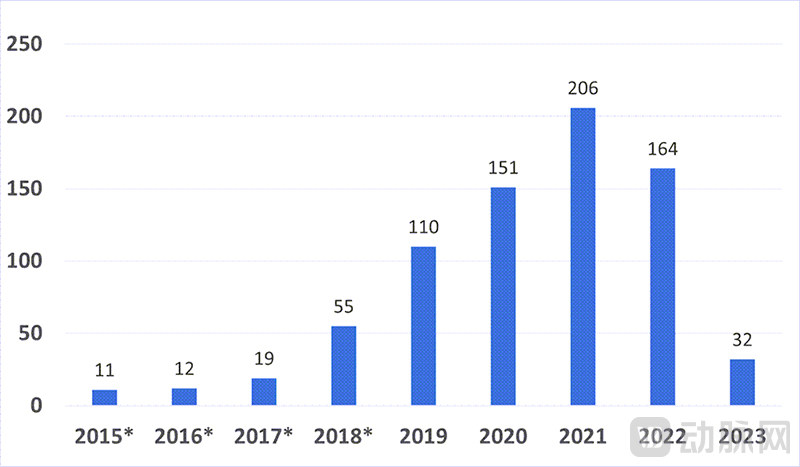
From 2015 through December 31, 2022 (with devices previously included under the EAP program also counted by the FDA), a total of 760 medical devices have been included in the “Breakthrough Devices” list.Of these, eight were approved by the Center for Biologics Evaluation and Research (CBER), which oversees biological products, while the remaining 752 were approved by the Center for Devices and Radiological Health (CDRH), which regulates medical devices and digital health.
Distribution of FDA “Breakthrough Devices” by Year (This chart is categorized by FDA fiscal year, corresponding to the calendar year ending December 31, 2022; image source: FDA official website)
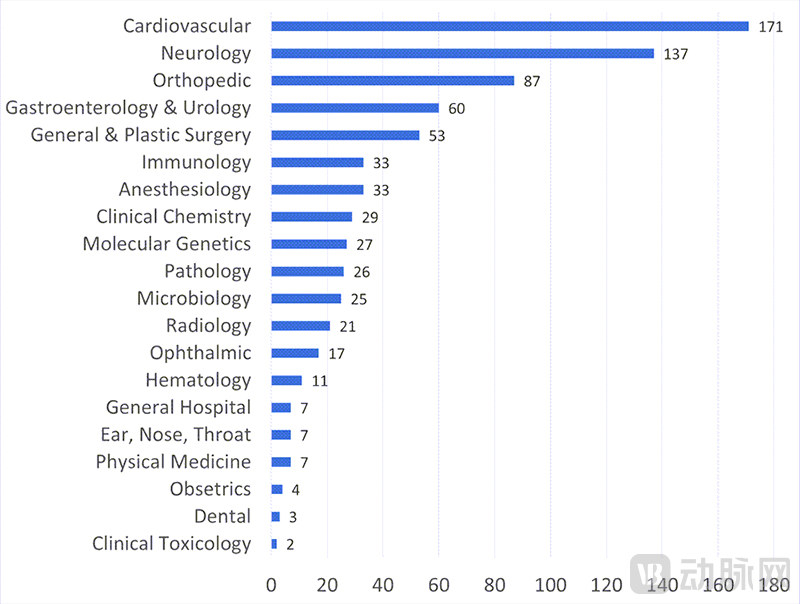
If categorized by field, “Breakthrough Devices” can be divided into 20 fields. Among these,Cardiovascular “Breakthrough Devices” numbered the highest, with a total of 171 devices over the years. This was followed by neurological “Breakthrough Devices,” with 137 devices. Next were orthopedics (87), gastroenterology (60), and plastic surgery (53).。
The cumulative number of “Breakthrough Devices” in these five areas reached 508, accounting for as high as 66.8%.This also represents the primary directions and trends in global innovation for top-tier medical devices.
Distribution of FDA “Breakthrough Devices” (by therapeutic area, as of December 31, 2022; image source: FDA website)
However, although the shortlist appears extensive, only a small number of candidates actually gain approval for market launch.Since 2015, only 62 “Breakthrough Devices” have received FDA marketing approval, with an approval rate of merely 8.9%.。
In 2022, a total of 19 “Breakthrough Devices” were ultimately approved for market launch. These included the first IVD device for the early diagnosis of Alzheimer’s disease, the first device to use eye-tracking technology for assessing ASD in children, and the world’s only system available for DCD heart transplantation.
The First IVD Device for Early Diagnosis of Alzheimer's Disease
Fujirebio Diagnostics’ Lumipulse G ß-amyloid ratio is the first in vitro diagnostic test device for the early detection of amyloid plaques associated with Alzheimer’s disease, and can be used to assess whether the cause of cognitive decline in patients aged 55 and older with cognitive impairment is related to Alzheimer’s disease.
The Lumipulse test helps physicians initially screen for potential cerebral amyloid plaques by measuring the ratio of β-amyloid 1-42 to β-amyloid 1-40 concentrations—specific proteins found in human cerebrospinal fluid (CSF) that can accumulate and form plaques—in conjunction with other clinical assessments, thereby guiding subsequent diagnostic and therapeutic decisions.
Prior to the market approval of this innovative medical device, physicians could only rely on imaging equipment to detect amyloid plaques in the brains of patients with cognitive impairment. For patients, imaging scans are time-consuming, costly, and carry radiation risks. The Lumipulse G ß-amyloid ratio test can be completed and reported within a single day, is relatively affordable, and poses no potential radiation risk, offering a valuable option for the early diagnosis of Alzheimer’s disease.
First Application of Eye-Tracking Technology to Assess ASD in Children
EarliTec Diagnostics’ EarliPoint System innovatively employs eye-tracking technology for the assessment of autism spectrum disorder (ASD) in children aged 16 to 30 months.
This system leverages Dynamic Quantification of Social-Visual Engagement (DQSVE) to capture subtle behavioral cues in children—often imperceptible to the naked eye—while they watch a series of short video clips depicting social interactions among children, thereby assessing their attention and responsiveness. The assessment is conducted by trained technicians in a setting where a child views these short videos of peer social interactions.
Eye-tracking technology assesses each fixation point at a rate of 120 times per second, then compares each data point with thousands of discrete measurements in a clinically validated database. By leveraging patented analytical techniques to contrast the results against age-expected reference metrics, it provides an EarliPoint Severity Index associated with levels of social disability as well as verbal and non-verbal abilities, thereby enabling early identification of children with ASD.
The World’s Only System for DCD Heart Transplantation
TransMedics’ independently developed portable organ preservation system, the Organ Care System (OCS) Heart System, is the first device capable of preserving hearts donated after circulatory death in a warm, beating state. It is also the only FDA-approved device for preserving both standard and extended-criteria donor hearts, and remains the world’s only system available for DCD heart transplantation.
The timeliness of organ transplantation is critically important; for instance, the heart can only tolerate up to 8 hours of cold ischemia time. Prolonged exposure to cold ischemia will result in permanent damage. Clinically, organs are typically preserved using the "static cold storage" method. This involves flushing the organ with a preservation solution immediately after procurement from the donor, followed by placing it in a refrigerated container to slow down metabolic processes through hypothermia.
However, this approach has gradually revealed certain limitations, such as impaired organ function following prolonged cold storage and the inability of clinicians to monitor organ functional status. Therefore, employing mechanical perfusion to recreate an in vivo-like environment ex vivo, thereby maintaining normal organ metabolism, represents a new direction in organ preservation technology.
Organ Care System (OCS) Heart System simulates human metabolic conditions by perfusing the organ with warm, oxygenated, nutrient-rich blood, thereby reducing ischemic time and maintaining organ viability. Physicians can also use this system to monitor organ function and viability in real time, assessing its suitability for transplantation.
Notably, the NMPA also recently released China’s 2022 Summary of Medical Devices and reviewed the registration and approval process for innovative medical devices.
In 2022, a total of 343 medical devices applied for the Special Examination and Approval Procedure for Innovative Medical Devices, representing a 37.8% increase from 2021. Among these, 68 were approved to enter the special review process for innovative medical devices, slightly more than the previous year. Fifty-five devices gained approval through the innovative medical device channel, marking a substantial 57.1% increase year-on-year.。
From 2014 to 2022, the NMPA approved a total of 189 Class III innovative medical devices. Among these, domestically produced innovative medical devices were developed by 134 enterprises across 15 provinces, while imported innovative medical devices were supplied by 8 enterprises from 2 countries.
2019 marked the first year of implementation of China’s new regulations on innovative medical devices. Since then, innovation in China’s medical device sector has gradually gained momentum, with year-on-year increases in the number of applications, entries into the review process, and final approvals. In 2022, all these indicators reached historic highs, surpassing even the pre-regulation peaks of 2017 (for entries into the review process) and 2018 (for application volumes). Quantitatively speaking, enthusiasm for innovation within the medical device industry has indeed been ignited.
| Year | Number of Applications | Enter the program | Approved |
| 2017 | 273 | 63 | 12 |
| 2018 | 316 | 45 | 21 |
| December 1, 2018: New Regulations Implemented | |||
| 2019 | 179 | 36 | 19 |
| 2020 | 197 | 54 | 26 |
| 2021 | 249 | 62 | 35 |
| 2022 | 343 | 68 | 55 |
In fact, this figure only represents the National Medical Products Administration’s statistics for Class III innovative medical devices. If Class II innovative medical devices approved by local administrations are included, the total number would be significantly larger. According to incomplete statistics from VCBeat, at least 89 Class II medical devices were included in local innovation review programs by various local administrations in 2022.
It should be noted that the approval processes for innovative medical devices vary across different regions. For instance, some regions have established specific approval procedures for Class II innovative medical devices, while others include innovative medical devices within their priority review pathways for medical devices.
In terms of sheer quantity, innovation in China’s medical device sector indeed presents a vibrant landscape. However, as the industry still requires further development, a significant number of “first-in-China” innovative medical devices remain at the stage of filling domestic gaps, with relatively few achieving the evaluation standard of “matching the performance metrics of international counterparts.” Overall, it is an objective fact that China’s medical device industry still lags behind the global advanced level to some extent.
Nevertheless, in 2022, several approved innovative medical devices worthy of mention achieved industry-leading standards in technology and design, as reflected in the evaluations issued by the National Medical Products Administration (NMPA).
The World’s First Capsule Robot to Improve Functional Constipation Through Intracorporeal Vibration
This product was launched by Shanghai Anhan Medical Technology Co., Ltd. It successfully entered the innovative medical device approval process in 2018 and received final approval from the National Medical Products Administration (NMPA) in February 2022. The NMPA recognized it as “the first of its kind, with no similar products currently marketed either domestically or internationally.”
Currently, although various treatment options are available for constipation, challenges persist, including high prevalence, significant treatment-related side effects, high recurrence rates, and low patient satisfaction. This single-use gastrointestinal vibrating capsule stimulates the colonic wall through vibration to promote colonic peristalsis, offering a novel non-pharmacological therapeutic option for adult patients with functional chronic slow-transit constipation who have responded inadequately to pharmacological treatments.
The World's First Dual-Source, Dual-Detector Dental CBCT
This innovative medical device from Beijing LargeV Instrument Co., Ltd. was included in the Innovative Medical Device Approval Program in 2020 and received approval in July 2022. It is “the world’s first dual-source, dual-detector oral CBCT product” (NMPA evaluation). Its core technology is dual-source imaging, which enhances spatial resolution through small-focus, high-power X-ray tube heads and high-resolution detectors. While meeting the imaging needs of the oral and maxillofacial region, it also provides cone-beam computed tomography (CBCT) examinations for otolaryngological diseases.
It features two imaging systems with large and small fields of view. The large-field-of-view imaging system is suitable for routine imaging examinations of the oral and maxillofacial region, nasal cavity, and pharyngolaryngeal airway, while the small-field-of-view imaging system offers high spatial resolution for imaging examinations of internal ear structures (middle ear and inner ear).
Prior to this, hospitals primarily relied on general-purpose CT scanners for ear imaging, which suffered from limitations such as insufficient resolution, failure to visualize key structures, and difficulty in detecting occult lesions. The introduction of this innovative medical device effectively addresses the challenge of inadequate imaging of fine otological anatomical structures with general-purpose CT, thereby advancing basic research and clinical diagnosis and treatment of ear diseases.
Rapidly Approved 5.0T Whole-Body MRI System Leads Globally
This device, launched by Shanghai United Imaging Healthcare Co., Ltd., was approved to enter the Innovative Medical Device Program in early 2022. Its core technology “has independent intellectual property rights, and key performance indicators have reached an internationally leading level” (NMPA evaluation). It received rapid approval in August 2022, with the entire review process taking less than a year—a rarity among innovative medical devices.
Time-of-flight magnetic resonance angiography at 3.0T can clearly depict cerebrovascular structures and is currently the first-line non-invasive cerebrovascular imaging technique in clinical practice. However, its suppression of background tissue signals is suboptimal, and its ability to evaluate distal branches of large vessels and small perforating arteries fails to meet clinical demands. Ultra-high-field 7.0T technology can address this limitation, but the increased field strength leads to greater B1 field inhomogeneity and heightened physiological discomfort in subjects.
The 5.0T MRI system achieves a balance, breaking through the limitation of ultra-high-field MRI being restricted to brain imaging for the first time, and enabling ultra-high-field whole-body clinical imaging; in neurological imaging, it rivals even higher-field equipment, providing more diagnostic information for cerebral small vessel disease and degenerative lesions.
A comparison of the approval processes for innovative medical devices in both countries clearly shows that while China’s medical device innovation still has room for improvement relative to global advanced standards, its rapid momentum in recent years is an indisputable fact.
A comparison of the FDA’s Breakthrough Devices Program and the NMPA’s Innovative Medical Device approval process reveals that the FDA adopts a “lenient entry, strict exit” approach. Although a substantial number of devices have been included in the program over the years, only 8.9% ultimately secured marketing authorization.
In contrast, the approval process for innovative medical devices in China differs. Based on aggregated statistics from previous years, the pass rate for gaining entry into the Innovative Medical Device Program is approximately 21%, while the success rate for obtaining a medical device registration certificate after entering the approval process reaches as high as 51%. If Class II innovative medical devices approved by local regulatory bureaus are also included, the overall pass rate may be even higher.
However, given that China’s innovative medical devices are currently in the stages of domestic substitution, incremental innovation, and follow-on innovation, this situation is entirely normal.
It is worth noting that innovative medical devices in China exhibit a significantly high degree of homogenization. Taking products that entered the innovative medical device approval pathway in 2022 as an example, cardiovascular innovative medical devices constituted the largest category, accounting for more than half of the total. In contrast, although cardiovascular devices also represent the largest category among “Breakthrough Devices” in the United States, their proportion differs substantially.
Furthermore, in 2022, the number of surgical robots included in the list of innovative medical devices was second only to that of cardiovascular devices; however, whether these products can fully meet clinical needs remains to be further observed.
This phenomenon also reflects the gap between China’s medical device innovation and the global cutting-edge level, spanning R&D investment, translation of scientific research, strengthening of basic sciences, and subsequent productization and commercialization. There is still a considerable way to go for China in medical device innovation.
The good news is that, driven by substantial demand, the state is placing increasing emphasis on innovation in medical devices. The ongoing implementation of new healthcare infrastructure initiatives also presents significant opportunities for leading domestic enterprises. Meanwhile, supportive policies, including incentives for domestic substitution and preferential reimbursement under the national health insurance scheme for innovative medical technologies, enable innovative achievements to realize commercial value in a shorter timeframe, thereby facilitating rapid growth. Furthermore, backed by China’s robust manufacturing foundation, the innovation of medical devices enjoys a solid basis for development.
We believe that innovation in China’s medical device industry will inevitably achieve stronger growth in the future and ultimately secure a significant position in the global landscape.