

Fallen Star in the NASH Biotech Arena: Is Combination Therapy Hype or Hope?

Metacrine
Clinical-stage biopharmaceutical company
Countless multinational corporations (MNCs) and biotech companies have suffered setbacks in the field of non-alcoholic steatohepatitis (NASH). To tackle this indication with significant unmet clinical needs, large multinational pharmaceutical companies often maintain multiple product pipelines to mitigate the risk of candidate failure. However, biotech firms with only a few or even a single pipeline are not so fortunate.
Metacrine, once a rising star in the NASH field, garnered significant attention for its combination therapy of the FXR agonist MET409 and the SGLT2 inhibitor for treating NASH. However, it also exemplifies the failures of biotech companies in developing new drugs for NASH. Although Metacrine has now suspended its investments in the NASH sector, this development has once again focused attention on combination therapies in NASH drug development.

Once Highly Anticipated by Renowned Investment Firms
Metacrine, founded in 2015, is dedicated to discovering and developing differentiated therapies for patients with liver and gastrointestinal (GI) diseases. The company shares a commonality with Intercept in that both center their novel drug development efforts on the farnesoid X receptor (FXR).
Metacrine started from a high vantage point; its FXR agonist technology originated from the renowned Salk Institute, one of the most prolific and highest-quality life sciences research institutions in the United States, where several Nobel laureates have worked. Bolstered by such cutting-edge scientific achievements, Metacrine was welcomed by the capital market at its inception.
Prior to its Nasdaq IPO in 2020, Metacrine completed three rounds of financing totaling $173 million:
Completed a $36 million Series A financing round in 2015, with investors including Arch Venture Partners, EcoR1 Capital, Polaris Partners, and venBio;
In 2017, the company completed a $22 million Series B financing round led by New Enterprise Associates (NEA), with participation from ARCH, Polaris, venBio, and Alexandria Venture Investments;
In 2018, the company completed a $65 million Series C financing round, led by Venrock Healthcare Partners, with participation from Franklin Templeton Investments, Deerfield Management, Arrowmark Partners, Invus, Lilly Asia Ventures, Vivo Capital, and others.
In these three rounds of financing,Notable investors include Polaris Partners, Franklin Templeton Investments, and Lilly Asia Ventures., it is evident that Metacrine was once highly regarded by the industry and even held the potential to become an emerging unicorn in the NASH field.
Backed by robust cash flow, Metacrine has established a proprietary library comprising more than 2,500 FXR compounds and selected the two most novel candidates for drug development. These are MET409 and MET642, the two pipeline assets in which Metacrine places high hopes for the future, as they enableMetacrine Has Two Core Selling Points:
First, both drugs are oral FXR agonists, but their chemical structures are distinctly different from other FXR agonists. They focus on two major indications—NASH and IBD (inflammatory bowel disease)—and hold the potential to improve the tolerability and therapeutic efficacy of FXR agonists;
More importantly, Metacrine is not only focused on the efficacy of monotherapy but also aims to demonstrate significant potential in combination therapies. Therefore, while advancing MET642 as a monotherapy for NASH, the company is also conducting clinical trials of MET409 in combination with SGLT2 inhibitors, a class of diabetes medications, for the treatment of NASH.
At this point, Metacrine still had a very promising outlook.
Meteor Falls: Poor Clinical Trial Results, Strategic Restructuring, 50% Workforce Reduction
Metacrine’s Turning Point Came in 2021, When Two Clinical Trials Failed in Succession.
In October 2021, Metacrine reported interim results from the Phase IIa clinical trial of MET642 in patients with non-alcoholic steatohepatitis (NASH). The data showed that MET642 reduced hepatic fat content, with a mean relative reduction of 26.9 ± 27.8% in the 3 mg group and 9.3 ± 55.8% in the 6 mg group, compared with 7.5 ± 21.0% in the placebo group.This clinical outcome was not impressive; the reduction in liver fat showed a weak correlation with dose. The efficacy of the high-dose group in reducing liver fat content might have been lower than that of the low-dose group, and it did not even demonstrate a significant difference compared to the placebo group.
This clinical outcome directly prompted Metacrine to announce a strategic reprioritization—pausing the development of MET642 in the NASH field and prioritizing its advancement into Phase II clinical trials for the treatment of IBD.
The setbacks did not end there. In November 2021, Metacrine reported the results of its Phase IIa clinical trial evaluating MET409 in combination with SGLT2 inhibitors for the treatment of patients with type 2 diabetes and NASH. The data showed thatThere was no difference in efficacy between MET409 combination therapy and MET642 monotherapy, either in terms of the reduction in liver fat content or changes in low-density lipoprotein levels.Combination therapy also failed to reverse Metacrine’s decline in the NASH field. Since then, MET409 has not appeared in any of Metacrine’s news releases.
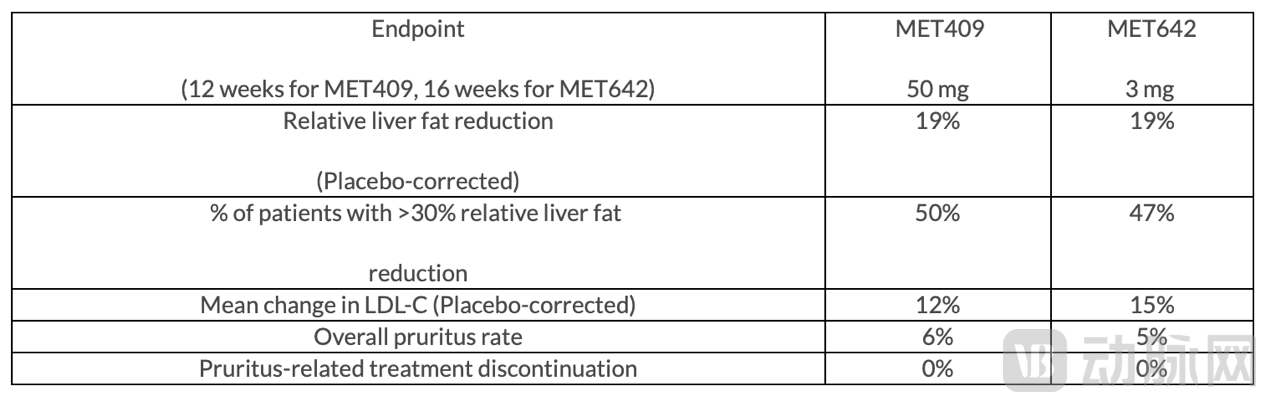
Comparison of Clinical Data Between MET409 Combination Therapy and MET642 Monotherapy, Source: Metacrine Official Website
The setbacks from clinical trial failures were far-reaching. The announcement of the failure of the MET642 clinical trial caused the company’s stock price to plummet by more than 50% at the time. In the aftermath, Metacrine’s share price remained depressed and continued to decline, ultimately forcing the company to announce a 50% workforce reduction in early 2022. The team, which originally comprised 35 employees, was reduced to just over a dozen.
In addition to layoffs, the departure of key senior executives appears to have left Metacrine hanging by a thread. Chief Medical Officer Hubert Chen resigned on December 31, 2021, leaving his responsibilities to be assumed by CEO Preston Klassen. General Counsel and Executive Vice President Catherine Lee resigned on January 28, 2022, and one month later, Chief Financial Officer Trisha Millican also stepped down from her position. Currently, Metacrine’s website lists only three executives: CEO Preston Klassen, Chief Business Officer Michael York, and Vice President of Human Resources Theresa Lowry.
Talent drain is only one aspect; unhealthy cash flow has also left Metacrine in a precarious position. As of December 21, 2021, Metacrine held $76.4 million in cash. The company had stated that its layoff measures would provide sufficient cash runway to last through 2023. However, by September 30, 2022, Metacrine’s cash and cash equivalents had declined to $52.8 million. While this amount is sufficient to support the completion of the Phase II clinical trial of MET642 for the treatment of inflammatory bowel disease (IBD), the company’s future remains uncertain, and Metacrine faces severe survival challenges.
The Path to Exploring Combination Therapies for NASH
Metacrine’s failure, which seems “all too common” in the NASH field, has once again prompted the industry to reconsider the likelihood of success for combination therapies in NASH.As of now, no monotherapy for NASH has emerged as a clear winner. How high can the success rate of combination therapies truly be? And can their efficacy surpass that of monotherapies?
As NASH is a chronic, progressive disease with complex mechanisms and multiple risk factors, the industry consensus is that monotherapy is not the sole approach. Theoretically, combining drugs with complementary mechanisms of action is more likely to improve efficacy and patient adherence while potentially reducing side effects. Consequently, combination therapy has become one of the key pathways being actively explored by companies focused on NASH.
Currently, the most common approach for treating NASH involves the combination of FXR agonists with either SGLT2 inhibitors or THR-β agonists. This is why Metacrine’s MET409 combination therapy has attracted significant attention. Although its ultimate failure has once again cast a shadow over combination therapies, it has further strengthened pharmaceutical companies’ resolve to conquer NASH.
Both multinational corporations (MNCs) and biotech companies have increasingly begun to strategize around combination therapies for non-alcoholic steatohepatitis (NASH). Internationally, Gilead Sciences and Novo Nordisk announced in 2021 a strategic partnership to conduct clinical trials evaluating the efficacy of a fixed-dose combination regimen comprising Novo Nordisk’s GLP-1 receptor agonist semaglutide, Gilead’s FXR agonist cilofexor, and its ACC inhibitor firsocostat. The resulting clinical data are highly anticipated.
Furthermore, Pfizer has conducted Phase II studies on the combination therapy for NASH in multiple countries, including China. The regimen combines the ACC inhibitor PF-05221304 with the DGAT2 inhibitor PF-06865571 (ervogastat). This combination received FDA Fast Track designation in May 2022, and Phase IIa clinical results demonstrated that it reduces hepatic fat while exhibiting a favorable safety and tolerability profile.
In China, combination therapies for NASH are emerging in large numbers. Ganlai Pharmaceutical, a subsidiary of Ascletis Pharma, is conducting research on the combination of the THR-β agonist ASC41 and the SCD1 inhibitor Aramchol for the treatment of NASH. Meanwhile, Ascletis Pharma is also developing three combination therapy regimens for NASH: ASC43F (THR-β + FXR), ASC44F (FASN + FXR), and ASC45F (FASN + THR-β). In addition, Treeline Biosciences is also carrying out research on the combination of an FXR agonist and a THR-β agonist.
Of course, in addition to the failure of Metacrine’s combination therapy, Gilead previously conducted a Phase II study combining the non-steroidal FXR agonist cilofexor (GS-9674) and the ACC inhibitor firsocostat (GS-0976), which ultimately ended in failure. Early studies showed that this combination could reduce liver fat in patients; however, it did not meet the primary endpoint of improving fibrosis in patients with severe liver fibrosis (stages F3–F4). Furthermore, there were alsoMultinational corporations (MNCs) such as Novartis have chosen to fully exit the NASH therapeutic area, with their FXR agonist candidate tropifexor having been abandoned by Novartis.tropifexorThe combination therapy with the dual SGLT1/2 inhibitor LIK066 (licogliflozin) was also subsequently terminated.
In the NASH therapeutic arena, where no monotherapy has yet reached the market, combination regimens remain to be explored and validated. Although Metacrine’s failure in developing a combination therapy for NASH is not an isolated incident, it does provide valuable lessons for pharmaceutical companies pursuing similar strategies. With NASH monotherapies on the verge of successful commercial approval, perhaps combination therapies, after enduring setbacks, will ultimately deliver even greater surprises.