

Velsera Files IPO Prospectus: Summa Equity-Backed Precision Medicine Platform Formed from Merger of Seven Bridges, Pierian, and UgenTec

Summa Equity Fund
Private Equity Investment Firms

Velsera
Precision Medical Technology Researcher
A prominent, oversized image on Velsera’s official website displays the company’s vision in dynamic motion.
It resembles an endlessly looping Möbius strip, flowing and creating, seemingly boundless in its possibilities.
In January 2023, at the J.P. Morgan Healthcare Conference, the precision medicine company Velsera announced its establishment. The company was founded on the philosophy of providing researchers, scientists, and clinicians worldwide with an uninterrupted flow of knowledge, thereby fostering a virtuous cycle that drives continuous innovation.
Investment fund Summa Equity acquired Pierian, Seven Bridges, and UgenTec for an undisclosed amount and merged them into Velsera.
Velsera is headquartered in Boston, United States, and employs more than 800 people worldwide. It will leverage the scientific, technological, and informatics capabilities of three companies to create a software platform that delivers precision medicine services. Furthermore, Velsera aims to reduce the healthcare burden on the general public by lowering the costs associated with diagnosis, treatment, and drug development.
Hans Cobben, Partner at Summa Equity and Chairman of the Board of Velsera, stated that the merger of the three companies “will accelerate innovation and deliver transformation at a staggering scale.”
In Velsera’s blueprint, “precision medicine” is repeatedly highlighted. As early as 2017, Mark Zuckerberg began to recognize the urgent need for advancements in precision medicine. He and his wife, Priscilla Chan, donated $10 million to the Institute for Computational Health Sciences at the University of California, San Francisco, to establish a database for precision medicine.
Velsera’s establishment has further fueled the growth of precision medicine.
News of the acquisitions of Seven Bridges, Pierian, and UgenTec emerged from across the Atlantic.
Summa Equity, the driving force behind the establishment of Velsera, is one of Europe’s most prominent impact investment funds. Since its inception in 2016, Summa Equity has focused on investing in companies that address global challenges and generate positive environmental, social, and governance (ESG) outcomes for society.
Previously active exclusively in Europe, Summa Equity opened a new office in Palo Alto, United States, in the summer of 2022. As its first office outside Europe, this move marked the beginning of its “gold rush” in North America.
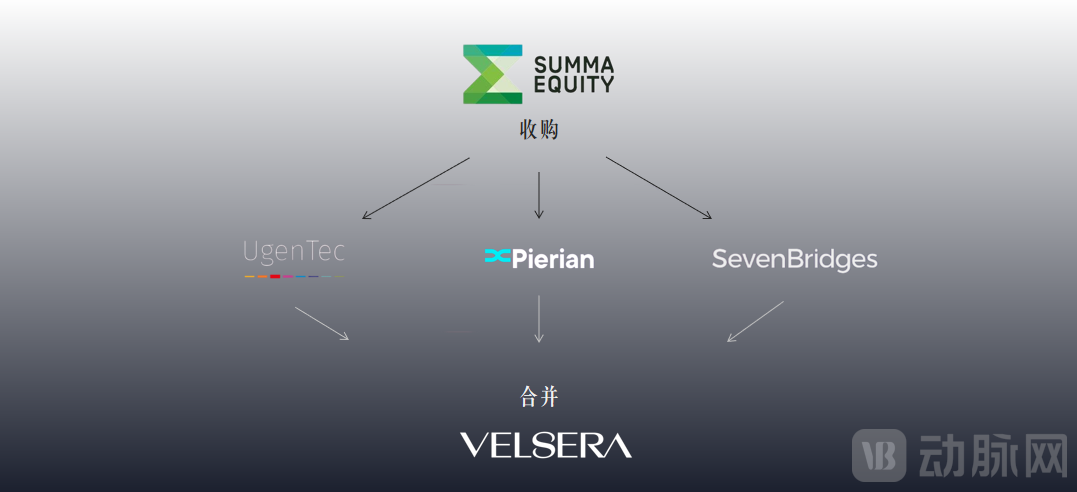
Summa Equity Acquires Three Companies, Merging Them into Velsera
Among the three companies, Seven Bridges is the most well-known. Founded in 2009 and headquartered in Boston, Massachusetts, Seven Bridges is a biomedical data analytics company that provides genomic research infrastructure for drug development. Its cloud platform offers genomic analysis and other forms of biomedical data analytics services.
Over the past 13 years since its founding, Seven Bridges has attracted significant capital investment, raising a total of $113 million across four rounds of financing.Leveraging its cloud platform, Seven Bridges has successfully provided services for the UK Government’s 100,000 Genomes Project, cancer genomics research at the U.S. National Cancer Institute, and personalized medicine initiatives at Stanford University.
Pierian was founded in 2014, leveraging the University of Washington’s gene sequencing technology. It is a digital diagnostics company specializing in clinical genomics technologies and services, providing analytical tools to laboratories worldwide.Pierian collaborates with clinicians and healthcare institutions worldwide to establish clinical genomics programs and a global sharing network. Additionally, Pierian leverages machine learning algorithms to analyze intelligent correlations between diverse information sources and individual patients’ genetic results, thereby providing advanced genomic insights and enabling more precise care.
Founded in 2014, UgenTec is a bioinformatics company headquartered in Hasselt, Belgium. It specializes in developing diagnostic software for DNA interpretation and analysis, aiming to fundamentally simplify PCR testing, and has received multiple awards.
Summa Equity has merged three companies specializing in digital diagnostics, bioinformatics, and healthcare data into Velsera, aiming to enhance medical diagnostics and precision medicine services. Concurrently, Velsera’s leadership team has undergone corresponding adjustments.
Gavin Nichols, CEO of Velsera, has over 30 years of proven success in business strategy and operations, with more than 20 years of experience in the healthcare and pharmaceutical industries. Prior to joining Velsera, Gavin served as CEO of Calyx, a medical imaging and eClinical company and a subsidiary of Parexel. He also spent over a decade as Vice President at Quintiles and has worked for companies such as Capgemini, Bioclinica, and Perspectum Diagnostics.
As CEO of Velsera, he will lead a diverse team of industry experts to advance the value cycle among precision medicine, clinical testing, healthcare, and knowledge sharing.
Tres Thompson serves as Chief Financial Officer at Velsera. He brings extensive experience in operations, sales, and business development within the fintech and healthcare information technology sectors. Prior to joining Velsera, he served for nearly six years as Chief Financial Officer and Chief Operating Officer at Symplr, a leading healthcare credentialing software company.
Velsera’s Chief Scientific Officer, Davis-Dusenbury, has brought scientific strength to the company. As the former CEO and CTO of Seven Bridges, she led and collaborated on the development of data analytics. Her articles have been published in top journals such as Nature and Cell.
Why Precision Medicine Is So Important
Precision medicine is an emerging approach to disease treatment and prevention. It takes into account individual differences in each person’s genes, environment, and lifestyle. This approach enables doctors and researchers to more accurately predict which populations will benefit from specific treatment and prevention strategies for particular diseases.
For example, many cancers can be prevented through lifestyle modifications, such as smoking cessation, weight and dietary improvements, and reduced alcohol consumption. Meanwhile, many cancer patients may also be influenced by genetic factors, specifically a hereditary susceptibility to carcinogenic agents.
With greater access to medical data and enhanced computational processing capabilities, researchers are able to explore the relationships among genes, drugs, and populations within massive datasets, uncovering the secrets of how genes influence individual development or specific diseases. This is the vision of precision medicine.
Today, the academic community is particularly active within the precision medicine ecosystem, with numerous researchers dedicating significant efforts to integrating breakthroughs in computer science and engineering with laboratory work and clinical findings. Similarly, a large number of pharmaceutical companies are heavily investing in precision medicine research to expand their drug portfolios.
For years, physicians have been able to tailor medical care to individual patients based on factors such as age, gender, preferences, mobility levels, community resources, and pre-existing conditions.
“The precise assessment of complex situations” differs from true “precision medicine” in that precision medicine relies on data, particularly genomic data, to determine specific therapeutic pathways for individuals. Genomic data is a relatively recent addition to physicians’ clinical practice.
Genetic testing is becoming faster and more affordable, providing researchers with the opportunity to collect large volumes of data from a more diverse patient population.By integrating these data with clinical, pharmacological, and socioeconomic information and subsequently analyzing the combined datasets, researchers and clinicians can identify effective specific treatment patterns and determine genetic variants potentially associated with therapeutic response. Clinical trials can then be employed to test and validate these hypotheses. If the results meet rigorous scientific standards, physicians can incorporate these specific therapeutic indications into their clinical decision-making.
It is worth noting that “precision medicine” is also known as “personalized medicine.” The term “personalized medicine” may be misunderstood to imply that every unique patient can receive fully individualized treatment, but this is not the case.
In its 2011 report, Toward Precision Medicine, the U.S. National Research Council pointed out:
Precision medicine refers to medical services tailored to the individual characteristics of each patient. This does not mean creating drugs or medical devices unique to each patient, but rather stratifying individuals into different subgroups that exhibit varying susceptibilities to specific diseases or differing responses to specific treatments... It should be emphasized that in “precision medicine,” “precision” means “accurate” and “exact.”
Velsera aims to connect healthcare and life sciences research, providing researchers, scientists, and clinicians with a dynamically flowing precision medicine ecosystem.
Velsera’s new data and analytics technologies can help customers identify unique disease risks and the most suitable personalized treatment options. This ensures that the right treatment is delivered to the right patient at the right time, thereby improving patient outcomes and efficiency.
This means that Velsera’s new platform enables the free flow of knowledge between clinical practice and R&D. As research findings are translated into diagnostics, and patient outcomes in turn drive new breakthroughs in research, the entire system generates a virtuous cycle.
Driving the Value Cycle, Empowering Innovation in the Medical Community
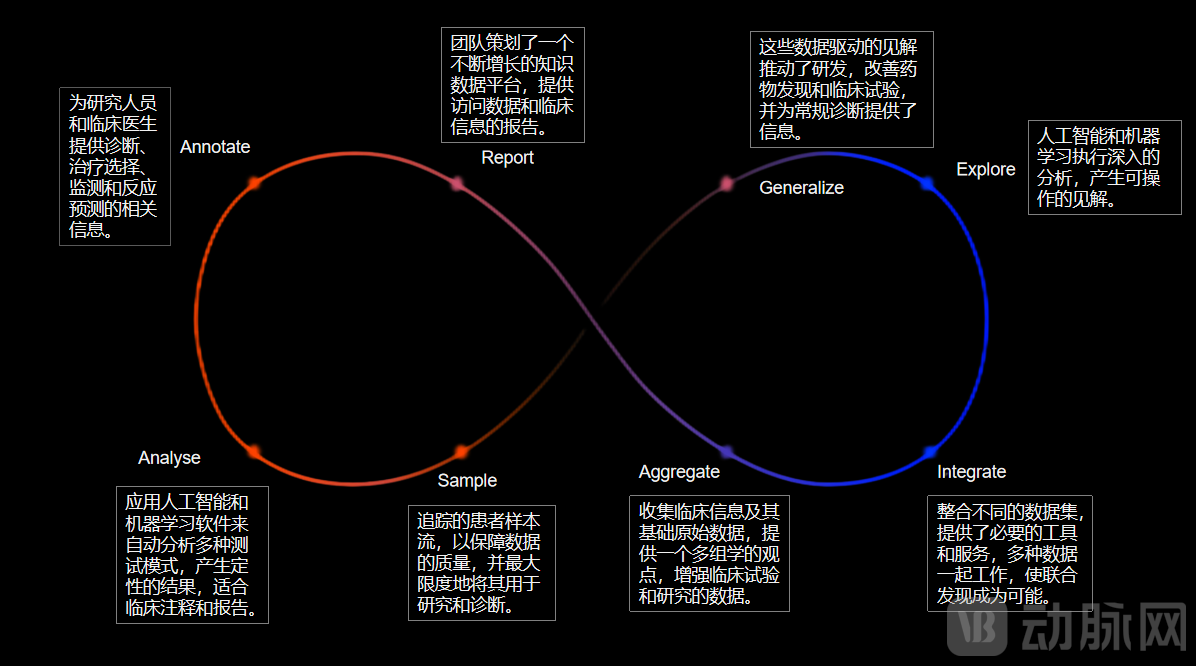
Velsera’s Advocated Value Cycle (Image source: Velsera; graphic by VCBeat)
First, the Velsera platform will manage and coordinate patient sample flows for clients using cutting-edge tracking and tracing technologies to ensure data quality and maximize the utility of patient data for research and diagnostics.
Furthermore, the Velsera platform applies artificial intelligence and machine learning software to automatically analyze multiple test patterns, generating qualitative, accurate results suitable for clinical annotation and reporting. It also provides researchers and clinicians with information relevant to diagnosis, treatment options, monitoring, and response prediction.
The Velsera team further collects clinical information and its underlying raw data to enhance clinical trial and research data, establishing a comprehensive knowledge base for clinical and health economics. This enables clients to access data, clinical information, and the latest reports. Experts can access the Velsera platform to collaborate with the Velsera team, leveraging the knowledge base along with Velsera’s artificial intelligence and machine learning tools to conduct in-depth analyses and generate new insights.
These data-driven new insights can, in turn, propel the development of precision medicine, enhance drug discovery and clinical trials, and inform routine diagnostics, ultimately feeding back into the sample flow cycle and driving medical innovation and advancement through the flow of knowledge.
Integrate Arima Genomics’ genetic testing technology to enhance the solution
In February 2023, just one month after announcing its establishment, Velsera launched a collaboration with Arima Genomics.
Arima Genomics and Velsera have entered into a marketing and licensing agreement under which Velsera will integrate Arima Genomics’ targeted next-generation sequencing test pipeline into its cloud-based Pierian clinical genomic information software.
In the workflow of precision medicine, researchers can use gene sequencing to determine which parts of DNA molecules contain genes and which contain regulatory information, thereby identifying differences between individuals with certain traits and those without. Next-generation sequencing is a collection of gene sequencing technologies that further enhances the speed and resolution of gene sequencing.
The original Pierian platform provided clinical laboratories with a streamlined solution for accurate gene sequencing data analysis, interpretation, and reporting. The joint product with Arima will offer Velsera a comprehensive workflow and solution, enabling laboratories to seamlessly manage clinical cases from sample to final clinical report.
Lindsay Mateo, Chief Commercial Officer at Velsera, stated that the integration of this technology will enable laboratories partnered with Velsera to deliver “the most comprehensive, clinically relevant results” to their customers.
Backed by substantial capital and boasting a highly promising technological foundation, Velsera is a force to be reckoned with. Will it capitalize on this momentum? We eagerly await the outcome.