

Allogene Therapeutics, Founded by Kite Pharma Veterans Behind $11.9B Sale, Advances Allogeneic CAR-T Pipeline with Recent SEC Filing

Vida Ventures
A Life Sciences Investment Fund

Two River
Venture Capital Firms

Allogene Therapeutics
Developer of Immunocyte Therapy

Bellco Capital
Private Equity Firm

TPG
Global Private Equity Investment Firms
Pulitzer Prize winner and author of The Emperor of All Maladies, Siddhartha Mukherjee, in his latest bookThe Song of The Cellin which he describes how cells compose the “symphony” of our bodies and likens T cells to “criminal investigators.” He writes: “T cells can detect and kill ‘virus-infected cells.’”
As early as 2017, the FDA approved the first autologous chimeric antigen receptor (CAR) T-cell therapy. It took researchers only 15 years to reach this milestone from initial testing.
CAR-T cell therapy involves collecting a patient’s white blood cells (including T cells), modifying them in the laboratory to express proteins known as chimeric antigen receptors (CARs) on their surface. These receptors act like a GPS, seeking out specific antigens found on the surface of cancer cells. The engineered cells are then infused back into the patient to locate and destroy any cancer cells bearing the target antigen.
Studies have shown that CAR-T cell therapy can still produce significant effects in many patients when other treatments fail. Since 2017, two autologous CAR-T cell therapies have been approved by the U.S. FDA for the treatment of relapsed or refractory acute lymphoblastic leukemia and relapsed or refractory large B-cell lymphoma.
Despite achieving notable results, these autologous CAR-T therapies have certain limitations.
The primary concern is its prohibitively high production cost. For instance, the cost of a recently approved autologous CAR-T cell therapy exceeds $450,000. Additionally, autologous CAR-T therapy faces several other challenges, including prolonged indwelling time for venous catheters, limitations on patient retreatment, and a range of adverse outcomes potentially arising from T-cell damage and variability. Furthermore, existing CAR-T therapies demonstrate limited efficacy against solid tumors.
To overcome the limitations of CAR-T therapy, Allogene Therapeutics, a biotechnology company based in California, is exploring allogeneic chimeric antigen receptor T cells (AlloCAR T™) development of cancer therapies. Unlike autologous cell therapies, AlloCAR T™T cells from healthy donors are used.
These cells are isolated, engineered to express CARs for the recognition and destruction of cancer cells, and modified via gene editing to evade the patient’s autoimmune response. Allogene believes that a single manufacturing run has the potential to provide treatment for more than 100 patients.
AlloCAR T™First, white blood cells are collected from healthy donors, then screened, tested, and transported to a central processing facility, where T cells are isolated and cryopreserved to create a supply of healthy donor cells. This means that most eligible patients, including those with critical conditions in whom T cell collection or expansion is difficult, will have access to treatment without undergoing the relatively cumbersome leukapheresis procedure. Subsequently, the T cells are engineered to express chimeric antigen receptors (CARs) that recognize specific cell surface proteins expressed in hematologic malignancies or solid tumors.
Next, AlloCAR T™Gene editing will be utilized to reduce the risk of graft-versus-host disease (GvHD) and allogeneic rejection. During this process, the CD52 receptor gene in T cells will be knocked out, rendering the CAR-T cells resistant to anti-CD52 antibody therapy. Consequently, the anti-CD52 monoclonal antibody (ALLO-647) can be used to suppress the host immune system, potentially enabling AlloCAR T™Maintain the implanted state to achieve comprehensive therapeutic effects. Finally, the T cells are purified and cryopreserved for on-demand delivery to patients.
Currently, AlloCAR T™Its lead product, ALLO-501A, targets CD19 for the treatment of relapsed or refractory large B-cell lymphoma (LBCL); ALLO-715 targets BCMA for the treatment of refractory multiple myeloma; and ALLO-316 targets CD70 for the treatment of clear cell renal cell carcinoma.
And these are just a small fraction of the AlloCAR T™ product portfolio.
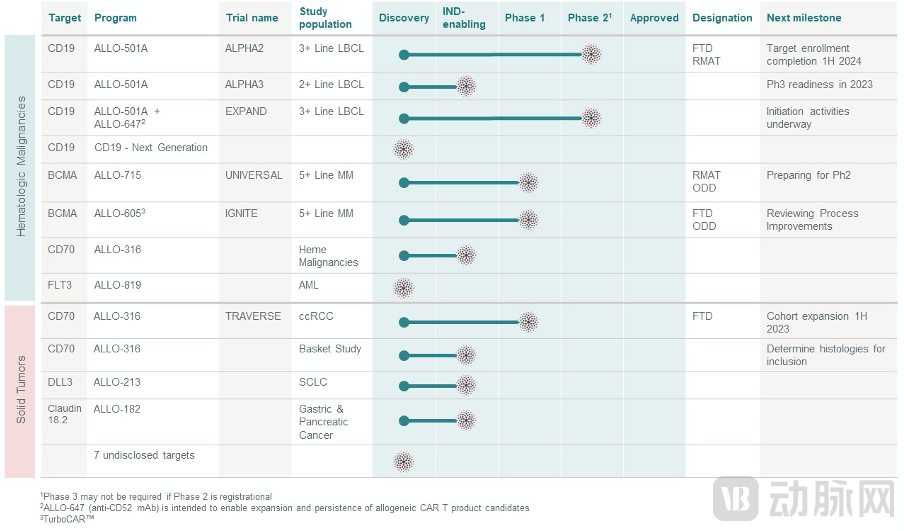
Allogene’s R&D Pipeline | Image source: Allogene Therapeutics official website
Allogene has made significant efforts in R&D investment. The company’s R&D expenses amounted to $75.4 million in the fourth quarter of 2022, and $256.4 million for the full year 2022, accounting for approximately 76.4% of its total operating expenses for the year.
On January 25, 2023, Allogene Therapeutics published a preclinical study in Clinical Cancer Research, the journal of the American Association for Cancer Research (AACR), demonstrating that DLL3 is highly likely to become a target for AlloCAR T™ALLO-213, an allogeneic CAR-T development candidate targeting DLL3, a tumor target for the treatment of small cell lung cancer (SCLC) and other potential solid tumors, can effectively control tumor growth without producing off-target toxicity.
SCLC is an aggressive disease with very limited treatment options. In the United States, approximately 30,000 patients are affected by this disease each year, and its 5-year overall survival rate is approximately 7%.
In February, Allogene presented Dagger at the Keystone Symposium in Canada.TMPreclinical Data of the Platform Technology.
DaggerTMAs a component of the anti-CD70 candidate product ALLO-316, this technology is designed to resist rejection of AlloCAR T cells by host immune cells, thereby extending the persistence window during which AlloCAR T cells can expand and actively target and destroy cancer cells. ALLO-316 is currently being evaluated in a study involving patients with relapsed or refractory renal cell carcinoma (RCC).
Allogene’s Chief Scientific Officer, Dr. Barbra Sasu, said, “Early clinical experience with ALLO-316 in advanced renal cell carcinoma suggests that DaggerTMcan significantly enhance the expansion and persistence of AlloCAR T cells. We aim to apply this technology to other candidate products targeting hematologic malignancies and solid tumors.”
Allogene was co-founded by former Kite Pharma executives Arie Belldegrun and David Chang.
Arie Belldegrun earned his M.D. from the Hebrew University–Hadassah Medical School in Jerusalem and completed his urology residency at Harvard Medical School. He later founded Kite Pharma, a company dedicated to developing innovative cancer immunotherapies. Currently, he serves as co-founder and chairman of multiple biopharmaceutical and investment firms, and is the Director of the Institute of Urologic Oncology at the David Geffen School of Medicine at UCLA.
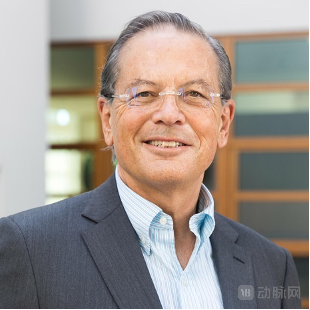
Arie Belldegrun. Image source: Allogene Therapeutics official website
David earned his M.D. from Stanford University and completed his fellowship in medical oncology at the Dana-Farber Cancer Institute, Harvard Medical School. He subsequently served as Associate Professor of Medicine and of Microbiology, Immunology, and Molecular Genetics at the David Geffen School of Medicine. As Executive Vice President of Research and Development and Chief Medical Officer at Kite, he led the development of YESCARTA, the first CAR-T therapy for non-Hodgkin lymphoma.®development, marking the first wave of therapies that treat cancer by genetically engineering white blood cells.

David Chang. Image source: Allogene Therapeutics official website
2017, Yescarta®After receiving FDA approval, Arie and David sold Kite Pharma to Gilead for $11.9 billion.
Use Yescarta®, with costs reaching as high as $370,000 per patient, and the process of reengineering a patient’s own T cells is also quite labor-intensive, resulting in too many patients passing away while waiting. Belldegrun and Chang stated that modifying autologous T cells is merely the first step; they believe the future of CAR-T therapy lies in allogeneic cells, allowing patients to bypass the wait times and individualized manufacturing processes.
On the night Kite Pharma was acquired, Aire and David attended the acquisition celebration hosted by Centerview Partners. Through a partner at Centerview, they learned that Pfizer was seeking collaborators to accelerate the development of its CAR-T pipeline.
In 2014, Pfizer partnered with the gene-editing company Cellectis to develop UCART19, a CAR-T therapy, along with a series of related technologies. At the same time, Pfizer held an 8% stake in Cellectis. UCART19 is an allogeneic CAR-T therapy indicated for hematologic malignancies expressing CD19. Arie stated that Pfizer adopted a large-company approach to developing this technology—rather than focusing on just one or two products, it assigned different teams to each product.
UCART19 performed rather modestly in early-stage clinical trials, but David stated in an interview, “When I reviewed its clinical data, what I saw was more a sense of hope.” He added, “We believe it has all the right components, and what we need to do is bring in an experienced team—along with financial support.”
In 2017, Belldegrun founded the life sciences venture capital firm Vida Ventures. The following year, the company, together with Two River, TPG, BellCo Capital (founded by Arie’s wife, Dr. Rebecka Belldegrun), the Office of the Chief Investment Officer of the University of California, and Pfizer, participated in a $300 million Series A financing round for Allogene Therapeutics.
This financing round is the third-largest Series A funding in the history of biotechnology, surpassed only by Kosmos Biotherapeutics and Vir. On the day the financing was announced, Allogene also revealed that Pfizer would hold a 25% stake in the company and secure two seats on its board of directors. As part of the transaction, Allogene obtained licenses from Pfizer for 16 preclinical CAR-T assets and the clinical-stage asset UCART19.
In fact, when Allogene decided to participate in the bidding, there were only three months left until the deadline for submitting the term sheet to Pfizer. What ultimately set Allogene apart from all competitors was the experience of its two founders. During their tenure at Kite, they brought Yescarta®Having secured IND approval and subsequently completed a successful acquisition, Pfizer has full confidence in its execution capabilities.
In September 2018, Allogene completed another $120 million in financing. In October 2019, Allogene completed the second-largest biopharmaceutical IPO on record, raising $324 million, which propelled the company’s valuation to approximately $3 billion. “We always knew that to continue growing and advancing our pipeline, we would need to tap into the public markets, so this was always part of the plan,” explained David.
On October 31, 2022, Allogene Therapeutics and Overland Pharmaceuticals established a biotechnology company, Allogene Overland Biopharm, in Shanghai, China. The joint venture will focus on the development, manufacturing, and commercialization of AlloCAR T for patients in Greater China, South Korea, and Singapore.TMTherapy.
Linglu Pharmaceuticals was founded in 2020, with a mission to provide innovative medicines to patients across Asia and around the world. Backed by Hillhouse Capital, the company is led by a team of biotechnology executives with a strong track record of drug approvals in Greater China.
Under the terms of the agreement, Anoling Lu will obtain rights to AlloCAR T therapies targeting BCMA, CD70, FLT3, and DLL3 within the licensed territory.TMExclusive License for Candidate Drug. Linglu Pharmaceuticals will invest $117 million in capital, including a $40 million upfront payment to Allogene and $77 million in capital to support the joint venture’s operations.
“This is an extraordinary milestone,” said Yao Shuyuan, CEO of Annoroad Gene Technology. “Our advanced facilities will enable us to accelerate the development of AlloCAR T”™.” With over 15 years of experience in the field of cell and gene therapy, Yao Shuyuan established and led the R&D business unit focused on CAR-T cell therapies at the beginning of his tenure at WuXi AppTec.
Allogene Overland owns a 68,000-square-foot GMP facility. The facility features a flexible modular design suitable for the production of all types of cell therapies. This scalable approach enables the simultaneous manufacturing of multiple AlloCAR T products.TM, to meet the needs of Asian cancer patients.
“Implementing autologous CAR-T therapy faces significant hurdles in a country as populous, diverse, and geographically dispersed as China. This new Shanghai-based facility not only enables our joint venture to serve more patients who may benefit from allogeneic CAR-T therapy, but also provides us with the opportunity to conduct clinical trials for new indications and other novel targets,” said Alison Moore, Chief Technology Officer of Allogene and Board Member of Allogene Overland.