

AppliedVR Submits IPO Filing for RelieVRx, the First FDA-Approved VR Therapy for Chronic Pain

AppliedVR
Digital Therapeutics Developer
As Haruki Murakami writes in *1Q84*, “Pain, in many cases, is alleviated and offset by other pain. Sensations, after all, are relative.” The brain appears capable of transmitting only one dominant signal; regardless of the nature of the pain, if another, more intense signal supersedes it, the original pain sensation will be diminished and counteracted.
To researchers, the quest for pain relief has become a pursuit of “a hundred ways to trick the brain.” Analgesics, which work by blocking C-fiber pathways and disrupting how humans perceive pain, represent the most mainstream and significant such “deception.” However, studies indicate that more than 50% of patients report that prescribed analgesics fail to achieve satisfactory pain relief, while also posing substantial risks of drug misuse and addiction.
Consequently, most studies have focused on non-pharmacological therapies as the forefront and core techniques in the treatment of chronic pain. These include physical therapy, massage, acupuncture, functional restoration training, psychotherapy, rehabilitation training, mindfulness practices, and mind-body interventions. With the advancement of XR (VR, AR, and MR) technologies, this emerging "deceptive approach" has gradually gained traction in the medical field, particularly in the management of chronic pain.
In November 2021, AppliedVR’s RelieVRx (formerly EaseVRx) digital therapeutic received FDA De Novo clearance, allowing it to be marketed as a prescription-only product, becomingThe first and currently only FDA-authorized VR therapy for chronic pain, used as an adjunctive treatment for chronic low back pain (CLBP).
Is VR Truly Reliable for Chronic Pain Management? Is It Genuinely Effective for Patients? And What Are Its Advantages Over Other Non-Pharmacological Interventions?
The International Association for the Study of Pain (IASP) defines chronic pain as pain that persists for more than three months. When pain persists over time, its impact on the body extends beyond the ongoing effects of the primary disease, continuously affecting the patient’s physiological, psychological, and social well-being. In other words, managing this complex syndrome of chronic pain requires not only treating the primary lesion but also addressing the compounding effects of psychological and social dimensions on the patient’s pain experience.
In 1935, science fiction author Stanley G. Weinbaum envisioned a VR headset in his story "Pygmalion's Spectacles." Decades later, the realization of this technology has not only been applied to widely recognized scenarios such as gaming and entertainment but has also gradually expanded into various fields including healthcare, education, and manufacturing. Leveraging the principle of limited human attentional capacity, VR was initially combined with pain management in the 1990s, aiming to attenuate the brain’s response to incoming pain signals through distraction.
The initial experiment, conducted by the Hoffman team at the University of Washington, used virtual reality (VR) to distract burn patients from pain. The results demonstrated that VR can serve as a non-pharmacological pain relief technique for adult burn patients and other individuals suffering from various painful conditions. Subsequently, the team applied VR to the management of dental pain, achieving similarly positive outcomes.
In 2004, Hoffman’s team further investigated the mechanisms of action underlying VR analgesia and the specific neural regions affected by this technology. The study found that VR substantially modulated activity in five brain regions associated with pain, including the anterior cingulate cortex, bilateral primary somatosensory cortex, secondary somatosensory cortex, insula, and thalamus, further demonstratingVR Can Directly Modulate the Human Brain’s Response to Pain。
In the field of pain management, virtual reality (VR) was first applied to the treatment of patients with phantom limb pain (PLP), and its therapeutic efficacy has been confirmed by multiple studies. Amputation can lead to numerous adverse effects, including persistent pain in the amputated area, where patients perceive the removed limb as still present and experience chronic long-term pain at that site; this condition is known as phantom limb pain (PLP). Studies have shown that approximately 76% of upper-limb amputees experience phantom sensations, and 49% of amputees suffer from PLP or residual limb pain. Currently, there are no specific drugs available for clinical treatment.
Since then, VR has been applied in multiple areas of pain management, including complex regional pain syndrome, fibromyalgia, and various types of chronic pain. In research, VR-based therapeutic approaches are also referred to as “distraction therapy” or “immersive therapy,” with some studies exploring their use as an adjunct to “mirror therapy.”
In 2016, biology teacher Robert Jester suffered a severe fall onto a hard surface when his ladder slipped while he was cleaning a chimney. “The back pain was excruciating; I saw only a flash of white light and could not clearly see the rescuers who came to help me,” he said.
A severed spinal cord meant he could no longer walk freely. He constantly felt as though his legs were submerged in boiling water while being stabbed repeatedly with a knife. Unable to endure the agony, he would clench his molars until they fractured. Tormented by pain, he devised more than ten suicide plans within the first year after the accident. He survived like a walking dead, relying on opioids to alleviate his suffering. Long-term opioid use stripped Jester of his joy, leading to gradual depression and frequent thoughts of, “What is the point of living?”
It was not until 2017 that a student’s father told Jester about AppliedVR, a company that had developed a therapy for pain relief—although at the time, AppliedVR was still focused on alleviating acute pain and anxiety and had not yet ventured into chronic pain management. Nevertheless, plagued by unbearable pain, Jester found a glimmer of hope and urgently needed such an assistive device. Fortunately, Josh Sackman, one of AppliedVR’s founders, recognized his suffering and promptly shipped the device to him.
“I saw a cow in a farm through VR; it tried to knock over the bowl of noodles in front of me to lick me, and I struggled to shoo it away. Later, I flew with the Wright brothers, maneuvering the aircraft from different directions.” Jester found himself becoming immersed in figuring out how to drive the cow away and how to maintain flight, no longer fixated on his pain. He began to consider whether VR could be used as a distraction to help him stop relying on analgesics.
Two months later, Jester discontinued the use of anesthetic analgesics. “Whenever I feel pain, I immediately use VR for training,” said Jester.
After Sackman and his co-founder Matthew Stoudt learned that Jester had gradually reduced his use of analgesic medications following VR therapy, they redesigned the VR treatment—RelieVRx (formerly EaseVRx)—to focus on treating chronic pain. In November 2021, RelieVRx received FDA approval as an adjunctive treatment for chronic low back pain (CLBP). In 2022, AppliedVR launched the product in select markets while actively establishing partnerships to prepare for its full commercial launch in 2023.
AppliedVR was founded in 2015, incubated by the market research firm LRW. Initially, the company aimed to address various medical challenges—such as pain, anxiety, depression, autism, addiction, and phobias—by leveraging VR’s power to modify behavior. Its pioneering VR products focused on alleviating preoperative stress, particularly anxiety and acute pain in children.
“Todd Maddox, Vice President of R&D at AppliedVR and a cognitive neuroscientist, explained the role of RelieVRx in an interview,”I have rewarded you with a book to help you breathe properly, and you do not need to follow any instructions to use it.“By using VR to immerse the brain in pain learning,” Maddox said, “this sets you on a path to changing cognitive behaviors.”
VR’s demonstrated efficacy in pain management has positioned it as a promising non-pharmacological therapeutic alternative. According to data from International Data Corporation (IDC), the medical value of AR/VR is rising significantly, with an expected compound annual growth rate (CAGR) of 33.36%. The market value is projected to increase from $621.7 million in 2018 to $3.497 billion in 2024. VR is being deployed across various healthcare settings, including anxiety and depression relief, stroke rehabilitation, and telemedicine.
RelieVRx is a VR system designed to alleviate chronic lower back pain, integrating AR and MR technologies. The device, which consists of a VR headset, controllers, and a respiratory amplifier, can be used by patients at home. It is an adjunctive pain management program grounded in biopsychosocial pain education, helping patients aged 18 and older improve chronic lower back pain through methods such as mindful escape, pain education (pain distraction), diaphragmatic breathing (dynamic breathing), and relaxation/interoception.
As a prescription therapy, RelieVRx involves an 8-week treatment course, during which patients are required to complete a daily 7-minute VR session using RelieVRx, includingBreathing and Pain Relief, Attention and Distraction Guidance, Mindfulness Escapecourses.
Over the course of an 8-week treatment program, diaphragmatic breathing is first enhanced through reaction-training games to activate and regulate the patient’s parasympathetic nervous system response. Subsequently, patients are educated on pain management principles—such as how the body perceives pain and strategies for pain control—to divert their attention from pain. Finally, pain education is employed to empower patients to engage in long-term health management.
Breathing is the most critical component of RelieVRx therapy. By synchronizing the user’s breathing rate with VR visualizations—typically a “breathing tree”—the system provides real-time feedback on physiological changes. Beth Darnall, Chief Scientific Advisor at RelieVRx and Director of the Stanford University Innovation Lab for Pain Relief, stated that using the breathing tree as a visual cue to inform users of their ongoing physiological changes yields effects far surpassing those of traditional cognitive behavioral therapy (CBT). “Biometric data is distilled into an aesthetically pleasing format, providing real-time, actionable feedback.”
Furthermore, RelieVRx can utilize VR to immerse patients in various calming environments (such as waves lapping against a sun-drenched shore), encouraging them to leverage mindfulness for further pain relief. Compared with other approaches, VR offers a non-invasive therapeutic modality that can gradually alleviate chronic pain in patients.
Research published by AppliedVR indicates that patients experienced significant pain relief after three months of using RelieVRx, with its analgesic efficacy improving over time. The study results showed that 65% of patients reported a reduction in pain intensity, and 46% of patients achieved a 71% reduction in pain. Currently, this therapy has been adopted by more than 200 healthcare systems and approximately 60,000 patients for pain management and wellness programs.
In addition to its presence in the chronic lower back pain sector, AppliedVR has also expanded its pipeline to other chronic pain conditions, such as fibromyalgia, postoperative pain, anxiety, and rheumatoid arthritis, all of which are currently in Phase I.
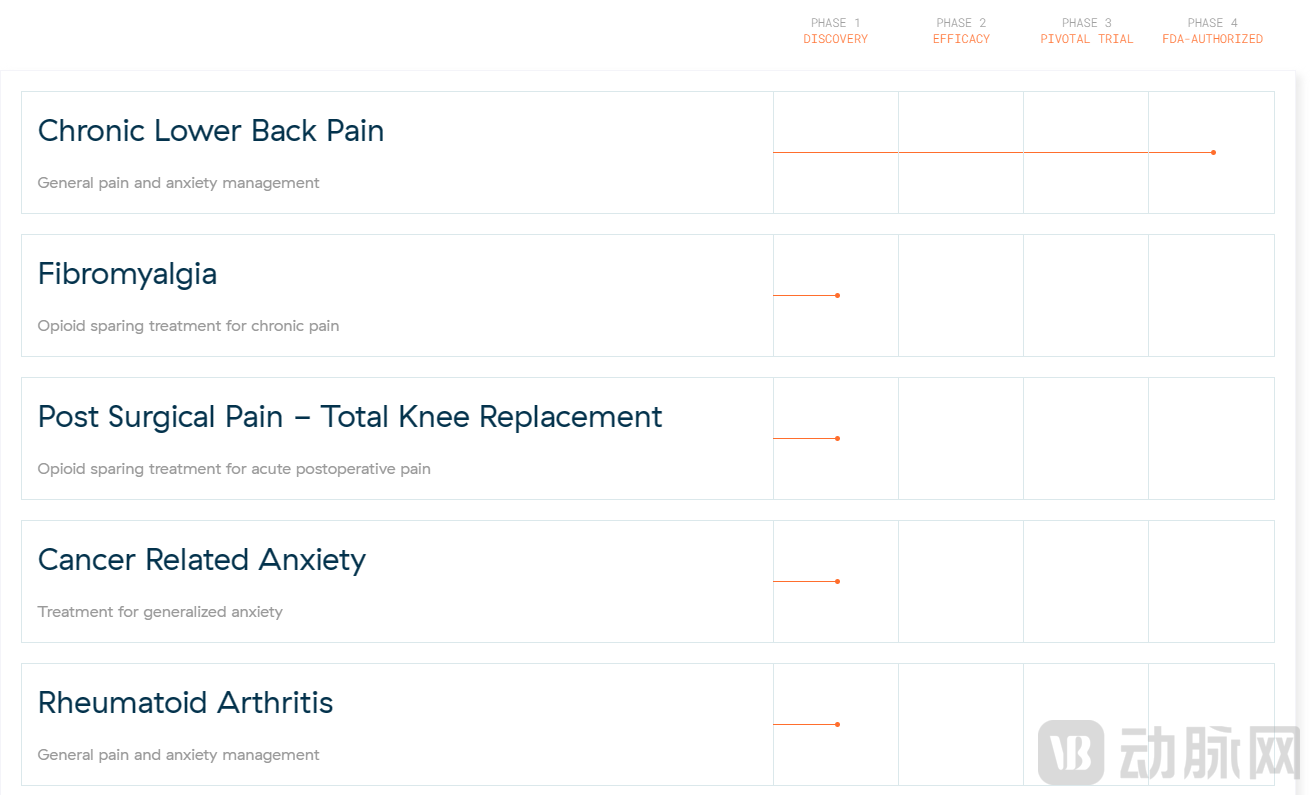
Treatment Pipeline. Image source: AppliedVR official website
Amanda DiTrolio, a healthcare technology analyst at CB Insights, stated in an interview that AppliedVR is considered the pioneer most likely to go the furthest in “providing assistive devices for pain patients.” To date, AppliedVR has completed three rounds of financing. After securing seed funding in 2016, the company consecutively closed its Series A and Series B rounds in 2021, bringing its total fundraising to $71 million.
AppliedVR is not alone in the field of VR-based pain management; Karuna Labs has also entered the arena. Karuna Labs has developed a hybrid model that combines virtual reality with telemedicine, pairing patients with pain coaches. During VR sessions, the VR headset and controllers track patients’ movements and posture to assist them in performing daily rehabilitation exercises, while simultaneously collecting motion data and transmitting it remotely to their pain coaches. The coaches then conduct weekly calls with patients, based on the recorded data, to guide them through pain management exercises.
Compared with pharmacotherapy and surgery, VR therapy has minimal side effects. In the 1990s, VR could induce nausea and dizziness, similar to motion sickness. However, as VR technology has matured, such vertigo has been significantly reduced, and its potential for application in a broader range of pain management areas continues to expand.
The bigger issue may lie in “who will foot the bill,” primarily due to the cost, pricing, and user experience of VR, which can be more time-consuming than pharmacological therapy and is not suitable for all patients. To advance the development of this therapy, a viable business model is needed.
In the United States, a therapy can only be considered for insurance coverage after it has received FDA approval. Although RelieVRx has already been approved by the FDA, it is still not covered by insurance providers. Therefore, AppliedVR is working to package RelieVRx as a single integrated product combining hardware and software, prescribed by physicians, to facilitate insurance reimbursement and thereby stimulate market growth.
Furthermore, collaborating with welfare agencies and insurance companies to incorporate VR therapy into insurance coverage, veterans’ benefits, and other programs is also a viable approach. In December 2022, AppliedVR entered into an agreement with the U.S. Department of Veterans Affairs (VA) to utilize RelieVRx in assisting veterans affected by chronic lower back pain.
VR remains an emerging technology in healthcare settings. Most patients are still unfamiliar with the therapeutic efficacy of VR-based interventions, and the medical industry is still in an exploratory phase. Challenges such as cumbersome operation and bulky design of VR devices may compromise patient adherence to treatment. In the future, research with larger sample sizes, broader populations, more objective evaluation metrics, long-term follow-up, and exploration of factors influencing intervention outcomes is needed to attract more patients to try VR, thereby enabling the true clinical adoption of VR therapy.
Furthermore, although VR therapy has been proven effective for chronic pain management, whether it can be used as a standalone treatment for pain remains to be further investigated.
References:
[1] Gong Shuwei, Liu Aifeng, Lang Shuang, et al. Progress in the Application of Virtual Reality Technology in the Treatment of Chronic Pain[J]. Chinese Journal of Pain Medicine, 2020, 26(06):438-442.
[2] Cai Honglan, Duan Baolin, Wang Ya, Cao Shenglian. Current Status Analysis of Anxiety, Depression, and Somatization Symptoms in Patients with Chronic Pain[J]. Chinese Journal of Pain Medicine, 2017, 23(10):788-790.
[3] Can Virtual Reality Help Ease Chronic Pain? Source: The New York Times