

Soaring 850% Revenue Yet Facing an RMB 11 Billion Loss: The Commercialization Dilemma of China’s 'Da Vinci' Surgical Robot Players

MedBot
Surgical Robot Developer
In February, Liang Xiao, Chief Physician of the Department of Surgery at Sir Run Run Shaw Hospital, Zhejiang University School of Medicine, performed a cholecystectomy on a local patient in Aral Hospital of the Xinjiang Production and Construction Corps. From Hangzhou, he operated the surgical robot console and transmitted surgical commands via a 5G network to the robotic arms in the operating room thousands of miles away, successfully completing the procedure.
On one hand, these highly futuristic scenarios have become a reality; on the other, the stock prices of related companies have been on a continuous decline in the secondary market.
In March, MedBot announced on the Hong Kong Stock Exchange that its 2022 revenue was expected to increase by more than 850% year-on-year, stating that the company's annual revenue for 2022 was projected to grow by over 850% compared with 2021, while the net loss was estimated at approximately RMB 1.1 billion to RMB 1.15 billion. Meanwhile, Tianzhihang, another industry leader, also released its full-year 2022 performance forecast, expecting a net loss of RMB 100 million to RMB 120 million in 2022.
For the surgical robotics industry, whether it is the continuous losses and declining stock prices disclosed in the announcements of listed companies, or the near-zero revenue status revealed in the prospectuses of companies planning to go public, all expose the current commercialization dilemmas faced by companies in the sector. The enthusiastic backing from the capital market in previous years stands in stark contrast to the current commercialization impasse. The narrative of “benchmarking against the da Vinci” has run its course; how to become the next da Vinci has become the critical issue that many companies must address at this stage. Chinese-made surgical robots are facing a major test.
The presence of a clear concept, market demand, profitability, and growth potential has driven the surge in interest in the surgical robotics sector in recent years.
Conceptually, the uneven distribution of medical resources in China can be significantly alleviated by surgical robots, which help mitigate the current shortage of medical resources. In terms of market size, according to Frost & Sullivan data, the global surgical robot market grew from $3 billion in 2015 to $8.3 billion in 2020, representing a compound annual growth rate (CAGR) of 22.6%. Regarding profitability, the industry benchmark, Intuitive Surgical, has seen continuous revenue growth over the years, and its stock price has surged more than 180-fold, making this sector full of potential and imagination.
Since 2015, the Chinese government has successively introduced multiple policies to encourage the innovative development of medical robots. The domestic sector has accelerated its pace, with domestically produced surgical robots entering a phase of explosive growth. As capital continues to flow into the field, this sector has become increasingly vibrant.
According to data from VCBeat, there were 10 financing rounds exceeding RMB 100 million in China in 2021 alone, with four of them surpassing RMB 500 million each. The total financing in this sector exceeded RMB 3 billion. In the secondary market, MedBot went public in 2021, with its market capitalization once exceeding RMB 60 billion. After years of accumulated financing, companies have secured ample “ammunition,” providing a solid foundation for product research and development.
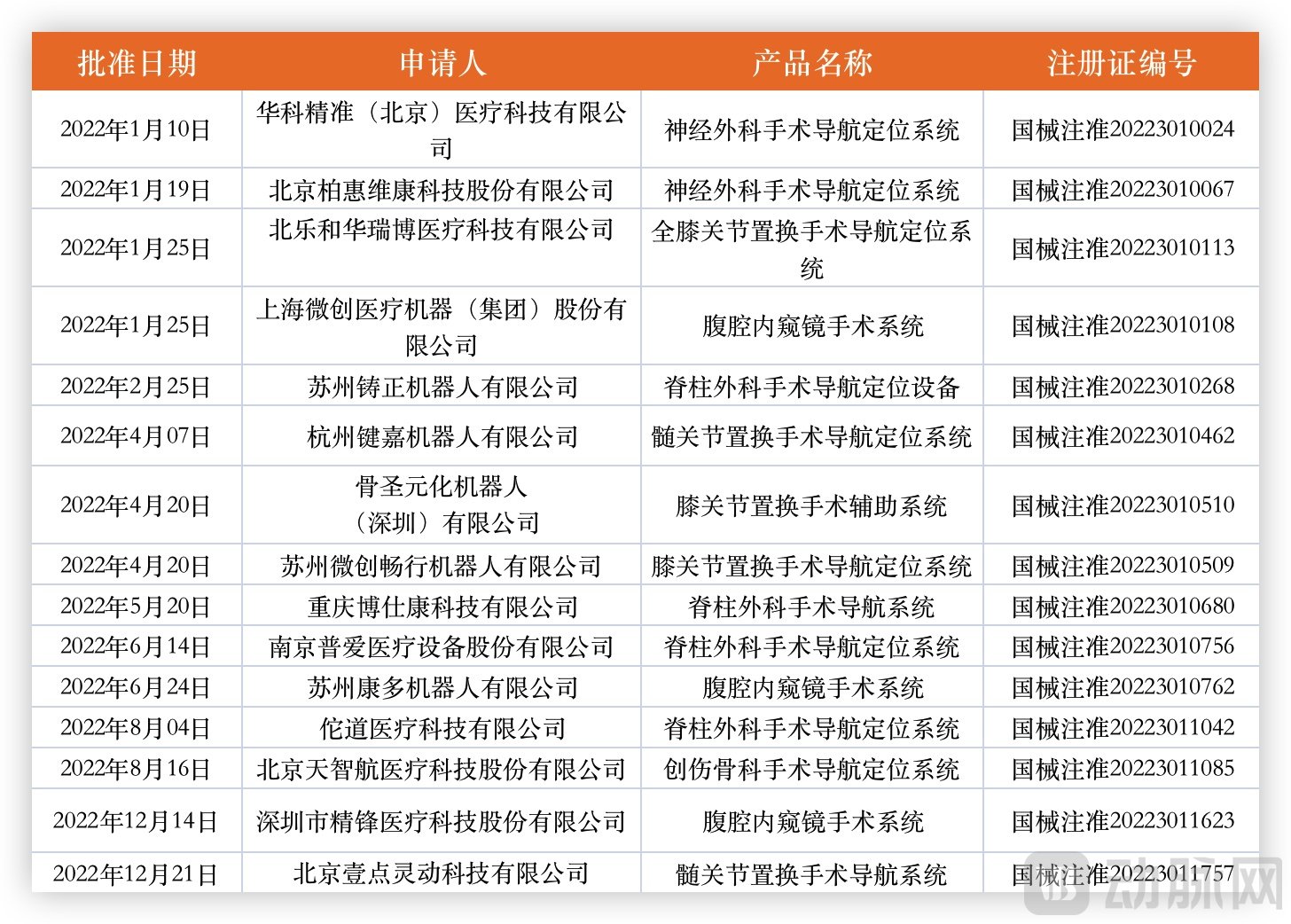
Domestically Produced Surgical Robots Approved in China in 2022, Compiled from Public Data
It typically takes about five years for a product to progress from concept to final design, and from research and development to regulatory approval. In recent years, products have been approved successively, but only a few each year. By 2022, the surgical robot market experienced a significant surge. According to incomplete statistics, a total of 15 products were approved throughout 2022, including three laparoscopic systems, ten orthopedic systems, and two neurosurgical systems.
Capital investment and technological accumulation have, over time, culminated in large-scale regulatory approvals and implementation.
However, regulatory approval is merely the beginning; commercialization represents the true test. Domestic brands still have a long way to go in their journey from “benchmarking against the da Vinci” to “becoming the da Vinci.”
Although many surgical robots claim to “rival the da Vinci system,” over the past two decades, virtually no company in the commercialization race for surgical robots has even come close to catching up with da Vinci.
It is difficult to impress hospitals.
According to public information, the da Vinci Surgical System is priced at approximately RMB 20 million in China, with annual service and maintenance costs of around RMB 2 million. These expenses are further compounded by consumables such as robotic arms, which have usage limits. Consequently, hospitals incur substantial costs in adopting the da Vinci system. As a result, many companies still aim to capture market share by offering domestically produced alternatives through competitive pricing strategies.
However, the actual outcomes appear to fall short of expectations.
For large tertiary hospitals that can afford various types of surgical robots, the purpose of purchasing these systems extends beyond improving surgical efficiency and building departmental capabilities; they also aim to enhance their institutional influence and leverage the renowned reputation of the da Vinci system to attract more patients. Given the multi-million-dollar investment, hospitals’ expectations for surgical robots go far beyond merely assisting surgeons in completing procedures. The additional value offered by the industry leader, da Vinci, aligns well with hospital needs.
In contrast, for many large tertiary hospitals, domestically produced surgical robots fall far short of the da Vinci system in terms of added value, such as brand influence, given that their clinical efficacy remains uncertain. This means that, in the eyes of these leading hospitals, the two are not viewed as products of the same category. Domestic products are perceived more as mere tools, whereas the da Vinci system is regarded more as a value investment.
Therefore, to capture market share, domestically produced surgical robots need to demonstrate their performance to prove clinical value, or achieve sufficient price competitiveness. Otherwise, hospitals will have little incentive to change the status quo.
It Is Harder to Win Over Physicians
The Da Vinci system’s current standing is attributable not only to its first-mover advantage but, more importantly, to the recognition of its clinical value by physicians.
In surgical procedures, physicians remain the primary decision-makers and operators at this stage, so surgical robots are expected to serve as highly competent surgical assistants. However, the robotic surgery training and education received by physicians in China are all based on the da Vinci system. Given such a high starting point and deeply ingrained habits, effecting change among the physician community requires companies to engage genuinely in clinical practice and truly understand clinicians’ needs.
A practitioner in the domestic surgical robotics industry told VCBeat that the R&D of surgical robots relies on medical-engineering collaboration, but in the past, greater emphasis was often placed on technology while clinical aspects were neglected. Some products even resembled “replicas” of earlier foreign models, lagging behind current mainstream products in terms of both technological innovation and clinical utility. Moreover, the path of imitation is fraught with challenges, as R&D iterations are more heavily constrained by patent restrictions.
These “tribute” products rarely resonate with physicians. Only by developing products with genuine clinical value can companies truly engage frontline doctors through academic promotion and educational training, thereby motivating them to embrace change.
Product iteration cycle has not yet been established
Surgical robots are products that integrate medicine and engineering, relying on iterative improvements through practical application. Only with sufficient clinical operational feedback can product iterations be carried out based on such feedback.
Orthopedic surgical robots represent a subsector within China’s surgical robotics landscape that has attracted a large number of market entrants; with 10 products approved in 2022 alone, it has become the most fiercely competitive segment.
Last year, the types of products approved were mainly concentrated in joint surgery robots and spinal surgery robots. In addition, there are dozens of companies still in clinical trials or pre-clinical research and development stages. Taking Tianzhihang, a listed company, as an example, according to its 2022 interim report, it has cumulatively completed approximately 30,000 surgeries. However, according to statistics from Life Science Intelligence, the domestic volume of orthopedic surgeries had already reached 9.66 million cases in 2018, indicating that the proportion of robot-assisted surgeries remains low.
This also aligns with the prevailing view among many physicians that orthopedic surgical robots still require optimization. Currently, most orthopedic surgical robots are only capable of assisting with specific steps of a procedure, such as positioning, rather than covering the entire surgical workflow. As a result, their clinical value is limited for experienced surgeons. Consequently, many companies are striving to advance human-robot collaboration, aiming to expand the current capabilities of orthopedic surgical robots and enable them to perform a wider range of surgical procedures.
This issue also exists in the field of laparoscopic surgical robots. With the approval of domestically produced robots, the current market landscape in China is dominated by the da Vinci system alongside Weigao’s Miaoshou, Microport MedBot’s Toumai, Kangduo, and Jingfeng. Given da Vinci’s leading position, it is quite challenging for domestic products to compete head-on. Consequently, many manufacturers have targeted single-port laparoscopic surgical robots as a breakthrough point. However, there are currently no approved products of this type available in China.
In other words, a virtuous product cycle encompassing R&D, sales, clinical use, feedback, and iterative improvement for domestically produced surgical robots has not yet been fully established.
Channel Development Cannot Wait
Following regulatory approval, the vision shared by many domestic companies is to deploy robots widely in hospitals and then unlock a second growth curve through a “consumables plus services” model, thereby becoming China’s equivalent of da Vinci. However, the reality is that many R&D-focused enterprises are incubated from universities and lack the inherent capability for channel development.
If the founding team is primarily focused on technological R&D, lacking experience in large-scale equipment sales and corresponding departmental resource accumulation, and fails to optimize product cost structures to design reasonable pricing and charging models based on the actual needs and financial capabilities of hospitals at different levels during the product finalization stage, the product will face numerous challenges in future market competition.
Commercial implementation is not merely a matter of sales; its core essence lies in whether the product’s underlying design can effectively control costs, and whether its performance and stability can match those of competitors while maintaining a price advantage.
Meanwhile, market promotion also tests the founding team’s ability to manage capital. Due to high technical barriers, surgical robots require substantial funding to build R&D teams. Even after a company moves past the R&D phase, finalizes its product, and obtains regulatory approval, continued financial investment is necessary to penetrate the market. Currently, surgical robots in China are still in the introduction stage, requiring companies to sustain sales-side investments for market education. Furthermore, competition in the surgical robot sector is intense; if a company fails to establish a market presence within the approximately 18-month window following regulatory approval, it will face competition from newly approved products.
Many domestic surgical robot companies, including MedBot and Tinavi, have proposed market strategies to penetrate lower-tier markets and reach primary care hospitals.
From a rational perspective, the expansion into lower-tier markets has, on another level, returned surgical robots to their core value: addressing the imbalance in medical resource distribution.
For secondary and lower-tier medical institutions, surgical robots can, to some extent, alleviate the imbalance in medical resources. Particularly in orthopedics, where young surgeons may struggle with precision control and consistency in overall surgical outcomes, orthopedic surgical robots can help physicians at primary-level hospitals achieve or approach expert-level performance in certain procedures, thereby addressing the challenges faced by grassroots patients in accessing and receiving effective treatment.
For endoscopic surgical robots, expanding sales into lower-tier markets not only helps avoid direct competition with the industry leader, the da Vinci Surgical System, but also aligns with the needs of primary healthcare institutions. If young doctors are unable to access new equipment and learn emerging techniques, they may choose to leave. Similarly, patients who are candidates for robotic-assisted surgery tend to prefer hospitals equipped with surgical robots for minimally invasive procedures.
Consequently, many Tier 3 Class B and Tier 2 Class A hospitals have a willingness to purchase surgical robots in order to retain both physicians and patients. Although constrained by price factors and unable to afford imported products represented by the da Vinci Surgical System, the approval and market launch of domestically produced surgical robots can fill this segment of market demand. For enterprises, true commercialization is achieved only when more hospitals are willing to adopt these systems, use them frequently, and integrate them as indispensable tools for surgeons.
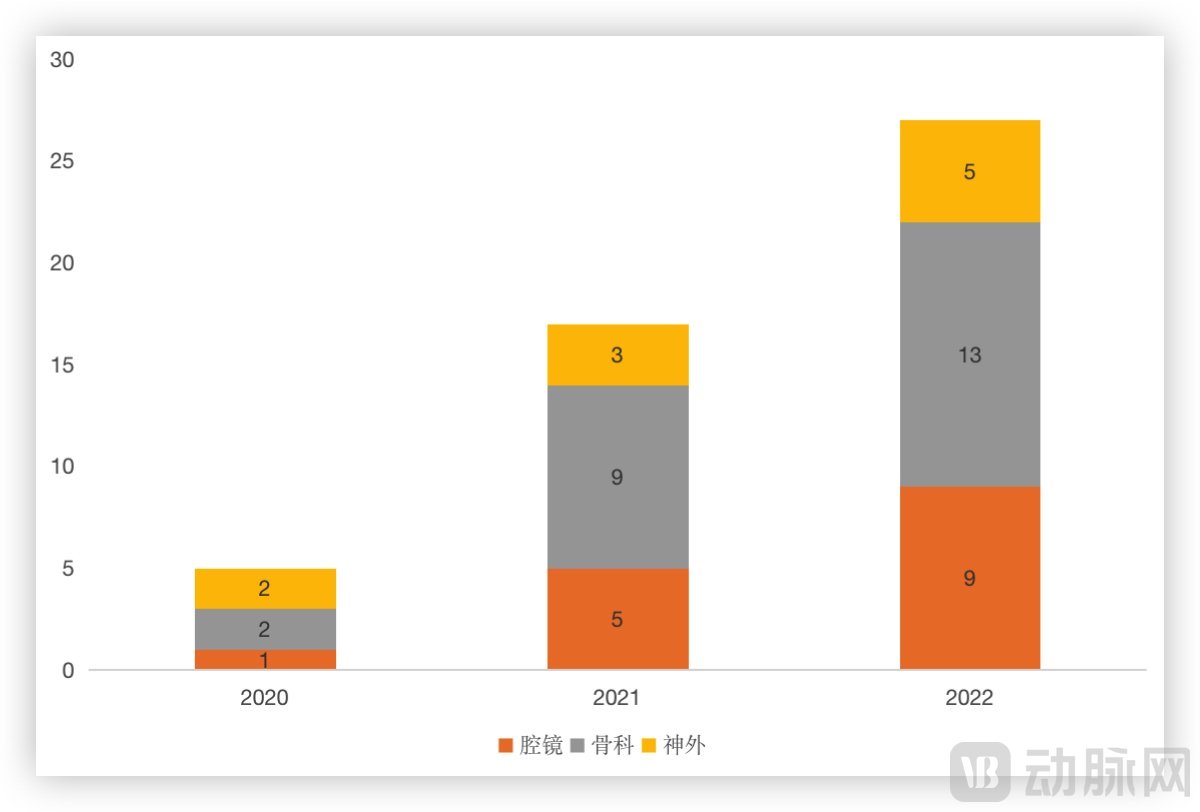
Number of Surgical Robots Procured by Public Hospitals in China Over the Past Three Years, Data Sourced from the China Government Procurement Network
Based on the winning bid data for surgical robots from the China Government Procurement Network over the past three years, in addition to an upward trend in sales volume, procurement by hospitals in cities other than first- and second-tier ones has become a significant source of incremental growth.
The trend of market penetration into lower-tier markets has already been observed abroad. In the United States, many small-city hospitals with modest population bases have successfully carved out a niche for themselves amid competition from large medical centers in recent years by equipping themselves with surgical robots. These institutions have effectively improved their operational performance by establishing specialized medical services. Meanwhile, surgical robot companies have also provided hospitals with access to surgeon resources and promotional strategies to help them build their own specialty capabilities.
In light of this, MedBot also mentioned in its 2022 semi-annual report that it deployed 30 training centers through self-built and jointly developed models with hospitals in the first half of 2022, trained over 200 doctors, and completed 800 training cases.
Not only the lower-tier markets, but overseas markets are also a target for domestic brands. MedBot’s independently developed Honghu orthopedic surgical robot has obtained U.S. FDA 510(k) clearance and European CE certification, and the company has already established a professional commercialization team in the United States, with international expansion imminent. In addition, another leading enterprise, Tinavi Medical Technologies, shared at an investor conference that it plans to start with EU certification and subsequently enter the U.S. market.
While policy-level incentives continue to encourage the R&D of medical robots, health insurance pricing frameworks for surgical robots are already being put in place.
In early March 2022, a document titled “Letter on Soliciting Comments on the ‘Guidelines for Improving Pricing and Related Policies for Auxiliary Procedures Such as Orthopedic Surgical Robots and 3D Printing (Draft for Comment)’” circulated within the industry, directly addressing price controls. A few months later, the Hunan Provincial Healthcare Security Administration issued the “Notice on Regulating the Use and Charging of Surgical Robot-Assisted Operating Systems,” finalizing the anticipated measures. Although the policy implemented by the Hunan Provincial Healthcare Security Administration has not been rolled out nationwide, companies must take proactive precautions.
Surgical robotics companies face the predicament of having to cut prices before turning a profit.
An investor told VCBeat that it is a smart move for surgical robot companies to target lower-tier markets. Rather than engaging in tough price wars with international giants over top-tier tertiary hospitals, these companies can reduce costs by streamlining certain features through differentiation, thereby achieving large-scale adoption in primary healthcare institutions. As more surgical robots gain regulatory approval in the future, industry-wide price reductions are inevitable. With expanding insurance coverage, the volume of robotic surgeries will rapidly increase. Companies that secure greater market share in lower-tier markets will achieve scalable revenue growth more quickly.
Furthermore, effective January 1, 2023, new subheadings for surgical robots were added to the Import and Export Tariff Schedule of the People's Republic of China (2023), granting zero import tariffs on surgical robots imported from countries and regions eligible for Most-Favored-Nation (MFN) treatment. This move not only underscores the state’s recognition of the utility and value of surgical robots but also signals that future market competition will intensify.
As can be seen, there are many factors affecting the commercialization of surgical robots. Starting from 2022, a large number of products will be approved for market launch within three years. Relying solely on price wars and burning cash cannot guarantee market dominance. Companies need underlying technological innovation, platform capabilities, and suitable business models to stay competitive in the future.
From R&D and hospital adoption to commercialization, every stage represents a formidable challenge for enterprises. Despite numerous obstacles, there are glimmers of hope. Although MedBot is projected to continue incurring losses in 2022, its year-on-year revenue growth of over 850% demonstrates that domestically produced surgical robots have taken a solid step forward amid the wave of marketization. This may well become a milestone in breaking through the dominance of imported products.