

Ankelai (Chongqing) Biopharmaceutical Files IPO Prospectus to Advance RNA Therapeutics for Chronic Diseases Based on Mesenchymal Stem Cells
Following the success of mRNA-based COVID-19 vaccines, RNA therapeutics have entered a phase of rapid development. Globally, this technology, with its vast potential, offers researchers in various countries a unique opportunity to expand the range of drug development targets.
Leveraging nucleic acids with specific sequences as therapeutics has broken the traditional paradigm of drug therapies that can only target proteins. These RNA-based drugs boast a rich pool of candidate targets and cover a broad range of indications. Currently, RNA therapeutics have been applied in various fields, including rare diseases, oncology, and neurological disorders. As the unique properties of these drugs continue to be uncovered, researchers dedicated to this field are exploring a pathway from developing treatments for rare diseases to addressing chronic and common conditions.
The prevailing industry view holds that, compared with antibodies and small-molecule drugs, RNA therapeutics offer advantages such as a broad pool of candidate targets, shorter development timelines, and higher clinical development success rates. In theory, they can be applied to any disease caused by specific gene expression. Consequently, they possess inherent advantages in the development of medications for chronic diseases.
For patients with chronic diseases, medication adherence is one of the critical factors influencing treatment outcomes. According to World Health Organization (WHO) data, 25%–50% of patients globally do not take their medications as prescribed. In the United States, poor medication adherence results in 125,000 deaths annually, accounts for 10% of hospital admissions, and causes economic losses of up to $289 billion per year. Relevant studies indicate that poor medication adherence is highly prevalent in China, particularly among elderly patients and those with chronic conditions requiring long-term maintenance therapy.
The long-acting nature and low propensity for drug resistance of RNA-based therapeutics have led the industry to increasingly recognize that RNA drugs may emerge as a powerful tool in the management of chronic diseases.
In the field of RNA-based therapeutics for chronic diseases, VCBeat has recently taken note of this company, which employs a unique technological approach combining “mesenchymal stem cells + RNA editing mediation.”Ankelai (Chongqing) Biopharmaceutical Technology Co., Ltd. (hereinafter referred to as “Ankelai”), under the leadership of its founder, Dr. Guo Xizhi, has developed core technologies across the entire industrial chain of RNA expression and editing. These include a next-generation virus-like particle packaging system, an exosome-based packaging system utilizing CD9/CD81 and other markers, next-generation high-fidelity RNA editing technology, and a universal circular RNA synthesis platform. Building on these capabilities, the company has established drug development pipelines targeting two chronic diseases: osteoarthritis and hyperlipidemia.
In 1985, the Human Genome Project was first proposed by American scientists. The project aimed to determine the nucleotide sequence composed of the 3 billion base pairs that make up human chromosomes (haploid), thereby mapping the human genome, identifying its genes and their sequences, and ultimately deciphering human genetic information. In other words, it sought to unravel the secrets of the 3 billion base pairs that constitute the approximately 25,000 genes in the human body.
The Human Genome Project, alongside the Manhattan Project and the Apollo Program, is recognized as one of the three major scientific initiatives and has been hailed as the “Moonshot” of life sciences. This grand-scale, multinational, and interdisciplinary scientific endeavor planted the seed of a genetic dream in the heart of Guo Xizhi, who was then still in middle school.
In 1993, Guo Xizhi resolutely chose to pursue graduate studies in Genetics at Wuhan University, stating, “To study DNA and gene structure is, in my view, the most promising endeavor at the scientific frontier.”
After completing his Ph.D. at the Shanghai Institutes for Biological Sciences, Chinese Academy of Sciences in 2003, Guo Xizhi pursued postdoctoral research at the National Human Genome Research Institute (NHGRI) of the U.S. National Institutes of Health (NIH), focusing primarily on bone development and metabolism as well as the regulatory mechanisms of related stem cells. Since 2008, as a Distinguished Professor at Shanghai Jiao Tong University, he has served as the Chief Scientist for the Ministry of Science and Technology’s Basic Research Program (the “973 Program”) and has presided over multiple Key Projects funded by the National Natural Science Foundation of China.
At Shanghai Jiao Tong University, Professor Guo Xizhi has long been engaged in research on animal models of diseases such as osteoporosis, arthritis, and diabetes. He established a technical platform for generating gene-knockout and gene-edited mice, enabling rapid screening and identification of functional and disease-related genes. “After reaching a certain stage, when we already knew that certain genes or proteins could indeed treat diseases, we began to consider how to translate these findings into clinical applications,” said Professor Guo Xizhi.
Leveraging mature technologies, Professor Guo Xizhi founded Ankela in January 2021 with the support of the Chongqing Research Institute of Shanghai Jiao Tong University, focusing on gene therapy development.
Compared with other stem cells, umbilical cord mesenchymal stem cells (UMSCs) offer advantages such as ease of acquisition, facile in vitro culture, long-term stability during serial passaging, low immunogenicity, and potent tissue repair capacity. They can be applied in the treatment of neurological disorders (such as Alzheimer’s disease), arthritis, diabetes, ulcerative colitis, hepatitis/liver cirrhosis, and cardiovascular diseases.
Conventional mesenchymal stem cells (MSCs) lack targeting specificity, resulting in limited therapeutic efficacy for specific diseases. Meanwhile, direct administration of RNA therapeutics alone often fails to achieve efficient delivery and protein translation, and may even trigger immune responses in patients. Ancure Therapeutics has adopted a technical strategy that combines the advantages of both approaches: it leverages the anti-inflammatory properties of MSCs to deliver specific RNA therapeutics. This approach achieves sustained release and targeted delivery for specific diseases, while circumventing the immune reactions and delivery efficiency barriers associated with RNA drugs.
Ankelai leverages four key technologies to accomplish the “RNA target design” and “RNA drug loading” stages of RNA drug development based on mesenchymal stem cells.
The first step is “RNA target design,” during which Ankelai, throughGeneralCircular RNA Synthesis SystemandNext-Generation High-Fidelity RNA Editing TechnologyAchieving high-level RNA expression and functional ablation.
Circular RNAs (circRNAs) are a special class of non-coding RNA molecules characterized by a closed-loop structure. They are resistant to exonuclease degradation and exhibit greater stability than linear RNAs. The Ankelai universal circular RNA synthesis system can package small RNA fragments, transfect cells for protein expression, and achieve highly efficient in vitro RNA circularization. With no residual exogenous viral sequences and low immunogenicity, this system ultimately enables high-level expression of RNA therapeutics.
Ankelai has engineered the protein structure of Cas13d by inserting a tag fusion protein to facilitate small molecule-induced binding and capture. The optimized Cas13d significantly reduces collateral cleavage effects, thereby enhancing therapeutic efficacy, while the optimized Cas13d-Tag improves RNA editing efficiency, making it suitable for active loading into virus-like particles.
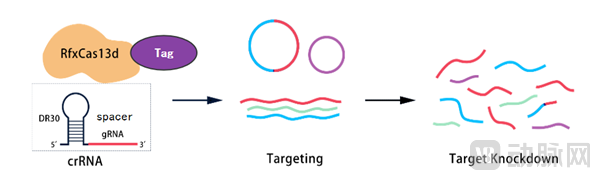 Anke Lai RNA Editing Technology. Image courtesy of Anke Lai
Next is the “RNA drug loading” phase; Ankelai possesses multiple RNA loading technologies, primarily developed in-house.Next-Generation Virus-Like Particle Packaging SystemandExosome-Based Packaging Systems Using CD9/81 and Other Markers。
The greatest challenge for RNA-targeted drugs lies in the fact that the nucleic acids composing these therapeutics closely resemble viral invaders. As these RNA strands circulate within the body, the human immune system mounts a counterattack. For RNA-targeted drugs to be effective, they must distribute throughout the body and reach their cellular targets undetected. This requires a form of camouflage—such as the addition of a single atom at one site or subtle chemical modifications at another—to evade immune surveillance and achieve successful treatment.
Anke Lai’s Next-Generation Virus-Like Particle Packaging System: Leveraging Chemically Induced Dimerization (CID) to Achieve Active Packaging and Purification of Target mRNA or Proteins. The Proprietary VSVG-Escape Protein Structure Evades the Human Immune Surveillance System, Significantly Reducing Immunogenicity and Enhancing Delivery Efficiency. As the Virus-Like Particle Packaging System Does Not Integrate into the Host Cell Genome, It Poses No Risk of Inducing Mutations.
Ankelai performs carrier engineering on exosomes such as CD9/81, achieving integrated exosome packaging, enrichment, and targeting. The company has established customized exosome-producing cell lines and manufacturing processes, effectively reducing immunogenicity, bypassing human immune barriers to the greatest extent possible, and enhancing delivery efficiency.
Currently, Ankelai has multiple technical patents under application and has obtained authorization for two patents.
As the aging population accelerates and lifestyles change, the risk of chronic diseases is gradually increasing, exerting an increasingly significant impact on people's physical health.
Inclisiran, an RNA-based drug for hyperlipidemia developed by Novartis, was approved by the European Medicines Agency (EMA) for marketing in Europe in 2020 and received FDA approval for launch in the United States in 2021, becoming the world’s first RNA therapeutic indicated for common chronic diseases. According to the latest updates, the drug has been accepted for review by China’s Center for Drug Evaluation (CDE) and is expected to enter the Chinese market in 2023. The launch of Inclisiran marks a significant historical milestone—the era of RNA therapeutics for chronic diseases has arrived.
An analysis of the R&D pipelines of RNA therapeutics companies reveals a growing number of programs focused on cardiovascular diseases, chronic hepatitis B, and diabetes. Industry experts predict that over the next 10 to 20 years, RNA therapeutics will be extensively applied in the management of chronic diseases, inevitably disrupting current treatment paradigms. As RNA therapeutics converge with antibody drugs and small-molecule drugs at shared targets and within overlapping therapeutic areas, their commercial value is poised for substantial growth.
Currently, Ankelai is primarily advancing two drug development pipelines for chronic diseases: osteoarthritis and hyperlipidemia.
Osteoarthritis is a common chronic joint disease, with its incidence gradually increasing with age. It is one of the most prevalent diseases worldwide, and traditional treatment methods have limited efficacy. As the aging population continues to grow, the clinical demand for osteoarthritis treatment is also expanding.
Mesenchymal stem cells (MSCs) have garnered significant attention in the clinical treatment of osteoarthritis and have been incorporated into China’s “Expert Consensus on Clinical Pharmacotherapy for Osteoarthritis.” Ankelai will utilize its independently developed virus-like particle packaging system to deliver a formulation combining mRNA molecules encoding anti-inflammatory and pro-repair genes with MSCs, thereby suppressing intra-articular inflammation and promoting the repair and regeneration of articular cartilage. Currently, Ankelai’s osteoarthritis drug pipeline is in the small animal experimental stage, and future progress in drug development will be advanced through collaborations with contract research organizations (CROs) and selected medical institutions.
Hyperlipidemia is one of the primary culprits behind cardiovascular and cerebrovascular diseases, with its prevalence rising year by year. According to data from the National Health Commission, the prevalence of dyslipidemia among Chinese adults is approximately 18.6%, including hypercholesterolemia at about 2.9%, hypertriglyceridemia at about 11.9%, and low high-density lipoprotein (HDL) cholesterolemia at about 7.4%.
The liver is a key hub for lipid metabolism, where lipoproteins responsible for transporting endogenous triglycerides and cholesterol are processed. Stimulation of hepatic lipoprotein synthesis factors can lead to elevated plasma cholesterol levels; therefore, RNA therapeutics with liver-targeting capabilities demonstrate promising therapeutic potential for lowering blood lipids.
Ankelai plans to utilize its self-developed virus-like particle (VLP) packaging system to encapsulate RNA editors. Following enrichment via centrifugation, the engineered viral particles will target PCSK9 mRNA, thereby achieving the therapeutic goal of treating hyperlipidemia. Among hyperlipidemia medications, drugs targeting PCSK9 represent a rapidly advancing innovative therapeutic area following statins; notably, Inclisiran, mentioned above, also targets PCSK9.
Currently, Ankelai has established a four-tier quality management documentation system and associated validation frameworks, thereby enhancing its GMP-compliant pharmaceutical production management and validation systems. The company possesses the potential for in-depth development of mesenchymal stem cell (MSC)-based gene therapies. Furthermore, it maintains GMP-grade MSC lines, with multiple key indicators—including stem cell molecular markers, colony-forming and differentiation capacities, immunomodulatory functions, and cytokine secretion levels—meeting established efficacy and safety standards.
In October 2022, the National Medical Products Administration (NMPA) issued the Guidelines for Good Manufacturing Practice of Cell Therapy Products (Trial). With policy liberalization and robust government support in China, various clinical research projects related to cell and gene therapy have been continuously launched. It can be said that this sector is now at a historic window of opportunity.
Certainly, although RNA therapeutics have seen some technological breakthroughs in recent years, the major obstacles still lie in the challenges of targeted delivery to organs beyond the liver and the efficiency of delivery to target cells. AndThe integration of RNA editing with stem cells may emerge as a new research direction.
Currently, Ankela also offers a series of research-grade cell products and technical services such as custom gene-edited cells. With the company’s further development and team expansion, Ankela is beginning to seek support from the capital market to advance the development of mesenchymal stem cell-based RNA therapeutic drugs and expand its pipeline of therapeutic products targeting diabetes and other metabolic diseases.