

Pioneering Non-Invasive Deep Brain Stimulation for Depression: Temporal Interference Therapy Validated by Intracranial Evidence and Clinical Trial

Neurodome
Neurodome, Inc.





"Smoking Gun" in the Brain
TI Electric Field Precisely Reaches Deep Depression Targets
To obtain the envelope electric field generated by TI stimulation in the deep brainDirect physiological evidence,This study utilized clinically implanted SEEG electrodes to2 patients with drug-resistant epilepsyReal-time recording was performed. Based on personalized electric field simulation(Using Neurodome's NervioWeb simulation modeling software), the study respectively targets 4 deep brain regions associated with depression:The left dorsolateral prefrontal cortex (DLPFC), the left subgenual anterior cingulate cortex (sgACC), the right ventral striatum (VS), and the right amygdala (Amg).Based on the electrode placement, Patient 1 targeted the left sgACC (carrier frequency = 2 kHz, difference frequency = 100 Hz) in a single session; Patient 2 targeted the left DLPFC (carrier frequency = 2 kHz, difference frequency = 10 Hz), right Amg (carrier frequency = 2 kHz, difference frequency = 100 Hz), and right VS (carrier frequency = 2 kHz, difference frequency = 10 Hz) in three separate sessions.TI stimulation is achieved using the NervioX-1000 device provided by Neurodome.
Results:The envelope voltage modulation amplitude at the target contact points was significantly higher than that at the non-target contact points (Figure 1A).The extracted envelope frequency was also highly consistent and stable with the preset stimulus frequency (Fig. 1B). This is the first direct confirmation in the living human brain:TI stimulation can precisely and stably deliver modulated electric fields to preset deep brain targets.Provides the most direct physiological evidence for non-invasive deep brain stimulation.
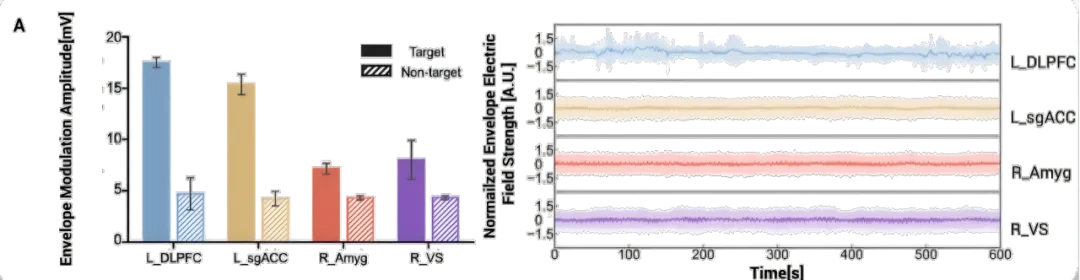
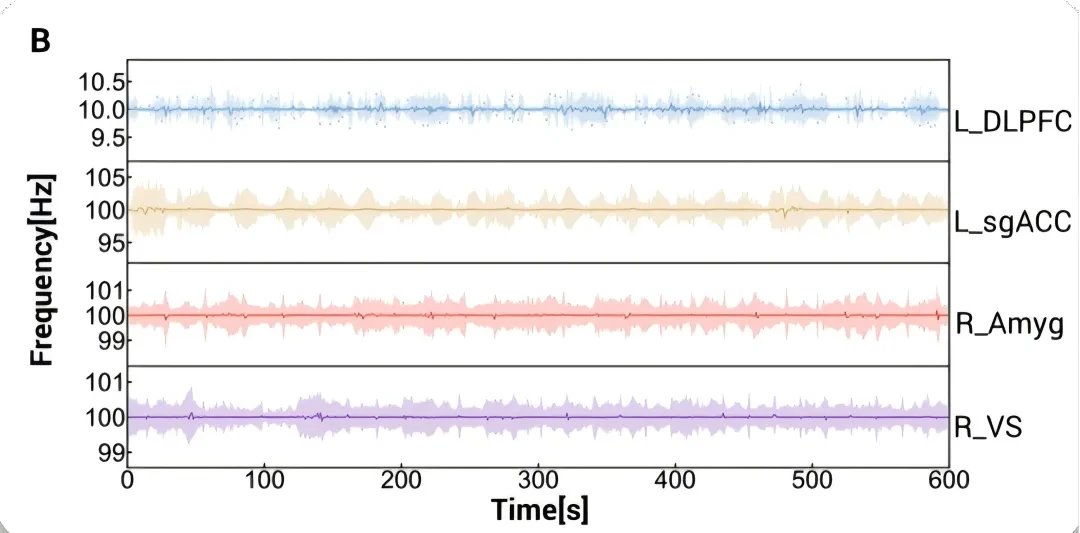
Figure 1: Validation of TI targeting through intracranial electric field recordings. (A) The left panel shows envelope modulation amplitudes at four target and non-target sites, with solid lines representing targets and dashed lines representing non-targets; modulation amplitudes at all target sites were significantly higher than those at non-target sites. The right panel displays normalized envelope electric field intensity, showing that the electric field strength remained stable during TI stimulation. (B) Envelope frequencies for sgACC, Amg, and VS stabilized at 100 Hz, while DLPFC stabilized at 10 Hz.

Clinical "First Victory"
5-week TI treatment significantly improves depressive symptoms
After confirming the feasibility of the target, the research team launchedRandomized, Controlled, Crossover Clinical Trial to Evaluate TI for Treating Depression. 15 patients with moderate to severe depression.Receive four active TI targeting DLPFC (10Hz), sgACC (100Hz), amygdala (100Hz), and ventral striatum (100Hz) respectively, and one sham stimulation in random order.Once a week for 20 minutes, lasting for 5 consecutive weeks.The medication regimen remained unchanged during the period.
After 5 weeks of intervention,The Hamilton Depression Scale (HAMD-17) score significantly decreased from baseline (P < 0.001) (Fig. 2C-D).Single-pulse stimulation analysis revealed that, except for sgACC,After active TI stimulation targeting the DLPFC, amygdala, and ventral striatum, HAMD scores were significantly reduced.Among them, DLPFC and amygdala stimulation also significantly reduced the Hamilton Anxiety Scale (HAMA) scores. Sham stimulation did not cause significant changes in symptoms.
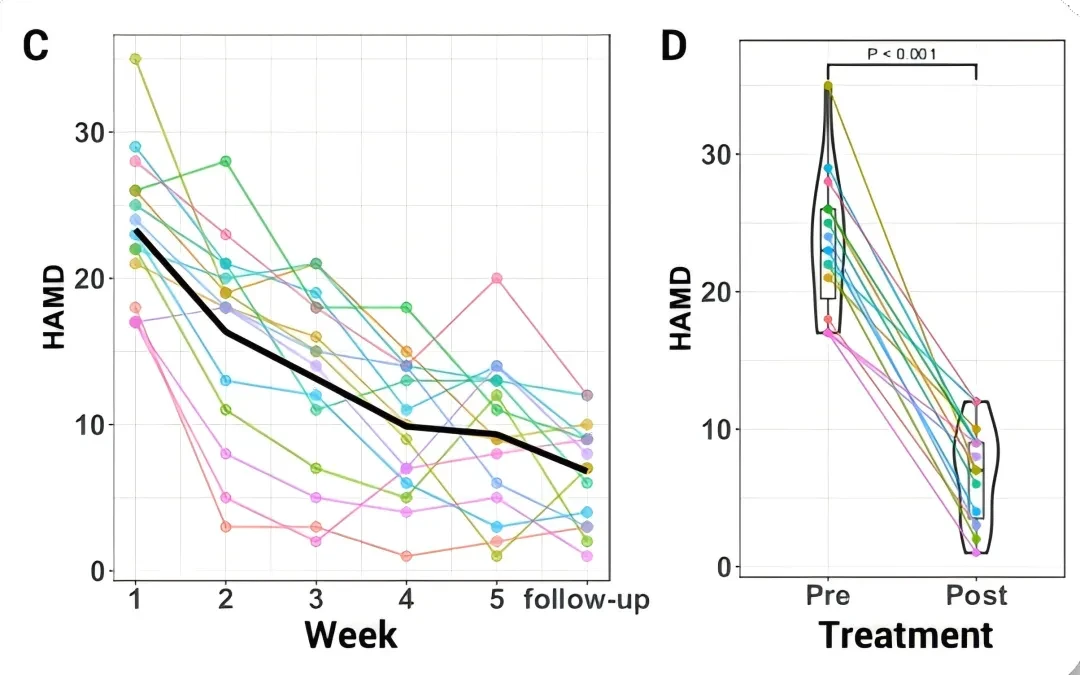
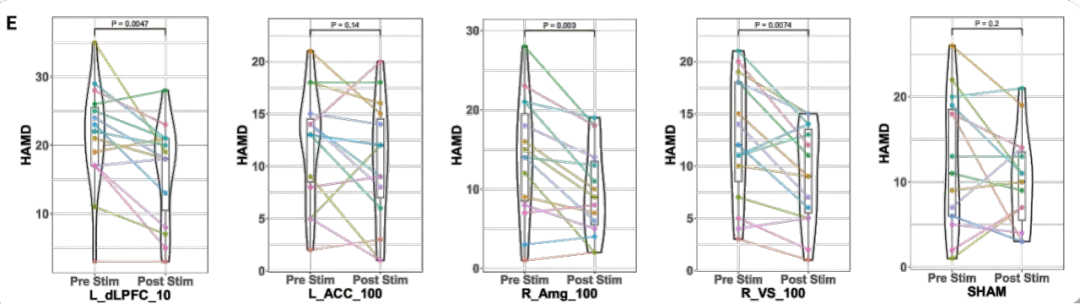
Fig. 2: C. Weekly HAMD-17 score changes in 15 MDD patients, with the black bold line representing the group average and colored lines representing individuals, showing continuous symptom improvement. D. Comparison of HAMD-17 total scores before and after treatment, with scores significantly decreased from baseline (P<0.001). E. Single-session analysis under various stimulation conditions: HAMD scores significantly decreased after targeting DLPFC (10Hz), Amg (100Hz), and VS (100Hz) stimulation (P<0.01), while no significant differences were observed for sgACC (100Hz) and sham stimulation.

Summary
SUMMARY
This study provides direct intracranial electric field recordings of TI stimulation in the deep human brain.It was confirmed that TI can achieve deep-targeted regulation, and preliminary clinical trials based on this have confirmed the potential of TI to significantly improve depressive symptoms. Research findingsThe left DLPFC and right amygdala are two of the most promising targets for TI in treating depression.This complete chain of evidence, from "intracranial validation" to "clinical efficacy," marks a critical step for TI stimulation in moving from concept validation toward therapeutic applications in mental disorders. It opens new avenues for non-invasive deep brain stimulation in treating depression and other neuropsychiatric conditions. Further validation and optimization will require larger sample studies in the future.
References
Yan J., Zhou S., Chen Y., et al. (2026). Pioneering depression treatment with temporal interference stimulation: Intracranial and clinical evidence in humans. The Innovation Medicine 4.100207. https://doi.org/10.59717/j.xinn-med.2026.100207.



Contact Consultation

WeChat Official Account
Neurodome
Pioneer in Non-invasive Deep Brain Neuromodulation

Phone 400-629-2019
Email info@neurodomers.com