

How China's RMB 13 Trillion Government-Guided Funds Are Investing in the Healthcare Sector

Dentafilm
Dental Medical Device Developer

GTJA Investment Group
Healthcare Investment Institution
Striving for the “upstream” has become an industry consensus: industrial chains are seeking breakthroughs in core raw materials and source technologies, while innovation is focusing on scientific and technological achievements and their commercialization. What changes are occurring in the “upstream” of another key industrial element—capital?
According to the "2022 Panorama Report on Fund of Funds" by the Fund of Funds Research Center, a total of 113 new fund of funds (FOFs) were established in 2022. Among them, 10 were market-oriented FOFs with an assets under management (AUM) scale of RMB 76.4 billion, while 103 were government guidance funds with a scale of RMB 470.9 billion. In other words, government guidance funds accounted for 91% of the total number of FOFs and 86% of the total capital scale.
In terms of both quantity and capital scale, government guidance funds have become a significant source of capital for domestic venture capital, and the healthcare sector is no exception. “Apart from funds managed by newly established GPs, there are hardly any RMB-denominated funds in which government guidance funds do not participate,” described a GP regarding the pervasiveness of government guidance funds.
So, how do government guidance funds invest in healthcare? Leveraging their administrative resources, how do these funds influence the allocation of factors within the healthcare industry? VCBeat has examined these questions through interviews with multiple innovation and venture capital professionals.
Government guidance funds are a crucial instrument for adjusting industrial structure, promoting industrial upgrading, and accelerating technological innovation. In particular, in recent years, local governments have increasingly recognized the significant power of government guidance funds in facilitating precise investment attraction.
According to statistics from Zero2IPO Research, by the end of 2022, China had established a total of 2,107 government guidance funds, with a target size of approximately RMB 12.84 trillion and a committed capital of approximately RMB 6.51 trillion. Among these, the newly established government guidance funds in 2022 were predominantly industry-oriented, primarily focusing on strategic emerging sectors such as high-end manufacturing, new materials, information technology, and biopharmaceuticals.
The big health industry has long been a crucial component of national strategy, and its significance is set to endure. During the 2023 “Two Sessions,” the Government Work Report proposed accelerating the development of emerging industries, including high-end equipment, biopharmaceuticals, new energy vehicles, photovoltaics, and wind power.
A review of the 2023 Government Work Reports from various regions also reveals that biopharmaceuticals, high-end medical devices, and smart healthcare were frequently mentioned and included in the list of key industries for the new year and even the next five years.
Government guidance funds will also become more active in the healthcare sector. In 2023, numerous large-scale government guidance funds were newly established across various regions, with biopharmaceuticals and high-end medical equipment designated as key investment areas.
In January 2023, the Beijing Economic-Technological Development Area (BDA) announced the establishment of a government-guided investment fund with an initial size of RMB 10 billion. The fund aims to direct social capital toward sectors aligned with the BDA’s industrial layout and strategic positioning, including high-end manufacturing, biopharmaceuticals, the digital economy, and urban renewal. It will prioritize support for the growth of innovative enterprises, mergers and acquisitions by leading companies, and the attraction of key projects.
In February 2023, the Guangzhou Industrial Investment Fund of Funds, with a scale of RMB 150 billion, was established, focusing on investments in semiconductors and integrated circuits, new energy, biopharmaceuticals and health, advanced manufacturing, next-generation information technology, and new consumption.
Some regions have also explored the establishment of special funds targeting the broader health industry to achieve more professional focus.
For example, the Shenzhen Biomedical Industry Fund, with a target size of RMB 5 billion, will focus on investments in biomedicine, cell and gene therapy, and other related fields, and has already completed the selection of its management institution.
In January 2023, Henan Province established the Zhongyu Biopharmaceutical Industry Investment Fund, with a total fundraising scale of no less than RMB 5 billion. The fund will coordinate existing industrial investment funds, municipal state-owned enterprises, industry leaders, and professional investment institutions to jointly establish industrial sub-funds.
Furthermore, the "Action Plan for the Construction of '415X' Advanced Manufacturing Clusters in Zhejiang Province (2023–2027)" proposes the establishment of four special industrial cluster funds targeting next-generation information technology, high-end equipment, modern consumption and health, and green petrochemicals and new materials, as well as one fund-of-funds dedicated to "specialized, refined, distinctive, and innovative" enterprises. Each fund shall have a scale of no less than RMB 10 billion.
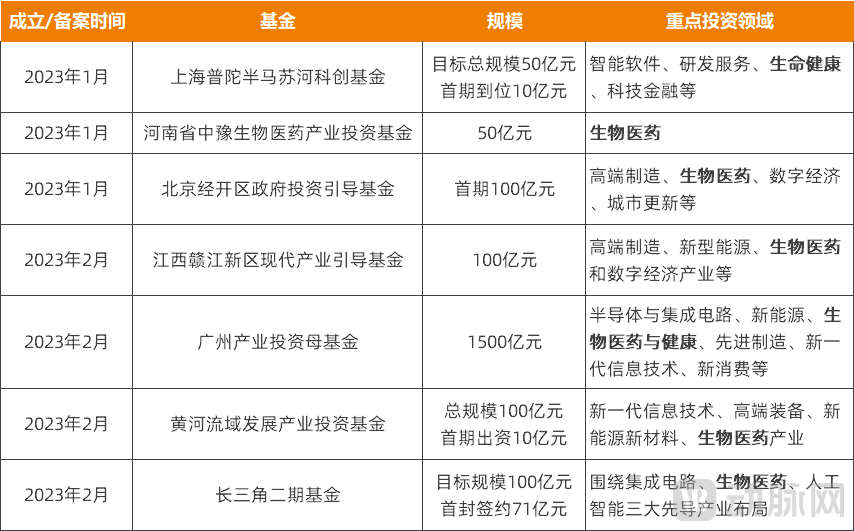
Some Government-Guided Funds Established Since 2023, Source: Asset Management Association of China, Official Websites of Local Governments
“From a macro perspective, China’s fiscal system is shifting from the previous land-based finance model to an equity-based finance model; therefore, government investment models represented by government guidance funds will receive increasing attention,” said Wang Haijiao, Executive Partner at GTJA Investment Group. In terms of specific investment operations, government guidance funds impose certain requirements on cooperating GPs regarding registered capital, senior management qualifications, and track records of successful cases, making it difficult for newly established GPs to secure participation from such funds. Furthermore, among the funds newly established over the past three years, virtually all have involved participation from government guidance funds, and this trend holds true in the healthcare sector as well.
In early 2023, GTJA Investment Group completed the fundraising for a RMB 500 million industrial fund. The limited partners (LPs) included government guidance funds, with joint contributions from the Xiangcheng District of Suzhou and its Huangdai Town. The fund will focus on niche sectors such as biopharmaceuticals, medical devices, and smart healthcare.
Weiweisi Medical, an innovative medical device company, completed its Pre-B financing round in 2022. Founder Zheng Jie has also noticed the heightened activity of government-guided funds. “Since the second half of 2021, a growing number of institutions with government-guided fund backgrounds have been evaluating projects in our Suzhou Industrial Park.”
It is evident that government guidance funds are influencing the development of the healthcare market through innovative venture capital investment.
Government guidance funds typically recruit and engage General Partners (GPs) for management, operating through models such as investing in sub-funds and making direct equity investments. Historically, these funds primarily acted as Limited Partners (LPs) in sub-funds; in recent years, however, the proportion of direct investments has increased, gradually evolving into a comprehensive model that combines direct investment, sub-fund investment, and hybrid approaches.
Since government-guided funds are operated on a market-oriented basis by cooperating general partners (GPs), their key investment sub-sectors do not differ significantly from the preferences of social capital, overall. However,Government guidance funds at different levels have distinct investment objectives, with unique characteristics in project selection and investment pacing.
In terms of hierarchy, national-level government guidance funds primarily invest in strategic emerging industries at the national level, covering a broad range of sub-sectors without specific geographic restrictions.
In 2016, the Ministry of Finance, the National Development and Reform Commission, and China State Development & Investment Corp. jointly established the National Emerging Industry Venture Capital Guidance Fund. The fund primarily invests in innovative enterprises within the strategic emerging industries and high-tech sectors that are in their start-up or early-to-mid stages and possess attributes of original innovation, integrated innovation, or secondary innovation through digestion and absorption. Consequently, the fund’s scope also extends to companies in the healthcare sector that meet these criteria.
Suzhou Weiweisi Medical Technology Co., Ltd., mentioned earlier, counted the National Emerging Industry Venture Capital Guidance Fund—managed by SDIC Chuanghe—as an investor in its latest financing round. The company’s core product, the semi-automatic external defibrillator (AED), has obtained CE and NMPA registration certificates, while its wearable cardioverter defibrillator (WCD) is poised to enter human clinical trials. Amid the trend of population aging, the product boasts diverse application scenarios and promising prospects.
Local-level guidance funds have a strong demand for supporting local enterprises and conducting targeted investment promotion: they either set local reinvestment ratios when investing in sub-funds, or directly invest in key local enterprises and major projects.
“To meet the local reinvestment requirements, we prioritize scheduling investment approval meetings for local projects and also recommend other portfolio companies to establish operations or set up subsidiaries in the region,” said Wang Haijiao. He noted that in previous collaborations with government guidance funds in Zhejiang, GTJA Investment Group invested in companies such as Annuoda, Libping Medicine, and Hehe Diagnostics, all of which established laboratories or subsidiaries in Zhejiang.
In addition to securing investment from national-level funds, Suzhou Weiweisi Medical Technology Co., Ltd. has also received funding from the government guidance fund of Anji County, Huzhou, Zhejiang Province, and has established a subsidiary in Anji. In fact, government guidance funds are currently showing a trend of decentralization, with district- and county-level funds becoming increasingly active in making direct investments to achieve more effective investment promotion.
During the establishment and operation of government-guided funds, various localities have implemented corresponding management measures for such funds, setting forth requirements on funding sources, operational models, management institutions and systems, and exit mechanisms, thereby ensuring that the funds operate within the prescribed regulatory framework.
“Government guidance funds impose stringent requirements during the pre-investment phases, such as market research and corporate due diligence, before making investment decisions; they also maintain high standards for post-investment compliance management.” However, in Zheng Jie’s impression, once an investment decision is made, the subsequent actions are executed with remarkable speed. “In recent years, social capital has become more conservative and cautious in its investments due to the broader economic environment. For startups, time is not only money but also a matter of survival.”
In terms of project selection, social capital should evaluate the industry prospects and market size of specific segments, while placing greater emphasis on whether a project possesses unique innovation, ranks among the industry leaders, or has the potential to become a market leader, as well as assessing the enterprise’s profitability and growth rate.
Government-guided funds may lower the aforementioned requirements due to other factors.Wang Haijiao believes that some government-guided funds are more aggressive than private capital (primarily in direct investments). “They focus on comprehensive returns, including the project’s impact on improving the local industrial structure and driving employment and tax revenue. If a project offers high comprehensive returns, they are willing to invest even if it carries high risks and valuations, or requires five to ten years to mature.”
Government guidance funds possess unique characteristics at the investment level. As limited partners (LPs) or corporate shareholders, they can also deliver specific value and resources to general partners (GPs) or portfolio companies.
As an LP, government guidance funds leverage robust administrative resources to establish collaborative mechanisms with local industrial authorities, enabling the regular or continuous solicitation of innovative projects and the creation of a pipeline of investable companies for selection by partner GPs.
“Government recommendations serve as a strong supplement to the deal sourcing for GP projects. Moreover, the greater value of government resources lies in facilitating access: if we target a subsidiary of a listed company, a spin-off project, or other high-profile opportunities, direct outreach may not yield results; however, if such a project is located in an area where one of our funds is based, leveraging government connections makes engagement significantly easier. This constitutes another deal sourcing strategy,” Wang Haijiao candidly stated.
Meanwhile,Whether as a limited partner (LP) or a shareholder, government guidance funds can provide healthcare companies with multifaceted support, including policy breakthroughs, research collaborations, facility construction for plants or laboratories, and human resources.
Zheng Jie stated that there are no mature technical standards in the niche sector where Suzhou Weiweisi Medical Technology Co., Ltd. operates. With investment from national-level funds, the company has the opportunity to engage with national-level projects and explore the establishment of technical standards, application scenario standards, and data management standards. “Developing new products and expanding into new fields is no easy task; it is difficult for a single enterprise to drive this alone, whereas government endorsement can enhance our competitive advantage.”
In 2022, Dentafilm, a digital dental equipment company, received investments from Haiheng Capital, Hongbo Capital, Chuanggu Capital, and the Hefei Angel Investment Fund, among others. Notably, the Hefei Angel Investment Fund is one of China’s leading government-backed angel funds that makes direct investments.
Huang Kaixian, founder of Dentafilm, noted that alongside this investment, relevant government departments have provided strong support for the company’s research projects. In September 2022, Dentafilm initiated an industry-research collaboration with the Hefei Institutes of Physical Science, Chinese Academy of Sciences, on the “Ultra-Widefield Laser Scanning Fundus Camera Project.” “With the assistance of government authorities, we have been able to engage in deep cooperation with multiple universities and research institutions in Hefei, incubating new projects or conducting R&D breakthroughs for core components.”
In addition, Dentafilm has planned a 1,000-mu production base in Hefei, with the first phase of 300 mu already completed. “Government departments have provided substantial support in land use and factory construction, including financial subsidies and guidance on the approval and filing processes for construction projects, which has saved us considerable time and effort.”
Overall, the advantages of government-guided funds in investment decision-making, pacing, and post-investment resource allocation are difficult to replace. Nevertheless, enterprises still believe it is necessary to introduce different types of investors at various stages—prioritizing government-guided funds in the early stage and social capital in the mid-to-late stages—to achieve complementary strengths between the two.
Recently, the latest round of State Council institutional reform plans was announced, with significant optimizations made to the science and technology sector as well as financial and securities regulatory bodies, underscoring the state’s high prioritization of these fields. Technological innovation will remain a long-term and core theme for future economic and social development, and sci-tech innovation requires a robust venture capital system for support.
It is understood that although government-guided funds have become the backbone of venture capital investment in China, the number of newly established funds has declined year by year in recent years, and the sector as a whole has entered a phase of optimizing existing assets.
In the future, government guidance funds, general partners (GPs), and innovative enterprises must forge closer and more professional collaborations to maximize the value of invested capital. Healthcare investment is characterized by its unique nature, high professional barriers, and long return cycles, thereby demanding a higher level of professional synergy among these three parties.
In the course of collaboration, government guidance funds prioritize local reinvestment ratios and assume responsibility for investment promotion, aiming to leverage greater social capital with limited public funds to invest in local enterprises and introduce new projects.
GPs prefer target regions with an established industrial base and even prospective investors, to facilitate the fulfillment of local reinvestment obligations; they also hope for minimal government intervention in decision-making, allowing GPs to fully leverage their professional expertise.
Corporate demands span every aspect of the development process, encompassing not only funding but also support for R&D, taxation, land use, market access, and IPOs. Resource requirements differ between R&D-focused and manufacturing-focused enterprises, and the needs of a single company vary across different stages of its growth. When confronted with a relocation subsidy of 200,000 yuan offered under a local government’s investment attraction policy, a medical technology company bluntly stated, “We’re not short of that subsidy; what we really need is orders!” This clearly illustrates the specificity of corporate needs.
In the course of collaboration, how can government guidance funds leverage administrative resources alongside market-oriented operations to advance the development of industrial parks and clusters? How can they optimize the allocation of industrial factors across regions? What impact will this have on the landscape of the healthcare market? Will local guidance funds engage in “involution” by competing fiercely for enterprises through investment promotion? These are all topics worthy of in-depth discussion.
To further streamline information channels among government-guided funds, investment institutions, and innovative enterprises, and to gain a deeper understanding of the mutual value created by these three parties, VCBeat will continue to closely monitor this sector.