

Starmab Bio Announces Breakthrough in Anti-Infective Biologics with Novel Pipeline Addressing Unmet Clinical Needs
With the intensifying aging of the population, the increase in invasive treatments, the expansion of immunocompromised populations, and the continuous emergence of various drug-resistant bacteria, small-molecule anti-infective drugs can no longer fully address infection-related clinical challenges.
In recent years, in the field of new drug research, drug development based on classic targets has struggled to meet the clinical needs for treating various drug-resistant bacterial infections. Meanwhile, research into novel drug targets against the increasingly severe threat of drug-resistant bacteria has encountered bottlenecks, leading to slow progress in the development of innovative anti-infective drugs both domestically and internationally.
However, in the anti-infective drug sector, infectious diseases are becoming increasingly complex and variable in clinical practice, leaving urgent unmet clinical needs. According to a Frost & Sullivan report, China’s anti-infective drug market is projected to reach RMB 125.4 billion from 2020 to 2025, while the U.S. anti-infective drug market may reach USD 7.5 billion by 2030.
The slow progress in new drug development contrasts sharply with the urgent need for novel anti-infective agents,"In the face of this contradiction and challenge, large-molecule drugs are being looked to with hope as an effective therapeutic approach."Macromolecular anti-infective drugs can address many clinical challenges that small-molecule anti-infective agents cannot.“For example, sepsis caused by severe infections and patients’ compromised anti-infective immune function,” Dr. An Maomao, Founder and Chief Scientific Officer (CSO) of Xingji Biology, told VCBeat New Medicine.
In the field of anti-infective drugs, Xingji Biology is an emerging company worth exploring in depth.In June 2020, Xingji Biology was jointly established by Fosun Pharma’s Fojian New Drug Fund and Chongqing Yaoyou Pharmaceutical, in partnership with Dr. An Maomao and Dr. Li Bohua. The company focuses on the research and development of large-molecule anti-infective drugs, including antibody-based therapeutics and long-acting fusion protein drugs.
Anti-infective macromolecular drugs are still in the early stages of development in China, but Xingji Biology has already made forward-looking arrangements in terms of team building, technology platforms, and pipeline layout.
Complementary Expertise of Founders Leads to the Birth of Xingji Biology with Capital Support
Dr. An Maomao, founder of Xingji Biology, is a professor at the School of Medicine, Tongji University. He has published multiple SCI papers in the field of anti-infective research and holds several national invention patents for new drugs.He has been engaged in research on infectious diseases for nearly 20 years, and has focused on the development of anti-infective neutralizing antibodies over the past decade. “Initially, I was only conducting exploratory research; however, subsequent preclinical study results demonstrated that neutralizing antibodies can indeed address many issues that antibiotics cannot, yielding encouraging experimental outcomes.” These findings inspired An Maomao to establish a biotechnology company dedicated to the research and development of anti-infective macromolecular drugs.
When An Maomao conceived the idea of starting a business, several foreign pharmaceutical companies’ anti-infective neutralizing antibody products had successively entered clinical trial stages, with relatively positive clinical results. Taking methicillin-resistant Staphylococcus aureus (MRSA), the most typical clinically significant superbug, as an example, Aridis Pharmaceuticals’ fully human antibody Tosatoxumab (AR-301), which targets alpha-hemolysin, has entered Phase III clinical trials for the treatment of Staphylococcus aureus ventilator-associated pneumonia. For the same indication, AstraZeneca’s Suvratoxumab (MEDI4893) is also preparing to enter Phase III clinical trials.
Alongside positive clinical progress, the outbreak of the COVID-19 pandemic has heightened the industry’s focus on the development of anti-infective drugs. In 2022, the U.S. Centers for Disease Control and Prevention (CDC) released a report indicating a significant increase in superbugs during the pandemic. Infections and deaths caused by drug-resistant bacteria rose by 15% in 2020, and from March to October 2020, 80% of hospitalized COVID-19 patients received antibiotic treatment.These developments have drawn attention to novel anti-infective agents, particularly neutralizing antibodies for infectious diseases, with numerous investment institutions in China seeking out emerging companies in this field.
At an industry conference, An Maomao met with the head of Fosun Capital’s New Drug Fund. Following in-depth discussions on his entrepreneurial vision, Fosun Capital’s New Drug Fund decided to support the establishment of Xingji Biology.Currently, the Fuxin New Drug Fund and Chongqing Yaoyou Pharmaceutical Co., Ltd. jointly completed a RMB 45 million angel financing round for Xingji Biology, and further assisted Xingji Biology in securing an A-round financing of over RMB 100 million.
The establishment of Xingji Biology would not have been possible without the support and participation of Dr. Li Bohua, Co-CEO and President., Dr. Li Bohua has over 20 years of experience in the development of antibody-based therapeutics. He has not only participated in the development and commercialization of antibody drugs but also led multiple research and development programs for monoclonal antibodies and bispecific antibodies, one of which is currently undergoing multicenter clinical trials. As a result, he and An Maomao have established a collaborative model characterized by clear division of labor and complementary expertise.
The combination of a senior expert in the field of anti-infectives in China and a senior expert in antibody engineering has laid the foundation for the development of Xingji Biology. “At Xingji Biology, Dr. An is primarily responsible for the discovery, non-clinical research, and clinical trials of anti-infective antibody drugs, while I am mainly in charge of antibody engineering, CMC development, and the company’s daily operations,” introduced Li Bohua. The two have not only effectively managed the upstream and downstream aspects of drug development but also formed complementary expertise.
Currently, Xingji Biology has brought together Ph.D. candidates from research teams at Tongji University, forming a dynamic and entrepreneurial technical team with capabilities spanning target identification, candidate molecule discovery, preclinical studies, and clinical trials.
Establishing a Diversified Technology R&D Platform to Address the Challenges in Anti-Infective Small-Molecule Drug Development
Currently, there are still unresolved clinical issues with anti-infective small-molecule drugs, such as cytokine storms or even sepsis caused by exotoxins released from Gram-positive bacteria, infections caused by multidrug-resistant Gram-negative bacteria, treatment failures in patients with invasive fungal infections due to compromised immune function, and viral infections lacking specific therapeutic agents. Addressing these challenges is the foundation upon which Xingji Biology builds its core competitiveness.
Based on this starting point,Xingji Biology has established a pipeline of macromolecular anti-infective drug products, with indications focused on hospital-acquired infections caused by super-resistant bacteria, as well as viral and fungal infections that pose serious threats to public safety.Meanwhile, a targeted and original technology platform has also been established to support pipeline advancement.
Both its technology platform and product pipeline have become the differentiating features that make Xingji Biology highly valued by investment institutions.
In terms of the technology platform,Xingji Biology possesses the capability to conduct research ranging from the discovery of novel targets for neutralizing antibodies against infections to clinical trials.The company has established a comprehensive technological platform encompassing hybridoma fusion and phage display technologies for constructing large-capacity phage libraries, high-throughput screening of anti-infective neutralizing antibodies, an "all-in-one" platform for druggability assessment of macromolecular drugs, antibody drug process development, and clinical pharmacology research on anti-infective neutralizing antibodies. These platforms empower and accelerate the research and development of innovative anti-infective neutralizing antibodies, shortening the cycle for identifying candidate drug molecules during the R&D phase and enabling early identification of risks and uncontrollable factors in CMC studies and preclinical toxicology studies. The company’s preclinical anti-infective efficacy research platform, in conjunction with toxicology studies outsourced to CROs and CMC studies outsourced to CDMOs, ensures product efficacy, safety, and quality controllability.The company’s clinical pharmacology research technology platform ensures a “seamless integration” between preclinical and clinical studies,Conduct early-stage preclinical and clinical PK/PD studies, and develop biomarkers to guide the design and execution of subsequent clinical trials, thereby enhancing the success rate of clinical development.
Leveraging these technological platforms and addressing unmet clinical needs,StarXingji Biology’s product pipeline covers Gram-positive bacteria, Gram-negative bacteria, fungi, and viruses. Currently, the anti-Streptococcus pneumoniae neutralizing antibody injection XJ103 is the most advanced candidate; its pre-IND application has been accepted by the Center for Drug Evaluation (CDE), and the IND application will be formally submitted in the near future.
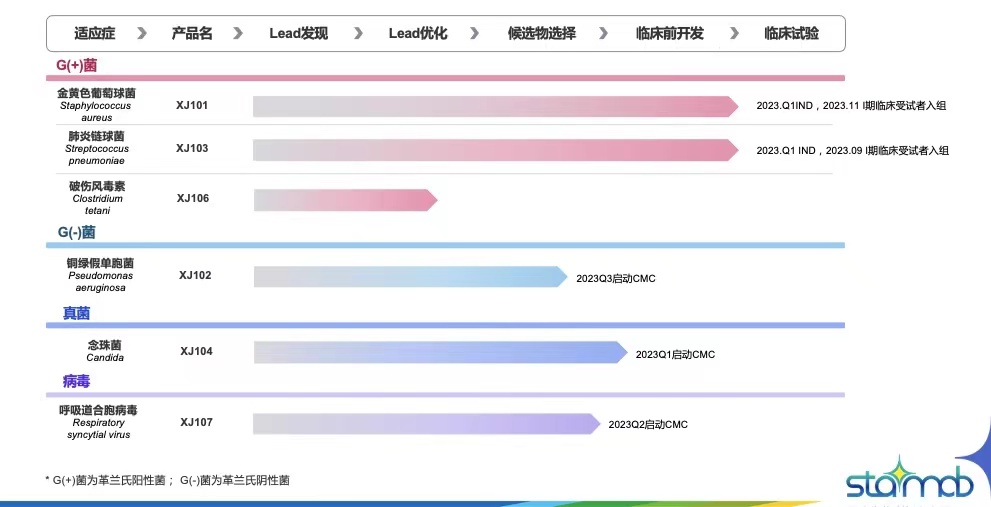
Xingji Biology’s Product Pipeline, Source: Xingji Biology
According to reports, it took four years for XJ103 injection to go from project initiation to the completion of all preclinical studies. Currently,There are no approved drugs of the same class or targeting the same mechanism worldwide; XJ103 is a global first-in-class therapy.XJ103 is a humanized monoclonal antibody molecule that exerts its anti-infective pharmacodynamic effects primarily by blocking Streptococcus pneumoniae invasion of the host, thereby preventing and treating potential complications such as cytokine storm and sepsis. This product features significant advantages,It has a long half-life in vivo, with effective blood concentrations expected to be maintained for more than six months. In the future, it can not only be used for the treatment of Streptococcus pneumoniae infections but also for prevention in high-risk populations during epidemic seasons.
In addition to XJ103, the anti-methicillin-resistant Staphylococcus aureus (MRSA) neutralizing antibody XJ101 is also about to submit a Pre-IND application.MRSA is the most typical multidrug-resistant "superbug" in clinical practice, and bloodstream infections caused by it are among the infectious diseases that seriously threaten critically ill patients, second only to ventilator-associated pneumonia.XJ101, independently developed by Xingji Biology, is a single-domain antibody-Fc fusion protein drug and the world’s first neutralizing antibody therapy intended for clinical use in MRSA bloodstream infections.
While advancing XJ103 and XJ101,Xingji Biology’s product pipeline also includes macromolecular drugs targeting Candida, respiratory syncytial virus, Pseudomonas aeruginosa, and Clostridium tetani.These projects cover Gram-positive bacteria, Gram-negative bacteria, fungi, and viruses in terms of the targeted pathogens. Currently, three macromolecular drug projects targeting Candida, respiratory syncytial virus, and Pseudomonas aeruginosa have basically completed the confirmation of candidate molecules and are about to commence IND-enabling CMC studies.
In the future, An Maomao and Li Bohua hope to rapidly advance the clinical studies of XJ103 and XJ101, as well as the preclinical research of other pipeline products. Meanwhile, Xingji Biology will further refine its various technology platforms for the development of anti-infective macromolecular drugs, enabling the company to quickly grow into a “unicorn” enterprise in China focused on the R&D of anti-infective macromolecular therapeutics.