

WeDoctor Advances 'Pay-for-Performance' Chronic Disease Management Model Amid National Health China Initiative
Recently, the Office of the Healthy China Action Promotion Committee issued the "Key Points for Healthy China Action in 2023" (hereinafter referred to as the "Key Points"), which covers 52 specific measures across four areas: improving and perfecting working mechanisms, formulating and issuing policy documents, solidly advancing key tasks, and organizing characteristic activities. This marks the fifth consecutive year that the Office of the Healthy China Action Promotion Committee has released annual key points for Healthy China Action since the launch of "Healthy China Action (2019–2030)." Among these, regarding the ongoing efforts in chronic disease prevention and control under Healthy China Action, the 2023 "Key Points" have included "strengthening health management for patients with chronic diseases such as hypertension and diabetes, promoting the integration of medical care and prevention, and enhancing service quality" as a key task led by the National Health Commission and advanced with concrete actions. Consequently, in conjunction with the implementation progress of the "Medium- and Long-Term Plan for Chronic Disease Prevention and Control in China (2017–2025)," China’s work on chronic disease prevention and control will enter a new phase focused on evaluating and summarizing outcomes. Regional comprehensive chronic disease prevention and control systems and chronic disease management models, such as the Digital Health Consortium, have become focal points of attention.
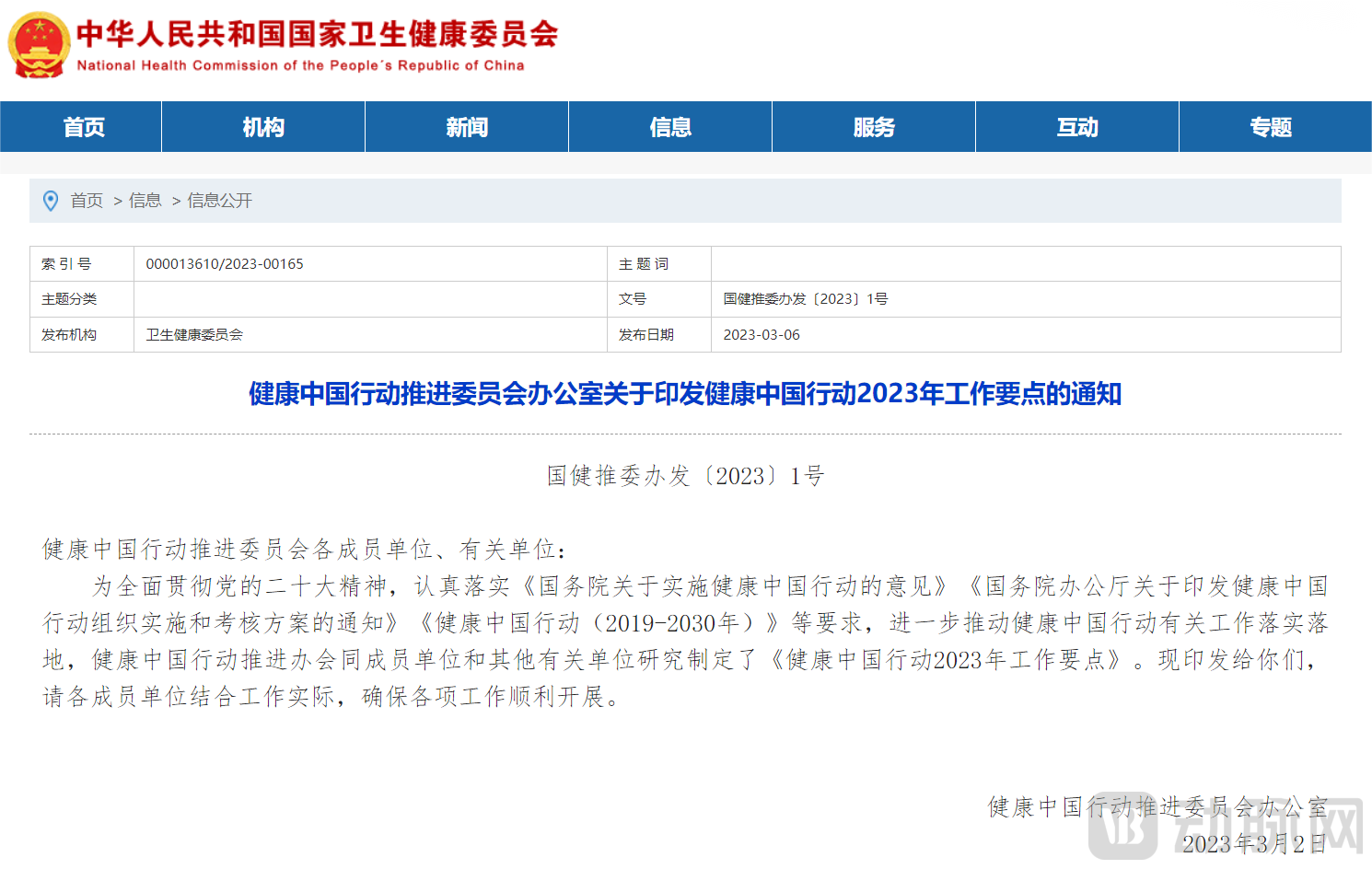 Notice on Issuing the Key Work Points of the Healthy China Action in 2023
According to the "Special Report on the Sixth National Health Service Statistical Survey" released by the Statistical Information Center of the National Health Commission, major chronic diseases such as cardiovascular and cerebrovascular diseases, diabetes, and cancer account for more than 90% of China's disease-related economic burden. The prevalence of chronic diseases among individuals aged 55 to 64 in China reaches 48.4%, while the incidence rate among those aged 65 and above is 62.3%. Chronic diseases not only pose a serious threat to the health of Chinese residents but also constitute a significant public health issue affecting China's economic and social development. Meanwhile, the comprehensive and complex nature of the factors influencing chronic diseases determines that their prevention and control will be a long-term and arduous task.
The “Healthy China Action (2019–2030)” establishes as its objective the transition from a disease-treatment-centered approach to a people’s health-centered approach. It prioritizes chronic disease prevention and control within the Healthy China Action framework, specifying in detail the goals, indicators, tasks, and division of responsibilities for major chronic diseases—including cardiovascular and cerebrovascular diseases, cancer, chronic respiratory diseases, and diabetes. This further demonstrates the national commitment to focusing on major diseases and prominent issues affecting public health, formulating and implementing medium- to long-term actions for disease prevention and health promotion, and ensuring the efficient and orderly advancement of the Healthy China Action.
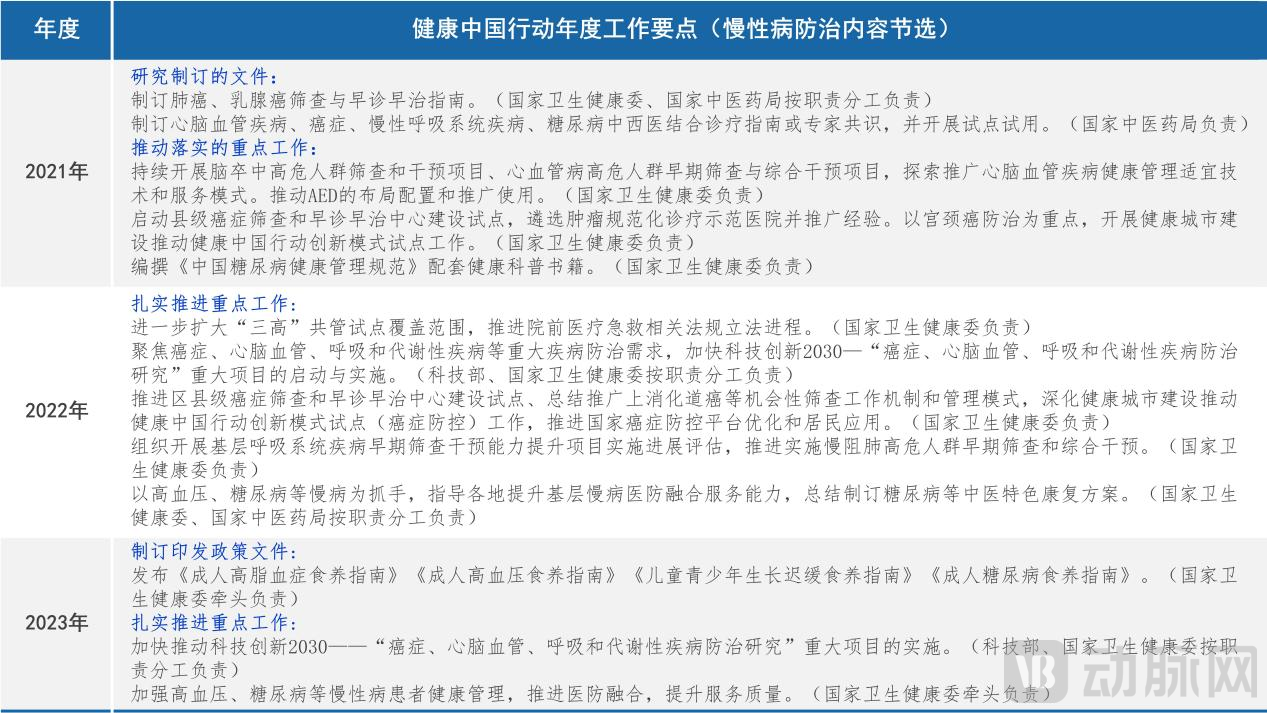
Annual Key Work Points of the Healthy China Initiative (2021–2023) (Excerpt on Chronic Disease Prevention and Control)
In the "14th Five-Year Plan for National Health," "comprehensive prevention and control of chronic diseases" was elevated to a national strategy for the first time, with a series of measures proposed for its implementation. These include achieving a 20% coverage rate of National Demonstration Zones for Comprehensive Prevention and Control of Chronic Diseases by 2025; enhancing comprehensive prevention and treatment capabilities for major chronic diseases, promoting joint management of the "three highs" (hypertension, hyperglycemia, and hyperlipidemia), and ensuring that the standardized management service rate for hypertension and type 2 diabetes patients at the primary care level exceeds 65%; advancing "Internet + Chronic Disease Management" (for diabetes and hypertension) to enable online follow-up consultations, prescription circulation, medical insurance settlement, and medication delivery; and supporting the deep integration of health management services tailored for the elderly, while innovatively developing smart health and elderly care services such as health consultation, emergency rescue, chronic disease management, and daily life assistance.
Guided by national policies and in alignment with the goals of the Healthy China Initiative, various regions have explored and implemented the construction of comprehensive chronic disease prevention and control systems, tailored to their local medical and health conditions. These efforts have actively promoted improvements in regional chronic disease management capabilities and service quality, giving rise to diverse innovative models such as Medical Consortiums for Chronic Diseases and Digital Health Communities. Among these, Tianjin’s Primary Care Digital Health Community was selected as one of the “Top Ten New Measures to Advance Healthcare Reform and Serve Public Health” in 2020, under the guidance of the Department of System Reform of the National Health Commission. It was also featured in the 2023 China New Social Governance Think Tank Report—Digital Transformation and Governance Reform, emerging as the most prominent innovative model for regional chronic disease management.
In April 2020, under the leadership of the Tianjin Municipal Health Commission, WeDoctor Internet Hospital spearheaded the establishment of a closely integrated medical consortium—the Tianjin Primary Care Digital Health Community—by collaborating with 266 primary healthcare institutions across the city. This initiative built a unified “Four Clouds” platform for these institutions, encompassing cloud-based management, cloud services, cloud pharmacy, and cloud diagnostics. Meanwhile, focusing on the health management of patients with chronic diseases such as hypertension and diabetes, the Tianjin Primary Care Digital Health Community worked with its member institutions to establish offline standardized chronic disease management centers, thereby implementing homogeneous online-to-offline (O2O) full-process services covering prevention, diagnosis, treatment, management, and health promotion for chronic disease patients.
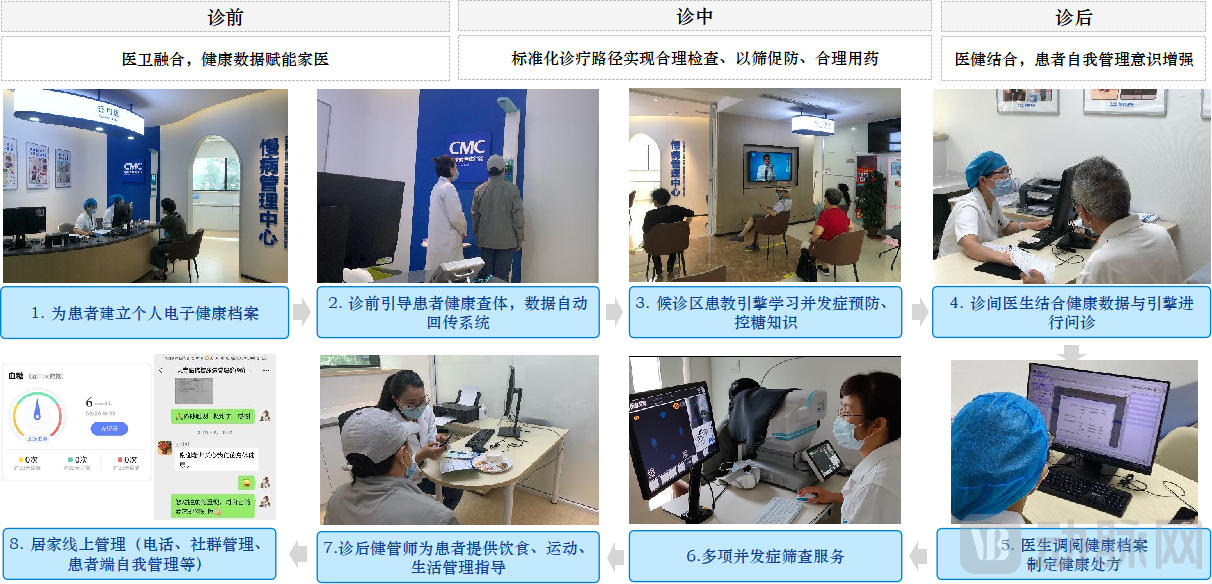 Digital Health Community Chronic Disease Management Center: "Prevention, Diagnosis, Treatment, Management, and Health Promotion" Care Pathway
Meanwhile, Tianjin’s Primary Care Digital Health Consortium has actively pioneered innovative service models such as digital healthcare. By leveraging remote patient monitoring, online follow-up consultations and prescription renewals, electronic prescription circulation, home delivery of medications, and real-time health education, the consortium provides patients with chronic diseases with more convenient and accessible health management, diagnosis, treatment, and medication services. Previously, primary healthcare institutions in Tianjin stocked an average of fewer than 400 drug varieties. Currently, through the “Cloud Pharmacy” platform, primary healthcare institutions within Tianjin’s Primary Care Digital Health Consortium are able to fully meet residents’ medication needs, offering 1,560 drug varieties comprising 2,785 specific specifications.
Of particular note is that the development of Tianjin’s grassroots digital health consortium has also been a process of implementing a comprehensive chronic disease prevention and control system centered on health. Since 2021, driven by the Tianjin Municipal Healthcare Security Administration and the Municipal Health Commission, designated diabetes outpatient special care management institutions within the consortium have begun exploring the implementation of diagnosis-related group (DRG) and capitation-based payment models for medical insurance funds. These efforts aim to enforce the medical insurance payment policy of “retaining surpluses and not covering deficits,” while establishing a health-oriented performance incentive mechanism. Under this framework, medical insurance has shifted from “paying for treatment” to “paying for health,” thereby mobilizing primary care physicians to proactively provide comprehensive health management services to patients.
This mechanism has been gradually established and refined at the primary care level, laying the foundation for Tianjin to accelerate the implementation of the Health Manager Responsibility System. On November 28, 2022, the Tianjin Municipal Healthcare Security Administration issued the “Notice on Accelerating the Implementation of the Health Manager Responsibility System for Diabetes as a Special Outpatient Disease.” Effective December 1, 2022, the management model for diabetes under the special outpatient disease program in Tianjin shifted from medical treatment-oriented care to health management, with the goal of gradually incorporating all patients with diabetes under this program into the health management system and promoting the transformation of healthcare institutions from a treatment-centered approach to a people’s health-centered approach.
As of the end of December 2022, Tianjin’s Primary Care Digital Health Consortium had signed chronic disease management cooperation agreements with 204 primary healthcare institutions and seven secondary hospitals, progressively co-establishing chronic disease management centers. Over 1.68 million patients have been enrolled in health records for management, and more than 110,000 diabetes patients have been contracted into groups and incorporated into the health stewardship responsibility system for outpatient special care services for diabetes. Among these, pilot primary healthcare institutions achieved a standardized management rate of 81.5% for diabetes patients, with an improvement of over 12.1 percentage points in blood glucose control rates. Medical institutions implementing capitation-based payment models reported a medical insurance surplus rate of 16.7%.
From the perspective of building a comprehensive chronic disease prevention and control system and the effectiveness of health management for patients with chronic diseases, Tianjin’s grassroots Digital Health Community has truly achieved the integration of medical care and prevention, as well as the combination of medical services and health management, thereby substantially enhancing the capacity of grassroots health management services. Currently, as “strengthening health management for patients with chronic diseases such as hypertension and diabetes, promoting the integration of medical care and prevention, and improving service quality” has been explicitly designated as a key priority in the Key Points of the Healthy China Action 2023, and with the final evaluation of the Medium- and Long-Term Plan for Chronic Disease Prevention and Control in China (2017–2025) approaching, comprehensive chronic disease prevention and control efforts across various regions, represented by grassroots Digital Health Communities, will enter a new phase focused on evaluating and summarizing outcomes. In this process, new models and achievements in the construction of comprehensive chronic disease prevention and control systems will continue to emerge in more regions, jointly advancing the realization of the goals set forth by the Healthy China Action.