

Kangrun Health Plans Funding Round to Expand Localized, Free Case Management Services for Cancer Patients
A biting chill in early spring can freeze the young to death. In late February, we met Jiang Zonglin, one of the project leaders and co-founder of Kangrun Health, at the designated Starbucks.
When discussing the Kangrun Health project, he could barely contain his excitement. “The launch marks the final battle” was a phrase he frequently used during the conversation. For him, everything is ready; all that remains is the crucial final element. Currently, Jiang Zonglin is in negotiations with various investment institutions, awaiting the arrival of funding to rapidly expand offline stores and provide localized services for cancer patients.
How exactly was this project, which aims to provide comprehensive, end-to-end case management for cancer patients, planned and prepared? During a two-hour in-depth interview, Jiang Zonglin provided the answers. It is worth noting that over the following days, successive versions of the business plan (BP), with increasingly refined details, were submitted to us. Perhaps a more “meticulous” commercial blueprint is gradually unfolding before him.

Kangrun Health Offline Store Schematic Diagram
A Powerhouse Merger: Kangrun Health Targets Closed-Loop Management for Cancer Patients
To understand the Kangrun Health project, one may need to delve into its backstory. Among the key figures in this story are Jiang Zonglin and Peng Jun.
Peng Jun has over 20 years of experience in the field of oncology patient management. After retiring from the military in his early years, he became one of the earliest practitioners in China’s specialized oncology pharmacies. In 2008, Peng Jun established an oncology pharmacy in Chongqing. According to Jiang Zonglin, this was likely among the first oncology pharmacies opened in Chongqing. Having long been dedicated to serving oncology patients, Peng Jun has provided services to thousands of patient families. He possesses a profound understanding of the pain points faced by oncology patient families and various service providers, as well as their underlying causes, and has developed his own solutions to address these challenges.
Jiang Zonglin has extensive experience in the banking sector. Having worked for 13 years at Standard Chartered and UBS in Shenzhen and Hong Kong, he founded a company in 2017 to provide estate management services, covering wills and inheritance, voluntary guardianship, palliative care, and insurance brokerage. Initially targeting individuals with cross-border assets, the business expanded to serve the general public after he established operations in Beijing in 2019.
While preparing to launch its palliative care services, Jiang Zonglin met Dr. Zhang Shuyuan, a member of the Palliative Care Expert Committee under the Shenzhen Municipal Health Commission. Through this expert, he was also introduced to Peng Jun. Shared by their common focus on “palliative care,” the two parties quickly reached an agreement. This collaboration gave rise to the Kangrun Health project, which integrates oncology management with legacy planning, aiming to provide comprehensive, end-to-end case management services for patients.
Currently, in addition to Jiang Zonglin and Peng Jun, the team includes Dr. Zhang Shuyuan, Director of the Department of Nursing at Fooyin University of Technology in Taiwan and a member of the Expert Committee on Palliative Care under the Shenzhen Municipal Health Commission; as well as former associate chief physicians from the Oncology Department of Southwest Hospital in Chongqing, clinical nutritionists, and licensed psychotherapists.
For the project lead at Kangrun Health, preliminary preparations are complete; the next step is to proceed with system integration and replication once funding is secured.
Providing holistic, one-stop, cross-lifecycle solutions for families affected by cancer
From the perspective of families affected by cancer, patients require comprehensive support spanning medical care, pharmaceuticals, nursing services, continuous post-discharge care, and social resources. However, constrained by information asymmetry and various objective limitations, seeking these supports individually incurs substantial costs in terms of time, money, manpower, and trial-and-error efforts. This imposes an even greater burden on families already in dire straits. Companies capable of systematically integrating these diverse resources and delivering them to patient families in a one-stop, cost-effective, and highly efficient manner are exceedingly rare. Kangrun Health is precisely endeavoring to fulfill this role.
Unlike the oncology patient management services currently available on the market, Kangrun Health’s offerings have their unique features:
First, the target audience differs. Traditional oncology patient management typically focuses on the patients themselves. In reality, however, cancer care, much like estate planning, often requires considering the entire family when delivering services. Kangrun Health serves patients’ families. For example, it assists families in disclosing diagnoses, facilitates discussions on treatment plans based on the family’s financial situation, provides early cancer screening and health insurance services, and helps arrange for early asset division and inheritance planning.
Second, there is a difference in the scope of services provided. While traditional patient management services have largely been confined to clinical consultations, medication management, and telephone follow-ups, Kangrun Health has further expanded its service perimeter to encompass hospice care, grief counseling, guardianship trusts, and estate management.
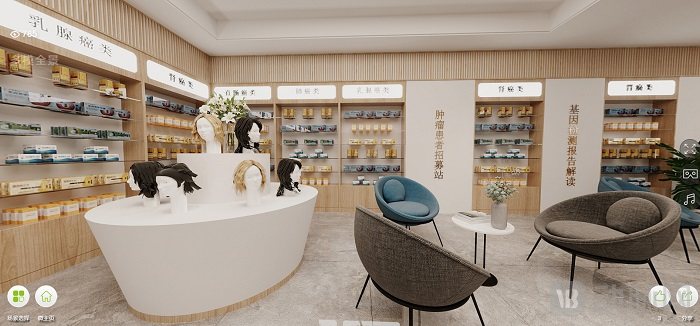
Kangrun Health Offline Store Schematic Diagram
Third, there is a difference in the fees for out-of-hospital management services. In the past, some patient management programs might have offered certain patient management services as value-added benefits to their own members. In the Kangrun Health project, however, patient case management services are provided free of charge. These complimentary services cover a wide range of areas, including medication procurement, charitable drug donations, symptom control, nutritional guidance, treatment efficacy assessment, consultations on preventing complications and metastasis, interpretation of genetic test reports, and psychological support. In addition to providing these free services, Kangrun Health also offers pro bono assistance to help patients address financial hardships—such as interpreting medical insurance policies, facilitating applications for civil affairs relief, and recommending affordable supplemental commercial insurance products (e.g., “Huimin Bao”)—thereby alleviating patients’ financial burdens and saving them worry, effort, and money.
Fourth, the mode of service delivery differs. Traditional patient management services have often been delivered via the internet; however, in Jiang Zonglin’s view, this approach defies common sense and is inevitably unviable in the field of oncology. Kangrun Health plans to establish local shared stores and assign case managers to serve patients, thereby allowing them to experience both the professionalism and the human warmth of the services provided.
“Truly creating value for patients” is a point Jiang Zonglin frequently emphasizes when highlighting the distinctiveness of the Kangrun Health project. In practice, through strategic alliances between industry leaders, they have addressed the fragmented management of cancer patients—described by Jiang as “each party tending only to their own section”—and are now able to provide one-stop, holistic, cross-lifecycle services to families of cancer patients.
One-stop service refers to Kangrun Health assigning case managers to patients, providing end-to-end companionship, and dynamically organizing and recording comprehensive information about patients and their families. This approach connects patients with physicians and various service providers, significantly reducing communication costs among all parties. “This is the essence of digital healthcare, which can substantially enhance the efficiency and effectiveness of the oncology ecosystem.” Holistic service emphasizes multi-dimensional support, covering medical consultations, medication management, nursing care, out-of-hospital management, and social support. The company positions itself as a practitioner committed to “patient benefit-centric” solutions. Cross-lifecycle service addresses a range of issues including palliative care, guardianship trusts, funeral services, bereavement counseling for family members, and inheritance matters.
Thus, the questions facing Kangrun Health may lie in: 1. Where will patients and healthcare professionals come from? 2. How can Kangrun Health achieve operational profitability?
Store Expansion Achieves Localized Management, with “Digital Classification” Becoming a Profit Driver
During the interview, Jiang Zonglin once crunched the numbers: assuming that an offline store for tumor patient management serves 300 people, opening 30 such stores in Chongqing would enable service to more than 9,000 tumor patients.
So, where do patients and case managers come from?
Regarding traffic sources, he joked, “I have 1,000 ways to do it.” He mentioned that in their past business operations, they collaborated with numerous hospitals, pharmaceutical companies, insurance institutions, and genetic testing firms to generate patient referrals. These referral initiatives were often carried out under an “altruistic” model. For instance, by partnering with companies that administer inclusive supplemental medical insurance (Hui Min Bao), they helped these insurers better serve their customers, thereby enhancing customer satisfaction and policy renewal rates. Additionally, the AI-powered triage mini-program and the structured and digitized electronic medical records they are currently developing can also enable a steady stream of online patient referrals.
“The current concern is not patient volume. We are more concerned that an excessive number of patients requiring management, coupled with staffing shortages, will lead to a decline in service quality.” In fact, relevant case managers already have a comprehensive recruitment and training system in place. By training general practitioners, pharmacists, nutritionists, nurses, social workers, and other professionals to serve as physician assistants, they further empower physicians to better serve patients and their families. These personnel can begin on-the-job practical training after a short period of instruction.
Meanwhile, the patient network established through offline stores can address issues related to customer satisfaction, profitability, and sustainable development.
On one hand, most of the services Kangrun Health plans to provide for cancer patients are offered free of charge; however, it also offers commercial services such as medical consultations, nursing care, specialized medical foods, laboratory and diagnostic tests, and notarization and legal services. Families of cancer patients have rigid demand for these services, and Kangrun Health naturally possesses the advantage of earning their trust.
On the other hand, Kangrun Health will implement digital classification for cancer patients. Once the patient volume reaches a certain scale, precise categorization can generate additional revenue streams. For instance, it can provide pharmaceutical companies with precisely matched patients for clinical trials, enabling rapid enrollment; additionally, it can offer manufacturers of foods for special medical purposes (FSMP) entirely new sales channels. These represent viable sources of income while simultaneously addressing long-standing pain points in the clinical trial and FSMP industries.
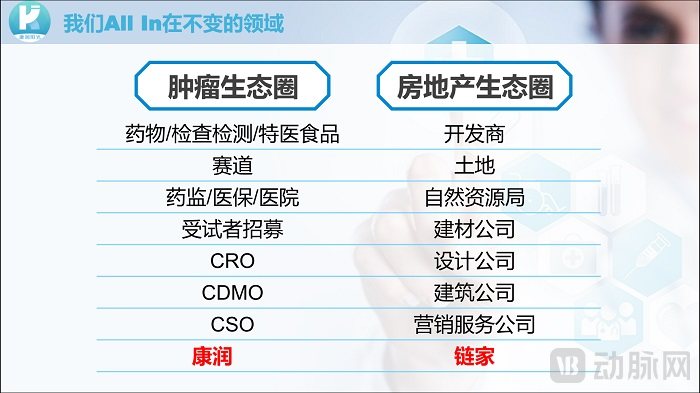
Jiang Zonglin stated that the mission of Kangrun Health can be understood through a simple analogy. Just as Lianjia plays a pivotal role in the real estate ecosystem, Kangrun Health aims to assume a similar position within the oncology ecosystem, striving to become the “Lianjia” of the cancer care landscape.
The Kangrun Health project is planning to raise funds, which will be primarily used for the rollout of offline stores, the establishment of a model oncology nursing facility, and the improvement and integration of its digital systems. According to its plan, three stores will be opened this May, with model validation and optimization to be completed by October this year. Following continuous improvements to its systems and team, the stores will be rolled out across China.
“We anticipate that each individual store will break even within six months at the latest, recoup its initial investment within the first year, and at least double its profits in the second year. We hope to engage with like-minded investment institutions to rapidly achieve system integration and project implementation, thereby benefiting cancer patients and achieving mutual success,” said Jiang Zonglin.