

Kindbody Files for IPO to Expand Accessible Fertility Care Across the U.S.

Kindbody
Women's Health Service Provider

Perceptive Advisors
Private Hedge Fund Sponsor
On March 2, women’s health services provider Kindbody announced the completion of a $100 million Series D financing round, led by Perceptive Advisors. This round brings Kindbody’s total equity and debt financing to over $290 million, valuing the company at $1.8 billion. The funds will be used to continue investing in the launch and operation of clinics across the U.S. market, further strengthening its care model.
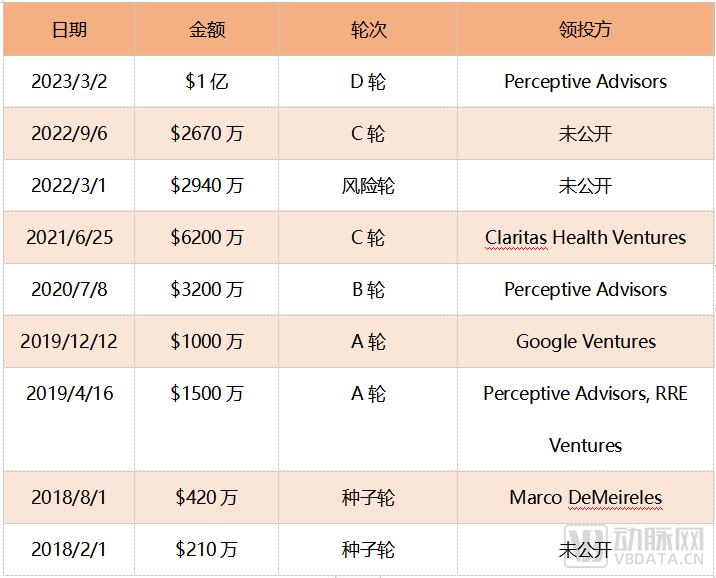
Kindbody's Financing History
Data Source: Crunchbase
Kindbody, founded in August 2018 and headquartered in New York City, New York, USA, is a technology-driven network of fertility clinics and family-building benefits provider led by its founder and chairperson, Gina Bartasi. It offers employers both remote and in-person care services.

Kindbody Founder and Chairwoman: Gina Bartasi
Image source: Kindbody official website
To date, Kindbody has completed nine rounds of financing, raising a total of $281.4 million. It is a fertility benefits provider trusted by 112 employers, covering more than 2.4 million employees. Additionally, thousands of self-pay patients across China receive fertility care directly from Kindbody through its mobile clinics and partner clinics.
What Makes Kindbody So Appealing That Capital Keeps Backing It??
Gina Bartasi is a seasoned entrepreneur with over 20 years of experience in the health tech industry. Her extensive expertise and professional journey ultimately led her to found Kindbody.
Before founding Kindbody, Gina observed that people rarely discussed fertility issues outside of the doctor’s office. Fertility care was a healthcare domain in which patients typically engaged with physicians only after problems arose. There was an urgent need to raise awareness and prioritization of fertility care. Meanwhile, Gina underwent multiple rounds of in vitro fertilization (IVF) to conceive her twin sons, depleting her savings in the process. IVF and assisted reproductive technologies are costly, and their success rates remain suboptimal.
Meanwhile, until the establishment of Kindbody, the demand for assisted reproductive technology (ART) in the United States remained undiminished. The supply of fertility care failed to meet demand, naturally driving up prices and placing it out of reach for many individuals from average-income households. High-quality fertility care became a true “luxury.”
After founding Progyny (NASDAQ: PGNY) in 2015, Gina recognized that employers actually preferred to purchase fertility benefits directly from providers, a approach that could save them millions of dollars. In response to employer feedback and industry insights, and aiming to address the undervaluation and high costs associated with fertility care, Gina co-founded Kindbody in August 2018 together with a team of healthcare and industry veterans.
“For a long time, fertility care has served only 1% of the population. We aim to make fertility care affordable and accessible to all.” Guided by this belief, Gina leads Kindbody in educating and empowering individuals on matters of fertility:
Prioritize “Fertility Desert”. Kindbody first launched its mobile clinics in 2018 to provide care directly to patients. Since then, the company has opened 11 brick-and-mortar clinics, prioritizing “fertility deserts”—areas with high demand and long wait times for fertility specialists, such as Atlanta.
Free services are provided.All women can receive a free blood test at Kindbody to assess ovarian reserve.
Support for Non-Profit Organizations.Gina has incorporated support for nonprofit organizations addressing systemic healthcare inequities into her corporate work, such as partnering with Fertility for Colored Girls to provide donation services.
Since its inception, Kindbody has maintained an average Net Promoter Score (NPS) of over 88—a metric where scores closer to 100 indicate higher customer loyalty and satisfaction—closely tied to Kindbody’s transparent, end-to-end service model.
Comprehensive: End-to-end, full coverage from preconception to postpartum
Currently, Kindbody owns and operates 31 clinics across China. Its medical team includes 34 board-certified (or dual-board-certified) reproductive endocrinologists and 52 embryologists. Supported by the expertise of this specialist team, Kindbody’s clinical management programs encompass fertility assessment and education, fertility preservation, genetic testing, in vitro fertilization (IVF), donor services, and surrogacy.services, adoption, and physical, mental, and emotional support from preconception to postpartum, achieving comprehensive end-to-end coverage across the preconception and postpartum periods.
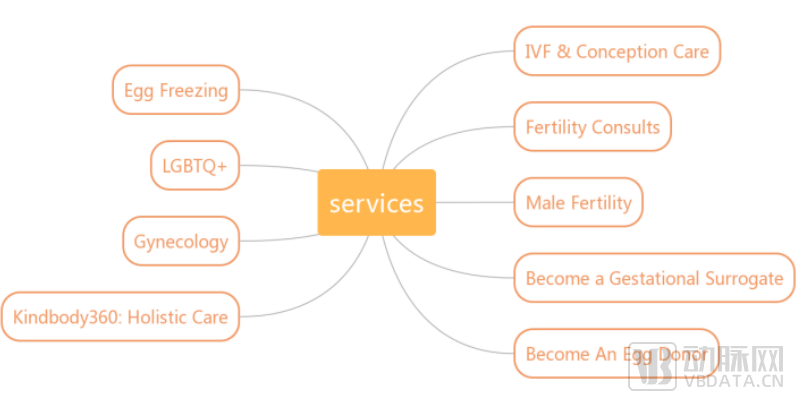
Kindbody’s Services
Source: Kindbody Official Website
The provision of the above services relies on Kindbody’s technical support.
According to BuiltWith, Kindbody actively uses 84 technologies on its website. These include Viewport Meta, iPhone/Mobile Compatible, and Let's Encrypt.
In actual diagnostic and treatment processes, Kindbody also employs advanced technologies. These include preimplantation genetic screening (PGS) and a cryopreservation technique known as vitrification to reduce the risk of multiple births. Additionally, Kindbody has established KindMR, its proprietary medical record and billing system, which allows patients immediate access to digital records and telemedicine platforms. This enables physicians to make optimal decisions and continuously improve quality of care.
Transparency: Bypassing Insurance Companies with Clearly Marked Prices
When healthcare companies and insurance providers are bundled together, the drive for profit steers patients toward high-priced physicians, while lacking aligned incentives to reduce patients’ medical costs.
Driven by its mission to democratize fertility care, Kindbody bypasses insurance companies by offering transparent, upfront pricing. The company replaces traditional fee-for-service models with bundled case rates for physicians and publishes all services and their corresponding fees directly on its website. By contracting directly with employers, Kindbody helps them save 25%–40% in costs.
In this regard, Kindbody has partnered with Walmart. On September 27, 2022, Walmart Inc. announced the designation of Kindbody as the Center of Excellence (COE) for fertility services under its new family-building benefits program. Employees can access Kindbody’s network of facilities across the United States, including a new clinic and in vitro fertilization (IVF) laboratory in Rogers, Arkansas, to receive comprehensive virtual, at-home, and in-clinic care.
To accommodate its business growth, Kindbody acquired three companies in 2022: Vios Fertility, Phosphorus Labs, and a gestational surrogacy agency. Following these three acquisitions, the number of Kindbody’s clinics across China more than doubled, and the company established a new KindLabs division, integrating genetic testing and carrier screening into its end-to-end medical service model.
Data from the National Bureau of Statistics shows that infertility in ChinaInfertility rates have been rising year by year, reaching 12%–18% in 2022. According to forecasts by VCBeat Research Institute, the potential demand for assisted reproductive technology in China is nearly 15.66 million people.
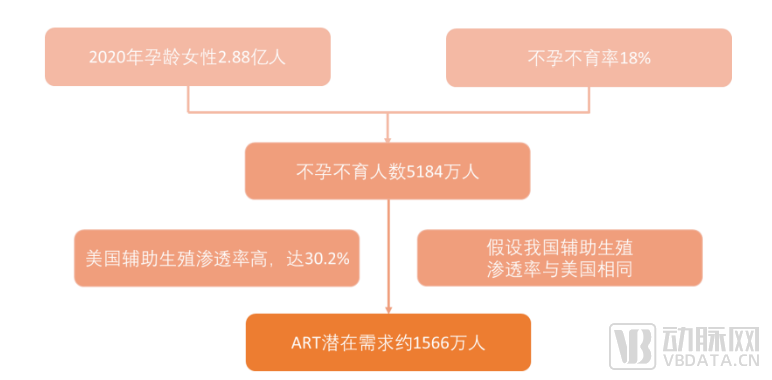
Data source: National Bureau of Statistics, VCBeat Orange Database
Source: VCBeat
Meanwhile, Frost & Sullivan statistics indicate that the penetration rate of assisted reproductive technology (ART) in China was only 7.0% in 2018, significantly lower than the 30.2% in the United States during the same period. In recent years, there has been little growth in the number of approved medical institutions providing ART services. As of May 2022, there were a total of 539 approved ART institutions in China, indicating an ongoing supply gap.
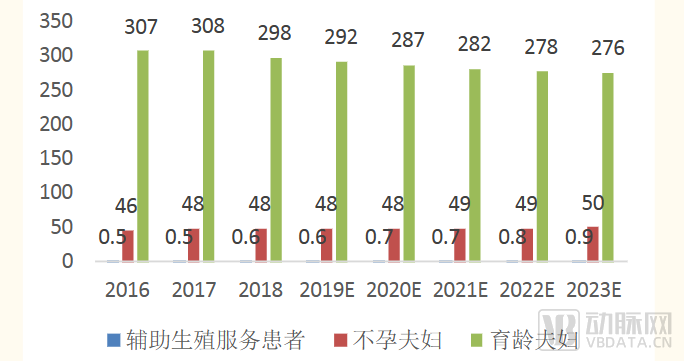
Breakdown of China's Demand for Assisted Reproductive Technology (Millions)
Source: Jinxin Fertility’s prospectus, Sinolink Securities Research Institute
Currently, China has companies such as Berry Genomics and Jiabao Renhe that specialize in the field of assisted reproductive technology (ART). Notably, Berry Genomics obtained the first preimplantation genetic testing (PGT) certificate in the ART sector in 2020. Jiabao Renhe has successively undertaken nearly 10 major national and provincial projects, filed over 30 patent applications, and registered nearly 30 software copyrights.
In terms of policy, since the release of the “Guiding Opinions on Further Improving and Implementing Proactive Fertility Support Measures” in August 2022, relevant authorities in Beijing, Hangzhou, and Jingmen have introduced supportive policies. These measures reduce the financial burden on infertility patients undergoing assisted reproductive technology (ART) through special subsidies or medical insurance reimbursement, effectively stimulating demand for ART services and fertility care.