

Jinkun Bio's Domestically Innovated Injectable Polyglutamic Acid Receives Type Inspection Acceptance, Entering China's Billion-Dollar Regenerative Aesthetics Market
As “returning aesthetic medicine to its medical roots” gradually becomes an industry consensus, investment in and R&D of new technologies and materials by upstream players in the aesthetic medicine sector have been particularly vigorous in recent years.
Recently,Ningbo Jinkun Biotechnology’s Polyglutamic Acid for Injection, the Exclusive Domestic Aesthetic Medicine Product, Has Been Accepted for Type Testing by the National Institutes for Food and Drug Control (NIFDC), Officially Initiating the Class III Medical Device Registration Process. It is reported that polyglutamic acid is a biopolymer material formed by the polymerization of glutamic acid monomers, possessingGood water solubility, moisturizing properties, biocompatibility, non-toxicity, and biodegradability, the research and development of its products and production processes were completed through a collaboration between Jinkun Biotechnology and Professor Qiao Changsheng from the School of Biological Engineering at Tianjin University of Science and Technology.
Ningbo Jinkun Biotechnology Co., Ltd. is a high-tech enterprise dedicated to the microbial manufacturing of biopolymer materials. Leveraging synthetic biology technologies, the company has established a leading R&D and application platform for biopolymer materials both domestically and internationally. It possesses comprehensive capabilities spanning from basic research to applied research, and from laboratory-scale pilot trials to industrial-scale production. The company has successfully completed the R&D, production, and sales of fourth-generation biomedical materials, including poly-L-lactic acid (PLLA), poly(lactide-co-glycolide) (PLGA), and polycaprolactone (PCL). Notably, PLLA-based products have achieved definitive clinical validation and enjoy a strong market reputation.
According to reports, Jinkun BiotechnologyA Production Base for Bio-polymer Materials with an Annual Polyglutamic Acid Capacity of 10,000 Tons Is About to Be Completed, the product can be widely applied in fields such as pharmaceuticals, cosmetics, food, agriculture, and ecological environmental protection.
Hydration and moisturization are among consumers’ fundamental demands. For many years, hyaluronic acid, as a humectant, has been the top choice for consumers, holding an unchallenged leading position in the medical aesthetics industry. However, with the continuous advancement of synthetic biology research, an increasing number of new materials are emerging, and hyaluronic acid is no longer the only option.
Polyglutamic acid molecules feature a multi-branched structure, with numerous hydrophilic carboxyl groups on their side chains, endowing them with exceptional water-absorbing and moisture-retaining capabilities. Polyglutamic acid can induce the skin to produce natural moisturizing factors (NMF). Under experimental conditions,FeasibleAbsorbs 4,000 times its own weight in water, with an optimal capacity of up to 5,000 times., significantly enhances the moisturizing capacity of the deeper skin layers, reduces moisture loss, and promotes the restoration of skin elasticity.
It is reported that, compared with hyaluronic acid and collagen, polyglutamic acid exhibits higher water affinity.Longer-lasting hydration with more enduring effects.
Extensive medical research and clinical trials have confirmed that tyrosinase is the key enzyme in melanin synthesis, and its activity level directly affects melanin production. Through research, Ningbo Jinkun Biotechnology Co., Ltd. has found that polyglutamic acid can effectively inhibit tyrosinase activity, reduce melanin generation, and achieveBrightens skin and evens out skin tonethe efficacy of.
Furthermore, polyglutamic acid possesses the ability to activate repair mechanisms, promote cellular regeneration, and scavenge free radicals, thereby exerting anti-aging and skin-tightening effects. Its safety, non-toxicity, and biodegradability also enable it to provide nutritional support to the skin.
Polyglutamic acid’s efficacy in long-lasting moisturization, hydration, and skin whitening makes it an optimal choice for combination with various nutritional agents. According to a report by Gongyan Network, the demand for polyglutamic acid exceeded 1,000 tons in 2022. However, similar to other materials in the field of synthetic biology, scaled-up production of polyglutamic acid remains challenging.
Synthetic biology products encounter challenges such as process scale-up, process control, and the design and selection of specialized equipment during industrialization, which can affect the stability of product quality and yield in large-scale production.
As an extracellular product, polyglutamic acid results in a highly viscous fermentation broth, making it difficult to remove bacterial cells using conventional centrifugation methods and rendering such approaches unsuitable for large-scale industrial applications. There are typically three methods for extracting polyglutamic acid: membrane separation precipitation, chemical precipitation, and organic solvent precipitation.
Membrane separation precipitation involves a relatively complex process and yields suboptimal results for fermentative broths with complex impurity profiles, often leading to membrane fouling and necessitating cumbersome cleaning procedures. Chemical precipitation employs inorganic salts; however, the subsequent desalting step is tedious, and the free carboxyl groups in poly-γ-glutamic acid can bind numerous inorganic salt ions, thereby increasing the difficulty of ion removal. Currently, organic solvent precipitation is predominantly used for industrial-scale production, but it tends to result in organic solvent residues and lower purity, making it mainly suitable for the manufacture of agricultural-grade poly-γ-glutamic acid products.
According to relevant industry standards, the purity requirements for polyglutamic acid vary depending on its application area. Agricultural-grade polyglutamic acid has lower purity requirements, while cosmetic-grade polyglutamic acid requires a purity greater than 92%.Medical-grade polyglutamic acid demands higher purity and is more challenging to mass-produce.
Jinkun BiotechnologyThe proprietary fully hydrated extraction process for polyglutamic acid is a separation and purification method that involves no addition of organic solvents, enabling large-scale production of medical-grade polyglutamic acid with purity exceeding 99%. Compared with other extraction methods, this approach ensures no residual organic solvents in the final product, significantly expanding its application scope, particularly for medical aesthetics product lines.
Ningbo Jinkun Biotechnology Co., Ltd. has established a proprietary strain library for polyglutamic acid production, selecting specific strains based on different raw materials and target molecular weights, achieving yields of up to 80 g/L. Meanwhile, the company has developed fermentation process control strategies for polyglutamic acid based on multi-omics technologies, ensuring strict regulation of the fermentation process and guaranteeing production stability.
From the upstream perspective, the continuous iteration of R&D technologies and procedural techniques has been the core driver advancing the medical aesthetics industry. Amid strengthened regulatory oversight, increasingly sophisticated consumers, and the evolving development of enterprises, competition within the medical aesthetics industry chain has shifted upstream, making raw material R&D a critical factor. Consequently, the strategic importance of the raw material segment at the upstream end of the industry chain is steadily rising.
From the perspective of the historical development of China’s medical aesthetics industry, advancements in raw material research and development have been a key driver of rapid industry growth. Taking hyaluronic acid, the “cornerstone” of the medical aesthetics field, as an example, technological progress on the raw material side—evolving from traditional animal-derived extraction to biofermentation—has made hyaluronic acid one of the most widely used product categories in China’s current medical aesthetics market.
Since its inception in 2013, Ningbo Jinkun Biotechnology Co., Ltd. has devoted substantial efforts to the research and development as well as industrialized production of raw materials for medical aesthetics. At the level of basic research, the company leverages gene editing, bioinformatics, high-throughput screening, metabolic engineering, and multi-omics technologies (genomics, transcriptomics, proteomics, and metabolomics) to develop proprietary intellectual property rights inBiopolymer Material Strain Resource Bank。
At the applied research level, Ningbo Jinkun Biotechnology Co., Ltd. has established a proprietary fermentation process for high-viscosity systems of biopolymer materials, and simultaneously set upFermentation Pilot-Scale PlatformandGreen Separation and Extraction Platform, enabling industrial-scale scale-up experiments and process package design, thereby laying the foundation for the industrialization, engineering implementation, and supporting infrastructure development of polymer materials.
At the level of quality standard control, Ningbo Jinkun Biotechnology Co., Ltd. has establishedQuality Control Platform, to perform physicochemical testing, biosafety evaluation, method development, quality management, and other tasks, ensuring product safety and consistent quality.
After nearly a decade of dedication to the field of biological raw materials, Ningbo Jinkun Biotechnology Co., Ltd. is currently active in the fields of biopolymer materials and high-end medical devices.Filed over 200 patent applications, including more than 60 granted invention patents, 23 utility model patents, and 3 design patents.。
Driven by the rapid advancement of synthetic biology and continuous progress in the medical aesthetics industry, upstream raw materials for medical aesthetics have achieved breakthroughs in technology and application. These developments have addressed the specific demands of niche medical aesthetic products, facilitating the widespread adoption of technology-driven solutions.
According to statistics, a total of 42 new ingredients were filed with the National Medical Products Administration (NMPA) in 2022, including nine biotechnology-derived ingredients. The intensifying competition within the medical aesthetics industry has prompted many domestic enterprises to shift their R&D focus upstream in the supply chain, prioritizing ingredient development. By developing proprietary core functional ingredients, these companies seek to differentiate their products, which has become a key driver boosting their R&D momentum and market vitality.
Leveraging synthetic biology technology, in addition to polyglutamic acid, Jinkun Biotechnology hasPoly-L-lactic acid, Pullulan, Polymalic acid, Recombinant collagen, Fibronectin...and other biological raw materials for technological and product development. The product portfolio comprehensively covers multiple pipelines, including wrinkle reduction, dermal filling, hydration, and anti-sensitivity, thereby meeting the primary needs of medical aesthetics consumers.
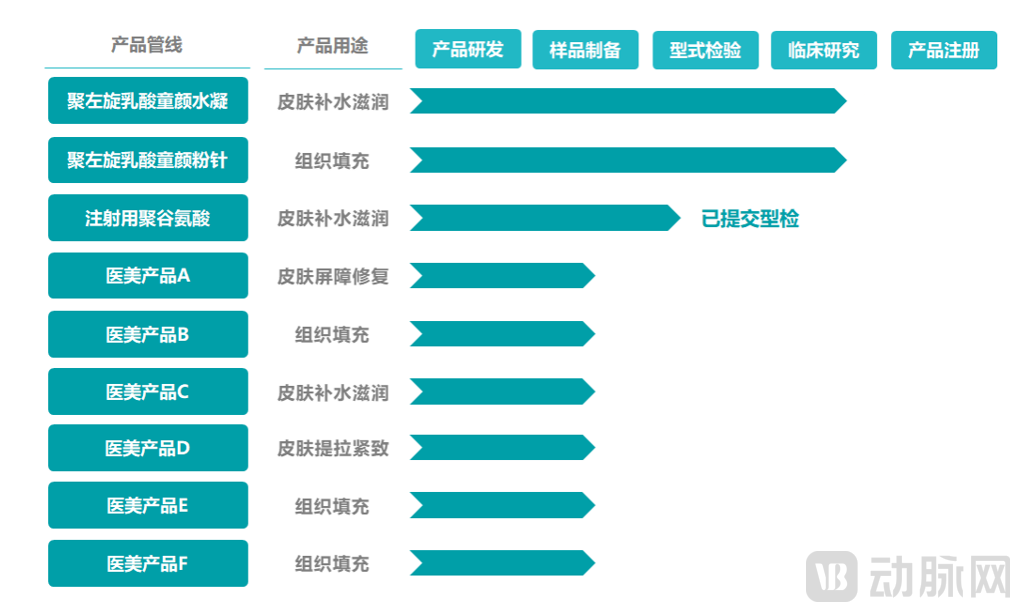 Jinkun Biotechnology's Aesthetic Medicine Product Pipeline
Overall, synthetic biology has already demonstrated significant potential and broad application prospects in the field of medical aesthetics. It holds substantial practical significance for addressing the current challenges in expanding the supply of raw materials for pharmaceuticals and cosmetics, and may serve as a new growth engine for the future development of the pharmaceutical and cosmetic industries.As a full-industry-chain platform company, Ningbo Jinkun Biotechnology Co., Ltd. has established capabilities spanning from basic research to industrial commercialization in the microbial manufacturing of biopolymer materials, thereby securing a favorable position in the impending competition for core raw materials.