

WeDoctor Gains Spotlight as National Healthcare Security Administration Reaffirms Inclusion of Internet-Based Medical Services in医保 Coverage
Recently, in response to the proposal to “include fees for internet-based remote consultations and remote diagnoses in the medical insurance settlement system,” the National Healthcare Security Administration stated that for “Internet+” medical services provided by designated medical institutions, if they are identical in content to offline medical services covered by medical insurance payment and adhere to the pricing standards of corresponding public medical institutions, they will be included in the scope of medical insurance payment and reimbursed accordingly after completing the requisite filing procedures.
The National Healthcare Security Administration’s renewed emphasis on including internet-based medical consultations in the national medical insurance scheme is a microcosm of China’s current strong support for the development of “Internet + Healthcare.”
In recent years, China’s “Internet + Healthcare” industry has experienced rapid development, accompanied by increasingly comprehensive health insurance policies. Guided by national policies, the pace of innovation in new digital healthcare models across China has further accelerated. For instance, WeDoctor has implemented Digital Health Communities in Tianjin, Shandong Province, and other regions. By leveraging internet hospitals integrated with physical medical institutions and connected to health insurance payment systems, WeDoctor has established a digitally driven, tightly integrated Internet Medical Consortium. Focusing on chronic disease management, it explores innovative health insurance payment methods based on “pay-for-performance,” providing patients with lifelong medical and health services tailored to specific diseases. Due to its significant social and market benefits, this model has attracted widespread attention from various stakeholders.
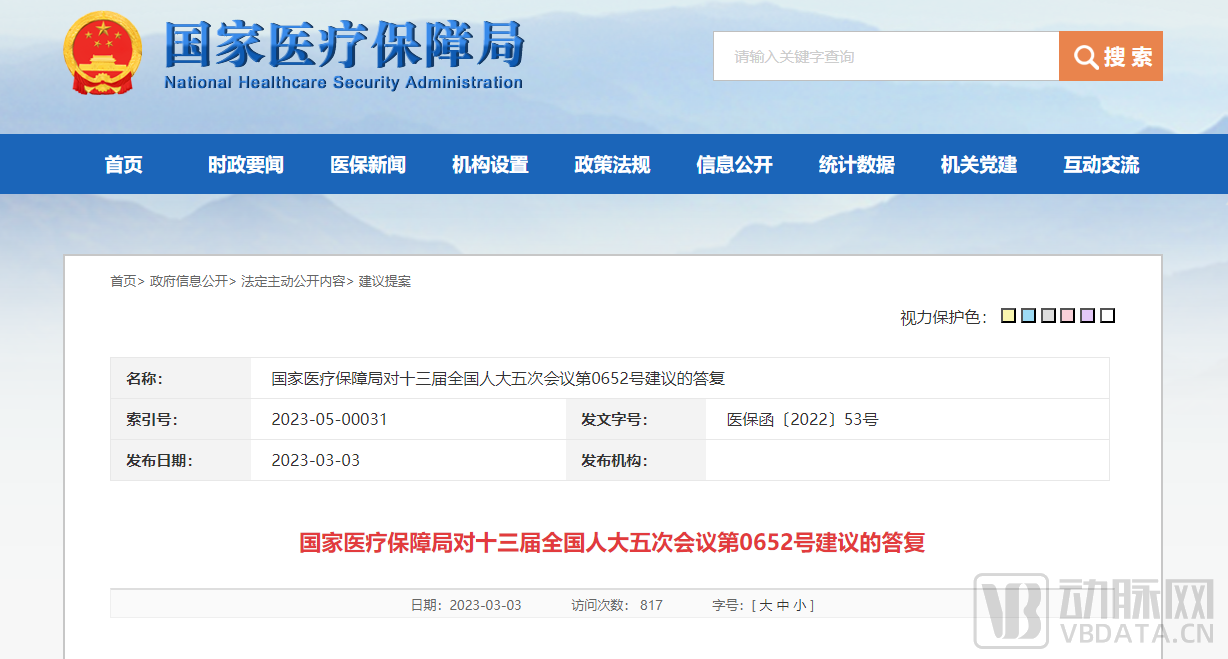 Source | Official Website of the National Healthcare Security Administration
In its response, the National Healthcare Security Administration (NHSA) pointed out that internet-based remote consultations and remote diagnostics are effective approaches to promoting the sharing of high-quality medical resources and meeting the public’s healthcare needs. In accordance with the decisions and deployments of the Central Committee of the Communist Party of China and the State Council, the NHSA has worked actively with relevant departments to formulate and refine health insurance reimbursement policies for “Internet+” medical services. A review reveals that in recent years, the national efforts to incorporate internet-based medical services into health insurance coverage have increased significantly year by year:
In August 2019, the National Healthcare Security Administration issued the "Guiding Opinions on Improving Price and Medical Insurance Payment Policies for 'Internet+' Medical Services," which clarified the medical insurance payment policies for "Internet+" medical services and put forward relevant requirements such as defining the scope of medical insurance coverage and improving the management of medical insurance agreements.
In March 2020, the National Healthcare Security Administration and the National Health Commission jointly issued the “Notice on Promoting ‘Internet+’ Medical Services During the Prevention and Control of the COVID-19 Pandemic,” clarifying that online follow-up consultation services for common and chronic diseases provided by qualified internet-based medical institutions to insured individuals may be included in the coverage of the basic medical insurance fund in various regions in accordance with relevant regulations.
In November 2020, the National Healthcare Security Administration issued the "Guiding Opinions on Actively Promoting Medical Insurance Payment for 'Internet+' Medical Services," requiring local medical insurance centers to fully recognize the significance of medical insurance payment for "Internet+" medical services, strengthen agreement management for such services, and optimize the administrative and service processes for medical insurance handling.
In accordance with the requirements of national medical insurance policies, various regions across China have actively explored and established sound regulatory systems for medical insurance funds that are adapted to the payment characteristics of “Internet+” medical services, taking into account local realities in the development of healthcare services. Leveraging this opportunity, they are promoting innovation in “Internet+” medical service models and even driving the digital upgrade of regional healthcare service systems, so as to meet the public’s demand for multi-level and diversified medical and health services.
In Shandong Province, in September 2019, WeDoctor entered into a strategic partnership with the Tai’an Municipal Government to jointly establish the Tai’an Digital Health Community and China’s first internet hospital dedicated to chronic disease management. Leveraging this internet hospital, which integrates medical insurance payment capabilities, as a platform, specialized chronic disease management zones—Chronic Disease Service Centers—were established within member hospitals of the Chronic Disease Internet Medical Consortium. This initiative enabled comprehensive “in-hospital + out-of-hospital” and “online + offline” services covering chronic disease diagnosis and treatment, health management, and medical insurance reimbursement. As a result, the consultation time for chronic disease patients was reduced from the previous 2–3 hours to just 20–30 minutes, and outpatient pressure on hospitals was alleviated by more than 20%.
The “Tai’an Model” has been highly recognized by the government and the industry, leading to its comprehensive promotion across all 16 prefecture-level cities in Shandong Province. As of December 31, 2022, WeDoctor had established more than 40 chronic disease management centers in cities including Jinan, Tai’an, Weifang, and Dezhou, cumulatively serving over 28 million insured individuals and providing more than 4.5 million consultations for patients with chronic diseases.
Tianjin has vigorously promoted the integration of “Internet + Healthcare” into grassroots and community settings. In April 2020, under the leadership of the Tianjin Municipal Health Commission, Tianjin WeDoctor General Hospital (Tianjin WeDoctor Internet Hospital) spearheaded the establishment of a closely-knit internet-based medical consortium—the Tianjin Grassroots Digital Health Community—in collaboration with 266 primary healthcare institutions across the city. By implementing “Cloud Management,” “Cloud Services,” “Cloud Pharmacy,” and “Cloud Testing,” along with standardized offline chronic disease management centers, the initiative has achieved standardized diagnosis and treatment by disease type, centralized cloud pharmacy services, and centralized cloud testing capabilities, thereby providing residents with integrated online and offline healthcare services. Meanwhile, focusing on chronic disease management, the Health Community has explored innovations in performance-based payment models, such as capitation and case-based payments, to establish a new mechanism for health accountability. In the 2020 campaign highlighting the “Top Ten New Measures to Advance Healthcare Reform and Serve Public Health,” Tianjin’s initiative to “innovatively build the ‘Four Clouds’ platform and promote the development of the Grassroots Digital Health Community” ranked first among the top ten measures.
Data shows that as of December 2022, the Healthcare Community had signed chronic disease management cooperation agreements with 204 primary healthcare institutions and 7 secondary hospitals, and was progressively establishing joint chronic disease management centers. Over 1.68 million patients have been included in managed health records, and more than 110,000 diabetic patients have been enrolled and placed under the specialized outpatient health stewardship responsibility system for diabetes. In pilot primary healthcare institutions, the standardized management rate for diabetic patients reached 81.5%, and the blood glucose control rate improved by over 12.1%. The medical insurance surplus rate for healthcare institutions implementing capitation payment reached 16.7%.
Practices in Shandong, Tianjin, and other regions demonstrate that continuous innovation and improvement of internet-based medical insurance policies not only enable the public to access convenient and high-quality digital healthcare services but also hold significant importance for advancing China’s tiered diagnosis and treatment reform. By leveraging digital integration among medical care, health insurance, and pharmaceuticals (the “Three Medical” sectors), these efforts contribute to building a value-based healthcare system centered on health, thereby truly achieving the goal of “strengthening primary care and safeguarding health.”