

NeoDynamics AB Files Prospectus to Enter China's $1B Breast Biopsy Market with NeoNavia System

NeoDynamics
Diagnostic Product Developer
On March 6, Swedish medical device company NeoDynamics AB (Nasdaq First North Growth Market: NEOD) announced that its FlexiPulse biopsy needle for the NeoNavia biopsy system has received patent certification in China.
NeoNavia was developed by the Karolinska Institutet (KI) in Sweden, one of the world’s leading medical universities. This biopsy system is based on patented pulse technology and is designed to provide clinicians with more accurate lesion localization and higher tissue sample yields, thereby enabling precise diagnosis and personalized treatment for patients.
FlexiPulse Biopsy Needle: Specifically developed for biopsy procedures in anatomically challenging areas, such as axillary lymph nodes. Its front-loaded open sampling needle ensures maximal tissue yield with minimal patient trauma during the biopsy process.
Following the granting of a similar patent in the United States in 2022, FlexiPulse’s recent patent approval in China marks a significant milestone for the company. CEO Anna Eriksrud stated that China’s breast biopsy market, currently valued at over $100 million (nearly RMB 1 billion) and growing at approximately 10% annually, presents substantial opportunities, and this patent paves the way for the company’s future market expansion in China.
The pathological results of breast needle biopsy are considered the "gold standard" for breast cancer screening. Currently, there are three main methods for breast needle biopsy: Fine-Needle Aspiration Cytology (FNAC), Core Needle Biopsy (CNB), and Vacuum-Assisted Breast Biopsy (VAB).
These traditional methods each have their advantages and disadvantages, but they primarily face three major challenges: difficulty in lesion localization, repetitive harm to patients caused by oversized biopsy needles or insufficient sampling, and operational difficulties in sampling from certain anatomical sites.
NeoNavia’s basic configuration is similar to existing biopsy devices on the market, consisting of three components: a base unit, a handheld driver, and a biopsy needle.
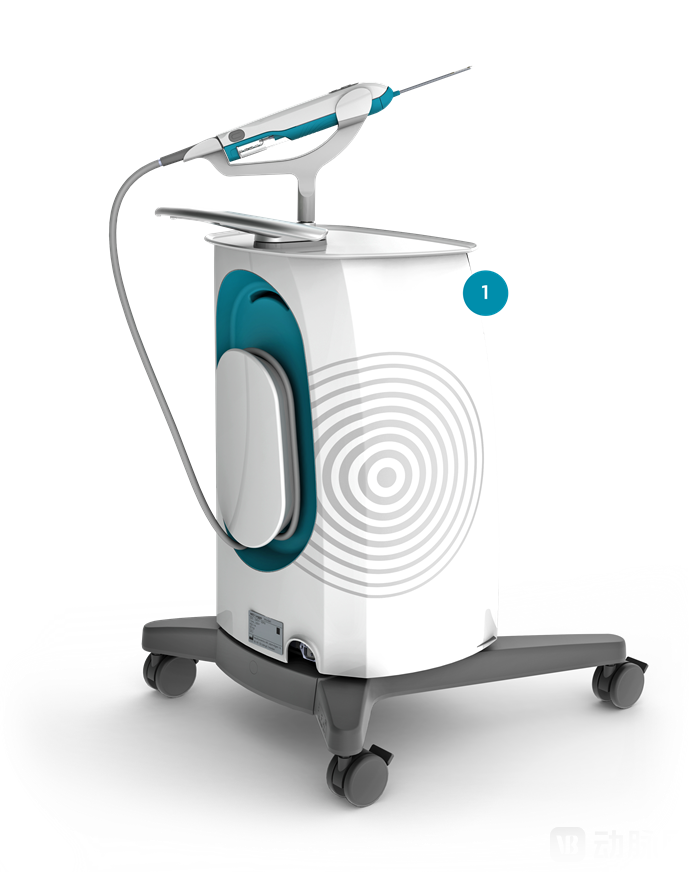
NeoNavia Biopsy System
Image source: NeoDynamics AB official website
So, how does NeoNavia leverage patented technological innovations to address these three major biopsy challenges?
Traditional CNB biopsy needles incorporate built-in spring mechanisms, which make penetration speed difficult to control and result in excessively long biopsy needles. Consequently, even with imaging guidance, they cannot accurately reach suspected lesions. NeoNavia is equipped with “Fourier micro-pulse technology,” enabling the sampling needle to advance in 1–2 mm increments, allowing for gradual and precise insertion into the body and tissues under the physician’s control.
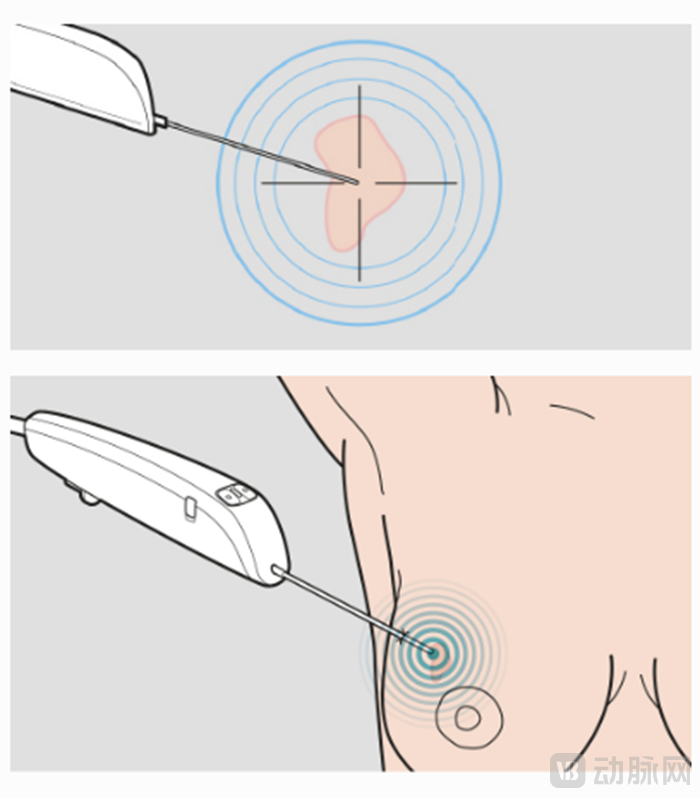
Sampling Under the Guidance of Patented Pulse Technology
Image source: NeoDynamics AB official website
Under pulse-driven actuation, physicians can control the biopsy needle to advance incrementally into tissue; however, the advancement speed at each step significantly impacts the body. According to fracture mechanics in solid mechanics, a higher insertion speed of the biopsy needle reduces the force required for tissue cutting and minimizes tissue displacement, thereby causing less trauma to the patient.
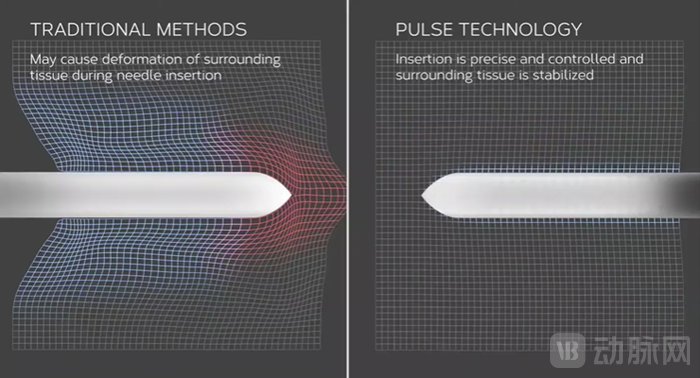
Conventional Sampling (Left) vs. Pulse-Guided Sampling
Image source: NeoDynamics AB official website
Based on this theory, the NeoNavia console is equipped with an oil-free piston compressor to provide pressurized pneumatic power for the automated biopsy needle driver. Driven by the compressor’s pneumatic force, the NeoNavia biopsy needle achieves a maximum velocity in air of 21.2 m/s, whereas conventional core needle biopsy (CNB) devices that rely on manual loading and manual spring release achieve maximum needle velocities in air of only 8–15 m/s.(Physica Medica,February 2018)
NeoNavia is equipped with three different types of biopsy needles, offering functionality that covers existing ultrasound-guided puncture biopsy systems in hospitals and clinics.
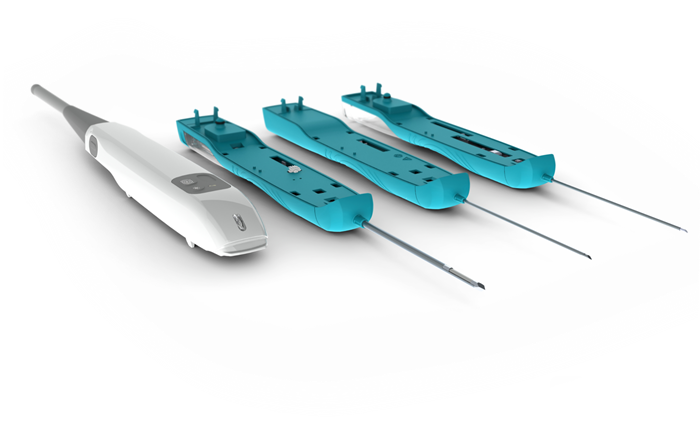
Handheld Driverand biopsy needles FlexiPulse, CorePulse, VacuPulse (from left to right)
Image source: NeoDynamics AB official website
VAB involves a longer needle tract, making conventional surgical hemostasis unfeasible, which may result in hematoma formation within the residual cavity. FNA yields limited tissue samples due to the use of fine needles, failing to provide a comprehensive representation of the lesion’s pathological characteristics. CNB can effectively compensate for the limitations of FNA. However, axillary lymph nodes, particularly those in the supraclavicular region, are often closely associated with blood vessels and nerves.
NeoDynamics AB’s exclusive FlexiPulse sampling needle achieves the highest tissue yield while minimizing damage to surrounding tissues, even in challenging biopsy sites such as axillary lymph nodes.
NeoNavia is configured with three types of biopsy needles: CorePulse and VacuPulse, the two most commonly used needles in current ultrasound-guided biopsies, and FlexiPulse, which has recently been granted a patent in China.
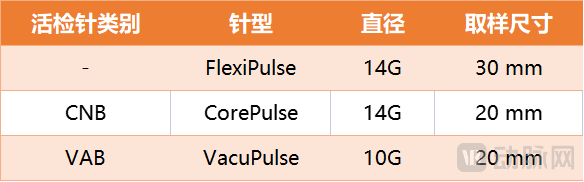
Three Types of Biopsy Needles Configured for NeoNavia
VCBeat
FlexiPulse was developed and designed for performing needle biopsies in technically challenging areas such as the axillary lymph nodes. Due to their proximity to blood vessels and nerves, as well as the small size and atypical morphology of early-stage lesions, tissue sampling from this region presents significant technical and anatomical challenges. The combination of NeoNavia and FlexiPulse addresses the difficulties associated with axillary lymph node biopsy.
FlexiPulse consists of two components: an open-ended sampling needle and a retractable stylet. Prior to inserting the biopsy needle into the lesion, the stylet extends from the tip of the biopsy needle to prevent healthy tissue from prematurely entering the sampling chamber during insertion. After insertion, the stylet retracts 60 mm into the sampling needle, thereby exposing the sampling needle and forming a sampling chamber of corresponding length. The sampling needle then rotates to separate the specimen from the surrounding tissue.
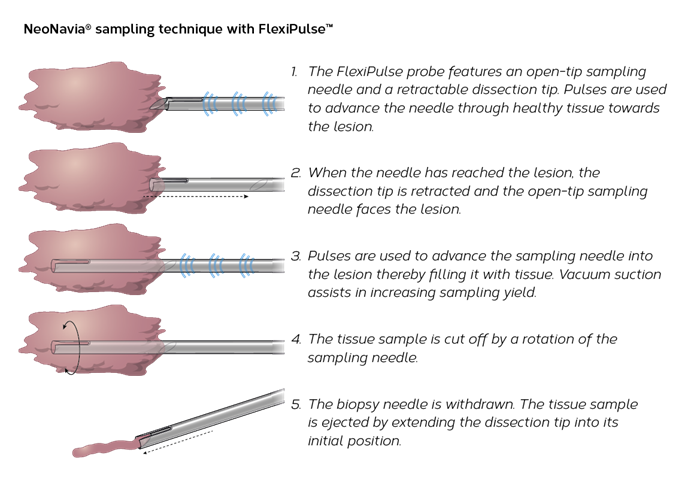
FlexiPulse Sampling Process
Image source: NeoDynamics AB official website
Why Is Axillary Lymph Node Sampling So Important in the Diagnosis of Breast Cancer?
Breast cancer is a malignant tumor arising from the epithelial cells of the mammary ducts, and axillary lymph node metastasis represents the initial stage of breast cancer cell dissemination. Therefore, early examination of axillary lymph nodes provides accurate information regarding nodal metastasis, which is of significant importance for tumor staging, formulation of treatment plans, and prognosis assessment.
NeoDynamics AB conducted a randomized controlled clinical trial (NCT04500262) across 11 research institutions in the UK to evaluate and compare the sampling efficacy of NeoNavia versus traditional 14G diameter core needle biopsy (CNB) in axillary lymph node tissue. The results were presented at the 2021 Annual Meeting of the Association of Breast Surgery (ABS).
As shown in the figure, FlexiPulse significantly outperforms standard CNB in terms of sampling rate.
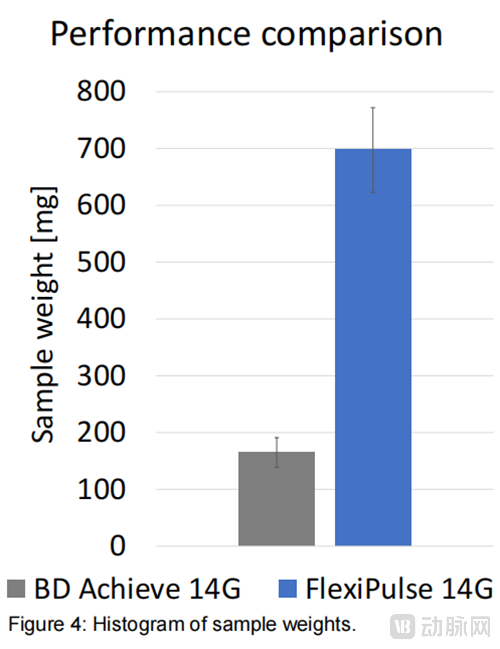
Histogram of sample weights
Image source: ABS 2021 Annual Meeting
NeoDynamics AB also conducted a single-arm clinical study (NCT03975855) across seven research centers in Germany, evaluating the sampling efficiency of FlexiPulse for axillary lymph nodes using an external control design. The findings were presented at the 2022 Annual Scientific Meeting of the British Society of Breast Radiology (BSBR).
Data show that, under air-pulse drive, physicians can better control the FlexiPulse biopsy needle for sampling lymph node tissue, achieving a success rate of 93% (107/115).
According to the latest 2020 global cancer burden statistics from the official website of the International Agency for Research on Cancer (IARC), China, as the world’s most populous country, had far more new cancer cases than any other country, and its number of cancer deaths also ranked first globally.
Among these, the number of new cancer cases among Chinese women was approximately 2.09 million, with breast cancer accounting for about 420,000 cases, ranking first.
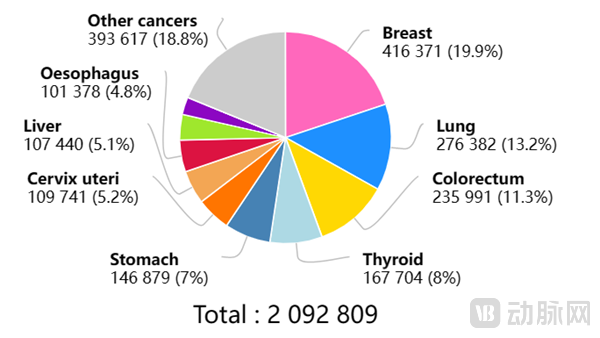
Top 10 Cancer Types by New Cases Among Chinese Women in 2020
Image source: IARC official website
As the “leading killer” of women’s health worldwide, breast cancer claimed the lives of nearly 700,000 women globally in 2020. However, as a superficial tumor, breast cancer is actually a malignant cancer that can be relatively easily detected at an early stage, and early diagnosis and treatment can significantly improve therapeutic outcomes and the five-year survival rate.
HuanYang Market Consulting’s “Global and China Puncture and Biopsy Needle Market Status and Future Development Trends, 2021–2027” (hereinafter referred to as the “Report”) points out that the global market size for puncture and biopsy needles reached RMB 5.5 billion in 2020 and is projected to reach RMB 9.4 billion by 2026, with a compound annual growth rate (CAGR) of 7.9%.
China ranks first in the number of new cancer cases, yet according to the Report, its biopsy market size is the third largest globally, trailing behind North America and Europe. In response to the current insufficiency in breast cancer screening efforts, China’s National Health Commission has set specific targets within its “Two-Cancer Screening” initiative: by the end of 2025, the early diagnosis rate for breast cancer among eligible women should exceed 70%.
According to official data from Yunyixie, five companies currently have NMPA registration approval for their breast biopsy systems in China: Mammotome, Bard, and Hologic from the United States, as well as Xishan Technology and Lisheng Medical from China.
In April 2020, Xishan Technology’s Zhenxuan DK-B-MS Breast Lesion Vacuum-Assisted Biopsy System received registration certification from the NMPA. Its biopsy needle features an adjustable vacuum-assisted window based on lesion size, enhancing the capability to manage minute lesions and enabling precise vacuum-assisted excision.
In September 2021, the Cassi Kexin Cryo-Coring Biopsy System, developed by Lisheng Medical, received registration certification from the National Medical Products Administration (NMPA). Utilizing proprietary cryogenic technology, the system freezes tissue samples onto the needle wall, thereby increasing the volume of viable tissue obtained per sampling.
NeoDynamics AB, a medical device company founded in Sweden in 2015, actually has deep “Chinese genes.”
As early as the second year after its establishment, Bo’ai New Open Source Medical Technology Group Co., Ltd. (hereinafter referred to as “New Open Source,” stock code: 300109) subscribed for a 31.92% equity stake in NeoDynamics AB with self-raised funds of RMB 17.7533 million, becoming its largest shareholder.
New Open Source is a Chinese medical technology company founded in 1987. It has accumulated certain brand influence and market appeal domestically, and this local advantage can help NeoDynamics AB accelerate its strategic layout in the Chinese market.
Although Swedish investment firm Gryningskust Holding AB acquired an additional 14.0% minority stake in NeoDynamics AB from New Open Source in 2022, New Open Source retains a 4.1% equity and voting interest following the transaction. The company will also be responsible for matters related to the future entry of the NeoNavia biopsy system into the Chinese market.
NeoDynamics AB’s commercial focus in 2023 remains on the United States; however, with its presence in the U.S. market and FDA clearance, the NeoNavia biopsy system is poised to enter the Chinese market at an accelerated pace.
According to NeoDynamics AB’s 2022 annual report, the company plans to formally enter the Chinese market starting in 2025. Therefore, the patent protection term in China over the next decade will provide an excellent foundation for NeoDynamics AB’s subsequent product applications, registrations, and launches in the country.
In addition, NeoDynamics AB has invested in the startup Szafran Biopsy AB and, through collaboration with dermatologist Rebecca Szafran at Karolinska University Hospital in Sweden, has enhanced a punch biopsy system for tissue sampling of suspected skin cancers, thereby expanding the application scope of its existing products and technologies.
Domestic breast biopsy systems have been registered and marketed for only a few years, whereas the earliest U.S.-made Mammotome system entered the Chinese market more than two decades ago, with its new products’ entire design-to-manufacturing process now based in China. Currently, the Chinese market is undergoing a transition in which domestic products are replacing imports by leveraging advantages in price and technology.
Therefore, NeoDynamics AB’s initial foray into the Chinese market not only means facing a more competitive landscape but also requires the company to compete against U.S. giants that have been deeply entrenched in China for over two decades, both in terms of patented technology and business models, while simultaneously benchmarking its prices and technology against domestically produced equipment to gain recognition from Chinese medical institutions and patients.
In contrast, within China, will NeoDynamics AB’s future commercial strategy in the Chinese market unleash a new wave of disruption on domestic manufacturers of breast biopsy devices, who are still in their early stages? The recent granting of a Chinese patent for FlexiPulse may also have certain implications for the development of domestically produced equipment and even for global market deployment.