

DIACCURATE Files IPO Prospectus: Advancing S6K-Targeted Precision Oncology with Lead Candidate DIACC3010 and Seeking Chinese Partners for Gastric Cancer Trials
“Precision” has always been an indispensable topic in the fight against cancer. Some companies have entered the track of “precision diagnostics,” while others have ventured into the field of “precision therapy.”
According to the White Paper on Targets of Class I New Drugs in China, a total of 1,955 Class I new drug applications were accepted in China from 2017 to 2022, involving 614 targets in total, among which 51% were oncology targets. PD-L1, EGFR, PD-1, VEGFR, and HER2 were the top five most popular targets, collectively accounting for approximately 300 investigational pipelines.
It is not difficult to observe that while popular targets “on the list” are typically applied to drug development for multiple different tumors, S6K (p70-S6 Kinase), which has been equally well-validated as being involved in multiple key metabolic nodes in tumorigenesis, has failed to become an active target in R&D pipelines.
What is the “valley of death” between the scientific validation of S6K and drug development? Are there any companies currently advancing S6K into clinical research?
Recently,VCBeat has taken note of DIACCURATE, a clinical-stage biopharmaceutical company invested in by Merck, and had the privilege of interviewing its CEO, Dr. Dominique BRIDON. The company’s orally administered small-molecule inhibitor targeting S6K has yielded highly promising results in preclinical and clinical studies for tumor types such as breast cancer and gastric cancer.
Founded in 2013, DIACCURATE initially focused on research and development related to immunomodulation for HIV. In 2020, DIACCURATE welcomed new business operations, a new CEO, and new investors. That year, the oncology drug R&D company BIOKINESIS merged with DIACCURATE. Under the leadership of the new CEO, Dominique BRIDON, the company gradually expanded its research into precision oncology therapeutics and secured exclusive global development rights for S6K from Merck.
DIACCURATE has established offices in Paris and Marseille, France. Its core R&D team comprises 15 leading scientists in the field, who are dedicated to developing innovative therapies for breast cancer, gastric cancer, pancreatic cancer, aggressive hematologic malignancies, HIV/AIDS, and other diseases. Supported by this exceptional team, the company currently has three innovative oncology products in its clinical pipeline advancing into clinical trials. Among these, four indication pipelines developed around S6K are progressing, with the most advanced having entered Phase II/III clinical trials.
Existing studies indicate that,S6K has been identified as a key metabolic node involved in multiple oncogenic pathways; it serves as a major regulator of cancer cell proliferation and survival, and is expressed in various cancer cells, including those of breast, gastric, brain, colorectal, and liver cancers.
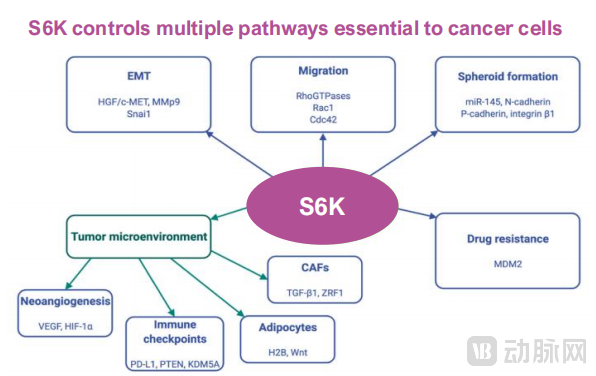 S6K Control Mechanism (Image provided by DIACCURATE)
The regulatory mechanism of S6K is relatively complex, which is one of the main reasons for the scarcity of related R&D pipelines. Based on the established logic of pathways in tumor tissue cells, inhibition of S6K kinase provides negative feedback to the upstream insulin receptor, leading to more robust activation of the AKT pathway. In other words, inhibiting S6K alone may trigger negative feedback that could paradoxically promote tumor cell proliferation.
Encouragingly, DIACC3010, a compound obtained by DIACCURATE from Merck, effectively mitigates the negative feedback mediated by S6K. As an optimized S6K inhibitor, DIACC3010 exhibits dual inhibitory activity against S6K and AKT1/3, with half-maximal inhibitory concentrations (IC50) of 0.9 nM for S6K, 1.4 nM for AKT1, and 1 nM for AKT3. Notably, it does not inhibit AKT2 and does not induce hyperglycemia.
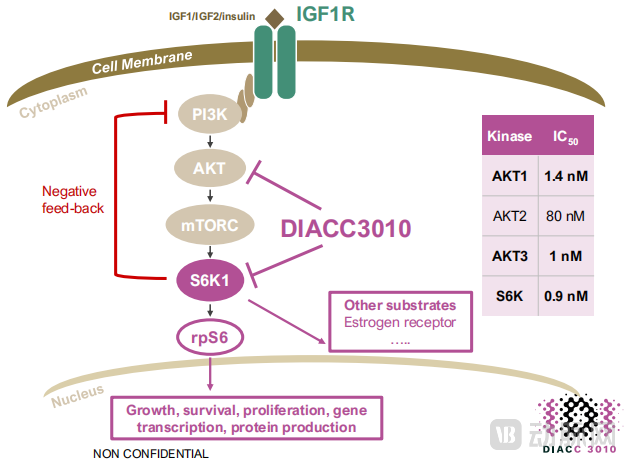
DIACC3010 Mechanism of Action Simulation (Image provided by DIACCURATE)
More critically, DIACC3010 possesses the ability to cross the blood-brain barrier. The barrier between human blood and the brain serves a vital function in preventing infections, but it also makes it difficult for the active ingredients of most drugs to penetrate the blood-brain barrier for effective drug delivery. For patients with brain cancer or complex tumors involving metastasis to the brain, DIACC3010 undoubtedly represents a promising avenue of exploration.
Based on current research, DIACC3010 has demonstrated highly promising therapeutic efficacy in indications such as breast cancer, glioblastoma multiforme, triple-negative breast cancer with brain metastases, and gastric cancer.
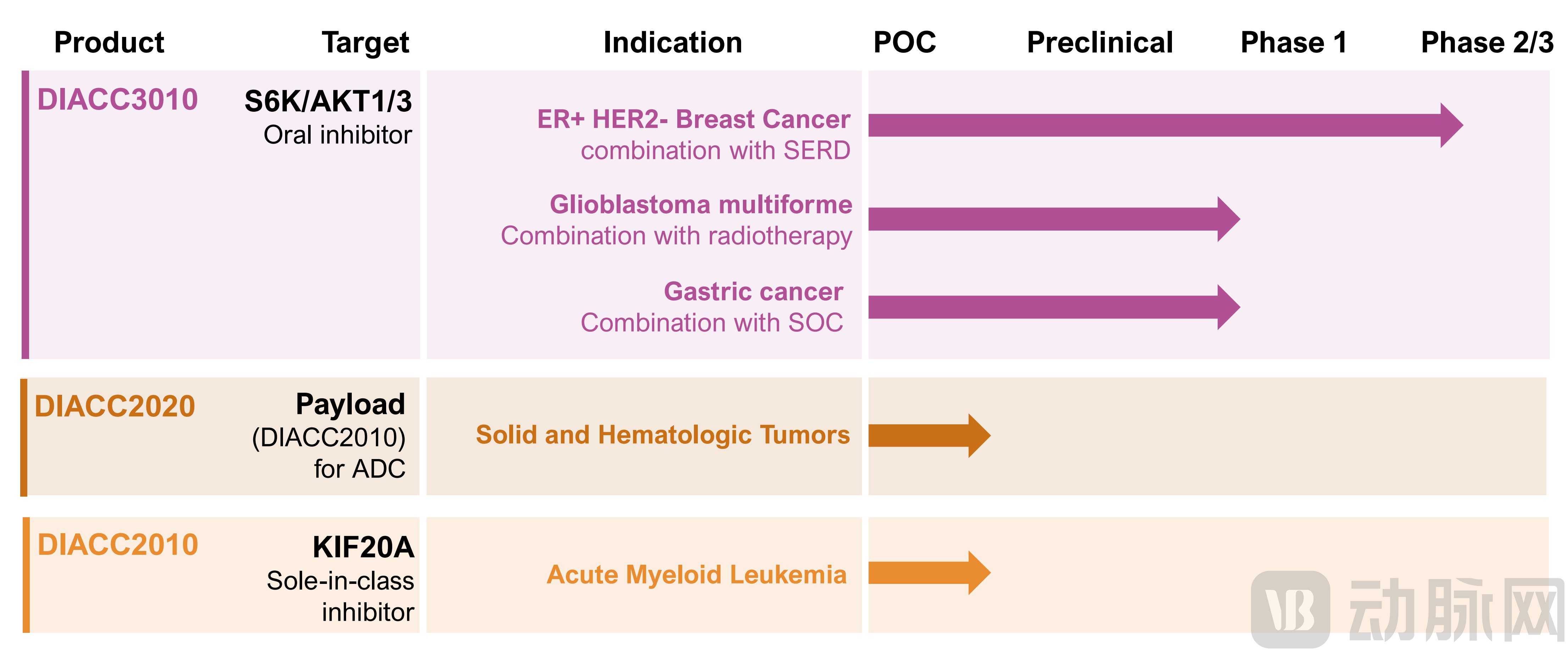 DIACCURATE’s Current Pipeline Progress (Image provided by DIACCURATE)
In preclinical studies using tumor-bearing mouse models, DIACC3010 demonstrated significant tumor inhibition and exhibited a differential effect by effectively blocking AKT feedback activation.
The Phase I clinical study of this oral small-molecule drug primarily focused on patients with refractory solid tumors, including those with advanced, recurrent, or metastatic disease, and enrolled 101 patients with breast cancer, colorectal cancer, endometrial cancer, pancreatic cancer, or lung cancer. Among the 62 patients who received monotherapy, over 80% demonstrated tumor inhibition by the drug. Among the remaining 39 patients who received combination therapy, the disease control rate reached up to 53.8%.
Overall, breast cancer pipeline development is progressing at the fastest pace. Diaccurate conducted a more in-depth analysis of patient responses in its Phase I clinical trial data completed with Merck, revealing that patients with ESR1+ mutations exhibited the best response. Among patients who had already received an average of five to six prior lines of therapy when treated with DIACC3010, a median progression-free survival (PFS) of 5.6 months was achieved. Following the approval of elacestrant earlier this year, Diaccurate will initiate global, multicenter Phase II/III clinical studies evaluating DIACC3010 in combination with elacestrant. Facing over 2 million new breast cancer cases globally each year, Diaccurate has differentiated its strategy by refining its target population to include patients with ESR1-mutated ER+/HER2- breast cancer and those with triple-negative breast cancer (TNBC) accompanied by brain metastases. ER+/HER2- breast cancer is the most common subtype, with its prevalence increasing with age and reaching 60–65% among postmenopausal women. Additionally, leveraging DIACC3010’s ability to cross the blood-brain barrier, patients with breast cancer and brain metastases represent another key study population.
Following its development by DIACCURATE, the S6K inhibitor DIACC3010 has been effectively validated in terms of target patient populations for specific indications, market potential, and developability, in addition to leveraging its inherent high technological barriers. Supported by academic and clinical development partners, including Merck, and driven by the global expansion potential afforded by diversified independent growth channels, DIACC3010 is poised to become a best-in-class therapeutic agent for breast cancer.
The S6K-related pipeline helps companies rapidly secure a competitive advantage in the precision treatment of tumors. Furthermore, DIACCURATE has developed DIACC2010, an inhibitor targeting KIF20A, and preclinical studies for acute myeloid leukemia are actively underway. The company is also involved in antibody-drug conjugate (ADC) therapeutics, with its payload pipeline candidate, DIACC2020, nearing completion of proof-of-concept.
In the short term, DIACCURATE’s primary development plans—whether in scientific research, financing, or international expansion—will continue to center on S6K.
In an interview, the company’s CEO, Dominique BRIDON, stated that while studying DIACC3010 for the treatment of gastric cancer, they noted that gastric cancer has become the second most prevalent malignant tumor in China. Given the country’s large population base, the greatest clinical need for gastric cancer treatment lies in China.
Therefore, the company plans to conduct mid-to-late stage clinical trials for gastric cancer patients in China after completing Phase I clinical trials focused on pharmacological and toxicological studies. Preliminary activities, including corporate due diligence and multidisciplinary discussions, will also be rapidly initiated in the near term.
Dominique Bridon candidly acknowledged that cross-border research is no easy feat. Although Chinese enterprises have repeatedly made their mark on the international stage, spanning from scientific research to product development, foreign companies still find it challenging to effectively understand and reach China’s leading biotechnology firms or related industrial parks through current information density and channel breadth. The results of such “outside-in” efforts remain less than ideal.
It is evident that the rapid development of biotechnology and innovative drugs in China over the past decade has attracted the attention of various types of overseas enterprises. How to proactively showcase their differentiated advantages in technology, products, and business models on the international stage is an inevitable consideration for companies as they grow.
It is often said that the solution to reducing “involution” is “going global,” which represents a self-driven outward expansion by enterprises. So, how can companies position themselves within an international perspective to gain visibility among overseas businesses?