

First Academic Conference on Elderly Mental Health and Care Convenes: How Digital Technologies Are Transforming Geriatric Care
It was the best of times,it was the worst of times…
In A Tale of Two Cities, Dickens wrote, “It was the best of times, it was the worst of times...” Perhaps we can also apply this sentence to describe the current state of care for the mental and psychological health of older adults—
On the one hand, the accelerating onset of an aging society has led to a further increase in the number of elderly individuals with disabilities and dementia. Home-based care, influenced by China’s traditional culture of “filial piety,” is challenged by declining birth rates, while institutional care faces a shortage of medical and nursing staff. Consequently, the substantial demand for mental health and psychological care among the elderly remains inadequately met.
On the other hand, AI tools such as ChatGPT have once again highlighted the potential of technological advancement. Developments in mobile communications, artificial intelligence (AI), virtual reality, the internet, and blockchain technology are continuously providing “productivity tools” for human society. In the realm of mental health care for the elderly, the integration of digital technologies holds promise for transforming traditional care models, fostering innovation while reducing costs and enhancing the accessibility and human-centric nature of services.
At present, how can we better provide care for the mental and psychological well-being of older adults? How can we more effectively integrate technology to innovate care models? These are undoubtedly among the key challenges facing healthcare service providers. To better implement the State Council’s 14th Five-Year Plan series on healthy aging and national mental health,The 1st Academic Exchange Conference on Geriatric Mental Health and Care, hosted by Shenyang Jing'an Hospital of Kaixin Medical Center and co-organized by Beijing Huilongguan Hospital, the School of Nursing at China Medical University, and others, was recently held....opening up new avenues of exploration for the mental health care of the elderly.
Experts and professors from Beijing Huilongguan Hospital, the School of Nursing at China Medical University, Liaoning Provincial Mental Health Center, and Shenyang Jing’an Hospital of Kaixin Medical delivered addresses at the conference.
Notably, the conference witnessed the premiere launch of Case Analysis in Psychiatric Nursing Education. The book was initiated and edited-in-chief by Director Xu Dongmei of Beijing Huilongguan Hospital, with Deputy Editor-in-Chiefs including Vice President Li Jie of Shenyang Jing’an Hospital (Kaixin Medical) and Director Shao Jing of Beijing Huilongguan Hospital. It was jointly compiled by nearly 30 experts and psychiatric nursing teams from 20 specialized mental health institutions across China. Aimed at using clinical psychiatric cases as a guide, the book is designed to enhance the practical caregiving skills of nurses working in specialized mental health hospitals or psychiatric departments of general hospitals.
Imbalanced Supply of Mental Health Care Services for the Elderly: Technological Integration and Model Innovation Emerge as Key Areas of Exploration
Real-world data may better illustrate the severe imbalance caused by the rapidly growing demand for mental health care among the elderly and the slow growth in supply.
From the perspective of demand, Professor Zhang Zhangjin of the School of Chinese Medicine at The University of Hong Kong cited relevant data in his work *Dying Without Disease: TCM Philosophy and Practice in Elderly Care*: currently, the prevalence of dementia in mainland China is 6%, with approximately 15.07 million elderly individuals aged 60 and above suffering from dementia. The prevalence of mild cognitive impairment (MCI) reaches 15.5%, corresponding to 38.77 million people affected by mild cognitive decline. Amidst this already substantial demand, the accelerating pace of population aging has further widened the gap between demand and supply.

Director Xu Dongmei, Beijing Huilongguan Hospital
From the supply side, the shortage of healthcare professionals providing services is even more alarming. This insufficiency is manifested in two aspects: first, there is a shortage of psychiatrists. According to Xu Dongmei, Director at Beijing Huilongguan Hospital, data from the National Health Commission shows that by the end of 2021, China had only 64,000 psychiatrists, accounting for just 1.49% of the country’s total physician workforce (4.287 million). Currently, the number of psychiatrists per 100,000 people in China remains below the global average. Second, there is a lack of specialized psychiatric nurses. Taking patients with dementia as an example, after physicians prescribe relevant psychotropic medications, patient management is often carried out by nurses with experience in dementia care. However, in 2019, the number of registered nurses in specialized psychiatric hospitals was only 95,791. Even by 2021, this figure had risen to merely 131,400.
The shortage of psychiatric healthcare professionals has led to a strain in the supply of specialized mental health care services. The rapidly aging society has further exacerbated this issue by driving a surge in demand for geriatric mental health care, leaving professional service provision severely stretched. Director Xu Dongmei pointed out that between 2012 and 2030, mental disorders will cause China’s economic growth to shrink by more than $9 trillion. How can this problem be better addressed? To reduce the socioeconomic burden while providing high-quality, professional geriatric mental health care services, some experts and scholars have turned their attention overseas.
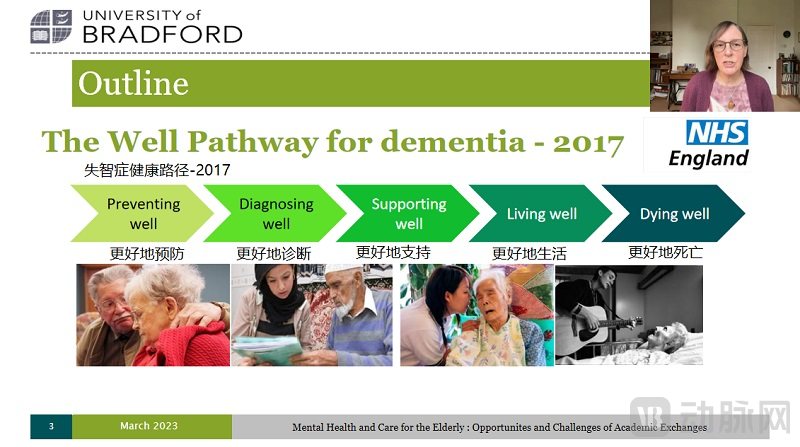
Professor Jan Obedyoe from the Dementia Research Centre at the University of Bradford, UK, delivered a speech at the conference.
Professor Jan Oyebode from the Centre for Dementia Research at the University of Bradford, UK, pointed out at the conference that the UK has made numerous explorations and attempts in the diagnosis, treatment, and care of dementia. As early as 2017, the UK outlined a health management pathway for dementia, proposing to achieve better prevention, better diagnosis, better support, better living, and better dying throughout the disease lifecycle. Early detection and early intervention are regarded as critical components. In fact, since the 1960s, the “deinstitutionalization” movement has gained momentum in countries such as the UK and the US, with corresponding development of community mental health services.One of the key areas of exploration in overseas psychiatric specialty care is how to better implement inpatient hospitalization during the acute phase and a model integrating social work and medical services during the rehabilitation phase.
Innovative HSH Care Model: Integration of Digital Technologies to Enhance Service Capacity
“Routine nursing measures merely adopt standardized care, which places greater emphasis on treatment while providing insufficient psychological and interpersonal support, resulting in suboptimal overall improvement for patients. Meanwhile, patients with schizophrenia exhibit significant declines in memory and cognitive function; without scientific management after discharge, they are highly susceptible to relapse.”Seamless hospital-community-home nursing interventions can continuously extend hospital-based nursing models and methods into communities and households, thereby promoting the robust development of the hospital-community-home care model, eliminating gaps in care coverage, providing scientific guidance and supervision on medication use, and maximizing the role of community support and home-based care after discharge, which is of significant importance for patients’ recovery.In the article “Impact of the Hospital-Community-Home Seamless Integration Rehabilitation Nursing Intervention Model on Patients with Schizophrenia,” published in China Modern Doctor, Li Jie, Deputy Director of Shenyang Jing’an Hospital under Kaixin Medical, and colleagues pointed out that this involves the provision of transitional care services.
In fact, developed countries led by the United States began exploring transitional care models as early as 1947, implementing widely adopted approaches such as community-based transitional care (e.g., hospital-at-home and day hospitals) and hospital-based transitional care models (e.g., the Advanced Practice Nurse [APN] model and acute care for older adults). In China, since the former Ministry of Health included the exploration and establishment of transitional medical and nursing care models in the Outline of the Development Plan for Nursing Careers in China in 2011, hospital-based transitional care models have been extensively implemented. However,The HSH model (Hospital–Community–Home Seamless Rehabilitation and Nursing Intervention Model), which integrates hospital-based and community-based approaches and is exemplified by Shenyang Jing’an Hospital of Kaixin Medical, remains a relatively innovative model.
It is worth noting that, as a specialized psychiatric hospital, Shenyang Jing’an Hospital under Kaixin Medical has clearly recognized the importance of specialized nurses in delivering care services. By shifting the primary role in healthcare delivery from physicians to nurses—who provide close, personalized care and have a deeper understanding of patients’ disease symptoms—these nurses can offer targeted symptom descriptions to assist physicians in formulating more tailored diagnosis and treatment plans for patients.
In fact,Under the HSH model, it is essential to achieve continuity in three key areas: information continuity (ensuring the accuracy of patient data during scenario transitions while safeguarding privacy), relational continuity (maintaining trust within the “physician-nurse-patient” relationship when receiving care from different providers), and care continuity (delivering seamless medical services). This process undoubtedly requires the integration of digital technologies to ensure service continuity and maximize operational capabilities. Kaixin Medical is also providing corresponding services by launching the Kaixin Medical APP and leveraging online platforms.——
In Hospital Settings, digital technologies can be leveraged for patient education, saving physicians' time, improving their work efficiency, and enhancing patients' medication adherence. By repeatedly explaining knowledge about schizophrenia to patients and their families, this approach encourages patients to take medications as prescribed and further helps patients and their families understand the importance of long-term maintenance therapy.
In Community Settings, providing timely follow-up and medical services through digital means. Currently, Kaixin Medical Shenyang Jing’an Hospital has partnered with multiple communities in Shenyang to establish internet clinics within these communities, offering telemedicine services to select patients, facilitating one-on-one doctor-patient communication, and helping patients receive continuous medical care.
In Home SettingsBy providing remote guidance to patients and their families, we help them respond appropriately to crises, thereby preventing dangerous behaviors such as aggression toward others or self-harm. Furthermore, by instructing family members on monitoring adverse reactions in patients and facilitating appropriate physical activity, we have improved the family atmosphere, which further promotes the development of healthy habits in patients.
Caregiving is not merely about attending to patients’ physical needs; greater emphasis must be placed on addressing their psychological well-being. Influenced by the traditional Chinese culture of “filial piety,” elderly patients often crave more companionship from their children. However, some elderly patients are unable to see their children due to factors such as demanding work schedules. In the past, certain cities even offered services providing conversational companionship for the elderly, at considerable cost. As a specialized psychiatric hospital, Kaixin Medical’s Shenyang Jing’an Hospital has recognized the need for “child-like” companionship among elderly patients, acknowledging that appropriate companionship helps stabilize their emotions. In light of this, Kaixin Medical has partnered with technology vendors to apply virtual digital human technology to elderly care settings, jointly developing an “Intelligent Companionship Robot” to address the lack of familial companionship in the psychological care of elderly patients. This solution is currently being implemented.
Ms. Cao Li, President of Kaixin Medical, stated, “By integrating digital technologies throughout the entire hospital-community-home care service continuum, we have minimized the costs of hospital-based care, enhanced care delivery capabilities, and made services more human-centered and accessible. Ultimately, the provision of continuous care has better served patients’ well-being.”
Regarding how digital technologies can be better applied to mental health care for the elderly, Kaixin Medical certainly has its own perspectives—
(1) Initial Application. Kaixin Medical treats a large volume of patients, enabling the identification of common patient needs. By analyzing and addressing these needs, the quality of medical services can be further enhanced. Furthermore, small-scale application for data collection facilitates rapid updates and iterations of related digital products, thereby better benefiting patients.
(2) Clinical Application. The comprehensive deployment of digital product technologies within hospitals enables the determination of product efficacy and value based on real-world studies.
(3) Full-scale implementation of the HSH model. The ultimate purpose of technological application is to serve the HSH model and better support the continuity of care services. It needs to be applied across three settings—hospital, community, and home—to maximize its value. (4) VR World (Ultimate State). Regarding future development goals, Kaixin Medical hopes that when digital technology advances to a sufficiently sophisticated level, technologies such as virtual reality will enable immersive, hands-on caregiving training, thereby better benefiting patients.
Undoubtedly, as digital technologies become more deeply integrated into medical institutions such as Shenyang Jing'an Hospital under Kaixin Medical, they will deliver higher-quality geriatric psychiatric care services in the future.
Industry Standards Are Becoming Increasingly Clear, and Technology-Enabled Care Is an Irresistible Trend
At a time when the nation places high priority on the elderly population, discussions and reflections on mental health care for older adults are undoubtedly helping to establish industry standards and guide caregiving practices.
Judging from the agenda set at the conference, the presentation of methodological content—including Director Li Xia’s “Identification and Intervention of Behavioral and Psychological Symptoms Before and During Dementia” from the Shanghai Mental Health Center, Shanghai Jiao Tong University School of Medicine; “Identification and Management of Behavioral and Psychological Abnormalities in the Elderly” from the First Hospital of China Medical University; and “Nursing Care for Elderly Patients with Anxiety and Depression” from the Liaoning Provincial Mental Health Center—indicates a deepening reflection within the industry on elderly psychiatric care. Furthermore, the newly released book, Case Analysis in Psychiatric Nursing Education, aims to provide better guidance for caregiving practices.
The innovative thinking exemplified by Kaixin Medical’s HSH model will undoubtedly further drive societal attention toward elderly mental health care. Conversely, while elderly individuals overseas do have a need for companionship from their children, cultural influences often compel them to face old age in isolation. With the development of “technology + service” virtual companionship under the influence of the cultural value of “filial piety,” there is hope that this approach may further change the plight of isolated aging among elderly patients abroad. Moreover, it has the potential to lead the global advancement of care services.
Perhaps, as Dickens wrote at the end of A Tale of Two Cities, “It is a far, far better thing that I do, than I have ever done…”—“What I do today is far better than anything I have ever done.” This may also serve as a metaphor for the current development of elderly mental health care, empowered by digital technologies.