

Post-$7B Lilly Deal: Which In Vivo CAR-T Assets Are Acquisition-Ready as MNCs Eye Chinese Biotechs?

Kelonia Therapeutics
Gene Drug Developer

Gilead Sciences
Innovative Drug Developer, Distributor

Johnson & Johnson
Medical Device R&D and Manufacturer

Umoja Biopharma
Cancer Treatment Drug Developer
May 3, 2026
eMedClub News
Recently, Eli Lilly's $7 billion acquisition of Kelonia Therapeutics once again demonstrated that large pharmaceutical companies are willing to pay a "sky-high price" for in vivo CAR-T technology. This is Eli Lilly's second major in vivo CAR-T deal this year, following the $2.4 billion acquisition of Orna Therapeutics in February.
In the past year, Gilead Sciences, AbbVie, Bristol-Myers Squibb, and AstraZeneca have continuously made acquisitions in the in vivo CAR-T field, with cumulative investments exceeding tens of billions of dollars.
Despite the industry's "acquisition frenzy," globally renowned investment researchInstitutionMorningStellar LordDepartment(Morningstar)Ben Zercher, senior analyst of biotechnology and pharmaceuticals at PitchBook, saidIt is expected that M&A transactions in the in vivo CAR-T field will slow down. This is not due to a lack of market interest, but rather because there are few high-quality acquisition targets left.。
He pointed out that leading pharmaceutical companies such as Johnson & Johnson and Novartis have not yet ventured into in vivo CAR-T projects; among biotech companies still available for acquisition,Umoja Biopharma Is the Most Watched Potential Target。
Why Umoja Becomes "The Most Watched Potential Target"
Umoja Biopharma possesses the proprietary VivoVec gene delivery platform, which combines a lentiviral vector delivery system with a novel T-cell targeting and activation surface complex to directly generate CAR-T cells within the patient's body. It has three key features:
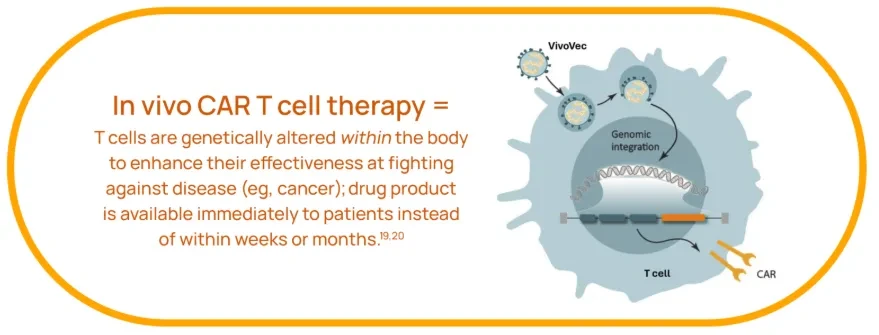
Integration of Multiple Functional Domains(MDF), which can enhance the binding, activation, and transduction capabilities of VivoVec particles with T cells;
The Cocal fusion glycoprotein, as a membrane protein, can bind to the host cell's low-density lipoprotein receptor LDL-R, assisting the virus in specifically targeting and entering T cells.
Controllability and flexibility, VivoVec can be used with RACR(Rapamycin-Activated Cytokine Receptor)When used in combination, it provides a controllable approach for immunotherapy by regulating the growth and survival of T cells.
Currently, Umoja has two candidate products in clinical trials. Among them,UB-VV400/410 is a CD22-targeted in vivo CAR-T, for autoimmune and non-Hodgkin lymphoma, currently in Phase I clinical trials.UB-VV111 is an in vivo CAR-T targeting CD19., for relapsed/refractory large B-cell lymphoma and chronic lymphocytic leukemia, received FDA Fast Track designation in September 2025 and is currently in Phase I clinical trials.
UB-VV111 Attracted AbbVie as Early as 2024, with a Potential Deal Worth $1.4 Billion; AbbVie Secures Option for Subsequent Licensing of the Product. Moreover, Umoja Has Also Partnered with IASO Biotherapeutics in China to Jointly Develop Ready-to-Use In Vitro and In Vivo Cell and Gene Therapies.
Exclusive technology platform combined with pipelines already in clinical trials is a key factor supporting Umoja as "one of the most watched potential targets." However, Ben Zercher believes that while Umoja's in vivo delivery technology is highly attractive, its existing collaboration with AbbVie may hinder other pharmaceutical companies from acquiring it cleanly. However, from an industry perspective,It is already a common practice in the cell therapy field for pharmaceutical companies to acquire biotechnology companies they have long-term collaborations with.It remains to be seen whether AbbVie will acquire Umoja.
Turn your attention to China?
"With fewer buyers and fewer targets, the pace of transactions will naturally slow down," Zercher said.Pharmaceutical companies may also turn their attention overseas, such as China's Xingrui Pharmaceuticals(Starna Therapeutics)Has advanced in vivo CAR-T to the clinical stage."
Stellar Therapeutics completed a Series B financing round of over 300 million RMB in October last year. The funds will mainly be used to upgrade and expand the extrahepatic targeted delivery platform, accelerate the clinical development of the in vivo CAR-T pipeline, and further solidify the company's innovative layout in the RNA therapeutics field. The company’s focus on three key areas — mRNA preventive vaccines, therapeutic cancer vaccines, and in vivo CAR-T — has also garnered positive attention from industry analysts.
In China, the in vivo CAR-T field is developing rapidly, within just a few years,The fastest-progressing product has advanced to the registrational clinical stage, while a large number of companies' pipelines have entered the IIT stage., covering multiple indications such as hematological tumors, solid tumors, and autoimmune diseases. In terms of technology, companies in China have gradually formed a development pattern where viral vector and non-viral vector technologies are advancing in parallel.
Overall, the in vivo CAR-T sector in China has enormous potential and is experiencing robust growth. There have already been instances where cell therapy companies gained favor from multinational corporations (MNCs). In the future, companies in this field might indeed fulfill Zercher’s prediction.Become the core target of defensive mergers and acquisitions and technology introduction for multinational pharmaceutical companies, continuously承接global cell therapy industry的innovation与commercialization落地需求。
Is it worth buying at a high price?
The scarcity of high-quality assets means that companies need to maximize the value of their existing pipelines. Zercher believes,The potential of in vivo CAR-T is sufficient to justify a high upfront payment, even for early-stage projects.; especially in the field, it can expand from oncology to autoimmune diseases,Dual-market potential makes high valuations of early-stage assets reasonable。
At the same time, Dr. Daina Graybosch, an analyst at Leerink Partners, believes that in vivo CAR-T is more efficient, and preliminary data shows comparable efficacy potential, with the possibility of becoming a disruptive alternative.
She pointed out that the major motivations for large pharmaceutical companies to make substantial investments are twofold:
1. Defensive Layout
Companies invest heavily when entering fields with high barriers to entry. If disruptive technology arrives, they must proactively become the disruptors. Gilead Sciences is a typical example—its Kite’s Yescarta and Tecartus have already been launched in the market but are facing fierce competition leading to declining sales. If in vivo technology achieves disruption, existing products will be impacted.
2 Diversified Layout
New entrants like Eli Lilly hope to build a diversified technology portfolio to address industry uncertainties.
In addition, Dr. Graybosch emphasized a key point."Clinical Data Ultimately Determines the Success or Failure of the Track"Currently, it has focused on two in vivo pipelines: one is Umoja’s UB-VV111, and the other is Legend Biotech's in vivo pipeline, which has completed the first patient dosing.
Dr. Graybosch stated, "In the rapidly evolving field of CAR-T, early results should not be overinterpreted. Small datasets can easily lead to overreactions. The first group of patients treated had unique circumstances, were closely monitored, received special medical care, and were treated by carefully selected doctors. I am more focused on...40-50 sample cases"Only with real follow-up data can we truly assess the potential and challenges."
At present, the outbreak of in vivo CAR-T stems from its goal, which is to maintain comparable efficacy while addressing all the pain points of ex vivo CAR-T. In the future, with technical optimization and more clinical data disclosure, this goal is also expected to be achieved.
References:
1.https://www.fiercebiotech.com/biotech/frenzied-feeding-playing-defense-and-disruption-lillys-kelonia-acquisition-and-future-vivo
2. Corporate Official Website

Dian Dian "Share”、“Like" and "In Progress”
Give me a little charge~