

Yachang Pharma: The Turning Point for NASH Therapeutics Is Here – How Will the 'Next Wave' Break Through?

Apricot capital
Venture Capital Institution
In December 2022, Madrigal announced positive results from the pivotal Phase III MAESTRO-NASH biopsy trial of resmetirom, a THR-β agonist for the treatment of NASH. In the same month, Intercept re-submitted its New Drug Application (NDA) to the FDA for obeticholic acid in the treatment of NASH. Amidst this wave of positive news, the secondary market for NASH therapeutics quickly rebounded, with share prices rising accordingly for companies such as Madrigal, Intercept, Viking, and Akero.
The domestic primary market has reversed its previous stance of “keeping at a distance,” with investment institutions once again conducting thorough due diligence in the NASH field. Since December 2022, multiple venture capital firms have proactively approached Hepagene Therapeutics to learn about its strategic layout and progress in NASH. Dr. Xu Xiaodong, Founder and CEO of Hepagene Therapeutics, stated,The Tipping Point in the NASH Field Has Arrived: The First-Generation NASH Drugs Will Be Approved This Year
Hepagene Therapeutics focuses on the R&D of innovative drugs for liver diseases and boasts a rich pipeline of NASH therapeutics. Its core team has years of research experience in the field of hepatology, with Dr. Xu Xiaodong, the founder, alone having authored or filed nearly 50 papers and patent applications related to liver diseases. As a serial entrepreneur, Dr. Xu previously founded Enantigen Therapeutic Inc., a company dedicated to viral hepatitis B, from which he has successfully exited.
Embarking on a new venture, this entrepreneur once again chooses to build a fully data-driven innovative pharmaceutical company with a global perspective. This simplicity and pragmatism are qualities more “capital-attractive” than any story.Why Has Hepagene Emerged as the Leader in China’s NASH Field? How Can Second-Generation NASH Drugs Break Through? Their Observations and Analysis of the NASH Landscape May Offer Insights for Late Entrants.

Focusing on NASH: Streamlining the Path for Serial Entrepreneurs
In 1999, after earning his Ph.D. in organic chemistry from New York University, Xu Xiaodong joined Johnson & Johnson as a research scientist, where he spent seven years in the laboratory accumulating experience in drug development. In 2007, he embarked on his first entrepreneurial venture by founding Enantigen Therapeutics.
“If n is removed, it becomes the E antigen, which represents the hepatitis B e antigen (HBeAg). In viral hepatitis B, a patient’s seroconversion from HBeAg-positive to HBeAg-negative essentially indicates a favorable outcome of immune clearance.” At that time, Dr. Xu Xiaodong was focused on researching novel therapeutics for viral hepatitis B. Enantigen was successfully acquired by OnCore Biopharma in 2014, leveraging its two promising hepatitis B drug candidates: a hepatitis B surface antigen (HBsAg) secretion inhibitor and a core protein assembly inhibitor.
Hepatitis B is a major global health concern. Hepatitis B virus (HBV) infection can lead to chronic liver disease, thereby increasing the risk of cirrhosis and hepatocellular carcinoma in patients. In 2014, there were up to 350 million HBV carriers worldwide, with more than 700,000 deaths attributed to hepatitis B annually. Although first-line nucleos(t)ide analogues are currently available, patients require lifelong medication, and functional or complete cure remains unattainable.
Innovative therapies continue to meet the clinical needs of hepatitis B, while hepatitis C and non-alcoholic fatty liver disease (NAFLD), as two other major causes of cirrhosis-related mortality, are garnering increasing attention. With hepatitis C now curable, non-alcoholic steatohepatitis (NASH) has emerged as the leading indication for liver transplantation in Europe and the United States.
In 2016, the estimated total number of prevalent NAFLD cases in China was 243 million, with NASH accounting for 32.61 million cases. To address emerging clinical needs, Dr. Xu Xiaodong embarked on his second entrepreneurial venture that year.Hepagene Therapeutics was established to address two key clinical needs: first, metabolic liver diseases, particularly non-alcoholic steatohepatitis (NASH) and cholestatic liver diseases; and second, chronic hepatitis B, by developing novel combination therapies aimed at achieving a functional cure for the virus.
Embarking on his entrepreneurial journey once again, Xu Xiaodong swiftly seized the three key elements of long-term success—team, innovation, and execution—along with a robust pipeline, to rapidly roll out his strategic layout.
Hepagene’s CSO is Dr. Xinjie Chu, co-founder of the Global Health Drug Discovery Institute at the Bill & Melinda Gates Foundation. He previously worked at two multinational corporations, Merck and Roche, and conducted postdoctoral research at the Scripps Research Institute, the largest private non-profit biomedical research institution in the United States. Dr. Que Liu joined Hepagene as full-time CMO in April 2021. He brings 20 years of clinical development experience in NASH, PBC, PSC, and CVD, with a long-standing focus on rare and metabolic diseases. He has previously held scientific roles at Allergan, Arena (acquired by Pfizer for approximately $6.7 billion), and Takeda. Furthermore, the scientific advisory team comprises world-renowned experts in autoimmune diseases and NAFLD/NASH, including Rohit Loomba, Merrill Gershwin, and Stephan Harrison.
With extensive experience, the Hepagene team has navigated the target selection and compound screening phases with minimal detours.In 2016, obeticholic acid received FDA approval in the United States for the treatment of patients with primary biliary cholangitis (PBC). Dr. Xu Xiaodong recognized the efficacy of the FXR target during the clinical trials of obeticholic acid, but also identified a series of adverse effects associated with its use in these trials, particularly pruritus. In the Phase III clinical trial of obeticholic acid, 51% of enrolled patients experienced pruritus at the therapeutic dose of 25 mg.
The Hepagene Therapeutics team analyzed the side effects of obeticholic acid and found that# The Design and Optimization of Next-Generation FXR Agonists Require Attention to Four Key Points: First, first-generation FXR agonists possess a bile acid structure that shares significant similarities with endogenous human bile acids, thereby leading to off-target effects; by adoptingNon-bile acid compound structures can effectively avoid this issue.; Second,To ensure high selectivity for TGR5 and other nuclear receptors; Third,Enhancing Liver Targeting, enabling the compound to accumulate in the liver while reducing its distribution in other organs; fourthly,Compounds must exhibit favorable druggability., especially with minimal complex metabolites.
Following rigorous screening, Hepagene’s first NASH project, HPG1860—a non-bile acid structured, liver-enriched FXR agonist—was successfully initiated. The latest Phase IIa clinical data show that at the efficacious dose, the incidence of pruritus was only 9.1%, with no cases of Grade 3 pruritus reported, demonstrating the most favorable safety profile among comparable products globally.
The team’s execution significantly accelerated the clinical trials for the core project, HPG1860. Over the three-year pandemic period, Hepagene completed Phase I clinical trials in China and Phase I and Phase IIa clinical trials in the United States, with patient enrollment for the Phase IIa trial even finishing ahead of schedule. Far from being hindered by the pandemic, the company achieved its planned milestones with high quality.
With the smooth progress of HPG1860 in clinical development, strategic layouts for other liver disease-related projects—HPG7233, HPG5119, HPG3466, HPG4892, and HPG6189—have also been sequentially initiated.HPG7233, another NASH drug candidate, is a liver-targeted THR-β agonist expected to reduce the gastrointestinal adverse events observed with similar agents in clinical settings; an Investigational New Drug (IND) application for this project will be submitted in the second quarter of this year. HPG3466, an IAP antagonist targeting hepatitis B and tumors, received FDA clearance for clinical trials in the United States in January of this year. Furthermore, the company’s proprietary GalNAc delivery platform will further strengthen its development of first-in-class therapeutics for liver diseases.
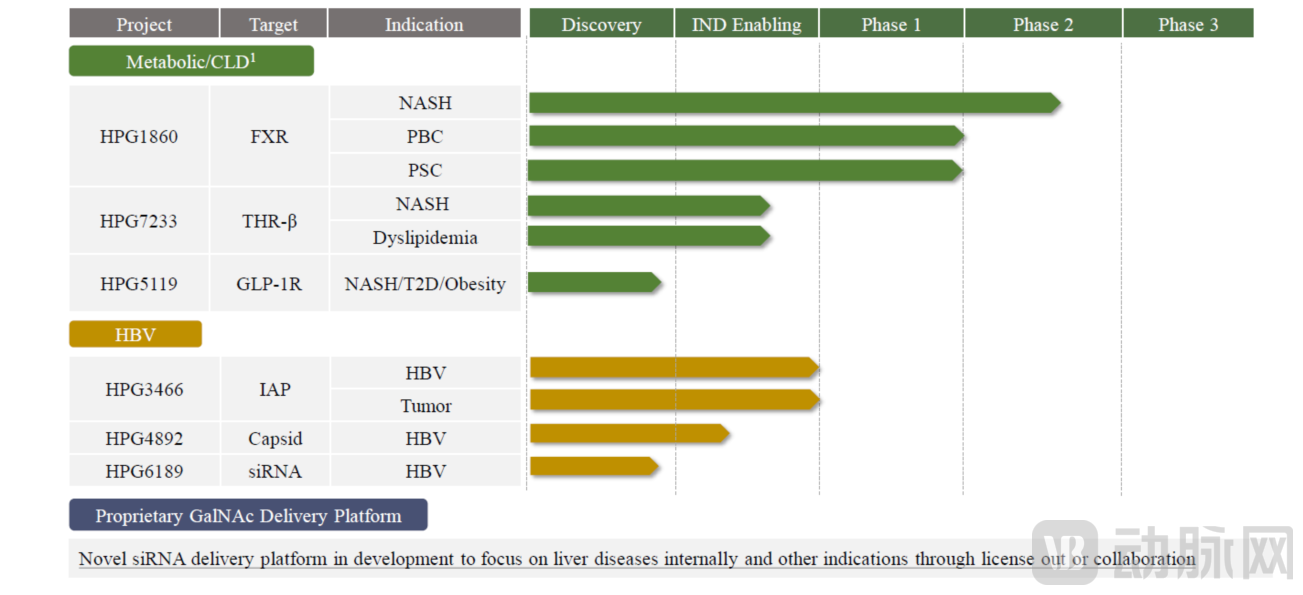 Yachuang Pharmaceutical Product Pipeline, Source: Yachuang Pharmaceutical
Currently, Hepagene Therapeutics is undertaking a new round of financing, expected to raise $30 million (or RMB 200 million), to advance the further clinical development of HPG1860, including Phase II clinical trials for primary biliary cholangitis (PBC) and primary sclerosing cholangitis (PSC) indications, as well as to propel the clinical trials of HPG7233 (a THR-β agonist).
High-Quality Drugs Emerge from the Succession of New Waves
The capital market is eagerly awaiting the good news of the first NASH drug approval. For practitioners who are dedicated to rigorous drug development,The first drug is undoubtedly important, but efficacy and safety are the keys to long-term success.。
Data from first-generation NASH drugs, represented by obeticholic acid and resmetirom, reveal two key issues. First, efficacy is limited, with improvement rates of only 10%–20% for both NASH resolution and liver fibrosis improvement endpoints. Second, there are safety concerns: FXR-targeting agents are associated with side effects such as pruritus and elevated LDL cholesterol, while a significant proportion of patients receiving THR-β inhibitors experience gastrointestinal adverse reactions.
Among common targets, Xu Xiaodong believes that,FXR, THR-β, GLP-1, and FGF21 are the most promising targets“THR-β and FXR have already been validated in large-scale Phase III trials, demonstrating statistically significant improvements, thereby confirming the efficacy of these targets. GLP-1 is currently undergoing global, multicenter Phase III clinical trials, with expectations that it will achieve at least an improvement in NASH resolution. FGF21 has shown excellent Phase IIb data, but further confirmation in Phase III trials is required. Additionally, siRNA therapies are also noteworthy, as they can modify dosing frequency.”
In addition to further optimizing monotherapies, next-generation NASH drugs can enhance efficacy through combination therapies and reduce adverse effects by controlling dosages. Regarding the two common combinations—FXR+THR-β and FXR+GLP-1—Dr. Xu Xiaodong explained that THR-β and GLP-1 improve lipid metabolism, while FXR has been demonstrated in Phase III clinical trials to significantly ameliorate liver fibrosis. Their mechanisms are complementary, making these the most promising clinical combinations.
Next, in addition to accelerating the clinical trials of the FXR agonist HPG1860 and the THR-β agonist HPG7233, Hepagene Therapeutics will initiate a combination therapy program involving these two drugs.Combination therapy has become an inevitable trend; how to maximize the synergistic effects of its components is a question worthy of joint exploration by the industry.
While the industry generally considers NASH clinical trials to be challenging, Xu Xiaodong believes they are not as complex as perceived. In Hepagene’s Phase II clinical trial in the United States, 15 clinical centers were activated, enrolling a total of 89 patients. Patients received continuous dosing for 12 weeks via once-daily oral administration, with reductions in liver fat assessed by magnetic resonance imaging (MRI). The first patient was enrolled in December 2021, enrollment concluded in May of the following year, and the last patient completed their final dose in July. The entire process was completed in approximately eight months.
Conducting NASH clinical trials in the United States is highly efficient, from patient enrollment and selection of clinical centers to the engagement of specialized clinical investigators. Even for Phase III trials, such as those conducted by Madrigal, only 52 weeks of Phase III clinical data are required to submit an application for conditional marketing approval.
On the other hand, the clinical costs for NASH are also relatively manageable, with per-patient expenses under $100,000, which is lower than those for oncology projects.
Certainly, the foundation for rapidly advancing clinical trials lies in recruiting suitable patients. Similar to Madrigal’s clinical trial strategy, Hepagene Therapeutics screens for NASH patients with stage F2 and F3 liver fibrosis. Without treatment, these patients are highly likely to progress to stage F4 cirrhosis. In contrast, patients at stage F1 can often reverse their condition through dietary and lifestyle modifications; including them in the trial would likely obscure any significant differences between the control group and the treatment group.
“Many people believe that another significant clinical challenge in NASH is liver biopsy. In fact, patients in Europe and the United States are relatively more willing to undergo liver biopsy, whereas this procedure may still face certain challenges in China.” Although non-invasive diagnostic methods hold promising prospects, FDA approval is still required before they can ultimately replace liver biopsy.To address this challenge, Hepagene Therapeutics has adopted a clinical strategy of first generating high-quality data in the United States, with China to be included in the Phase III clinical trials at a later stage.。
Hepagene has never worried about losing its first-mover advantage; instead, it is precisely the perspective of a latecomer that enables it to clearly see the failures and lessons of its predecessors, thereby developing truly superior, best-in-class drugs.
Progress Amid Setbacks Is the Norm in Drug Development. As the only chronic disease area without any approved pharmacological treatments, the NASH R&D market is experiencing significant volatility. Dr. Xu Xiaodong predicts that NASH therapeutics will evolve through first-, second-, and third-generation agents, a trajectory akin to the iteration of nucleos(t)ide analogs for hepatitis B. After lamivudine was initially launched and rapidly suppressed viral replication, drug resistance quickly emerged. Through successive generations of development, entecavir and tenofovir alafenamide (TAF) have now become the mainstream therapies.The iterative development of drugs is a normal process.