

China's Central Authorities Encourage Digital Healthcare to Lead the Construction of Integrated Medical Service Systems
Recently, the General Office of the Central Committee of the Communist Party of China and the General Office of the State Council issued the “Opinions on Further Improving the Healthcare Service System,” proposing the establishment of an efficient and high-quality “integrated healthcare service system” to provide comprehensive, full-lifecycle health services to the public, and explicitly stating that “privately run medical institutions may take the lead in forming or participate in medical consortia.”
This marks a further policy push to support private healthcare providers in playing a “vital force” role within medical consortia, which serve as the fundamental model of integrated healthcare delivery systems. Particularly at present, digital technology has become a key element in enhancing the equity, accessibility, and quality of healthcare services, as well as a prerequisite for building a high-quality, efficient, and integrated healthcare system. Consequently, policy incentives are increasingly directed toward encouraging digitally enabled, innovative private healthcare providers to take the lead in establishing closely knit medical consortia.
In recent years, domestic practices have yielded positive outcomes. For instance, Tianjin’s exploration of the “Digital Health Community” model is regarded as a typical case in China of building a high-quality, efficient, and integrated healthcare service system through digitalization. It has drawn attention for its initiatives in digitally empowering primary care and implementing health accountability systems. With the release of the Guidelines, innovative healthcare reform models such as the Digital Health Community will accelerate their deepening development.
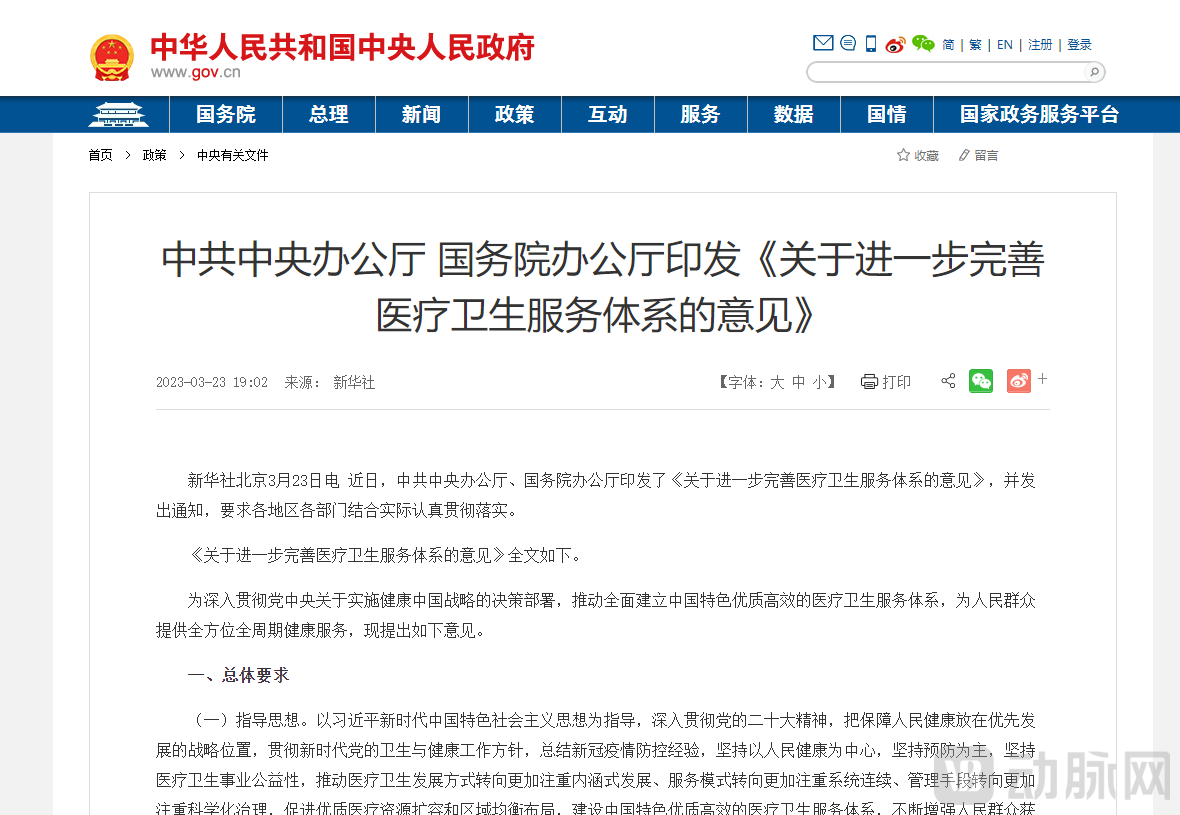
The “Opinions” set forth clear objectives: by 2035, to establish an integrated healthcare service system that is well-structured, clearly delineated in roles, complementary in functions, continuous and coordinated, efficient in operation, and resilient, thereby aligning with the basic realization of socialist modernization; to significantly enhance the equity and accessibility of healthcare services as well as the capacity to deliver high-quality care; and to promote a substantial improvement in the health status of the population.
Centered on the vision of an “integrated healthcare delivery system,” the Opinion outlines a comprehensive plan across five areas, with a focus on advancing hierarchical diagnosis and treatment reforms and establishing medical consortia. Among these, several innovative institutional arrangements have drawn significant industry attention.
For instance, the Guidelines explicitly state that “socially funded medical institutions are supported to take the lead in forming or participating in medical consortia.” This indicates that policy support is being extended to diverse entities involved in building integrated healthcare service models. Particularly in a context where digitalization has become a new productive force capable of comprehensively empowering the healthcare system, innovative consortium models characterized by digitalization—such as digital health communities and chronic disease medical consortia—are poised for greater development opportunities.
The “Opinions” mention strengthening health management for major chronic diseases, coordinating chronic disease management, rehabilitation, and nursing services for the elderly, and exploring the establishment of joint chronic disease clinics by primary healthcare institutions in collaboration with higher-level medical institutions to carry out treatment, prevention, and rehabilitation for common chronic diseases. Overall, in the era of population aging, the importance of chronic disease management is becoming increasingly prominent, and the new model of “joint chronic disease clinics” established within medical consortiums will gradually be promoted as a specific measure.
The “Opinions” also emphasize the need to improve diversified and composite healthcare insurance payment methods, and to “explore implementing global budgeting for tightly integrated medical consortia, strengthen supervision and assessment, and allow retention of surpluses while sharing reasonable overspending.” This requires medical consortia to accelerate reforms toward health-centered, outcome-based payment models and develop more diversified financing and payment mechanisms. In addition, the “Opinions” affirm the positive role of new technologies, explicitly stating that we should “leverage the supporting role of information technology and develop ‘Internet + Healthcare’,” among other measures.
Industry analysis suggests that building a high-quality, efficient, and integrated healthcare service system to address the uneven distribution of medical resources and fragmented service delivery in China will be a key priority for the country’s healthcare sector over the next two decades.
In this process, the formation of tight-knit medical consortiums led by new, digitally-enabled private healthcare providers is an encouraged direction for healthcare reform and a significant development opportunity for the industry. This approach builds on enhancing primary care capabilities through digitalization, implements standardized chronic disease management, and innovates value-based payment models such as diagnosis-related group (DRG) and capitation-based payments.
According to media reports, the innovative and practical policy arrangements outlined in the Opinions have, to some extent, incorporated innovative experiences from local efforts to build integrated healthcare delivery systems. Notably, Tianjin’s “Digital Health Community” healthcare reform model has drawn industry attention, with its multifaceted explorations aligning well with the requirements set forth in the Opinions.
It is reported that, under the guidance of the Tianjin Municipal Health Commission and the Tianjin Municipal Healthcare Security Administration, Tianjin WeDoctor Internet Hospital, as the lead entity, has collaborated with 266 primary healthcare institutions across the city to establish a closely integrated internet-based medical consortium—the “Tianjin Primary Digital Health Community.” By implementing the unified “Four Clouds” platforms—namely “Cloud Management,” “Cloud Services,” “Cloud Pharmacy,” and “Cloud Diagnostics”—alongside standardized offline chronic disease management centers, this initiative achieves standardized diagnosis and treatment on a disease-specific basis, centralized cloud pharmacy services, and centralized cloud diagnostic services, thereby providing residents with integrated online-and-offline medical and health services. Meanwhile, this innovative medical consortium uses chronic disease management as an entry point to explore and implement payment reform based on “disease-based/capitation bundled payments” within the medical insurance system. It has established a “pay-for-performance” system for medical services and implemented a health accountability mechanism, aiming to achieve better health outcomes while maintaining cost control.
Data shows that as of December 2022, the medical consortium had signed chronic disease management cooperation agreements with 204 primary healthcare institutions and 7 secondary hospitals, and gradually co-established chronic disease management centers. More than 1.68 million patients have been registered for management, and over 110,000 diabetic patients have been enrolled under the special outpatient health stewardship responsibility system for diabetes. The standardized management rate for diabetic patients in pilot primary healthcare institutions reached 81.5%, and the blood glucose control rate improved by more than 12.1 percentage points. The effectiveness of its reforms has been widely recognized; in April 2022, five ministries and commissions, including the National Development and Reform Commission, jointly issued a document proposing to “guide localities in exploring the development of grassroots digital health communities.”
Innovative medical consortium models have become one of the breakthroughs in China’s efforts to build an integrated healthcare service system. Innovative paradigms such as the Digital Health Community have already explored a new, adaptable, and effective pathway for medical consortia. In the future, with the accelerated implementation of the “Opinions” and the gradual rollout of various requirements and measures to improve the healthcare service system, the replication and expansion of such innovative medical consortium models across China will significantly accelerate. They are poised to become the preferred digital solution for realizing the Healthy China initiative and establishing a high-quality, efficient healthcare service system with Chinese characteristics.