

How a Veteran Media Entrepreneur Is Tackling Customer Acquisition and Cost Control Challenges in China's Elderly Care Market
What Would an Elderly Care Brand Founded by a Veteran Media Professional Look Like?
Beijing Xiaoyang Elderly Care Service Co., Ltd. (hereinafter referred to as “Xiaoyang Elderly Care”) may offer an answer.
In March 2021, Ma Hui founded Xiaoyang Elderly Care. Prior to this, the founder had successively served as a journalist for China Media Group, editor-in-chief of an automotive media outlet, and director of project operations at Renren.com. Although hailing from a media background, Ma Hui has openly stated that he has always had an entrepreneurial spirit and had been “seeking startup opportunities in the elderly care industry for over a decade.”
Today, the establishment and operation of Xiaoyang Elderly Care has become the starting point for Ma Hui to realize his entrepreneurial dream in the elderly care industry, as well as a powerful tool for him to address the current pain points in the sector.
Expanding scale through an “online marketing + offline stores” model, Xiaoyang Elderly Care addresses the actual needs of seniors by offering service packages tailored to their individual requirements via community-based elderly care stewards. It partners with B-side clients to overcome customer acquisition challenges, establishes offline elderly care stores within a 3-kilometer radius to serve surrounding areas, and leverages algorithms to calculate the most cost-effective labor costs for controlling expenditures. Xiaoyang Elderly Care’s business model is quite distinctive.
The distinctive model has indeed contributed to the development of Xiaoyang Elderly Care. To date, Xiaoyang Elderly Care operates six offline stores and secured millions of yuan in seed funding in 2022.
Indeed, in recent years, with declining birth rates and an accelerating aging population, domestic demand for elderly care has become increasingly evident and urgent. Coupled with supportive national policies and rising economic standards, the market size of China’s elderly care industry has been growing steadily. Unfortunately, however, despite the impetus from various stakeholders, the domestic elderly care sector still exhibits a fragmented and even disordered market landscape. In Ma Hui’s own words, it is characterized by “fragmentation, disorder, and greed.”
Against this backdrop, various stakeholders are actively exploring diverse development models for elderly care service institutions, either by partnering with the government to develop senior living real estate projects or by targeting high-net-worth individuals with premium elderly care offerings. However, for the broader elderly population, which elderly care service model is the most suitable? And which enterprises can achieve sustainable long-term growth? In an interview with VCBeat, Ma Hui shared his perspectives and outlined the solutions adopted by Xiaoyang Elderly Care to address key operational challenges, including customer acquisition, service standardization, and labor costs.
Almost anyone with a basic understanding of healthcare knows that there is strong demand for elderly care and that the elderly care industry is massive in scale. But just how massive is it?
Let us begin with the demand side. Data from China’s Seventh National Population Census in 2020 shows that the population aged 60 and above exceeded 260 million, accounting for more than 18% of the total population. (According to international standards, a region is considered to have entered an aging society when individuals aged 60 and above constitute 10% of its total population.)
Meanwhile, the China Statistical Yearbook shows that in 2020, the elderly dependency ratio in China was 17.8%, whereas in the 1990s, this figure was less than 9%. This means that in the past, each elderly person was supported by an average of 11 people, while in 2020, each elderly person was supported by an average of only 6 people.
This is merely the “elderly care challenge” at the societal level; in other words, the government also faces a more thorny “elderly care challenge.” According to the Actuarial Report on China’s Pensions 2019–2050 released by the Chinese Academy of Social Sciences in 2019, China’s basic pension fund is projected to incur its first deficit in 2028 and be fully depleted by 2035.
The aforementioned data not only highlights the vast demand for elderly care in China but also underscores its urgency.
Meeting this growing and urgent demand naturally relies on the support of national policies. In addition to state-funded basic old-age insurance and state-welfare nursing homes, the government has introduced a series of policies to promote the development of private elderly care institutions.
For example, the “Opinions on Promoting the Development of Elderly Care Services” issued by the State Council in 2019 stated that the large-scale and chain-based development of elderly care institutions should be maintained; it also called for promoting the integrated development of home-based, community-based, and institutional elderly care, supporting elderly care institutions in operating community elderly care service facilities, and providing door-to-door services for seniors living at home.
The continuous emergence of demand, coupled with national policies, has “created” the current massive market scale for elderly care.
According to the "White Paper on China's Health and Elderly Care Industry" released by Frost & Sullivan, the market size of China's health and elderly care industry (measured by consumption expenditure) grew from RMB 2.9 trillion in 2016 to RMB 4.9 trillion in 2020, with a compound annual growth rate (CAGR) of 14%. The market is projected to continue growing at a rate of 15% from 2020 to 2025.
Regarding the reasons for the market’s continued growth, Frost & Sullivan stated: First, the State Council’s issuance of the “Opinions on Promoting the Development of Elderly Care Services” signals that the country will continue to deepen the development of the elderly care service system; second, the deepening aging of China’s population will further stimulate market development; and third, the influx of capital has also injected vitality into the market’s growth.
In summary, the elderly care industry holds significant development potential due to its convergence of high demand, favorable policy support, and capital infusion. From Ma Hui’s perspective, the greatest entrepreneurial opportunities lie in elderly care service providers at the downstream end of the industry chain. This is because, regardless of how the upstream and midstream sectors evolve, there will always be a need for “channels” that can directly reach the elderly population. In Ma Hui’s view, these “channels” are precisely the elderly care service providers.
Unfortunately, the existing elderly care service projects in China have many unsatisfactory aspects, to the extent that Ma Hui used the words "scattered, chaotic, and greedy" to describe them.
The term “fragmented” refers to the current dispersed competitive landscape of the industry, where no leading enterprise with strong brand influence has emerged. (Note: This applies only to the mid- and low-end elderly care market.)
The “chaos” is closely linked to the “fragmentation” of the industry—perhaps because no clear market leader has emerged in the mid-to-low-end elderly care sector, this market is rife with irregularities, ranging from a lack of standardized service systems to outright fraud and absconding with funds.
As for “greed,” it refers to the fact that some elderly care institutions were not originally established to serve the elderly population and meet their care needs, but rather to exploit national policy incentives favoring the elderly care industry in order to secure various subsidies.
Moreover, even setting aside these industry irregularities, the several development models currently “popular” within the sector are either too costly to replicate or fall far short of meeting actual elderly care needs. Therefore, identifying a development model for elderly care institutions that both addresses the real-world needs of the aging population and is practically implementable and scalable has become a top priority for the industry.
Xiaoyang Elderly Care has adopted a development path combining home-based care with community-based care.
The reason is not uncommon—China’s elderly care sector has gradually adopted the “9073” model, whereby, due to limited resources, only 3% of seniors can reside in nursing homes, another 7% rely on community-based care facilities, and the remaining 90% age in place at home.
What Are the Home-Based Elderly Care Needs of the Older Adult Population?
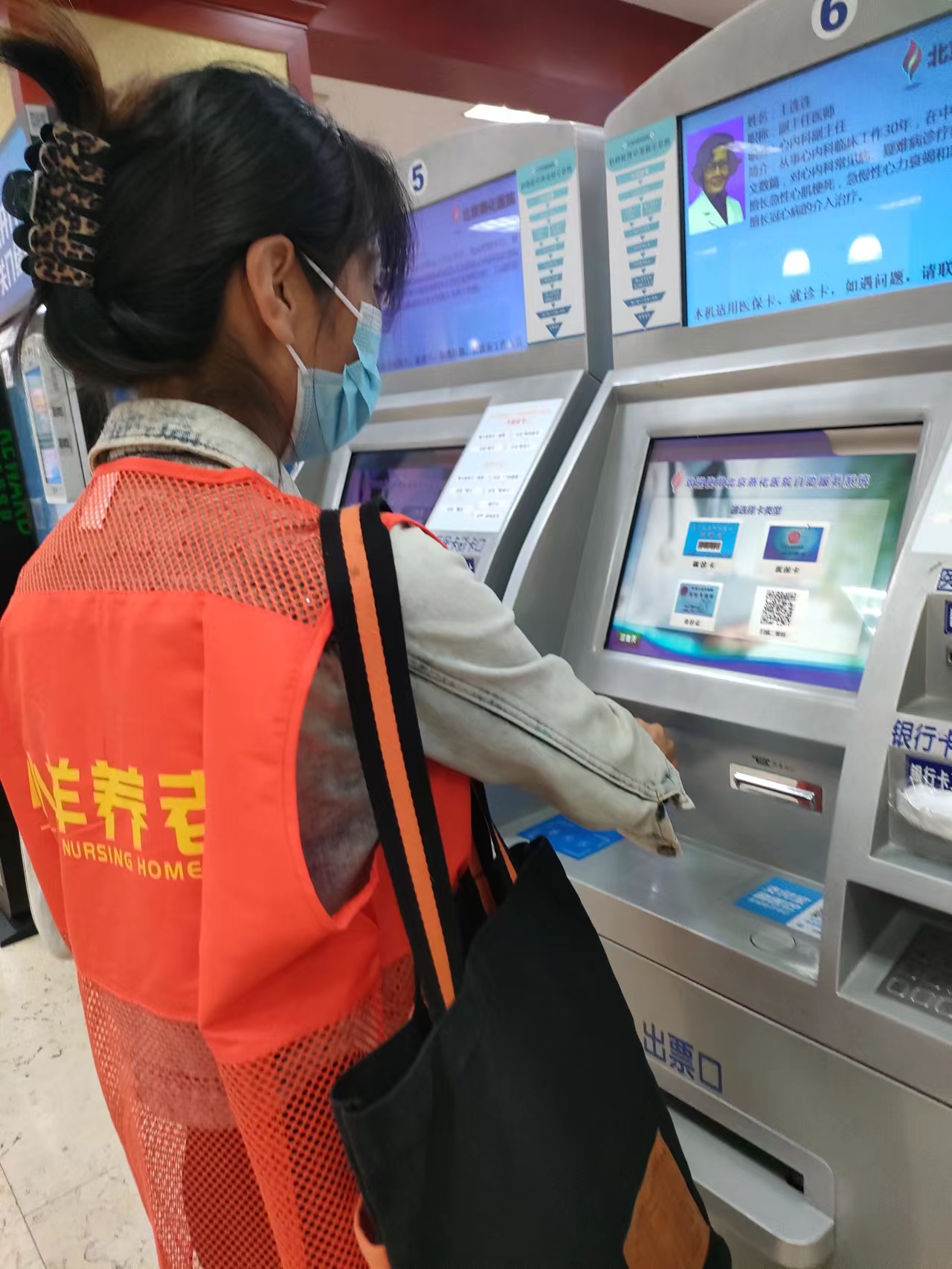
According to Ma Hui, the primary needs of elderly individuals receiving home-based care include transportation, medical consultations, and bathing. To address these needs, Xiaoyang Elderly Care has launched several service packages. These include the “Peace of Mind for Children” package, which offers varying levels of support; the “Peace of Mind Medical Care” package, focused on meeting healthcare needs; and the “Home Services” package, designed to resolve daily living challenges.

This may seem no different from other home-based elderly care service providers in the market. However, its innovation lies in the introduction of “elderly care stewards.” If seniors find it troublesome or difficult to choose from various service packages, they can directly opt for the elderly care steward service, securing an on-call “son or daughter” who assists with meeting diverse needs at the most affordable price.
Meanwhile, Xiaoyang Elderly Care also has its own unique features in customer acquisition and cost control.
Overall, Xiaoyang Elderly Care’s business model can be succinctly interpreted as online customer acquisition coupled with offline store-based service delivery. Its offline stores are expanded according to a site-selection strategy centered on areas with high concentrations of elderly residents, with a 3-kilometer radius (a 15-minute walk) covering the surrounding neighborhoods. As a result, the response speed for services is significantly enhanced, given that each offline store is within a 15-minute walking distance from users’ residences.
Furthermore, within Xiaoyang Pension’s “in-house” customer acquisition system, offline store-based acquisition proves more direct and effective compared to online strategies targeting paying customers (the elderly’s children).
This is because physical stores are more likely to build trust with the elderly population—"the store is physically there, visible to seniors as they come and go, making them more inclined to trust what they can see."
According to Ma Hui, Xiaoyang Elderly Care has indeed conducted relevant calculations, revealing that both customer acquisition and conversion rates in areas with physical stores are higher than those in areas relying solely on online customer acquisition.
In reality, Xiaoyang Elderly Care employs a diversified customer acquisition strategy—serving not only as a service provider within the insurance-funded elderly care industry chain but also partnering with housekeeping agencies and even residential property management companies. Ma Hui even admitted that collaborations through these latter channels have proven more effective.
Having examined Xiaoyang Pension’s customer acquisition system, we now turn our attention to how it addresses cost control.
“Actually, the cost of opening offline stores is not high, so we are not really concerned about store-opening costs; rather, we are worried about labor costs. Therefore, we have specifically devised a solution to control labor costs,” said Ma Hui.
The labor cost solution mentioned by Ma Hui refers to an algorithmic model that, through the collection of extensive preliminary data and leveraging algorithmic capabilities, can project the concurrency patterns and peak periods of service items within a specific region, thereby determining the required number and types of service personnel for that service area.
Moreover, in fact, through this algorithm, Xiaoyang Elderly Care can also calculate the optimal locations for opening stores. This is similar to how KFC assesses per capita consumption levels and food preferences in an area before deciding to open a restaurant, or how Didi Chuxing estimates ride-hailing demand in a new region before expanding into it.
However, during the interview, Ma Hui also admitted that the current algorithm system is still in the refinement stage. Xiaoyang Elderly Care is seeking a new round of external financing to upgrade and iterate this algorithm software.
At this point in the discussion, there appears to be one conventional issue related to chain-based and large-scale operations that has yet to be addressed: service standardization. VCBeat has learned that, rather than rushing to open new stores and expand its scale, Xiaoyang Elderly Care prioritized service standardization from its inception. The company has established a standardized service workflow, along with a follow-up mechanism and a supervisory system, aiming to ensure service quality to the greatest extent possible.
“In the future, a number of leading brands in elderly care services will certainly emerge. With the gradual rise of these top-tier brands and progressive policy guidance, the industry is bound to develop in a healthy direction, establishing standardized service norms,” said Ma Hui. “Of course, Xiaoyang Elderly Care aims to become one of them. However, before that, we will first focus on cultivating the elderly care market in North China and Beijing, laying a solid foundation for further expansion into the national market.”