

Two Strategic Pillars Behind Kangji Medical's Resilient Growth: A Deep Dive into Its 2022 Financial Report

Kangji
Supplier of Minimally Invasive Surgical Instruments and Consumables
On March 28, Kangji Medical, a leading enterprise in minimally invasive surgery, released its latest financial report.
Data shows that in 2022, against the backdrop of a decline in surgical volumes across the industry due to the pandemic, Kangji Medical achieved counter-trend growth, with total revenue reaching RMB 790 million, a year-on-year increase of 13.9%. Domestic sales rose by 11.4% year on year, while export revenue surged by 46.9%. Net profit attributable to shareholders amounted to RMB 480 million, representing a 4.8% year-on-year increase. Three years after its listing, Kangji Medical has delivered a financial performance marked by steady growth.
As the domestic leader in minimally invasive surgery, Kangji Medical’s financial report features numerous highlights, and the development trends of China’s minimally invasive surgery industry can also be discerned from the report.
Key highlights from the financial report include: Kangji’s rapid expansion in overseas markets, with foreign trade revenue increasing by 46.9% year-on-year; Kangji turned centralized volume-based procurement into an opportunity, further expanding the market share of its star single-use consumables; a wave of new product approvals drove robust growth and completed the company’s strategic layout in the surgical robotics platform.
Notably, Kangji has continuously expanded its market share in the three years since its listing."Transformed from a domestic market disruptor to one of the top three leaders in the field of minimally invasive surgery."
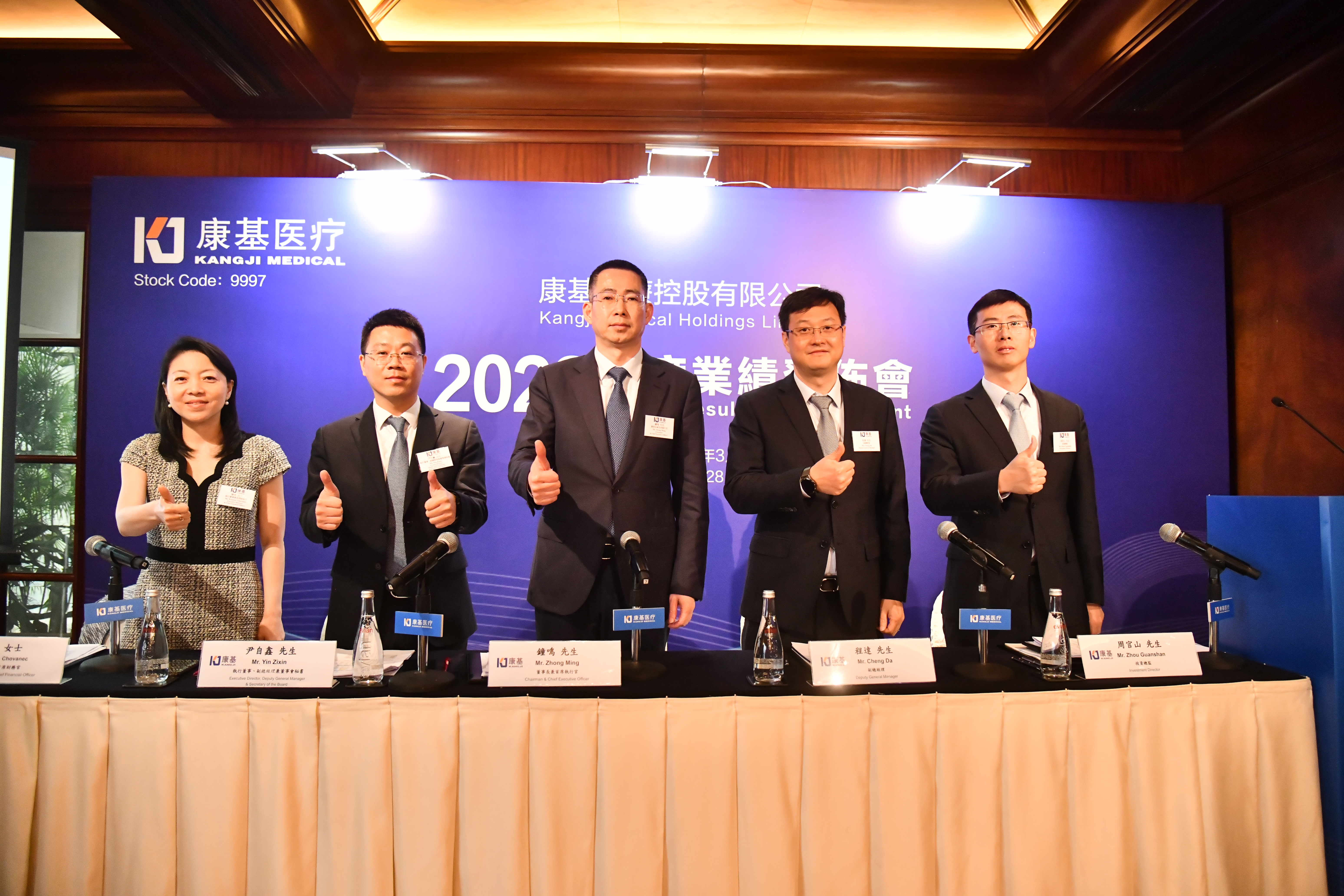
Photos from Kangji Medical's 2022 Results Presentation
Image source: Kangji
Kangji, founded in 2004, is now a 19-year-old company in a phase of rapid growth. How has Kangji managed to evolve from a domestic market disruptor to an industry leader, achieving counter-trend growth? A review of Kangji’s annual reports from the past two years reveals that its operational success is closely tied to its strategic upgrades.
Currently, the minimally invasive surgical industry is upgrading towards intelligence and digitalization. Coupled with trends such as volume-based procurement, domestic substitution, and industrial consolidation, the sector has reached a critical turning point in its development. For Chinese enterprises to achieve further leaps in growth, they require guidance from clear, long-term strategies. As a leading domestic player, what strategic upgrades has Kangji implemented? What insights does this offer to other companies in China? VCBeat interviewed several senior executives at Kangji.
Looking back at the strategic backdrop of Kangji Medical’s upgrade, the company previously focused on the domestic market, developing two flagship product lines—disposable surgical instruments and disposable implantable consumables—thereby breaking import monopolies and emerging as a champion in its vertical niche.
In 2020, Kangji Medical, as the first domestically produced minimally invasive surgical company to be listed on the Hong Kong Stock Exchange, created a historic moment in China's minimally invasive surgery field.Kangji, sensing a renewed sense of mission following its public listing, has decided to undertake a strategic upgrade aimed at becoming a world-class medical device company.
From Champion of a Vertical Niche to a World-Class Medical Device Enterprise: Achieving This Leap Requires a Phased Approach
Kangji Medical has divided its current strategy into two major directions: one is to upgrade product categories, providing clinical “equipment + instruments + consumables” surgical solutions; the other direction is to deeply layout in the global market.
Kangji opts for strategic upgrade,Internal drive stems from the new heights achieved by enterprises after their initial public offering., while the external driving force stems from Kangji's keen perception of changing market conditions both domestically and internationally.
Yin Zixin, Executive Director and Deputy General Manager of Kangji Medical, stated that Kangji Medical maintainsClose Connection。In the past, clinicians had relatively low recognition of domestically produced products. Based on this, Kangji did not blindly expand its product line.
In recent years, Kangji has sensed a shift in market trends.
First, the recognition of domestic brands among clinicians both in China and abroad has increased.In the past, doctors in China placed greater trust in foreign brands for products such as ultrasonic scalpels and staplers, often hesitating to try domestically produced brands due to safety concerns. Overseas,For a long time, “Made in China” was often perceived as synonymous with subpar quality.. However, as the strength of domestic industrial chains has improved, biases among doctors both in China and abroad toward domestically produced products have gradually been dispelled, and trust has begun to rise.
Second, on the policy front, policies encouraging the domestic substitution of medical devices have accelerated the development of China’s domestically produced device industry.In recent years, the Chinese government has continuously introduced policies to encourage and support the procurement of domestically produced equipment, creating a more favorable competitive environment for such products. Taking endoscopes as an example, the trend toward domestic substitution, combined with the upgrade of in-hospital high-definition products to 4K systems, presents opportunities for domestic manufacturers to enter the market.
Having cultivated the minimally invasive surgery field for over a decade, Kangji has gradually established a certain level of brand recognition., Kangji decided to seize the momentum and upgrade its strategy, focusing on minimally invasive surgical scenarios,Upgrade the product line and precisely reposition for target markets, aiming to provide physicians with one-stop solutions.
If Kangji’s product upgrades and globalization strategy are viewed as the two wheels driving future growth, then R&D empowerment is indispensable for powering these wheels.
Chinese medical device companies began with follow-on innovation and previously lacked systematic capabilities for original innovation. In the new era of import substitution, the industry has placed new demands on leading domestic medical device enterprises: to transition from follow-on innovation to independent innovation, and from single-market development capabilities to global resource integration capabilities.
Kangji anticipated this trend at an early stage. According to financial report data, Kangji’s R&D investment reached RMB 66.01 million in 2022, representing an 83% increase from 2021. In 2022, Kangji obtained registration certificates for 11 new domestically produced products, 13 overseas product registration certificates, and one Zhejiang Provincial Innovative Product designation.
Kangji did not follow the trend of imitation-based innovation; instead, it leveraged the integration of medicine and engineering as a breakthrough point to build up its R&D capabilities.
Since its inception, the integration of medicine and engineering has been an intrinsic R&D DNA at Kangji. At Kangji, junior R&D personnel and engineers are required to engage in extensive communication with physicians, supplemented by specialized training, to effectively translate clinical language and needs into product design.
It is precisely due to this R&D DNA ingrained in its core that numerous successful cases of medical-engineering integration have emerged at Kangji.
Take Kangji Medical’s flagship product, the polymer ligation clip, as an example.Yue Jiqiang, Head of R&D at Kangji Medical, recounted the product’s research and optimization process: “During our discussions with physicians, we discovered that polymer ligation clips were prone to detachment during application. Through extensive observation and analysis of the clipping procedure, along with repeated testing alongside clinicians, we implemented innovative adjustments to the clip applier. These improvements enhanced the firmness and stability of the ligation clips at the applier’s tip, significantly improving clinical outcomes.”
As Chinese companies transition from imitation-based innovation to original innovation, the test is not merely the competitiveness of individual products but the strength of the overall R&D system. Currently, Kangji has deeply cultivated four key specialties—general surgery, gynecology, urology, and thoracic surgery—and has established an integrated R&D framework encompassing “equipment, instruments, consumables, and surgical robots,” thereby enabling the provision of comprehensive minimally invasive surgical solutions.
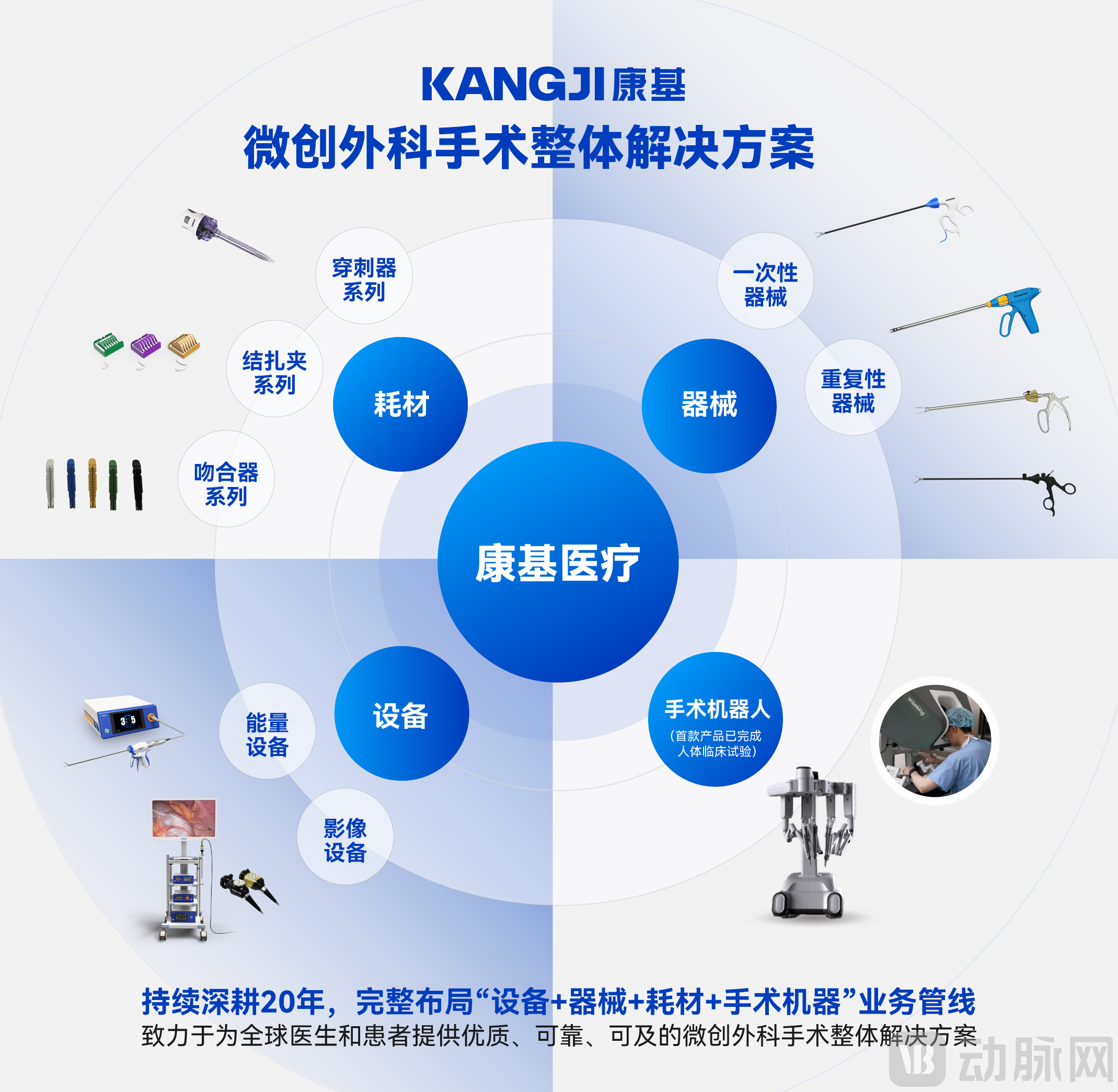
Kangji Medical: Layout of Integrated Solutions for Minimally Invasive Surgery
Image source: Kangji
In the equipment sector, Kangji Medical previously had a limited product portfolio. Following its strategic upgrade, the company has initially completed its R&D layout for imaging systems and energy-based surgical platforms.
Currently, Kangji has established its family of medical endoscopic camera systems in the imaging field, including full HD medical endoscopic camera systems, 4K medical endoscopic camera systems, and 4K fluorescent medical endoscopic camera systems. It also offers 3D camera systems and a pipeline of single-use electronic endoscope products.
In the energy platform segment, Kangji has launched ultrasonic scalpel products and will continue to expand its portfolio with plasma scalpels, high-frequency ultrasound integrated systems, and other products.
In recent years, Kangji has entered a period of R&D fruition. Over the past three years, it has obtained two Class III product registration certificates and twenty Class II product registration certificates.
The intensive approval of key products reflects the release of Kangji’s accumulated R&D strength. In terms of R&D layout, Kangji Medical conducts long-term R&D planning on a 5–10 year cycle. Taking energy platform products as an example, Kangji Medical began laying out related technologies as early as 2015.
Medical device innovation also encompasses extensible innovation, which enhances product competitiveness by integrating global resources. Kangji Medical applies this strategy to innovative products that are still far from large-scale industrialization, deploying its layout through investments and acquisitions.
In the field of surgical robotics, Kangji acquired a 35% equity stake in Weijing Medical. Weijing Medical’s first-generation product has completed urology clinical trials, its second-generation four-arm surgical robot has been submitted for type testing, and its single-port surgical robot is in the design phase.
Kangji’s independently developed robotic-arm laparoscopic surgical instruments have passed the special approval process for innovative medical devices in Zhejiang Province, paving an innovative path for multi-dimensional spatial manipulation in traditional laparoscopic surgery.
Leveraging its highly efficient integrated R&D platform and its foundation in medical-engineering integration, Kangji has identified and strategically positioned itself to address numerous domestic gaps and globally leading products in the field of minimally invasive surgery, and will continue to strengthen its product portfolio in this sector.
In addition to upgrading its product portfolio, another key pillar of Kangji’s strategic transformation is to intensify its global expansion. Kangji has chosen to ramp up its investment in globalization at a time when the world is grappling with the pandemic-induced uncertainties in overseas markets, a move that demands considerable courage.
However, Kangji firmly believes that expanding overseas is an inevitable path to becoming a global medical device enterprise, and the overseas market holds significant strategic importance for such companies.
Cheng Da, Head of International Marketing at Kangji Medical, stated, “Based on the revenue of the world’s largest surgical device companies, the Chinese market typically accounts for only 10% of global sales. The larger market for minimally invasive surgical devices lies overseas. We must adopt a more proactive, aggressive, and targeted approach to expanding our presence in overseas markets.”
According to the 2022 annual report, Kangji Medical held cash and cash equivalents of RMB 2.818 billion. This robust cash flow has provided Kangji Medical with the financial strength to make investments from a long-term perspective. Despite numerous challenges in recent years, Kangji Medical has continued to increase its investment.
Kangji Medical is increasing its investment in overseas markets in two areas: one is to enhance market registration abroad, and the other is to boost the export of its own branded products.
Overseas market registration certificates are the key to entering international markets. In 2022, Kangji obtained registration certificates for 13 products overseas, covering core markets such as Europe, the Middle East, and the Asia-Pacific region.
While increasing its registration investments, Kangji is also gradually expanding the output of its proprietary brands to enhance product value-added.In the past, Chinese companies’ export of minimally invasive surgical products was predominantly based on OEM models, with few independent brands, resulting in a lack of brand recognition for domestic brands in the global market. Kangji Medical’s previous overseas expansion also relied primarily on OEM arrangements, but the company is now gradually adjusting its strategic layout.
From OEM to Own Brand: Kangji Medical Recognizes that the Performance and Quality of Chinese Brands Have Gained Widespread Acclaim, with Performance Gaps Relative to Top-Tier Global Brands Now Minimal. Meanwhile, Chinese Companies Enjoy Unmatched Supply Chain Advantages, Including Lower Manufacturing Costs, More Ample Raw Material Reserves and Inventory, Greater Supply Chain Resilience, and Faster Delivery Capabilities.
These two factors convinced Kangji of the feasibility of launching its own brand, believing that independent Chinese brands have the opportunity to capture a larger share of the overseas market.
Over the past two years, Kangji’s strategic upgrade has been commercially validated.
Kangji Medical’s ultrasonic scalpel generated RMB 18.15 million in revenue in 2022, a year-on-year increase of 54.2%; its 4K medical endoscopic camera system recorded revenue of RMB 20.56 million, representing a year-on-year growth of 233.4%.
The new strategic upgrade direction has also withstood the test of external uncertainties.
Since 2020, the National Healthcare Security Administration has implemented volume-based procurement for high-value medical consumables. Under this normalized procurement regime, Kangji’s upgraded product portfolio and target market mix demonstrate enhanced resilience against risks.
Under the support of its newly upgraded strategy, while many brands adopted a wait-and-see approach toward the market, Kangji Medical chose to take proactive action and make flexible adjustments, seeking opportunities amidst industry transformation.
Yin Zixin revealed Kangji’s strategy regarding centralized procurement, stating, “Centralized procurement for medical devices differs from that for pharmaceuticals. Medical device sales are regional in nature, and physicians often have preferred brands. Under the current rules, procurement categories are divided into large-volume and small-volume groups, which mitigates the intensity of competition, leads to more rational and moderate price reductions, and enables companies with stronger supply capabilities to capture larger market shares.”
Volume-based procurement (VBP) has also rationalized industry competition, deterring some manufacturers from entering new fields due to VBP policies. For leading enterprises, however, VBP has lowered the barrier to hospital access. Against the backdrop of VBP, top-tier players are poised to further consolidate and enhance their market share and standing. Therefore, we view VBP primarily as an opportunity. Kangji is also flexibly adjusting its business model in response to VBP.”
Currently, Kangji has won bids for key products in multiple provincial-level centralized procurement programs, and its market share has increased following the implementation of these procurements.
Currently, with the aging trend and the continuous increase in the penetration rate of minimally invasive surgery, the volume of surgeries in the domestic minimally invasive surgical field will continue to rise, and the market will keep expanding. Kangji is one of the first participants in China's minimally invasive surgical field and has grown into a leading Chinese manufacturer over 19 years.
What Insights Does Kangji’s Development Offer to the Industry? An analysis of Kangji’s strategic upgrade and implementation reveals that the secret to staying at the forefront lies in long-term strategic planning and a steadfast commitment to sustained investment. Long-term planning has enabled Kangji Medical to adopt a broader and more forward-looking perspective, while its unwavering dedication to investment serves as the pathway to realizing a grander vision.