

Mental Health Industry Accelerates: How Leading Players Are Shaping the Future
The 21st Century Is the Century of Psychology. Mental Health Is Receiving Unprecedented Attention.
On the one hand, the mental health industry has achieved initial success in its development.Lu Lin, an academician of the Chinese Academy of Sciences and president of Peking University Sixth Hospital, pointed out that the social mental health service system is advancing steadily, and the healthcare service capacity in the field of mental disorders is gradually improving. This progress is attributable to the continuous introduction and implementation of policies such as the National Mental Health Work Plan, the year-on-year expansion of mental health medical institutions and professional talent pools, and deepening research into the diagnosis, treatment, and underlying mechanisms of mental disorders.
On the other hand, the industry needs to further establish and improve relevant mechanisms.Li Yingxin, a member of the National Committee of the Chinese People's Political Consultative Conference and Vice President of the Beijing No. 4 Intermediate People's Court, pointed out that it is necessary to establish a comprehensive system for children’s mental health education, strengthen mental health education in primary and secondary schools, enhance psychological nurturing within families, foster a social atmosphere that values mental health, and promote multi-party collaboration to address the mental health concerns of children and adolescents.
The growing emphasis on mental health is driven by the severity of mental health issues. The "2022 National Mental Health Survey Report: Current Status, Influencing Factors, and Service Conditions" shows that among adults, the detection rate of depression risk in the 18–24 age group is as high as 24.1%, while it stands at 12.3% for the 25–34 age group. Mental health problems are increasingly affecting younger populations.
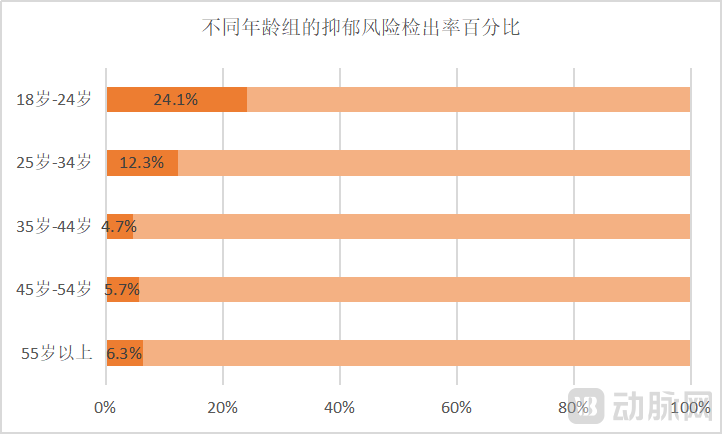
Data source: "2022 National Mental Health Survey Report: Current Status, Influencing Factors, and Service Conditions," graphic by VCBeat
The state previously issued the "Opinions on Strengthening and Improving Specialized Psychiatric Medical Services," proposing to "enrich the technical means of specialized psychiatric medical services, including"Accelerate the development of information-based service models such as “Internet Plus” and telemedicine, leverage information technology to facilitate the downward distribution of high-quality medical resources, streamline patient access to care, and enhance the overall efficiency of healthcare services..” In the digital mental health sector, where demand continues to emerge, how are internet-based mental health service platforms developing?
Online Mental Health Service Platforms Flourish, Meeting the Diverse Needs of the Population
To understand the development of online mental health platforms, it is essential to grasp the current state of psychiatric and psychological healthcare services. On one hand, from the patient’s perspective, individuals with mental disorders often experience the most profound stigma compared to those with other medical conditions, frequently going to great lengths to avoid in-person consultations. On the other hand, current healthcare institutions are predominantly specialized psychiatric hospitals or general hospitals with psychiatric and psychological departments, which prioritize pharmacological treatment for mental disorders over comprehensive mental health services. During the pandemic, barriers to accessing care for patients with mental health conditions further accelerated the emergence and growth of online mental health service platforms.
Mental health service platforms that directly serve the general public can be broadly categorized into three types: comprehensive healthcare service platforms represented by JD Health, vertical psychological counseling platforms represented by YiXinLi, and vertical psychiatric and mental health medical service platforms represented by HaoXinqing.Compared to more generalized comprehensive medical service platforms and “diagnosis and treatment”-oriented, lightly specialized vertical psychological counseling platforms, mental health service platforms in vertical fields such as Haoxinqing focus specifically on psychiatric and psychological specialties, targeting a more niche audience and providing more in-depth diagnostic and therapeutic services.
Comprehensive Medical Service Platform, Providing “Wide-Area” Pharmaceutical Services
Comprehensive medical service platforms typically leverage their large user bases to provide services covering a wide range of disease types. These platforms usually attract relevant healthcare professionals to join and further integrate pharmaceutical resources needed by patients to deliver comprehensive care. Companies such as JD Health and AliHealth, while offering comprehensive medical services, are continuously establishing various specialized departments, including psychiatry and psychology. Their competitive advantages lie in their supply chain integration capabilities and pharmaceutical e-commerce services.
Just as general hospitals are often criticized, comprehensive medical service platforms are frequently perceived by external observers as having relatively balanced specialty development but lacking dominant, specialized departments. This perception, however, has left substantial room for the growth of various types of specialized platforms. The emergence and rapid expansion of platforms focusing specifically on areas such as psychological counseling and psychiatric mental health services serve as prime examples.
Vertical Psychological Counseling Platform: Strengthening the Out-of-Hospital Mental Health Service System
For patients whose mental health issues are not severe enough to warrant pharmacological treatment for psychiatric disorders in a hospital setting, the emergence of online psychological counseling platforms has effectively addressed their mild-to-moderate mental health concerns. For instance, Yi Xinli, founded in 2012, has evolved from initially popularizing psychological knowledge into a comprehensive platform offering services such as psychological counseling. JianDan XinLi, established in 2014, has to date provided professional psychological counseling services to over one million individuals. Yi Dian Ling, founded in 2015, also delivers psychological counseling services through an internationally standardized training system for psychologists.
Services offered by such platforms are typically geared toward clients with mild to moderate mental health issues. However, when encountering clients with severe psychological problems, it is often necessary to advise them to seek treatment at hospitals or other medical facilities. This presents one of the key opportunities for specialized mental health service platforms to intervene.
Vertical Mental Health and Psychiatry Medical Service Platform, Delivering One-Stop Service Provision
While general psychological counseling platforms place greater emphasis on “counseling,” vertical mental health medical service platforms tend to prioritize “treatment.” These platforms typically attract a large number of clinical psychiatrists to provide therapeutic services to patients. Representative platforms in this category include Haoxinqing, Zhaoyang Doctor, and Xiaodong Health. For instance, Haoxinqing has currently onboarded nearly 50,000 psychiatrists and mental health specialists across China, boasting the largest physician network among platforms in this field, thereby delivering treatment services to patients.
Compared with comprehensive healthcare service platforms, vertical mental health and psychiatric care platforms focus deeply on a specialized domain. They are often better at identifying application scenarios that meet specialty-specific needs, thereby providing more convenient and efficient medical services to both doctors and patients. By leveraging their accumulated resources in the professional field—including physicians, medications, and patients—these platforms are more likely to establish a reputation-based advantage. Furthermore, the continuous expansion of more targeted diagnosis and treatment systems will enable these platforms to achieve technological breakthroughs and innovations more rapidly.
It is relatively easier for vertical mental health service platforms to extend their offerings downward to include “psychological counseling” services. However, vertical psychological counseling platforms face significant challenges in attracting more clinical practitioners to join their networks. For instance, Haoxinqing (Beijing Fine Hin Mobile Medical Technology Co., Ltd.), which already possesses strong resources of clinical specialists, is currently building a professional consultation service system centered on psychiatric physicians and psychotherapists delivering specialized treatment, supplemented by psychological counselors. This approach aims to achieve stratified coverage for patients with different conditions. Medical value embodies the benefits provided by physicians through diagnosis, treatment, rehabilitation, and disease management during the delivery of medical services—a value proposition that pure pharmaceutical e-commerce platforms cannot offer. Ultimately, vertical mental healthcare service platforms that integrate pharmaceutical supply chains, medical personnel, and other resources can deliver professional, high-quality, one-stop services for patients with mental health needs.
Financing Hits New Highs as Capital Focuses on Platform Innovation and Commercialization Capabilities
The increased uncertainty brought about by the previous pandemic has led to a surge in demand for mental health services. Capital optimistic about the future development of the digital mental health sector has been continuously injecting funds into the industry. According to the "2022 Blue Book on the Digital Mental and Psychological Health Service Industry" released by Fine Hin, there were 115 financing events in the overseas digital mental health field in 2021, with cumulative funding exceeding $3.4 billion.
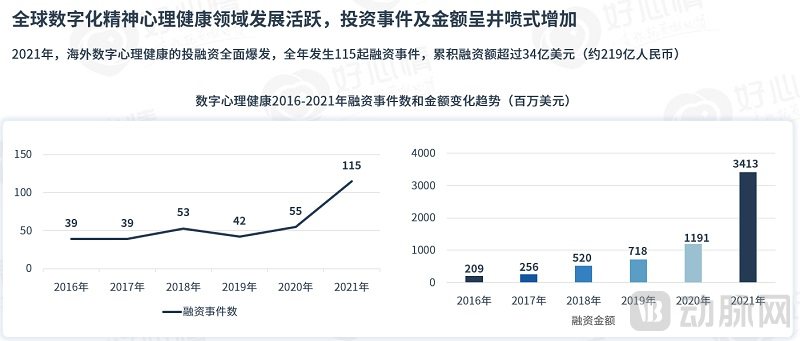
Image source: “2022 Blue Book on the Digital Mental Health Services Industry”
Across China, digital mental health platforms have been increasingly favored by investors in recent years. Generally, the maturity of a sector can be gauged by the stage at which most companies within it are raising funds. According to currently disclosed financing data, companies such as Zhaoyang Doctor, YiXinLi, and Jiandan Xinli have mostly reached Series B or B+ rounds. This indicates that the industry still requires a period of development before reaching maturity. However, we have also observed that Beijing Fine Hin Mobile Medical Technology Co., Ltd. (Haoxinqing) announced in September and October 2021 that it had completed its Series C round led by ByteDance and its Series C+ round funded by Oriental Pearl Fund. It is poised to be the first to complete a Series D financing round, leading industry development and potentially transitioning more rapidly from the primary capital market to the secondary market.
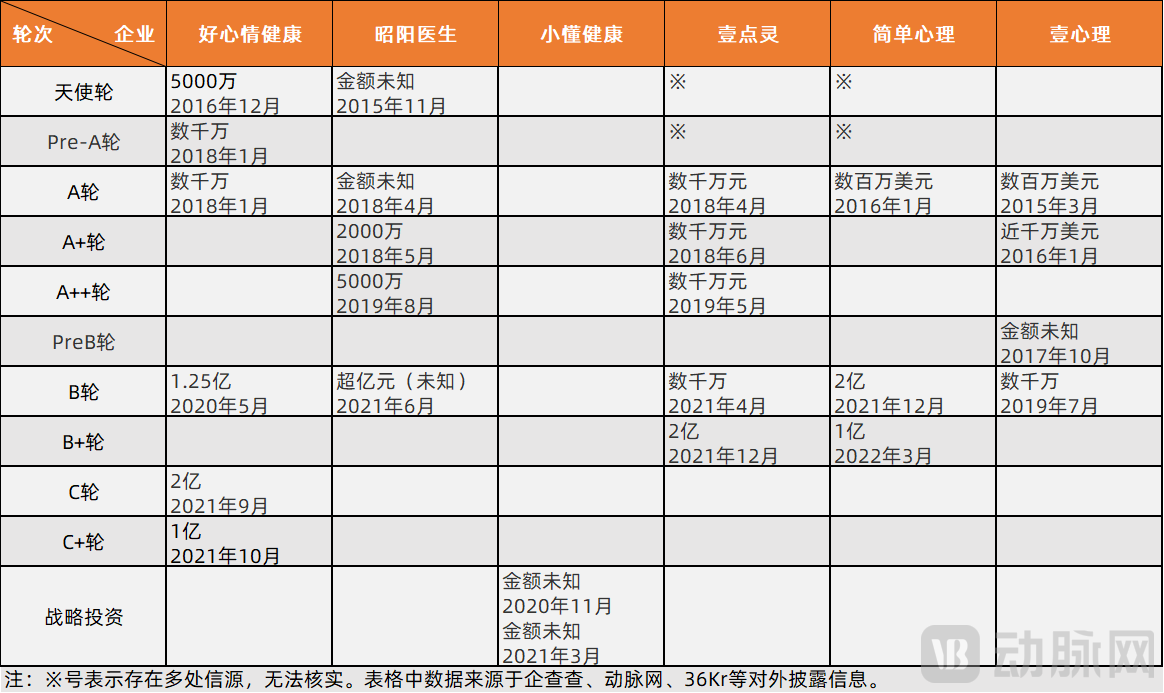
It is not difficult to see that, at the current stage, a company’s platform innovation capabilities and its ability to commercialize solutions largely determine whether it can secure further financing and achieve more rapid growth.
First, whether patients’ diagnostic and treatment needs can be effectively met.From the perspective of innovations in diagnostic and therapeutic methods alone, it is crucial for enterprises to introduce innovative approaches within clinical care settings. Currently, in the field of mental health, we are witnessing the launch and integration of more cutting-edge technologies, including artificial intelligence, virtual reality, and digital therapeutics.
Numerous enterprises have recognized the importance of digitalization and innovation. For instance, when JianDan XinLi completed its financing round last March, it announced plans to accelerate its digital transformation. Similarly, upon completing its strategic financing in 2020, XiaoDong Health proposed establishing a Psychological Big Data Research Institute to participate in government- and university-led research projects. Meanwhile, Fine Hin took a proactive step by officially launching innovative technology products based on virtual reality and artificial intelligence last year, including the Fine Hin VR Therapy System and the Fine Hin AI Digital Companion for psychological support. Some of these products have already applied for clinical certifications. In terms of innovation, Fine Hin has taken the lead by being the first to successfully implement and commercialize its products.
Fine Hin has recognized that physicians remain the primary providers of patient care, and thus, the core issue lies in enhancing physician efficiency. To better empower physicians, Fine Hin has explored and launched solutions such as an intelligent prescription warning and auxiliary review system, an emotional alertness and intervention system for special populations, products for quantitative analysis of depression and anxiety risks based on EEG data, and the Fine Hin Psychological CT. These initiatives aim to better assist departmental physicians in delivering improved patient care. This exploration continues to advance.The leading platform, Fine Hin, is currently collaborating with the National Mental Health Center on a 5G + mental health project.
It is worth adding that, while pursuing technological innovation, the platform is also further consolidating the fruits of its own technological innovations—currently,Fine Hin has filed over 30 patent applications (based solely on searches for “Beijing Fine Hin Mobile Medical Technology Co., Ltd.”), of which 27 innovative patents have been granted.Judging solely by the number of patents granted, it holds an absolute advantage in patent volume compared to other companies that have secured only single-digit patents. It is reported that its investment in technology research and development continues to increase.
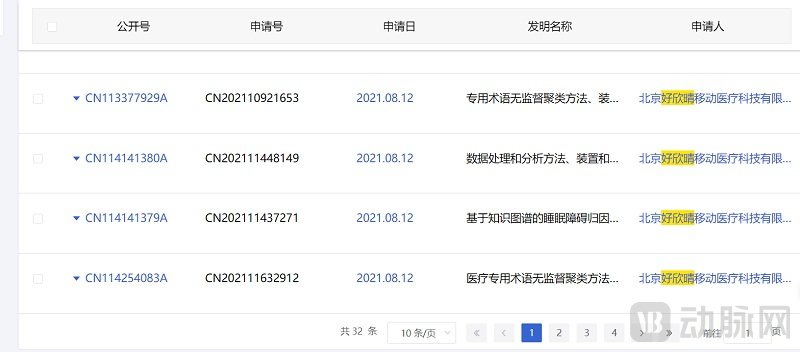 Source: China National Intellectual Property Administration - Patent Search and Analysis
Second, whether it can maximize patient reach.As early as its inception in 2015, Fine Hin recognized that offline medical services struggled to meet the diagnostic and treatment needs of all patients. After obtaining an internet hospital license in 2017, Fine Hin delved deeper into the core aspects of healthcare services, extending beyond initial online consultations to include diagnostic tools and service assurance. The company also acknowledged that online platforms alone could not fully address the needs of patients requiring offline care. Currently, Fine Hin has established 15 offline outpatient clinics across 11 provinces in China, achieving an integration of online and offline services. By covering comprehensive healthcare scenarios—spanning pre-consultation, during-consultation, and post-consultation phases—and providing end-to-end services, Fine Hin has further enhanced the accessibility of healthcare for patients. In the future, Fine Hin may well expand its nationwide presence. In contrast, Simple Psychology’s offline psychological counseling institutions are primarily located in cities such as Beijing and Shanghai, while Zhaoyang Doctor’s offline clinics are based in the Guangzhou region.
Third, whether further commercial expansion can be achieved.While many companies provide services directly to consumers (C-end patients), some are evolving from their original C-end focus to a dual B-end and C-end strategy. These companies are beginning to offer Employee Assistance Program (EAP) services—essentially corporate mental health services—to better serve end-users by engaging with businesses (B-end). In fact,In the process of providing EAP services, it is also necessary to provide tiered services for users, which further tests the service capabilities of the platform itself. Vertical mental health service platforms that offer both psychological counseling and psychotherapy services inherently possess greater advantages.Currently, we also observe that vertical online psychological counseling platforms such as Jiandan Xinli and Yidianling are attempting to expand into corporate Employee Assistance Program (EAP) services. However, no detailed data have been disclosed regarding the specific progress of these expansions.
An interesting point may be that most current platforms offering EAP services primarily focus on online, light-touch consultations. Haoxinqing, however, is changing this landscape by leveraging its own strengths: currently,Fine Hin has also achieved innovation in the provision of corporate Employee Assistance Program (EAP) services, emphasizing both online and offline channels and leveraging renowned physicians and experts to deliver seamless integration of psychological counseling and clinical diagnosis and treatment services.It has also achieved notable success in expanding its Employee Assistance Program (EAP) services—reportedly, the number of corporate clients it serves has exceeded 100, and it also provides psychological services to primary and secondary school students in certain provinces.
Furthermore, a point that cannot be overlooked is whether it can maximize the fulfillment of patients’ needs beyond treatment.For patients with mental disorders and their families, when pharmacological treatment is required, there is often a strong desire to minimize the associated treatment burden—referring specifically to reducing both the physiological side effects and the financial costs of medication. Most healthcare service platforms tend to prioritize the comprehensiveness of drug availability while paying less attention to the burdens imposed by these medications. Vertical mental health service platforms may have recognized this issue. For instance, Xiao Dong Health has mentioned leveraging medication data to “reduce disease recurrence rates and adverse drug reactions.” Beijing Fine Hin Mobile Medical Technology Co., Ltd. (Hao Xinqing) has gone a step further by collaborating with pharmaceutical companies on real-world data studies to improve medication efficacy. Simultaneously, it facilitates clinical trial recruitment, helping pharmaceutical companies launch new drugs more quickly and effectively, thereby benefiting patients. Furthermore, Hao Xinqing has introduced “Hao Xinqing Bao,” an innovative payment solution designed to further alleviate the financial burden on patients.
In fact, by examining how patient needs are met as described above, we can also broadly identify several ways for companies to achieve profitability (it is perhaps unavoidable to mention the leading platform, Beijing Fine Hin Mobile Medical Technology Co., Ltd., using it as an example): revenue may involve fees for online and offline “diagnosis and treatment” + “consultation” services; fees for C-end services plus B-end and G-end services; and insurance businesses, pharmaceutical company collaborations, e-commerce platform services, and more driven by ecosystem expansion.

Currently, enterprises with multi-point layouts in the aforementioned businesses are experiencing more pronounced revenue growth as they expand their scale. According to industry insiders,Currently, achieving annual revenue exceeding RMB 200 million serves as a watershed moment in the mental health sector, with most companies generating less than this amount. Furthermore, it has been disclosed that Beijing Fine Hin Mobile Medical Technology Co., Ltd. surpassed RMB 500 million in revenue in 2022, driven by its multi-pronged efforts in both consumer-facing (C-end) and business-facing (B-end) services.This revenue level has already created a certain gap with the second tier, which also reflects, from one perspective, the current disparities among enterprises.
It is important to emphasize that mental health services possess unique characteristics. When providing such services, enterprises are often expected to generate greater social benefits and contribute more effectively to fostering a socially supportive psychological environment. A significant number of companies have recognized this imperative. With few exceptions, major platforms are committed to popularizing psychological knowledge among the public, helping individuals with potential mental health concerns identify their issues more accurately and promptly. During the pandemic, numerous platforms provided mental health services to the public free of charge. Leading enterprises have further collaborated with government bodies to better channel their services back into society. For instance, Beijing Fine Hin Mobile Medical Technology Co., Ltd. (Good Mood) offers psychological education content and mental health services within the “Xuexi Qiangguo” app. Furthermore, Good Mood has partnered with multiple professional associations, including the Chinese Society of Anesthesiology, the Psychiatric Branch, and the Psychological Assessment Committee.By setting an example, we will further establish industry standards for mental health and psychiatry in China, thereby better benefiting the entire population.The number of partnerships established with relevant associations also serves as an indicator of the extent to which a company’s capabilities are recognized.
Integrating Innovative Technologies and Services to Transition from “Disease Treatment” to “Health Promotion”
Driven by sustained demand growth and the high priority placed on mental health by countries worldwide, the market size for mental health promotion is expanding rapidly. According to projections from the authoritative database Statista, global revenue in the mental health market will reach USD 20.09 billion in 2023 and continue to grow steadily. An overview of digital mental health service provision both domestically and internationally reveals several notable trends:
First, integrate innovative technologies with services to deliver care that is both more compassionate and more cost-effective.The integration of technology has, to some extent, reduced the cost of service delivery; however, how to ensure that patients receive care imbued with humanistic concern remains a critical question for enterprises to address. Leading platforms such as Fine Hin have made significant strides with initiatives like their VR therapeutic systems, AI-driven digital companions for psychological support, and Haojingxin music therapy. These efforts ultimately refocus healthcare services on the patient as a whole person.
Second, draw on overseas models to better achieve innovation in payment methods.Better integration of commercial health insurance with mental health services to reduce financial burden is one of the key patient needs. We have also observed that some platforms have taken steps in this direction and are conducting relevant explorations, such as Fine Hin’s “Mood Insurance” product. Meanwhile, certain insurance institutions are currently easing underwriting restrictions for mental disorders to better benefit patients themselves.
Third, the shift from "disease treatment" to "health promotion."As the focus of treatment shifts upstream, greater emphasis is being placed on early intervention and even on maintaining users’ long-term health to reduce costs. This may well be one of the key issues that leading tech giants should prioritize. We are also seeing major platforms such as Fine Hin making substantial efforts to place greater importance on mental health maintenance.
In China, a multitude of platforms—ranging from comprehensive medical service providers to specialized psychological counseling and mental health platforms—have undertaken extensive exploration and experimentation. We have every reason to believe that leading platforms in the mental health sector, such as Fine Hin, will better steer the industry’s direction and drive its rapid development. We are currently emerging from the darkness before dawn, welcoming the arrival of a new era.