

Switzerland Emerges as a Hotspot for Chinese Companies' Overseas Listings, Raising $3.55 Billion with Over 40 Firms in the Pipeline

Lepu Medical
Developer and Manufacturer of Cardiac Interventional Medical Devices and Pharmaceuticals

CanSinoBIO
Vaccine Developer

yuwell
Developer and Manufacturer of Basic Medical Devices
Since 2023, two Chinese companies have listed on the SIX Swiss Exchange (hereinafter referred to as “SIX”) by issuing Global Depositary Receipts (GDRs), becoming the only two listings on the exchange to date in 2023. From 2022 to the present, a total of 11 Chinese companies have issued GDRs and listed on SIX, raising approximately USD 3.55 billion (equivalent to over RMB 24 billion), with more than 40 additional companies currently preparing for or having already initiated their application processes.
The surge in listings in Switzerland was sparked by a new policy. In 2022, the China Securities Regulatory Commission issued the Provisions on the Supervision and Administration of Depository Receipts under the Stock Connect Mechanism between Domestic and Overseas Stock Exchanges, expanding the “Shanghai-London Stock Connect” into the “China-Europe Stock Connect,” thereby providing strong policy support for Chinese enterprises seeking overseas financing.
This trend has naturally swept through the healthcare industry as well. In September 2022, Lepu Medical and Joincare Pharmaceutical listed on the SIX Swiss Exchange; to date, Aier Eye Hospital, Yuwell Medical, CanSinoBIO, Baike Biological, and iRay Technology have successively planned or advanced their listings in Switzerland.
Dozens of Chinese companies have flocked to the SIX Swiss Exchange within a year—what is its allure? What does listing on the SIX Swiss Exchange mean for healthcare companies? Read on for our analysis.
Overseas listings for fundraising are inextricably linked to a company’s business layout. Currently, several healthcare companies that have already listed or plan to list in Switzerland have all engaged in overseas operations to varying degrees.
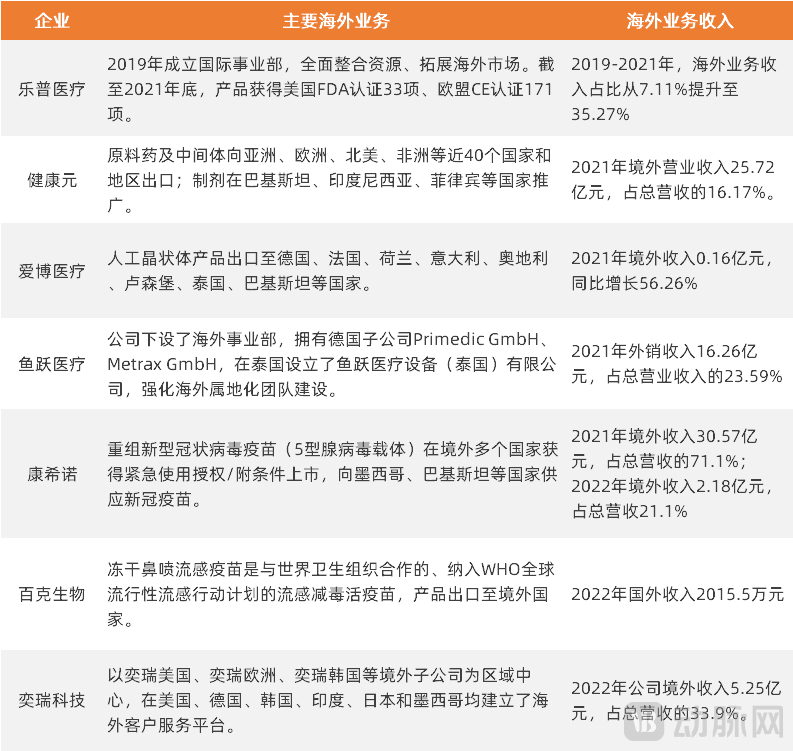
Overseas Business Layout of Seven Companies, Source: Company Financial Reports
(Some companies have not yet released their 2022 financial reports; therefore, information from the 2021 financial reports is used as an example.)
Among these companies, Lepu Medical, Joincare, and Yuwell have numerous listed products and have established extensive business operations overseas.
Lepu Medical established its International Business Division in 2019 to comprehensively integrate resources and expand into overseas markets; through the global layout of its products, it has effectively mitigated the impact of domestic centralized procurement policies. As of the end of 2021, Lepu Medical had cumulatively filed 1,385 patent applications, with 33 products receiving U.S. FDA clearance and 171 products obtaining EU CE certification.
Driven by its ongoing internationalization strategy, Lepu Medical’s overseas revenue reached RMB 554 million, RMB 1.542 billion, and RMB 3.76 billion in 2019, 2020, and 2021, respectively, with its proportion rising from 7.11% to 35.27%. During the COVID-19 pandemic, Lepu Medical rapidly advanced the CE certification and sales of its COVID-19 antigen test kits, which boosted overseas sales of these antigen tests as well as other products.
Health Yuan’s active pharmaceutical ingredients (APIs) and intermediates are exported to nearly 40 countries and regions across Asia, Europe, North America, and Africa. In terms of finished formulations, the company has strengthened market access and promotion for its respiratory, assisted reproductive, antifungal, antiviral, and gastrointestinal products in countries and regions such as Pakistan, Indonesia, and the Philippines.
Yuwell has also established an overseas business division, strengthened the construction of localized teams abroad, and continuously expanded its export channels.
In addition, iRay Technology has established overseas branches in the United States, South Korea, Japan, Germany, and other regions, and set up overseas customer service platforms or sales teams in multiple countries. In 2022, iRay Technology achieved overseas revenue of RMB 525 million, accounting for 33.9% of its total operating revenue.
It is worth noting that Yirui Technology’s procurement of certain key raw materials, such as CMOS sensors, chips, and cesium iodide, is relatively concentrated, with overseas purchases accounting for more than 20%.
Aier Medical’s internationalization strategy is also advancing rapidly. Since the launch of its intraocular lens products, they have been exported to countries including Germany, France, the Netherlands, Italy, Austria, Luxembourg, Thailand, and Pakistan.
Among several companies, CanSinoBIO's overseas revenue share once reached 71.1%.
During the pandemic, CanSinoBIO’s recombinant novel coronavirus vaccine (adenovirus type 5 vector) received emergency use authorization or conditional marketing approval in China and multiple other countries, positively impacting its operating revenue. In 2021, CanSinoBIO achieved profitability for the first time, with overseas revenue reaching RMB 3.057 billion, accounting for 71.1% of total operating revenue, primarily driven by COVID-19 vaccine supplies to countries such as Mexico and Pakistan.
However, this was only a special circumstance during the pandemic. In 2022, the global market environment for COVID-19 vaccines changed, with vaccination growth slowing down and even an oversupply in some regions. As a result, CanSinoBIO's overseas revenue share dropped to 21.1%. Due to high R&D expenses of 778 million yuan, accounting for 76.35% of total revenue, CanSinoBIO returned to a loss-making state once again.
For enterprises, internationalization has become a long-term strategy, and choosing overseas listing is an important way to implement this strategy.
However, short-term objectives for overseas listings vary among different companies. For firms already in the commercialization stage, such as Lepu Medical and Yuwell, the focus is on expanding overseas production, sales, and distribution networks. In contrast, for companies like CanSinoBIO that continue to maintain high levels of R&D investment, an overseas listing is needed to raise capital to support subsequent R&D efforts, particularly to further expand international operations, optimize clinical trial site selection, and explore business collaboration opportunities.
So, why the Swiss Exchange?
A broader context is that life sciences companies are a hallmark of the SIX Swiss Exchange. Jos Dijsselhof, CEO of the SIX Group, the parent company of the SIX Swiss Exchange, has stated that the exchange is a primary listing venue for European healthcare companies, with pharmaceutical, biotechnology, and medical device firms accounting for approximately one-third of the European life sciences market.
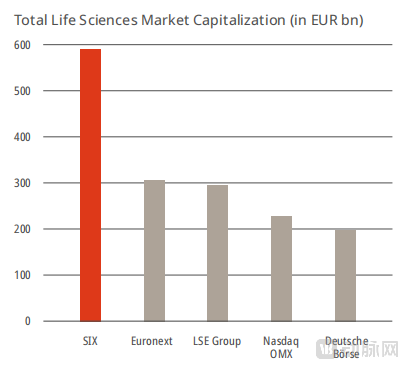
Market Capitalization of Life Sciences Companies on Major Stock Exchanges (Unit: €1 billion). Source: SIX and STOXX, as of January 2020
The high concentration of life sciences companies on the SIX Swiss Exchange is no coincidence. For a long time, Swiss pharmaceutical, biotechnology, and medical device companies have maintained strong interactions with local financial institutions, fostering a virtuous industry ecosystem that has drawn international attention.
Wave after wave of life sciences companies have grown on the SIX Swiss Exchange, which in turn continues to attract a steady stream of influential firms.
Global pharmaceutical giants Novartis and Roche are listed on the SIX Swiss Exchange, laying the foundation for a diversified industry ecosystem.
In 2000, the Swiss pharmaceutical company Actelion listed on the SIX Swiss Exchange. In 2017, Johnson & Johnson acquired Actelion for $30 billion and spun off Actelion’s drug discovery and early-stage R&D division into a new company, Idorsia, which was distributed to Actelion’s former shareholders as a kind dividend in specie. Idorsia also listed on the SIX Swiss Exchange in June 2017.
The SIX Swiss Exchange is also highly attractive for cross-border listings, with companies such as Newron, Cosmo, IGEA Pharma, and Cassiopea having listed on the exchange in recent years.
Meanwhile, Switzerland boasts a rich life sciences cluster and a robust life sciences ecosystem, encompassing large pharmaceutical companies, small and medium-sized enterprises (SMEs) and startups, world-leading universities, industry associations, and more.
According to information released by Switzerland Trade and Investment Promotion, the life sciences sector in Switzerland includes sub-sectors such as biotechnology, the pharmaceutical industry, and medical technology. Among these, biotechnology and the pharmaceutical industry cover the entire value chain and possess significantly growing production capacity. These two sub-sectors contribute more than 40% of Switzerland’s exports, making this industry a key pillar of the national economy.
In 2019, the life sciences industry in Switzerland employed 95,000 people, particularly in Basel, the Lake Geneva region, and the Zurich–Zug region.
Therefore, by choosing to list in Switzerland, Chinese enterprises can leverage the ecosystem of the Swiss Exchange and even Switzerland’s life sciences industry to accelerate the implementation of their internationalization strategies.
Some more direct reasons stem from the listing process and speed.
According to analyses by Chinese securities firms, choosing to issue Global Depositary Receipts (GDRs) on the SIX Swiss Exchange entails disclosure requirements similar to those for listings in other major markets, covering internal control quality reports, audit reports, financial data reports, and disclosures of management transactions. The key differences are that GDR issuers are not treated as primary market entities; instead, they undergo a filing-based issuance process with the exchange, which requires fewer documents. Moreover, the approval timeline at the SIX Swiss Exchange can be as short as 20 working days, allowing a GDR project to be completed within approximately three to four months from initiation.
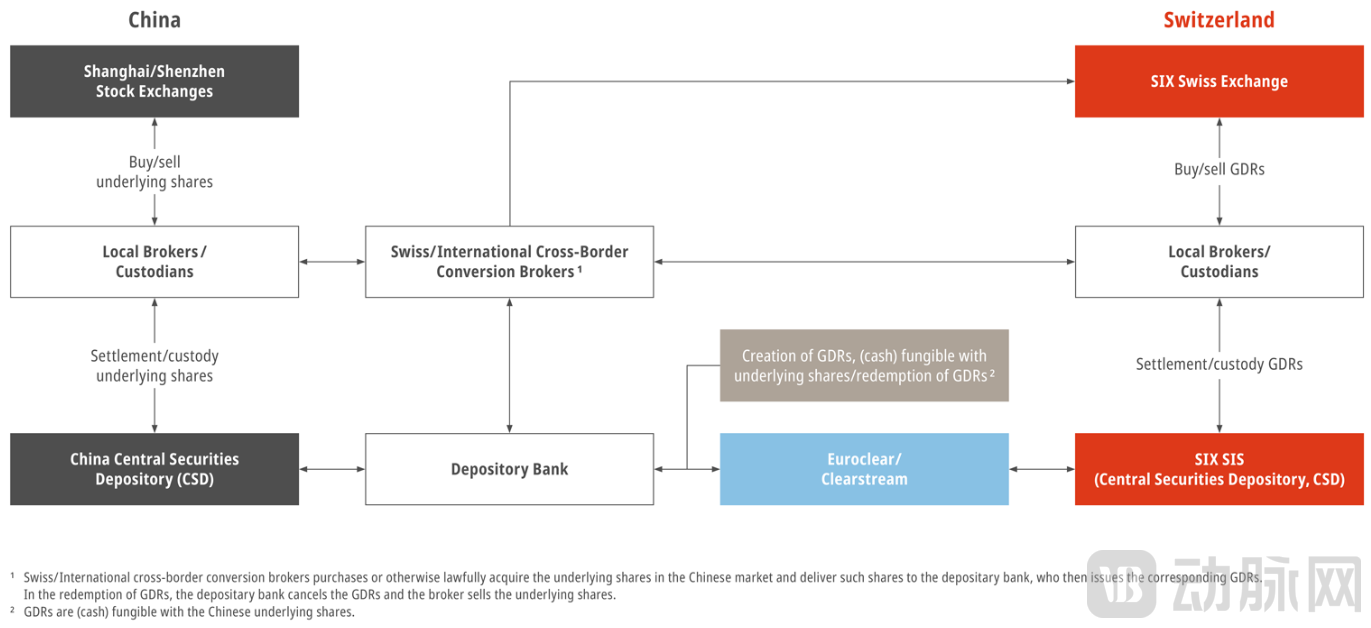 Process for Chinese Companies to List via GDR Issuance in Switzerland, Image Source: SIX Swiss Exchange Official Website
In recent years, influenced by the international macroeconomic environment, companies listed in the U.S. have successively delisted and withdrawn capital. In contrast, the European market has remained relatively stable. Taking into account factors such as industrial resources and listing costs, the Swiss Exchange has become a popular overseas listing destination for many A-share companies across various sectors, including the healthcare industry.
In September 2022, the total funds raised by Lepu Medical through its GDR issuance amounted to US$224 million, with net proceeds of US$220 million after deducting underwriting fees; Joincare Pharmaceutical Group issued GDRs raising approximately US$92.04 million.
Real capital can be directly deployed to expand overseas business, bringing with it richer overseas industrial and human resources, as well as greater international influence.
Overall, issuing GDRs and listing in Switzerland will hold specific value for the overseas business development of different enterprises.
First, improve the global R&D, production, and sales system.
Independently developing leading and competitive products is an enduring theme for innovative enterprises. Expanding overseas financing channels to allocate raised funds toward global R&D is also a common aspiration among companies.
After securing overseas financing, companies can more readily establish overseas R&D centers and advance international clinical trials and product registrations. Meanwhile, through models such as licensing or co-development, they can introduce products featuring globally leading technologies or expand their key products to global markets, thereby maximizing the value of their product portfolio and R&D pipeline.
By establishing overseas production bases and supporting sales networks, companies can reduce the costs of expanding into international markets and provide more timely customer service.
For example, following the listing of its Global Depositary Receipts (GDRs) in Switzerland, Lepu Medical will establish overseas industrial production bases to expand international manufacturing capacity, set up overseas business development centers, and build a global product sales network and after-sales service system. These initiatives aim to shorten production radii, reduce manufacturing costs, and facilitate deeper penetration into local national markets as well as the global market.
Second, seek broader M&A opportunities.
It has become commonplace for listed companies to rely on mergers and acquisitions (M&A) to expand their business, capture greater market share, and raise technological barriers, a trend that is particularly pronounced in the medical device sector, where technological innovation is core.
Taking the digital X-ray detector sector, where iRay Technology operates, as an example, overseas giants have strengthened their competitiveness through horizontal mergers and acquisitions that combine strengths and integrate advantageous resources. Notable examples include Canon’s acquisition of Toshiba Medical (including its detector business) and Varex Imaging’s acquisition of the imaging components business of traditional giant PerkinElmer.
Strengthening market position through investments and mergers and acquisitions is also a key strategic plan for iRay Technology. In its 2022 annual report, iRay Technology noted that amid increasingly fierce industry competition, relying solely on organic growth would no longer suffice to meet future competitive demands. The company intends to pursue strategic investments and acquisitions in businesses related to core components of digital X-ray imaging that offer forward-looking strategic integration with its existing operations and future development. By integrating cutting-edge technologies globally, iRay Technology aims to further establish and enhance an integrated global platform encompassing R&D, sales, and supply chain operations, thereby enabling the company to expand its product portfolio and capture a greater share of niche markets.
Comprehensive medical device companies have also expanded their business footprints and enhanced their technological capabilities through acquisitions. Yuwell, for instance, entered the emergency care sector by acquiring Germany’s Metrax, which owns the well-known AED brand Primedic.
Through overseas listing and financing, companies can identify global leading technologies that align more closely with their core businesses and pursue broader M&A and investment opportunities, particularly on the SIX Swiss Exchange, which hosts a high concentration of life sciences companies. Switzerland itself is also a hub for advanced medical device enterprises.
Third, enhance the brand’s overseas awareness and influence.
Brand awareness and influence carry significant added value for enterprises. Enhancing global brand awareness and influence can subtly facilitate the global business expansion of Chinese companies, helping them attract international customers and talent.
The influence of the Swiss Exchange in the life sciences sector will directly enhance the visibility of listed companies. A common saying in the industry goes: If Nasdaq is the litmus test for internet companies, then the Swiss Exchange is the “certificate of authenticity” for healthcare.
Taking vaccines as an example, although the hype surrounding COVID-19 vaccines has “moved on,” the pandemic has heightened the emphasis on immunization among governments and the general public worldwide. There remains substantial market potential for innovative vaccine development to address unmet immunization needs.
In particular, one of the World Health Organization’s (WHO) goals is to improve global public health, with vaccines playing a crucial role in this effort. As the WHO headquarters is located in Switzerland, vaccine manufacturers such as CanSinoBIO and Changchun Bcht Biotech Co., Ltd. would see their influence significantly enhanced if they successfully list on the Swiss Exchange.
In 2022, CanSinoBIO established its European Operations Center in Switzerland, engaging in business services, promotion and publicity, alliance management, global pharmaceutical affairs operations, and market analysis.
Benefiting from a well-established overseas R&D, production, and sales system and enhanced global influence, the company has attracted top-tier talent worldwide. By strengthening collaborations with experts in relevant fields abroad, establishing branch offices and overseas talent hubs, and cultivating local core technical personnel, the company has achieved deeper integration with the markets and cultures of its target business regions, thereby advancing its internationalization strategy more effectively and sustainably.
Furthermore, the issuance of GDRs and listing in Switzerland can help companies further introduce overseas professional investment institutions and industrial investors, optimize their equity structure, and continuously enhance governance transparency and standardization.
For a long time, the Chinese market has been a fiercely contested arena for large multinational corporations, driven by its massive population and vast market potential.
Driven by policy guidance, market demand, and competitive pressures, domestic enterprises have enhanced their awareness and capacity for innovation, no longer content with the domestic market alone but expanding their horizons overseas. In the domestic market, they secure market share through strategies such as inclusion in centralized volume-based procurement and national medical insurance reimbursement lists, while their overseas presence has gradually expanded from developed countries like those in Europe, America, Japan, and South Korea to emerging markets.
Therefore, the scope of innovation has shifted at this stage: from domestic innovation to global innovation. Whether a company possesses disruptive platforms, differentiated products, or leading technologies within the global market has become the key determinant of its global competitiveness.
Global innovation, and the sustenance of global innovative capacity, require ample financial and resource support. Since 2022, a series of new policies have been introduced in both domestic and international securities markets, creating a more favorable environment for companies to raise capital in the secondary market.
In February 2022, the “Shanghai-London Stock Connect” mechanism was expanded into the “China-Europe Stock Connect,” extending the issuance market for Global Depositary Receipts (GDRs) from the UK to Switzerland and Germany. This move further enhances the interconnectivity of global capital markets, demonstrates confidence in the opening-up of the capital market, and enables more high-quality Chinese enterprises to expand their overseas financing channels.
In February 2023, following pilot programs on the STAR Market, ChiNext, and the Beijing Stock Exchange, the registration-based IPO system was steadily rolled out across the entire A-share market, making the entire issuance and listing process more standardized, transparent, and predictable.
In March 2023, the Hong Kong Stock Exchange announced the launch of a listing mechanism for specialized and sophisticated technology companies, lowering the minimum market capitalization requirements for both commercialized and non-commercialized companies, as well as the R&D expenditure ratio threshold for non-commercialized companies.
Major stock exchanges impose varying requirements on companies regarding their specific sectors, revenue and profit levels, and R&D investment, each offering distinct advantages. Collectively, they provide diversified financing channels for enterprises. With stronger financial and resource support, global innovation by Chinese healthcare companies is sure to accelerate significantly.
References:
The Swiss StockExchange:Enjoy the Benefits of Europe’s Leading Exchange for LifeSciences Companies
Swiss Commercial Counselor: China and Switzerland Are Innovative Nations, Joining Hands in Biopharmaceutical Cooperation
Huabao Securities: New Ideas for Overseas Financing: Why Do Chinese Companies Choose GDRs When Going Global?