

Tia Files for IPO: Building a Modern Healthcare Home for Women with Over $150M Raised and Backing from Melinda Gates

Pivotal Ventures
Venture Capital Firms
VCBeat has learned that Tia, a U.S. women’s healthcare company, recently secured a new round of financing from Pivotal Ventures, founded by Melinda Gates. The funds will be used to scale commercial operations, expand its clinic network across the United States, and launch a new group mental health counseling service in early April. Previously, Tia completed a $100 million Series B financing round in September 2021, bringing its total funding to approximately $150 million.

Tia's Financing HistoryData Source: Arterial Orange
Positioning itself as a “modern medical home for women,” Tia is committed to establishing new standards in women’s care by providing integrated in-person and virtual services that support women’s mental, physical, and reproductive health, thereby expanding its market reach in holistic preventive healthcare for women. However, in a women’s health sector that has been neglected for decades, Tia’s path is inevitably fraught with challenges.
Tia was founded in 2016 by Carolyn Witte and Felicity Yost, with its headquarters in New York, USA. The Tia platform was officially launched in 2017, initially as a chatbot application designed to help users answer questions about contraception and sexual health. This marked the first iteration of Tia, which Carolyn Witte developed by investing her life savings after experiencing personal health issues, and it also signaled the beginning of Tia’s effort to open up a new frontier in “women’s healthcare.”

Co-founders Felicity Yost (left) and Carolyn Witte (right)
Image source: Tia official website
Initially, Witte and Yost envisioned Tia as a free information app where users could input their health concerns and questions and receive responses from health experts. Thanks to social media marketing, Tia garnered over 10,000 registered users within just 90 days, with daily conversations peaking at 3,000. Witte and Yost also personally engaged in answering user inquiries.
At this time, although Tia had not yet generated revenue, it was very popular among users.
What followed was ongoing deliberation between the founders and the board of directors. They hired professional engineers, designers, and health educators to expand the team, aiming to address user inquiries and support the rapidly growing user base. However, Tia still lacked a sustainable revenue model; the app alone could not sustain Tia’s ambitions.
Witte recognized that Tia should directly provide the care users were seeking, thereby establishing a complete business loop. Although building its own clinics was a more ambitious and costly vision, Tia opened its first physical clinic in New York City in 2019, staffed by a team of 15 physicians, physician assistants, registered nurses, therapists, and other healthcare providers.
In its first month of operation, Tia welcomed 800 members, each paying an annual membership fee of $150, with insurance premiums for its services covered by Tia. Within a year, Tia’s membership base expanded to over 3,500.
For a newly invested startup, pivoting its business direction is a difficult, risky, and capital-intensive decision. However, from both financial and strategic prioritization perspectives, it is an extremely critical move and a turning point in the company’s development. The lesson Witte draws from this experience is that founders should not raise capital too early; instead, they are advised to wait until they have a clearly defined business model before taking action.
Currently, Tia has launched behavioral health care services for patients, establishing a more personalized care delivery model. In the future, the company will also expand to provide prenatal care and obstetrics. To date, Tia has developed four markets: New York City, Los Angeles, Phoenix, and San Francisco, and is expected to serve 100,000 women nationwide by the end of 2023.
Witte stated, “Whether you’re seeking treatment for urinary tract infections, pelvic pain, migraines, thyroid disorders, or infertility, or looking to have an intrauterine device (IUD) inserted, or managing conditions like PCOS (polycystic ovary syndrome) as I do, Tia is your medical home. At Tia, you can schedule appointments with primary care physicians, obstetrician-gynecologists, mental health therapists, and other health specialists. This is the ‘comprehensive women’s healthcare’ we aim to provide.”
Integration of Online and Offline Services,
Building a One-Stop, High-Quality Women’s Healthcare Service Platform
The U.S. women’s healthcare system has long been a vast, outdated, and convoluted “mess,” plagued by five deeply entrenched major problems:
I. Not Being Heard. The healthcare system’s failure to listen to women can lead to distrust, misdiagnosis, and delayed care.
II. Fragmented System. Women's health is often siloed within reproductive healthcare, leaving gaps across specialties beyond gynecology.
III. Lack of Personalization. Healthcare typically defines a “correct” path for everyone, without taking into account each individual’s life experiences.
IV. Lack of Prevention. The lack of attention to preventive healthcare has led many people to rely on emergency care, which is less expensive and more accessible.
5. Poor clinical environment. The design of most healthcare spaces fails to make women feel comfortable, safe, confident, and supported.
Tia has built the “Modern Women’s Healthcare Home” by addressing the above-mentioned issues.
Tia’s signature women’s health experience includes regular primary care visits and annual gynecological exams, while also offering mental health support, nutritional counseling, acupuncture, and other evidence-based health services, available both remotely and in-person.
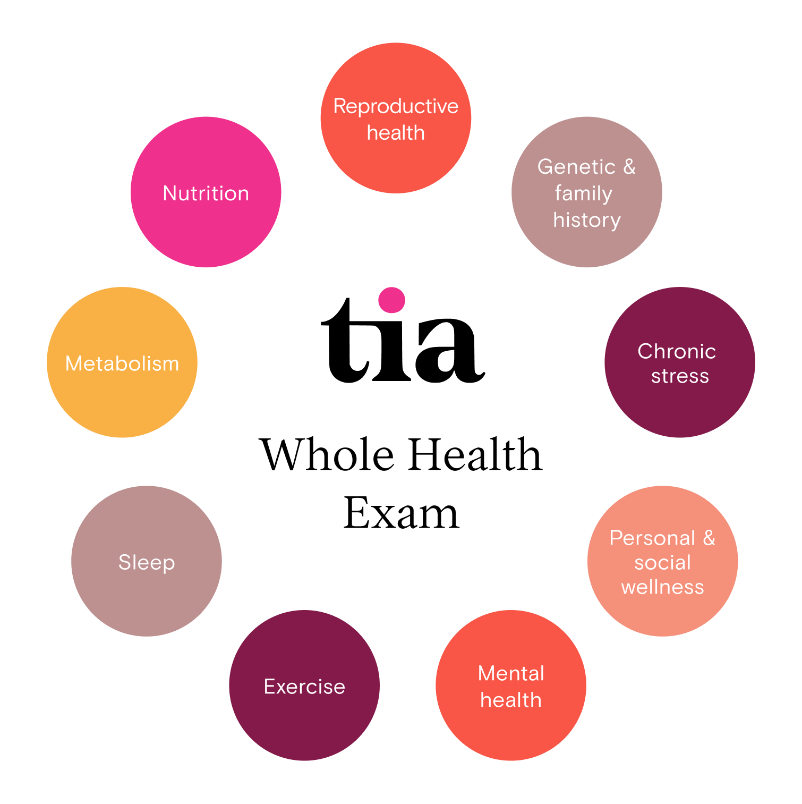
Tia’s Business Scope | Image source: Tia’s official website
Tia’s services have the following characteristics:
1. One-stop service. Tia integrates gynecology, primary care, mental health, and evidence-based wellness into a unique care model accessible through both in-person and virtual appointments. Adhering to patient-centered principles, it emphasizes lifestyle and prevention to support acute care needs, chronic disease management, and overall health.
2. Seamless and Convenient. The Tia platform connects patients and healthcare providers throughout the entire care journey, offering in-person, virtual, and hybrid care options. From user-friendly appointment scheduling to insurance verification and optimized clinic workflows, it makes healthcare more convenient, collaborative, and interconnected.
3. Reduce Costs. Tia delivers team-based care that meets patients’ needs, while preventing provider burnout and lowering costs. By connecting patients and healthcare providers through collaborative care tools, it ensures a more continuous healthcare experience for everyone.
4. Premium Experience. Tia provides end-to-end services for patients and healthcare providers, spanning from health records and clinical care to community activities.
Tia has experienced rapid growth in recent years. In 2021, Tia partnered with CommonSpirit Health to launch Tia-branded women’s health clinics. CommonSpirit Health is the largest nonprofit health system in the United States, operating 137 hospitals and more than 1,000 clinics. This collaboration has opened new avenues for women’s healthcare. The first physical clinic opened in Phoenix, with plans to expand across Arizona and other markets in the coming years.
Tia and CommonSpirit share a vision to “treat the whole person, not just the patient”—replacing one-size-fits-all medicine with a human-centered care approach that recognizes diverse populations have distinct clinical, psychological, and experiential healthcare needs.
In 2022, Tia signed its second major health system partnership agreement with UCSF Health in San Francisco, launching the Bay Area’s first clinic—the San Francisco Flagship Women’s Clinic. UCSF Health plans to collaborate with Tia to develop a new network of integrated clinical clinics for women in the Bay Area, enabling patients to more easily coordinate specialty and inpatient care at UCSF.
By connecting Tia’s clinics with UCSF Health’s specialty and inpatient facilities, the two companies aim to fill critical gaps in primary care, delivering integrated, comprehensive care that ensures mental and reproductive health for women and their families.
In January this year, Tia added Cedars-Sinai as its third major health system partner to advance primary care for women, marking the largest health system partnership to date, with plans to collaborate with Cedars-Sinai to open clinics in the Los Angeles area.
Under this collaborative model, Tia integrates its primary care services with specialized care from health systems to reduce fragmentation and advance preventive health. This approach connects women’s primary care needs with their specialty care needs, ensuring, as Witte stated, that the “baton is passed on.”
Tia and Cedars-Sinai plan to serve more than 100,000 women in the Los Angeles area. In 2021, Tia successfully opened its first local clinic in Silver Lake. Now, in partnership with Cedars-Sinai, Tia has opened its second clinic in the Los Angeles area in Santa Monica. They plan to open additional clinics this year in Pasadena, Studio City, and Culver City.
“Building bridges with leading health systems is essential to creating a new standard of care for women,” Witte revealed, explaining the fundamental reason behind Tia’s collaboration with health systems.
There are over 200 digital health companies for women worldwide,
The Era of the Women's Health Market Is Arriving
Services tailored specifically for women have historically been too “niche”; although investment in femtech is growing, it still accounts for a relatively small share of total digital health deal value.
The emergence of Tia has transformed how the healthcare system prioritizes and serves women, redefining standards of care. The female digital health market is seeing more companies reach maturity or go public, such as Maven Clinic, which focuses on women and families, and Volpara Health, whose mission is to prevent late-stage breast cancer.
To date, according to statistics from VBInsight, the industrial think tank of VCBeat, there are more than 200 companies worldwide with recorded financing whose core business is women’s digital health.
As numerous companies deepen their engagement in the industry, they have gradually refined health solutions covering the entire female life cycle, paying attention to menopause, cervical cancer, polycystic ovary syndrome (PCOS), and other women's health issues. Furthermore, these companies are placing greater emphasis on integrating technologies such as artificial intelligence into their services, with the aim of helping women scientifically alleviate and address women's health concerns.
As Chinese women’s self-awareness continues to rise and access to women’s health knowledge improves, bolstered by mature digital women’s health management models from abroad, China’s women’s health management market is entering its own era.