

Sunrise Secures €17 Million Series A Funding to Advance Jaw-Motion-Based At-Home Sleep Apnea Monitoring

Kurma Partners
Healthcare-Focused Venture Capital Firms

Sunrise
Sleep Monitoring Technology Researcher
According to a survey by the World Health Organization, 27% of people worldwide experience poor sleep quality, and nearly half of the Chinese population suffered from sleep disorders in 2022. Among various sleep disorders, obstructive sleep apnea (OSA) affects 1 billion people globally, with over 100 million individuals in China severely impacted by this condition.
However, sleep-disordered breathing has not received widespread attention, despite its large patient population and low rates of diagnosis and control. According to data from Southwest Securities, the diagnosis rate for obstructive sleep apnea (OSA) in the United States is less than 20%, while the diagnosis and treatment rate in China is below 1%, with even lower rates in other countries. Sleep-disordered breathing remains a major chronic disease market with significant unmet treatment needs.
Amid the backdrop of an imbalance between supply and demand in healthcare, Sunrise was established. Sunrise is a digital health company specializing in sleep monitoring.
VCBeat has learned that Sunrise recently announced the completion of a €17 million Series A financing round, led by Kurma Partners, with participation from the European Innovation Council (EIC Fund), the European Commission’s renowned Deep Tech initiative. Since its inception, Sunrise has completed three rounds of financing, bringing its total funding to €24.5 million.
Sunrise plans to use this funding to commercialize its technology in the United States and hire new talent, with the goal of expanding its team tenfold over the next five years.

Sunrise's Financing Record Data Source: VCBeat
Sunrise was founded based on the findings of over a decade of research into sleep apnea by Dr. Jean Benoit Martinot, a sleep specialist.
Jean Benoit is a pulmonologist specializing in pulmonary function testing and a sleep specialist certified by the BASS and ESRS. He has published 65 articles in journals such as the American Journal of Respiratory and Critical Care Medicine, Nature and Science of Sleep, and Frontiers in Neurology, covering topics including sleep apnea, lung cancer, and CPAP therapy. Under the subtle influence of his father, an experienced pulmonologist and sleep specialist, his son Laurent Martinot has also entered the field of cardiopulmonary and respiratory medicine.
At that time, the HypnoLaus study showed that 49% of men and 23% of women aged 40 and older were affected by sleep-disordered breathing, yet the diagnosis rate for sleep apnea was less than 20%. This father-and-son duo recognized the severe risks posed by sleep apnea and aimed to make sleep testing accessible to everyone, thereby raising public awareness of the condition.
Supported by the Sleep Apnea Project (sensapnea) of the European Institute of Innovation and Technology (EIT Health), Sunrise was born in Namur, Belgium.
In recent years, Sunrise has experienced rapid growth. In 2020, the clinical validation of Sunrise devices was published in JAMA (Journal of the American Medical Association), introducing to global experts the sensor’s excellent performance in terms of sensitivity and specificity for sleep monitoring.
In early 2021, Sunrise won an award in the “Health & Wellness” category at CES. That same year, Sunrise completed a €6.5 million financing round and subsequently launched its first sleep apnea diagnostic product on the global market, becoming one of the fastest-growing companies in Belgium.
Sunrise’s Second-Generation At-Home Sleep Apnea Test Received FDA Approval on February 13
For traditional apnea diagnosis, patients are required to visit a hospital sleep center to undergo clinical polysomnography (PSG) testing, wearing various sensors to collect sleep data throughout the night.
Polysomnography is the “gold standard” for monitoring sleep apnea, but the “single-night testing” approach can lead to misdiagnosis.
With technological advancements, Home Sleep Apnea Testing (HSAT) has gradually entered the public eye. However, this method of monitoring biosignals is technically complex, and the occurrence of false negatives or other complications may render sleep data unusable.
The principle behind the Sunrise device’s sleep monitoring is based on mandibular movement. Mandibular movement (MM) can reveal changes in the activity of the trigeminal motor nucleus, which are driven by brainstem centers involved in the transition between sleep and wakefulness. Patterns of mandibular movement can reflect the interaction between sleep stages and respiratory control.
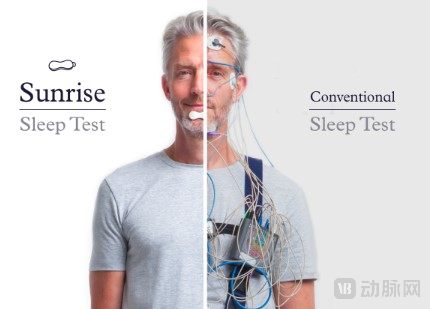
Comparison Between Sunrise Devices and Traditional Devices
Image source: Sunrise official website
This coin-sized, non-invasive, and affordable device, weighing just three grams, analyzes signals from the human body, jaw movements, and other common indicators of apnea by measuring subtle mandibular movements in combination with traditional biosignals such as airflow and blood oxygen saturation. It ultimately leverages AI algorithms to help detect obstructive sleep apnea (OSA) and several other sleep-related breathing disorders.
This algorithm can analyze sleep staging with accuracy comparable to that of PSG.
In terms of compatibility and reliability, Sunrise has overcome the challenge of unusable HSAT data, offering high clinical accuracy, an optimized patient experience, and reduced healthcare costs.
As early as the 1980s, sleep research had already begun to emerge. The growing market demand has driven the continuous expansion of the global sleep health economy, prompting various businesses to compete for entry into the sleep medicine and services industry. Broadly speaking, the sleep health sector is primarily divided into two major tracks: sleep monitoring and sleep assistance.
In the sleep monitoring sector, UK-based medical device company Acable offers the AcuPebble SA100, a compact wearable device that enables automated remote home testing for obstructive sleep apnea.
Leading smart wearable device manufacturers, including Apple, Huawei, Xiaomi, and Huami, have also introduced sleep health monitoring features in their products, becoming key players in this field.
Sleep Aid Sector, which includes basic sleep products such as mattresses and pillows, has attracted companies like Xilinmen, De Rucci, and Xi Yue Technology. These enterprises initially focused on traditional home furnishings but have continuously expanded into the sleep health domain amid intense market competition. In addition to basic sleep products centered on bedding, numerous companies are also deploying medical products designed to improve sleep and treat sleep disorders.
As awareness of sleep health rises, demand for sleep health services continues to expand, fostering a trend of collaboration between home furnishings companies and technology firms. This has given rise to new market segments, such as digital therapeutics and lifestyle medicine.
“A Million Strong Crossing the Yangtze” serves as an apt metaphor for the current state of the sleep health industry. However, to successfully navigate this fiercely competitive landscape and emerge as a leader, industry participants must introduce novel strategies and solutions, enhance their capabilities in innovation and technology application, and break through the status quo. This will usher in a new era for the entire sleep health sector, ultimately enabling the hundreds of millions who toss and turn through countless nights to achieve restful sleep.