

Zhejiang University Spawns a Regenerative Medicine Startup Powerhouse: A Surge of Innovation from Lab to Market
In February 2023, news that Xianshi Bio, a provider of biomaterials and regenerative medicine services, had achieved new business milestones caught the attention of VCBeat.
On the one hand, the regenerative medicine industry has seen a surge in interest over the past two years, with frequent innovations in key areas such as bio-regenerative materials and stem cell repair. In 2022, it became a hotbed for investment, ranking first among sub-sectors with the most intensive financing activity. That year, 22 companies completed 28 financing rounds, attracting top-tier healthcare innovation investors such as Sequoia Capital, Lilly Asia Ventures, CDH Investments, and Qiming Venture Partners.
On the other hand, Xianshi Biotechnology is also a scientist-founded startup that has garnered significant attention in recent times. Yu Xiaohua, the founder and CEO of Xianshi Biotechnology, holds a Ph.D. in Materials Science from the University of Connecticut in the United States. In 2020, he began serving as a Distinguished Researcher at the Second Affiliated Hospital of Zhejiang University School of Medicine and the Orthopedics Research Institute of Zhejiang University. In September of the same year, he founded Xianshi Biotechnology, which focuses on the development of next-generation tissue regeneration materials, with some products expected to complete clinical registration by the end of 2024.
VCBeat’s further analysis of the backgrounds of innovators and entrepreneurs in the field of regenerative medicine reveals that, beyond Xianshi Biotech, companies such as Disai Biotech, Yongqinquan Intelligence, JieNuoFei Biotech, Bitai Medical, and Pengtuo Biotech all maintain varying degrees of affiliation with Zhejiang University. On one hand, an increasing number of Zhejiang University professors and PhD graduates are pursuing the industrialization of regenerative medicine; on the other, the university is supporting scientists through investment and incubation initiatives to help them navigate the “first mile” of their entrepreneurial journeys. Unbeknownst to many, Zhejiang University has rapidly cultivated a powerhouse cohort of regenerative medicine startups.
Regenerative medicine is a broad concept, with some perspectives suggesting that “the entire scope of medicine can be referred to as regenerative medicine.” VCBeat has conducted expert surveys and concluded that regenerative medicine in the narrow sense primarily encompasses cell and gene therapy (CGT), tissue engineering, and regenerative materials. Within this scope, this article reviews selected information on regenerative medicine associated with Zhejiang University.
Regenerative medicine is a vibrant, emerging field that has captivated generations of university scientists. Zhejiang University has placed significant emphasis on this area and established its strategic layout at an early stage.
In 2011, the Zhejiang Provincial Key Laboratory of Tissue Engineering and Regenerative Medicine Technologies was established, evolving from a foundation initially laid in 2006 by Professor Ouyang Hongwei of the School of Medicine, Zhejiang University, upon his return to China. The following year, Professor Ouyang Hongwei led the establishment of the Zhejiang University Stem Cell and Regenerative Medicine Research Center. This center serves as a key base for the Zhejiang Provincial Key Discipline for Innovative Research in Regenerative Medicine, the Zhejiang Provincial Key Innovation Team in Regenerative Medicine, and the Zhejiang Provincial Key Laboratory of Tissue Engineering and Regenerative Medicine Technologies.
Subsequently, a series of regenerative medicine-related laboratories and research teams have emerged, frequently yielding scientific achievements.
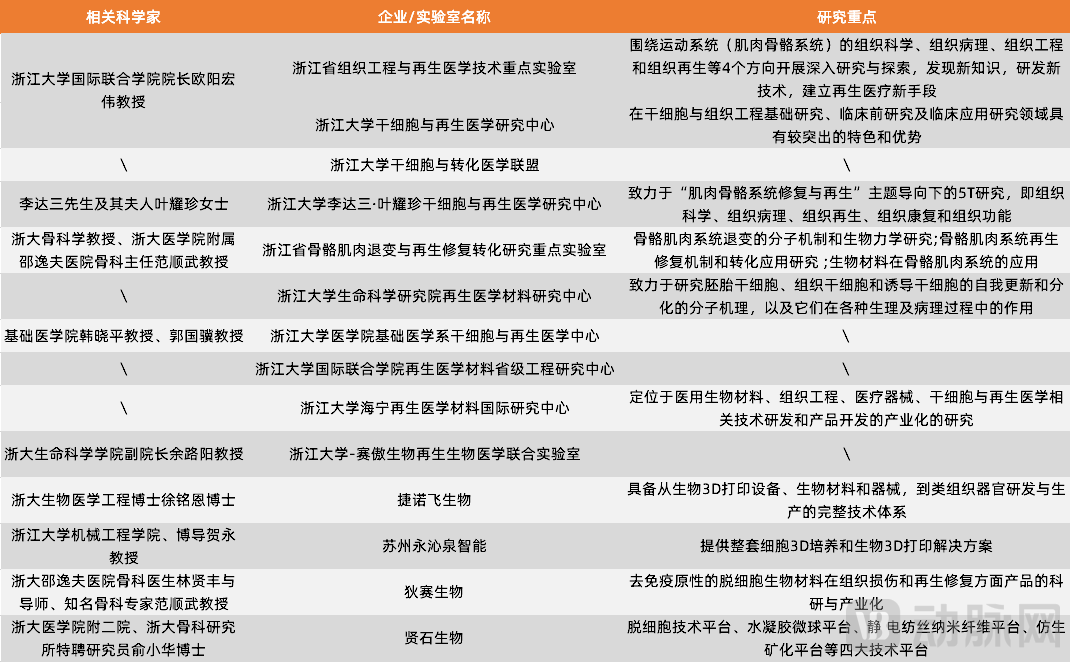
Zhejiang University: Selected Regenerative Medicine Laboratories and Commercialization Companies
“Regenerative medicine,” a term relatively unfamiliar to the general public, has secured a prominent position in the medical field by virtue of its advantage in providing holistic and systemic replacement of damaged human tissues, and has long been a popular research focus at Zhejiang University. After years of extensive research, some scientists have achieved phased breakthroughs in specialized subfields and are seeking to commercialize these advances for clinical application.
Zhejiang University Professors and PhDs Move Toward Industrialization
Although a “post-90s” generation,Dixie BioFounder Lin Xianfeng has been engaged in basic research on acellular regenerative repair technology since 2008, with over a decade of experience. In 2013, Lin Xianfeng was admitted as a graduate student in orthopedic surgery at Zhejiang University. He later earned his Ph.D. in Orthopedics from the School of Medicine, Zhejiang University, and serves as a Distinguished Researcher and Attending Physician in the Department of Orthopedics at Sir Run Run Shaw Hospital, Zhejiang University School of Medicine.
In 2018, he co-founded Dice Biotech with his mentor, Professor Fan Shunwu, a renowned expert in minimally invasive spine surgery in China. The company is dedicated to the research and industrialization of decellularized biomaterials with reduced immunogenicity for products aimed at tissue injury and regenerative repair. Its first bone repair product has been submitted to the National Medical Products Administration (NMPA) for review as an innovative medical device. In 2021, Dice Biotech secured tens of millions of RMB in angel-round financing, led by Zheshang Venture Capital and participated in by Shanghai MedRay Medical.
At the same time as Disai Biotech was established, located in SuzhouYongquanquan IntelligenceIt has also officially commenced operations. Yongquanquan Intelligence is an industrial commercialization project based on the scientific research achievements of the Bio-Manufacturing Laboratory at Zhejiang University, founded and chaired by Professor He Yong, a doctoral supervisor from the College of Mechanical Engineering at Zhejiang University.
Bio-3D printing is a novel regenerative medicine engineering technology developed on the basis of multidisciplinary integration. In a narrow sense, it refers to the process of manipulating cell-laden bioinks to construct living structures. Among these, the development of suitable bioinks has always been a core issue in bio-3D printing.
Yongquan Smart has established a quantitative production line for bioinks, launching more than 10 series of bioink products. The company provides comprehensive solutions for 3D cell culture and bioprinting, with broad application prospects in the field of three-dimensional cell culture. It has served thousands of research groups at domestic and international institutions, including Harvard University, the University of Cambridge, Tsinghua University, Peking University, and Zhejiang University. Yongquan Smart previously secured Pre-A round financing from Suzhou Venture Capital.
JenoBioDr. Xu Mingen, the founder, also studied at Zhejiang University. He was admitted to Zhejiang University in 1995, and after earning a Bachelor’s degree in Pharmacy and a Ph.D. in Biomedical Engineering, he conducted postdoctoral research in bio-3D printing at the Department of Mechanical Engineering, Tsinghua University.
In 2013, Xu Ming’en’s team founded Cellink Bio (Jie Nuo Fei Biotechnology), which has since grown into a comprehensive provider of 3D bioprinting solutions in the biomedical field. The company possesses a complete technological framework encompassing 3D bioprinting equipment, biomaterials, and devices, as well as the research, development, and production of tissue-like organs. It delivers systematic products and services for research and clinical applications in scientific research, drug development, regenerative medicine, and personalized healthcare.
It is worth noting that VCBeat has listed only a subset of entrepreneurs from the “Zhejiang University-affiliated” cohort in the field of regenerative medicine. Many other innovators, driven by personal commitment to benefit the industry, are making significant contributions in niche areas of regenerative medicine. Like artisans meticulously refining ordinary objects, they leverage technological innovation to honor tradition while surpassing it.
Dr. Yu Xiaohua of Xianshi Biotechnology summarized,Zhejiang University’s research in the field of regenerative medicine exhibits characteristics of both “breadth and depth.”Dr. Yu Xiaohua introduced that regenerative medicine is inherently a multidisciplinary field. At Zhejiang University, research in regenerative medicine is not confined to a single discipline or school; rather, it is conducted across the College of Pharmaceutical Sciences, School of Medicine, College of Life Sciences, and College of Materials Science and Engineering, among others. These diverse units bring distinct research perspectives to the table, and in practice, various teams provide collaborative support from multiple dimensions.
The depth of the research is mainly reflected in the collaboration between various disciplines at Zhejiang University and between its colleges and affiliated hospitals, namely, the integration of medicine and engineering.
On the one hand, the robust clinical disciplines and resources of Zhejiang University-affiliated hospitals, combined with Zhejiang University’s strengths in basic research, facilitate the identification and cultivation of original innovation projects that align with clinical needs and possess high potential for growth. On the other hand, basic research empowers clinical disciplines; when confronted with challenges in the diagnosis and treatment of clinical diseases, clinical researchers can leverage Zhejiang University’s comprehensive university background to transcend traditional medical paradigms and employ interdisciplinary knowledge to indirectly address these clinical challenges.
For instance, in December 2022, Lin Xianfeng’s team, in collaboration with Tang Ruikang’s team from the Department of Chemistry at Zhejiang University, published a research paper in Nature. This study achieved the cross-kingdom implantation of natural photosynthetic systems from plants into mammalian cells, enabling the implanted photosynthetic systems to independently provide key energy metabolism to controllably enhance cellular anabolism, thereby realizing the cross-kingdom medical application of photosynthetic systems. This research has demonstrated promising clinical application prospects in the treatment of age-related degenerative diseases, such as osteoarthritis.
Zhejiang University’s long-term research in regenerative medicine has enabled scientists to cultivate the seeds of technological achievements in this field. To help these seeds germinate and grow, Zhejiang University must also create a fertile environment for the translation of scientific and technological achievements, one that integrates elements from government, industry, academia, research, healthcare, and investment.
Currently,Scientists Are Facing Dual Policy Opportunities in Regenerative Medicine and the Translation of Scientific and Technological AchievementsFirst, governments at all levels have attached great importance to the field of regenerative medicine and provided key support through industrial policies, thereby clarifying the broad market prospects and favorable production and operating environment for the regenerative medicine industry. In addition, as a series of macro-level policies and supporting documents encouraging the translation of scientific and technological innovations continue to be introduced, universities, as important sources of innovation, are continuously improving their internal mechanisms and systems for technology transfer. Currently, the work of translating medical innovations has evolved from policy appeals at the national level into voluntary actions by local governments, universities, and medical institutions.
Specifically, Zhejiang University has continuously rolled out a series of reform measures and established a relatively comprehensive policy framework, providing practical guidance and a basis for the translation of its scientific and technological achievements.
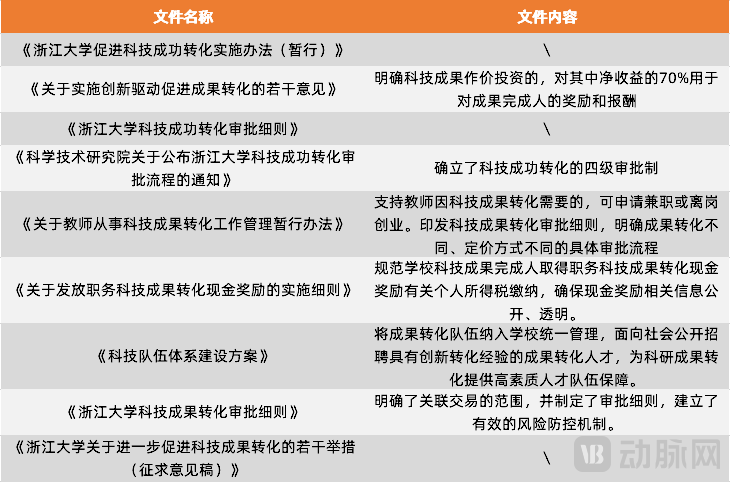
Zhejiang University’s Policies on the Conversion of Selected Scientific and Technological Achievements
Some entrepreneurs also highlighted Zhejiang University’s vibrant innovation and entrepreneurship ecosystem, along with its comprehensive policy framework and transparent approval processes for the commercialization of intellectual property. “For professors and researchers within the Zhejiang University Hospital System who wish to pursue innovation and technology transfer, policy accessibility is exceptionally high.”
Building a “Research” Bridge Between “Academia” and “Industry”
In the realm of industry-academia-research collaboration, Zhejiang University is also proactively exploring the development of a technology transfer system by integrating resources from on-campus institutions such as the Academy of Sciences and Technology, the Industrial Technology Research Institute (ITRI), and the National University Science Park.Established a full-chain translation process encompassing original innovation, technological R&D, achievement transformation, and incubation for industrialization.
The Industrial Technology Research Institute of Zhejiang University (ITRI-ZJU) is a vital link in Zhejiang University’s innovation chain. It performs three core functions: organized management of achievement commercialization, centralized administration of local research institutes, and development of the ITRI headquarters. The institute provides comprehensive services in technological innovation, technology transfer and commercialization, startup incubation and industrialization, as well as industry-academia-research collaboration.
2019In [Year], the Industrial Technology Research Institute launched the “Zhejiang University Zhicheng” brand for the construction and operation of an innovation and entrepreneurship ecosystem community. It has been deeply engaged in innovation and entrepreneurship carriers such as co-working spaces, technology incubators, university science parks, and characteristic towns, serving regional innovation and national strategies to build a high-quality innovation and entrepreneurship ecosystem. At its core is the FOCUS innovation service system, which is dedicated to providing professional services that are Full-field, Overarching, Career-long, Universal, and Stimulating.
A sound intellectual property circulation mechanism can stimulate the innovation and productivity of technology transfer in universities. AndEstablish a Dedicated Technology Transfer Center, which can strengthen the connection between universities and external innovation forces, promote more innovative projects to smoothly move out of the laboratory, and achieve project implementation.
2008In 2011, the Technology Transfer Center of Zhejiang University was recognized as one of the first national demonstration institutions for technology transfer. Adhering to a scientific and technological cooperation strategy that prioritizes the Yangtze River Delta, fosters strategic partnerships in the Pearl River Delta and Beijing-Tianjin-Hebei region, and promotes strategic interactions with central and western China as well as the three northeastern provinces, the Center has continuously optimized its industry-academia-research collaboration layout. To date, it has established 93 regional branches across China.
2016In August, Zhejiang University, in collaboration with the Zhejiang Provincial Department of Science and Technology, co-founded the Zhejiang Intellectual Property Exchange Center. The center has actively promoted the valuation and equity participation of intellectual property (IP) rights and scientific and technological achievements, enhanced its capabilities in IP planning and services, and achieved full coverage of three major transaction methods: negotiated pricing, listed trading, and auction. As of August 14, 2022, the center had facilitated a cumulative total of 7,726 transactions involving various types of IP rights and scientific and technological achievements (including 6,238 patents), with a total transaction value reaching RMB 1.74284 billion.
University-local government collaborations and university-enterprise partnerships are also important avenues for Zhejiang University to promote the translation of regenerative medicine achievements.For instance, Yongquanquan Intelligence, founded by Professor He Yong of Zhejiang University, was established with the support of the Suzhou Institute of Intelligent Manufacturing. Co-established by the School of Mechanical Engineering at Zhejiang University and the Wuzhong Science and Technology Innovation Park, the Institute is a new-type R&D institution that integrates five core functions: talent aggregation, transfer and commercialization of research achievements, incubation of emerging enterprises, cultivation of innovative talents, and services for innovation and entrepreneurship, operating under a “R&D + industrial incubation” model.
In terms of university-enterprise collaboration, Zhejiang University also signed a ten-year technical development and cooperation agreement with Sai’ao Biology to establish the Joint Laboratory for Regenerative Biomedicine. Led by Professor Lu Yang Yu from the School of Life Sciences at Zhejiang University, the laboratory is jointly committed to the research and development of cutting-edge technologies in stem cell therapy, including human amniotic epithelial stem cells and mesenchymal stem cells. In November 2022, the Stem Cell Trial Unit of the Zhejiang University–Sai’ao Biology Joint Laboratory for Regenerative BiologyArrived at the Chinese Space Station aboard the Tianzhou-5 cargo spacecraft.
Direct Investment: Bridging the Gap from Academia to Industry
It is worth noting that Zhejiang University not only builds a bridge between “academia” and “industry,” but also leverages an investment model to help laboratory achievements “leap” across the valley of death and reach the production line.
Driven by the innovation-driven development strategy, technological transformation, and the growing trend of scientist entrepreneurship, an increasing number of university-affiliated venture capital firms have emerged. Leveraging their disciplinary strengths, medical resources, scientific research capabilities, and industrial networks, these firms are better positioned to support scientists during the “first mile” of their entrepreneurial journeys.
Zhejiang University established its technology transfer and investment platform, the “Zhejiang University Innovation Institute,” as early as 2012. Over the past decade, the institute has achieved remarkable success. Its healthcare portfolio includes not only a group of high-potential tech companies such as Rouling Technology, Shengshi Technology, Lingnao Technology, Bitai Medical, Puang Medical, and Kaishi Biotechnology, but also listed enterprises like Minfound Medical Systems, JetMed, LC Bio, and MicroTech Medical.
In July 2021, the Zhejiang University Innovation Institute invested in a company that had been established for less than six months.Pengtuo Bio. Pengtuo Biotechnology, led by Dr. Meng Guolu, Chief Physician of the Department of Neurosurgery at Xuanwu Hospital of Capital Medical University, is a research and industrialization platform for biomedical materials, possessing comprehensive industrialization capabilities encompassing biomedical material design, R&D, translation, production, quality system management, and product registration.
In December 2022, Zhejiang University Innovation Institute and Zijingang Capital co-led the investment inBiotai Medical. Bitai Medical has Dr. Wang Xu, Dean of the College of Materials Science and Engineering at Zhejiang University of Technology, as its Chief Scientist, and Dr. Chen Si, Professor and Doctoral Supervisor, as its General Manager.
Bitai Medical specializes in the R&D and manufacturing of medical hydrogels and biomaterials. It has pioneered a biomaterials R&D platform globally, built upon its proprietary “multimodal imaging” and “spacer protection–sustained drug release–monitorable” combination technologies. The company has independently designed and developed a new generation of radiotherapy protection spacer materials that are injectable, rapidly form in situ, enable precise positioning, provide long-term imaging visibility, and feature personalized, controllable degradation. Serving the global market, Bitai Medical fills a domestic gap in China.
Now, leveraging Zhejiang University’s research capabilities, technological achievements, and talent advantages, the ZJU Innovation Institute has grown into a comprehensive sci-tech innovation platform under Zhejiang University Holdings. It integrates technological innovation, business model innovation, commercialization of scientific and technological achievements, market investment, talent development, and enterprise incubation for early-stage technology projects.
Furthermore, to address the financing needs of enterprises entering the park, Zhejiang University is integrating resources from government departments, venture capital firms, financial institutions, and intermediaries. By establishing initiatives such as the Zixing Angel Investment Fund, the Zijin Venture Capital Alliance, the Financial Supermarket, and the Zhejiang University Science and Technology Board, it provides a range of sci-tech financial services spanning from the startup to the mature stage of enterprise development. This effort aims to build a full-chain, diversified investment and financing service system with its own characteristics—the “Zhicheng·Zhirong” system—designed to support enterprises throughout their entire growth lifecycle.
An entrepreneur once described the hardships of starting a business as “jumping off a cliff and assembling an airplane on the way down.” For scientists turning entrepreneurs, this is even more true.
On one hand, as scientist-entrepreneurs, this “regenerative medicine startup dream team” needs to shift their mindset, directly address shortcomings in management and operations, identify entrepreneurial pathways tailored to their specific circumstances, and leverage their inherent advantages in scientific research and clinical resources to strengthen their corporate moats.
How Can This “Regenerative Medicine Startup Dream Team” Accelerate? We Found Some Answers in Corporate Needs.
First, on the policy front, current support measures in many regions are predominantly tailored to startups, while policies for growth-stage enterprises require adjustment and upgrading. There is a need for more policies that facilitate the industrialization and commercial deployment of products from growth-stage companies. Second, regenerative medicine companies with Zhejiang University backgrounds inherently possess advantages in clinical resources. These companies could establish closer ties with clinical resources by “engaging clinical experts at an earlier stage to participate in the product development process, thereby ensuring that products better address unmet clinical needs.”
Furthermore, from the perspective of regenerative medicine, this “startup all-star team” of industry participants is itself actively or passively engaged in fierce market competition.
According to VCBeat’s predictions on industry trends in the “2022 Regenerative Medicine Industry Report,” the global regenerative medicine sector remains in its nascent stages due to the relatively short development history of tissue engineering, stem cell technology, and regenerative materials. Meanwhile, China is currently experiencing robust growth, with a minimal gap between leading domestic and overseas technologies in this field, presenting Chinese enterprises with significant opportunities to leapfrog their competitors.
Precisely because the industry is still in its nascent stage, regenerative medicine companies encounter two major obstacles during the process of innovating technologies and translating products:
First, the approval processes for medical devices, as well as industry regulations and standards, remain imperfect. Companies with cutting-edge innovative products often encounter significant challenges in establishing clinical indications and obtaining clinical approvals. Second, clinicians exhibit relatively low acceptance of innovative products, and some investors lack a deep understanding of original innovation projects, necessitating substantial time and effort dedicated to market education.
Overall, amid the surging tide of translating scientific and technological achievements into practical applications, this “regenerative medicine entrepreneurial dream team” from Zhejiang University represents a significant cohort within the medical innovation industry: hailing from academia, they are deeply focused and genuinely passionate, maintaining the innovative vitality of their youth throughout years of prolonged scientific research.