

Carbon Silicon Intelligence Launches DrugFlow 1.0: A Proprietary AI-Driven Platform Breaking Core AIDD Technologies
The past week has been the most sensational period for artificial intelligence. Following the release of GPT-4.0, Baidu launched ERNIE Bot, Microsoft introduced Copilot, and Google unveiled Bard, its competitor to ChatGPT, on the same day. Meanwhile, NVIDIA released its new H100 GPU, which delivers training and inference performance improvements ranging from several-fold to tens of fold compared to the previous generation. As the field of artificial intelligence experiences a surge of activity, the realm of innovative drug development is also undergoing transformative changes.
March 24, 2023: AI Infrastructure and Service Provider for New Drug DevelopmentCarbonSilicon AIAnnounced that the company’s independently developed AI-driven new drug discovery platform—DrugFlow1.0Officially Released. Distinguished scholars and industry experts from Zhejiang University, Peking University, East China University of Science and Technology, Sichuan University, Central South University, the Shanghai Institute of Materia Medica (Chinese Academy of Sciences), the Institute of Materia Medica (Chinese Academy of Medical Sciences), Guangzhou National Laboratory, Roche China R&D Center, CSPC Pharmaceutical Group, Akeso Bio, and Huashen Zhiyao attended the conference. The event adopted an innovative virtual live-streaming format, attracting nearly 10,000 views during the conference.
The event kicked off with an opening address by Professor Yang Bo, Dean of the Scientific and Technological Research Institute of Zhejiang University and Executive Vice Dean of the Institute for Intelligent Innovative Drugs at Zhejiang University. She stated that the Institute for Intelligent Innovative Drugs at Zhejiang University aims to cultivate a cohort of outstanding talents in the field of intelligent new drug discovery, thereby boosting the research and development of original drugs in China. Professor Hou Tingjun is not only a professor at the Institute but also a renowned expert in computational chemistry, while Mr. Deng Yafeng, CEO of CarbonSilicon Intelligence, is a seasoned expert in the field of artificial intelligence; both have been deeply engaged in their respective industries for many years. The newly released DrugFlow 1.0 represents the collective wisdom of these two experts and the CarbonSilicon Intelligence team. Furthermore, it responds to the national call for developing foundational software with independent intellectual property rights, with the hope that DrugFlow will genuinely facilitate new drug R&D efforts in China in the future.
Next, Deng Yafeng, CEO of CarbonSilicon Intelligence, delivered《Breakthrough in Core AIDD Technologies: Empowering the Innovative Drug Sector》The keynote address covered the challenges and pain points in new drug development, the vast market for novel therapeutics in China, the rapid rise of artificial intelligence (AI) and its similarities and differences with physics-driven approaches, as well as the original mission and vision behind the establishment of Carbon Silicon Intelligence. It then provided a detailed introduction to the functions and features of the DrugFlow product, particularly its core underlying technologies, and offered a comprehensive comparison of key technical indicators against existing products in the field. This demonstrated that DrugFlow 1.0 is not only unique in capabilities such as molecular generation and AI-automated modeling, but also possesses world-leading technical prowess in traditional functionalities including docking, rescoring, and drug-likeness prediction. Within just over six months of its founding, the team has published more than ten articles in top-tier journals such as Nature Communications, Nucleic Acids Research, and the Journal of Medicinal Chemistry, underscoring the team’s technical strength.
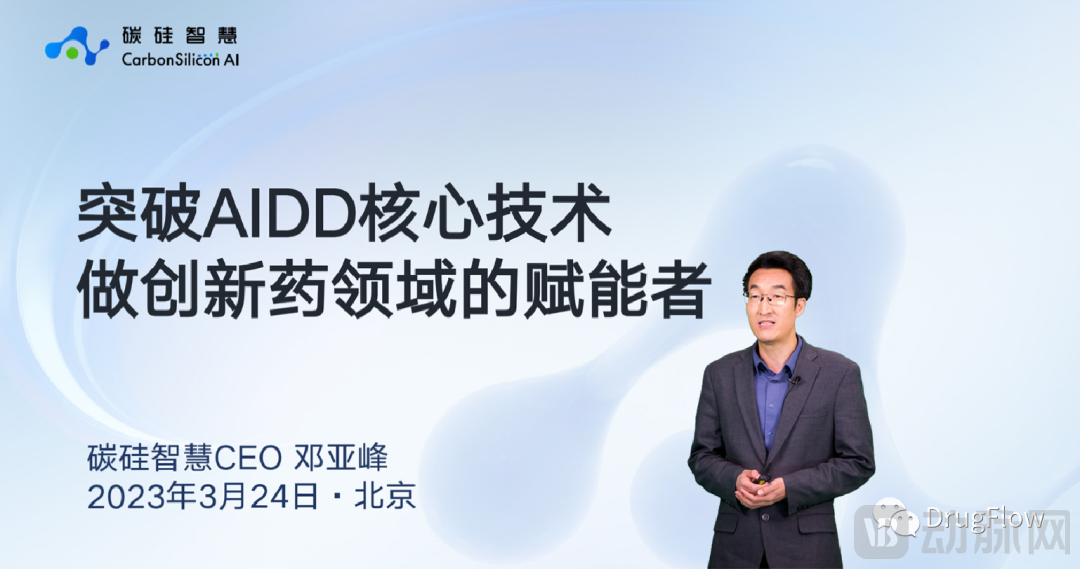 On-Site Speech by Deng Yafeng, CEO of CarbonSilicon Intelligence
Deng Yafeng stated, “There are few teams in the field of new drug development that are diligently developing domestically produced software with independent intellectual property rights. The CarbonSilicon Intelligence team possesses both such capabilities and a strong sense of mission. Committed to being an enabler in innovative drug R&D, CarbonSilicon Intelligence has launched DrugFlow, a SaaS platform for drug discovery. Leveraging state-of-the-art AI-driven drug discovery (AIDD) technologies and automated solutions, we aim to collaborate with strategic partners on joint R&D for key pipelines, and have already established significant strategic collaborations in areas such as small molecule and AAV design. While our journey began with belief, we have already witnessed breakthroughs by AI in molecular generation, docking, and rescoring. With the implementation of emerging AI technologies—such as pre-trained models, AIGC, and reinforcement learning—in this field, the evolution of AIDD technology will accelerate. Today’s launch of DrugFlow is merely the beginning; we are confident that an AI-driven era of life sciences is surely ahead.”
It is reported that DrugFlow covers key stages including target discovery, hit identification, and lead optimization. It integrates world-leading modules for target discovery, activity prediction, druggability assessment, molecular generation and optimization, virtual screening, and AI modeling, thereby helping medicinal chemistry experts identify potential drug-like molecules more efficiently and conveniently. Committed to building a software platform that spans the entire drug R&D process, DrugFlow boasts four major advantages: high accuracy, originality and reliability, ease of use, and security with flexibility. By leveraging data generated from automated hardware to iteratively refine its models and integrating expert knowledge into the workflow, DrugFlow ultimately establishes a unified, data-driven, human-AI collaborative design platform, which is poised to significantly enhance the predictability and success rate of drug development.
The newly released DrugFlow 1.0 version primarily introduces four core functionalities: activity prediction, drug-likeness prediction, molecular generation, and AI modeling.
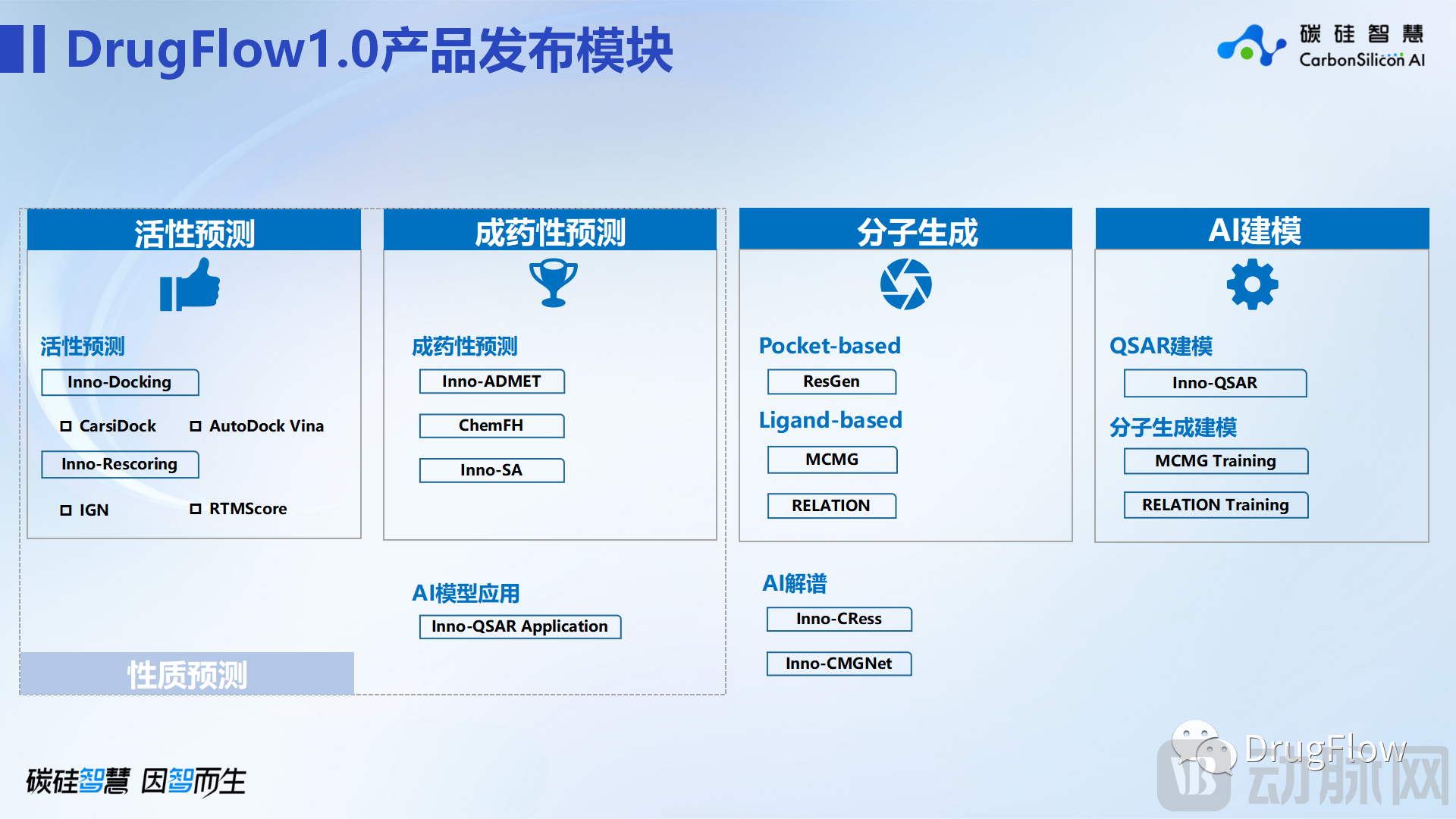 Overview of the DrugFlow Module
In terms of activity prediction, DrugFlow 1.0 encompasses two core functionalities: rescoring and docking. On one hand, leveraging physically derived docking conformations, DrugFlow incorporates RTMScore, the current state-of-the-art rescoring function in the field, which significantly enhances virtual screening capabilities and assists users in making more informed molecular selections. On the other hand, the Inno-Docking module integrates both the established physics-based docking engine AutoDock Vina and CarsiDock, a proprietary AI-driven docking program. CarsiDock represents a novel approach entirely based on AI modeling that explicitly accounts for conformational rationality. In mainstream public benchmarks, CarsiDock achieved an accuracy of 91.2% under the criterion of a root-mean-square deviation (RMSD) ≤ 2 Å, marking the first time such accuracy has surpassed 90%. Furthermore, under the stricter criterion of RMSD ≤ 1 Å, CarsiDock demonstrated a success rate 26% higher than that of both physics-based methods and other AI-based approaches. Additionally, DrugFlow 1.0 provides comprehensive capabilities for protein preprocessing, ligand preprocessing, and automated, intelligent configuration of docking parameters.
In the field of druggability prediction, DrugFlow1.0 offers the Inno-ADMET module. This module supports systematic evaluation of 17 physicochemical properties, 5 medicinal chemistry properties, 21 druggability parameters, and 27 toxicity endpoints. Currently, the module incorporates two proprietary algorithms: one is the MGA method based on multi-graph neural networks, which not only outputs ADMET predictions but also provides interpretability regarding the relationship between properties and substructures; the other is the MERT method based on pre-trained Transformers, which achieves higher predictive accuracy. Overall, the Inno-ADMET module boasts the advantages of "broad coverage of prediction endpoints with high accuracy," "fast speed," and "interpretability."
In molecular generation, DrugFlow 1.0 supports both ligand-based and pocket-based approaches. On one hand, the ligand-based approach represents a novel drug design methodology that generates molecules based on active ligands, offering two algorithms: MCMG and RELATION. MCMG is a multi-constraint, ligand-based molecular generation method that employs knowledge distillation to integrate conditional transformers with QSAR-based reinforcement learning algorithms, thereby satisfying multiple constraints and generating novel molecules with desired physicochemical and pharmacological properties. RELATION, by contrast, combines 3D generation of protein pocket–ligand complexes with bidirectional transfer learning, enabling the generation of a large number of structurally valid compounds with certain affinity for the target protein. On the other hand, the pocket-based approach requires only the protein pocket structure, as exemplified by the newly released ResGen algorithm. ResGen is a pocket-based 3D molecular generation algorithm that leverages autoregressive models and multi-scale modeling techniques to generate molecules with favorable binding affinity and reasonable protein–ligand binding poses, while ensuring molecular diversity. This method is applicable not only to de novo drug design but also to fragment-based molecular generation.
In terms of AI modeling, DrugFlow 1.0 provides an AI Modeling module to address users’ needs for building AI models based on their proprietary data. This module offers functionalities including data preprocessing, data splitting, descriptor definition, and machine learning algorithm modeling. Users can build their own AI models simply by uploading data and configuring parameters via the web interface. To enhance modeling performance, the system employs AutoML for parameter and model selection, and supports pre-training techniques based on Transformer and Graph Neural Network (GNN) architectures, which can significantly improve model accuracy compared to traditional machine learning algorithms. Furthermore, on the results page, the AI Modeling module provides comprehensive model evaluation metrics and corresponding interpretations of model performance.
In addition to the aforementioned modules, DrugFlow 1.0 also provides several user-friendly tools, such as the AI-powered NMR spectrum interpretation tool—NMR Parsing. Tailored specifically for the most common spectral analysis scenarios encountered by medicinal chemists during synthesis, it leverages two AI-based retrieval and generation algorithms, CReSS and CMGNet, to elucidate the structures of unknown compounds. Users need only input the chemical shift values from the ¹³C NMR spectrum to rapidly determine molecular structures, significantly enhancing spectral interpretation efficiency.
Following the product launch, He Hao, Vice President of Business Development at CarbonSilicon Intelligence, introduced“Spark Initiative — DrugFlow University Support Program”,Addressing issues such as high costs, poor usability, and unsuitability for teaching associated with existing software, this initiative aims to provide university faculty and students with advanced, user-friendly, and cost-effective domestic AI-driven drug discovery (AIDD) software, featuring dedicated support for educational scenarios. The goal is to promote the widespread adoption of AIDD software in higher education institutions and cultivate more AIDD talent in China. To date, over ten prestigious institutions, including Peking University, Zhejiang University, Sichuan University, Sun Yat-sen University, Jilin University, Nankai University, Jinan University, China Pharmaceutical University, Macau University of Science and Technology, the Shenzhen Institutes of Advanced Technology of the Chinese Academy of Sciences, and Guangzhou National Laboratory, have joined the “Spark Initiative” and offered positive evaluations.
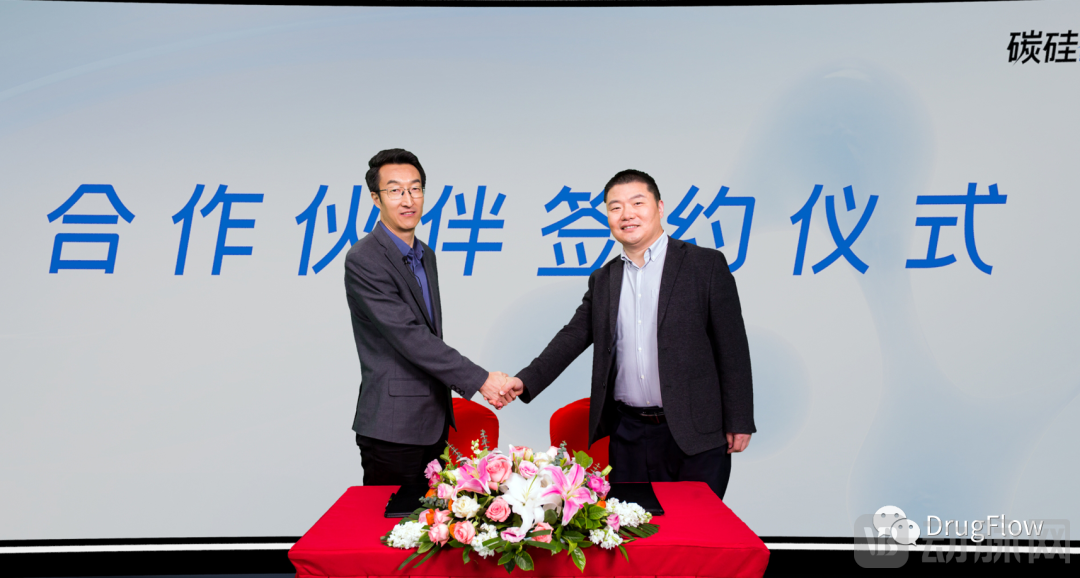 Carbon Silicon Intelligence Strategic Signing Ceremony
At the conclusion of the press conference, a strategic partnership signing ceremony was held. The agreement was signed by Deng Yafeng, CEO of CarbonSilicon Intelligence, and Song Yunlong, General Manager of Shanghai Yishi Pharmaceutical Technology Co., Ltd., a subsidiary of CSPC Pharmaceutical Group. During the ceremony, Mr. Song stated that Shanghai Yishi, as a wholly-owned subsidiary of CSPC Pharmaceutical Group, has been dedicated to the research and development of innovative small-molecule drugs. He noted that the CarbonSilicon Intelligence team possesses extensive expertise in the field of AI-driven drug discovery (AIDD), with its DrugFlow product featuring leading-edge technology. Through this collaboration, both parties aim to leverage their respective strengths, particularly the advantages of DrugFlow 1.0 in early-stage molecular design, and look forward to the timely realization of tangible outcomes from this partnership.
Following the press conference, a meeting was also held“Symposium on the Progress and Challenges of AI-Driven New Drug Development”During the keynote session, Professor Hou Tingjun from Zhejiang University, Professor Liu Zhenming from Peking University, and Professor Tang Yun from East China University of Science and Technology delivered outstanding presentations. In the roundtable forum, nine renowned experts from academia and industry gathered to discuss the current status and challenges of AI-driven drug discovery (AIDD), a topic of significant interest within the field, and provided insights into the future development of AIDD.

DrugFlow Trial Application QR Code
About Carbon Silicon Intelligence
CarbonSilicon IntelligenceWe are a technology company focused on new drug R&D, positioned as an AI infrastructure and service provider in the field of new drug development. We aim to deeply integrate cutting-edge life science technologies with information technologies such as artificial intelligence. Targeting new drug R&D, we leverage advanced AI techniques—including generative AI (AIGC), self-supervised pre-training, and reinforcement learning—while seamlessly integrating physical computing and hardware/software automation technologies. By enhancing capabilities in data generation, data management, and AI-driven data modeling within the new drug R&D domain, we digitize and intelligentize every stage of the drug discovery process, establishing a closed-loop system of wet-lab and dry-lab data to address key challenges in new drug development.
About DrugFlow
DrugFlowDrugFlow is an AI-driven, one-stop platform for innovative drug discovery developed by CarbonSilicon Intelligence. Its core algorithms are independently owned intellectual property, and the platform is offered to third-party clients via SaaS or hybrid cloud deployment. DrugFlow covers key stages including target identification, hit discovery, and lead optimization. It integrates world-leading modules for target discovery, activity prediction, druggability assessment, molecular generation and optimization, virtual screening, and AI modeling, enabling medicinal chemistry experts to identify potential drug-like molecules more efficiently and conveniently. Committed to building a software platform that spans the entire drug R&D workflow, DrugFlow iteratively refines its models using data generated by automated hardware systems and incorporates expert knowledge into the process. This ultimately creates a unified, data-driven, human-AI collaborative design platform that significantly enhances the predictability and success rate of drug development.