

PulmoShield Completes Successful 16-Day Pivotal Animal Trial for China's First Stacked Membrane ECMO Oxygenator Circuit
Recently, the ECMO system independently developed by Feidun Medical successfully completed its registration animal trials. It is understood thatAll experimental sheep successfully reached the 16-day clinical endpoint under both V-V and V-A modes, achieving a 100% survival rate.. During the survival period of the animals, the entire ECMO system operated stably, providing continuous and stable blood flow; the ECMO device did not experience any malfunctions such as black screens or shutdowns; no adverse events, including blood leakage, air ingress, or thrombus formation, were observed at the connections of the ECMO membrane oxygenator, blood pump head, and blood circuit tubing.
Regarding blood gas parameters, post-membrane oxygen saturation in the test subjects reached 100%, and post-membrane partial pressure of oxygen (PaO₂) was maintained above 300 mmHg. The post-membrane partial pressure of carbon dioxide (PaCO₂) was consistently controlled within 45 mmHg, demonstrating excellent oxygen exchange and carbon dioxide removal capabilities. The transmembrane pressure difference was consistently maintained at 10 mmHg per liter of blood flow, and plasma-free hemoglobin levels remained below 10 mg/dL, indicating minimal hemolytic impact on blood cells. Other core indicators, including additional blood gas parameters, complete blood count, and blood biochemistry, all met the expected targets. Upon completion of the study, gross anatomical examination and histopathological analysis of the animals revealed no significant abnormalities attributable to the device.
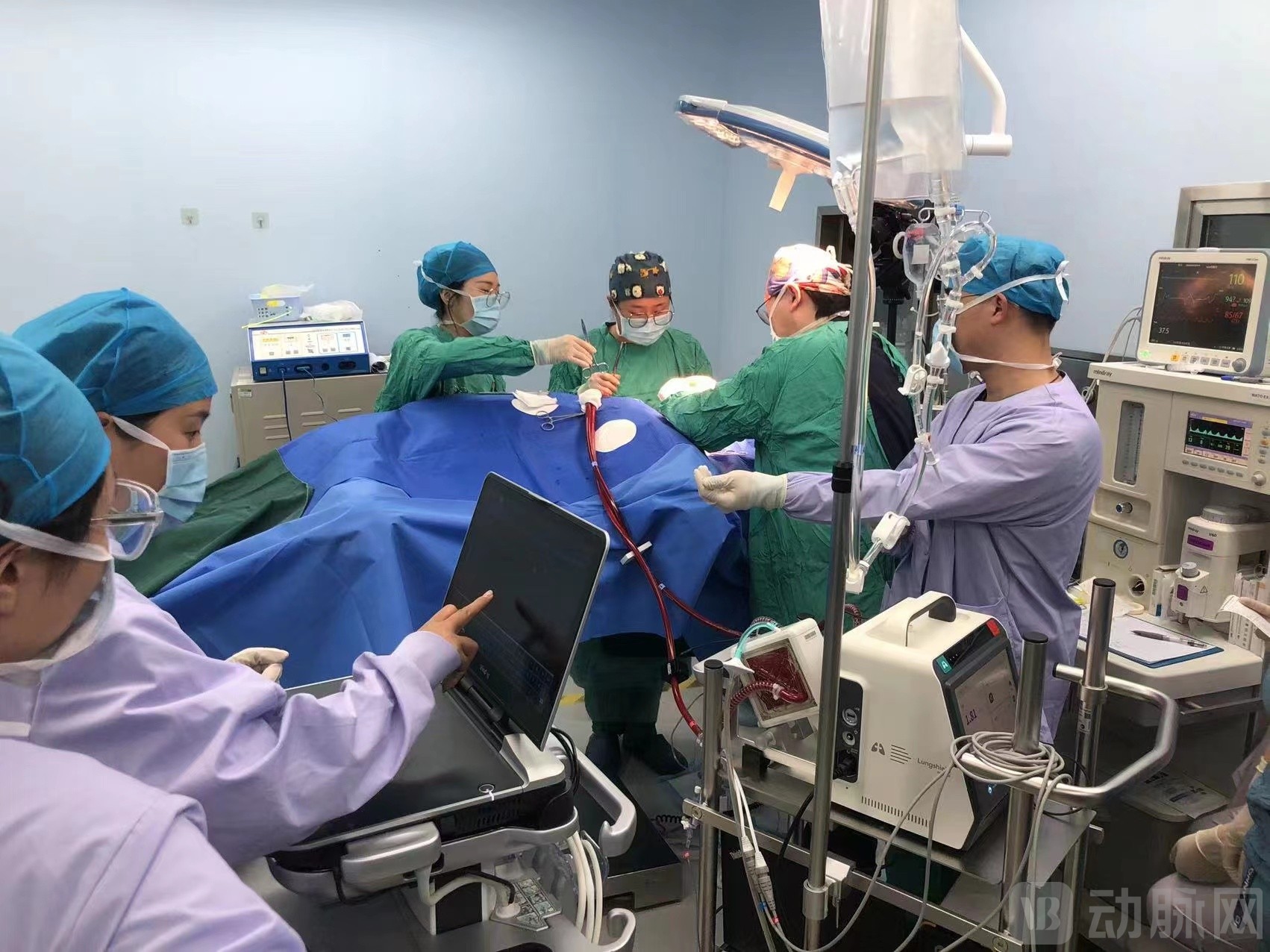 Feidun Medical ECMO System Registration Animal Study
The successful completion of this animal study further validates the safety and efficacy of Feidun Medical’s ECMO system, propelling it into a new phase of development. The product will soon commence registration clinical trials. Meanwhile,The company’s stacked membrane oxygenator achieved stable operation for 16 days, marking a significant breakthrough compared to the industry’s best performance of 14 days, and providing a more reliable solution for long-term cardiopulmonary circulatory support.。
ECMO is known as the “ultimate weapon” in the ICU, and the COVID-19 pandemic has further elevated ECMO to a life-saving “pedestal.”
ECMO System: The ECMO system drains venous blood from the body, oxygenates it and removes carbon dioxide via an oxygenator, and then pumps it back into the patient’s circulation to maintain normal cardiopulmonary function, thereby buying time for life-saving interventions.In 2021, the number of ECMO rescue cases in China was 10,656, representing a 53.6% increase compared to 2020.
Clinical practice places particular emphasis on efficacy, safety, and stability—such as the oxygenation efficiency, carbon dioxide removal rate, and product stability of ECMO systems—as these factors influence patient prognosis and the incidence of complications including bleeding, thrombosis, and infection. Meanwhile, during clinical application, some patients present with complex conditions that necessitate prolonged ECMO support."Due to the high cost of replacing oxygenators and potential issues such as leakage and infection during replacement, clinical practice has placed higher demands on the service life of oxygenators."
Traditional membrane oxygenators employ a roll-wrapped configuration for their gas exchange membranes. This design offers high fiber membrane utilization and can filter out some air emboli not removed by the cardiotomy reservoir. However, it features a long blood flow path, higher transmembrane pressure gradient, and a greater propensity for thrombus formation between membranes, making it suitable for short-term cardiopulmonary bypass in conventional cardiac surgery.
In contrast, the PMP membranes of stacked membrane oxygenators are cut into square shapes and feature a longitudinal and transverse overlapping design.The blood flow path in the stacked membrane oxygenator is shorter, with a larger cross-sectional area and more uniform blood distribution. Additionally, the lower transmembrane pressure differential significantly extends clinical usage time, making it relatively more suitable for prolonged extracorporeal circulation.
Stacked Membrane Oxygenators Have Been in Clinical Use in China for Over a Decade. Based on cumulative feedback from clinical practice, stacked membrane oxygenators demonstrate significant advantages in terms of efficacy, safety, and duration of use.
In the Chinese ECMO market, Medtronic was the first company to introduce this therapy and initiate clinical applications. However, Germany’s Maquet achieved a late-mover advantage, largely due to its unique stacked membrane oxygenator design, which enables an extended operational lifespan of up to 14 days. This has positioned Maquet as a global leader in the ECMO field, capturing over 70% of the market share in China.
However, stacked-film oxygenators present high technical barriers, with only a few companies worldwide engaged in their development. In addition to unique blood channel flow field designs, the stability of the manufacturing process is also critical.
The manufacturing process for stacked membrane oxygenators is complex, requiring more components than traditional membrane oxygenators. Upstream, domestic suppliers and production equipment for traditional membrane oxygenator components are already available in China. However, the development of stacked membrane oxygenators remains immature domestically, necessitating corporate participation in development, continuous validation, and optimization. This results in high upfront R&D investment and production costs.
“The original aspiration to ‘develop ECMO systems that are affordable for more Chinese people’ drives LungShield Medical to rise to the challenge.”
According to Chen Zulin, CEO of Feidun Medical, the company targeted Maquet’s PLS extracorporeal circulation kit—hailed as the “industry gold standard”—from the outset of product development. Building on a similar stacked-membrane design, Feidun Medical further optimized flow field dynamics and achieved iterative improvements in core performance, thereby delivering a “me-better” domestically produced alternative.
By optimizing flow field design, such as relatively elevating the positions of the oxygenator’s blood inlet and outlet ports and shortening the blood inflow and outflow pathways,The transmembrane pressure difference of the Feidun Medical oxygenator is only 38 mmHg (at 5 L/min), significantly lower than the 90–110 mmHg (at 5 L/min) observed in conventional oxygenators. This design effectively reduces blood cell damage, features a shorter blood pathway and more uniform distribution of blood flow channels, thereby achieving higher gas and heat exchange efficiency.。
Furthermore, the performance of the blood pump head, another core component of the ECMO system, is critical. Driven by domestic clinical needs, the blood pump head must meet the challenging requirement of having a low priming volume while causing minimal damage to blood cells.
Over the past decade, LungShield Medical’s R&D team has designed multiple clinically validated, high-performance blood pump heads for numerous multinational medical device companies worldwide, accumulating extensive expertise in flow field design.By optimizing the flow field design of the blood pump impeller, LungShield Medical has effectively reduced the pump’s volume, achieved a lower priming volume, enhanced pump head stability, and improved hemolysis indices, making it better suited to meet the needs of clinical practice in China.
In the overall structural design of the ECMO controller unit, the LungShield medical team will also optimize and improve it by combining the clinical environment in China and the usage habits of doctors. The ECMO oxygenator kit and blood pump adopt a detachable bracket design, which can be placed on the main unit for easy carrying and intra-hospital transportation, or separated and fixed to a trolley or beside the patient's bed for use. Even if the ECMO system is placed on soft blankets or cushions, it will not cause kinking of the blood tubing, affecting the stability of blood flow within the tubing.
“We hold our ECMO products in awe, because patient life is paramount.” Ms. Zhang Jin, Head of Quality and Regulatory Affairs at Feidun Medical, stated that in the validation of product safety and efficacy, Feidun Medical adhered to a rigorous scientific attitude, conducting over one hundred in vitro blood tests before proceeding with multiple rounds of acute and chronic animal trials.This registration animal study is the third chronic animal trial conducted by Feidun Medical.。
Following comprehensive validation of product safety and efficacy, Feidun Medical’s ECMO system is now “poised for launch,”The company will initiate registration clinical trials in the first half of this year.。
In addition to achieving technological breakthroughs in its core products, Feidun Medical also places great emphasis on the depth and breadth of its product portfolio.The company is dedicated to building a comprehensive solution for ECMO therapy. In addition to ECMO oxygenator kits and consoles, it is also developing products such as long-acting anticoagulant coatings, femoral arterial and venous cannulas, and monitors for blood oxygen saturation and hematocrit.。
Su Kai, Director of Clinical and Marketing at Feidun Medical, stated: “ECMO represents the highest level of clinical extracorporeal life support, imposing stringent requirements on hospital environments, medical teams, and equipment configuration. Currently, the most critical shortage in clinical practice is for ECMO oxygenator kits, followed by ECMO consoles. In the long term, however, femoral arteriovenous cannulas, blood oxygen saturation monitors, and hematology analyzers are also essential clinical needs. We provide more comprehensive solutions to genuinely address the challenges and difficulties faced by clinicians in China.”
Meanwhile, in the field of life support, Feidun Medical is also developing a new generation of interventional left ventricular assist systems and extracorporeal carbon dioxide removal systems. In this high-barrier life support sector, Feidun Medical’s confidence stems from its robust talent pool and its development approach centered on deep medical-engineering collaboration.
The company's core team comprises a world-class Sino-German R&D team and an experienced domestic team specializing in industrialization and commercialization.
Its wholly-owned subsidiary, enmodes GmbH in Germany, was established in 2011 by Professor Ulrich Steinseifer, Director of the Institute for Medical Engineering at RWTH Aachen University, and Professor Tim Kaufmann.Over the past decade, this team has delivered more than 50 medical device development projects in the cardiovascular field for medical device companies across over 20 countries. These projects include, but are not limited to, blood pumps, oxygenators, and interventional pump products, all of which have been extensively validated in clinical applications and successfully launched on the market.。
China’s R&D team also boasts extensive experience in medical device development, with members hailing from top-tier universities and renowned medical companies both domestically and internationally. The core management team comprises senior executives from multinational corporations who have dedicated many years to the cardiovascular field, all possessing substantial expertise in the research and development, manufacturing, and commercialization of life-support devices.
The Chinese-German team worked in close coordination to advance the localization of innovative products in China, laying a solid foundation for Feidun Medical’s global expansion.