

Who Controls the Future of mRNA? Patent Battles Engulf Moderna, Pfizer, and BioNTech
Did $18.4 Billion in mRNA COVID-19 Vaccine Sales in 2022 Amount to a Loss-Making “Futile Effort”?
According to the Insight database, Moderna’s COVID-19 vaccine, mRNA-1273, achieved sales of $18.4 billion in 2022, ranking fifth on the annual drug sales list.
However, the “patent war” over LNP delivery technology for this mRNA vaccine has been ongoing for nearly seven years.Arbutus contends that, without its patented LNP delivery platform, Moderna could not have advanced its mRNA vaccines to widespread use at record speed.
Initially, Moderna obtained licenses to several Arbutus patents on LNP technology through Acuitas via a sub-license arrangement in 2015. However, Arbutus contended that this arrangement was unlawful, filed a lawsuit in 2015, and ultimately prevailed. In 2018, Arbutus terminated the relevant patent license with Acuitas, thereby restricting Moderna’s scope of use of Arbutus’s LNP technology and plunging Moderna’s vaccine development into difficulties.
Although Moderna challenged the validity of Arbutus’s LNP patents in December 2021, Arbutus successfully defended its position, causing its stock price to surge by 95%. To date, Moderna has never directly disclosed specific details about the LNPs used in its products. However, Arbutus submitted certain public materials from Moderna to the court to demonstrate that Moderna had utilized its LNP technology. In February 2022, Arbutus formally filed a lawsuit against Moderna, alleging that Moderna’s mRNA vaccines infringed upon multiple LNP-related patents and seeking damages.
It is worth noting that Moderna’s COVID-19 vaccine sales exceeded $18 billion in both 2021 and 2022. Analysts at Jefferies stated that Arbutus Biopharma is poised to receive substantial compensation if it prevails in the lawsuit, with its stock price potentially surging by 200–300%.
This case is merely the tip of the iceberg in mRNA-related patent litigation. The structures of lipid nanoparticles (LNPs) and modifications to mRNA molecules have established broadly defined patent barriers, drawing not only Moderna but also Pfizer and BioNTech into significant mRNA patent disputes.
LNP, short for lipid nanoparticles, is currently the most mature delivery technology and is the most widely used in clinical practice.Technological maturity and the number of clinical cases mutually reinforce each other in a “snowball” effect, continuously “attracting” new mRNA pipelines, which has led to diverse applications of LNP technology.
Currently, Chinese mRNA manufacturers seeking to commercialize their products using LNPs have opted to secure licenses from Arbutus., but due to restrictions on the duration of access permissions, continuous authorization applications are required. This poses a significant risk of being "strangled" and has negative impacts on development pressure, product costs, and sustained innovation.
The other part opts for licensing from other patent holders, procuring proprietary component materials used in commercially available overseas products, and other such forms., yet they must always be prepared for the risk of corporate litigation and the possibility that their achievements will come to naught.
Companies that develop their own LNP-like technologies by conducting R&D on the structures and combinations of LNP components must also take such risks into consideration.Yet even industry giants like Pfizer and Moderna cannot completely circumvent patent constraints. Chinese enterprises adopting such approaches for pipeline development are highly likely to face infringement lawsuits during subsequent marketing authorization applications or clinical trial phases.
It is evident that whether a company holds proprietary patents for delivery technologies can directly impact its operations across multiple dimensions, including pipeline advancement, market expansion, commercialization, sustained innovation, and legal risk management.
In recent years, companies in this sector have also gradually come to recognize the necessity of independently mastering delivery technologies.
In fact,LNPDelivery technologies are far from “impeccable,” leaving ample room for companies to independently explore superior delivery solutions.
Due to hepatic accumulation, the therapeutic applications of conventional LNP technology are relatively limited.Furthermore, extensive hepatic accumulation can lead to localized hypersensitivity reactions. Reports have indicated that the liver-accumulating properties of LNPs can trigger immune-mediated attacks on the liver, resulting in hepatic injury.More importantly, the structure of LNPs is prone to significant accumulation in the bloodstream, leading to immunotoxicity.In some cases, allergic reactions to lipid nanoparticles (LNPs) can be severe. Prior to administering LNP-delivered therapeutics, patients require pretreatment with antihistamines and corticosteroids, which significantly limits their application in the management of chronic diseases.
In addition to LNP technology, cationic polymers, protamine, exosomes, and lipid-polymer hybrids (LPP) are all delivery technologies currently emerging in the industry, capable of circumventing the significant patent barriers associated with LNPs.
Currently, the lipid-polymer (hereinafter referred to as “LPP”) delivery technology has been thoroughly validated in terms of technical principles, pipeline verification, and clinical performance, demonstrating comparability with traditional LNP delivery technologies. The global exclusive commercialization rights to this technology are held solely by Stemirna Therapeutics, a leading global mRNA platform company.
Over hundreds of thousands of years of evolution, our bodies have developed effective defenses against viruses. When microorganisms enter the body, immune cells can precisely identify bacteria and viruses based on their distinct shapes, sizes, and components. Taking RNA viruses as an example, when single-stranded or double-stranded RNA viruses invade, they activate various receptors, thereby triggering innate immune responses within the body. Immune cells then recognize and phagocytose these pathogens, or otherwise minimize the viral impact.
Leveraging this immune characteristic of the human body, a virus-like structure is designed to deliver mRNA. The host immune system readily recognizes and phagocytizes these structures. Once the mRNA-containing virus-like particles are phagocytized, the mRNA is expressed within the body.
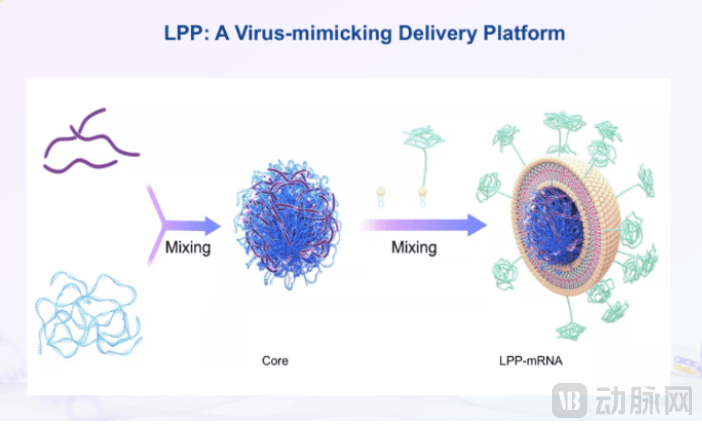
Schematic Diagram of LPP Carrying mRNA (Image Source: Stemirna Therapeutics)
Stemirna Therapeutics’ LPP is a bilayered, virus-like structure featuring an mRNA-polymer complex as its core and a lipid envelope as its shell.The main components of LPP include nucleic acids, cationic polymers, ionizable lipids, helper phospholipids, cholesterol, and polyethylene glycol (PEG) lipids.
The bilayer nanoparticles of LPP offer superior mRNA encapsulation and protection compared to traditional LNPs, and enable the gradual release of mRNA molecules as the polymer degrades. Furthermore, the excellent dendritic cell targeting capability of the LPP platform enhances T-cell immune responses through antigen presentation, thereby achieving optimal immunotherapeutic efficacy.
mRNA-loaded LNPs exhibit strong liver tropism. In contrast to the hepatic accumulation observed with LNPs, LPPs can address this issue through three approaches: material selection, compositional modification, and particle property optimization.
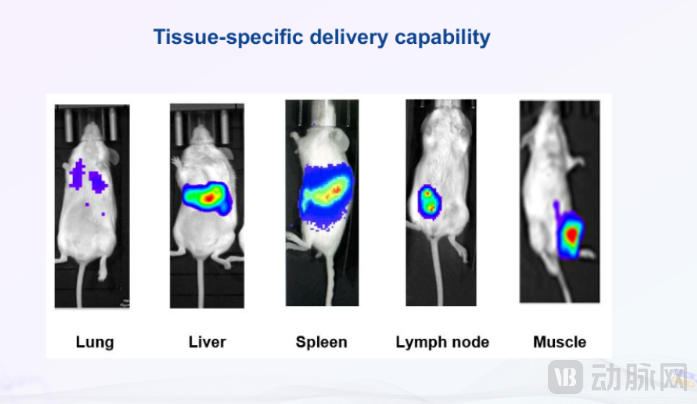
Organ Retention of LPP-mRNA Particles in Tumor-Bearing Mice (Image source: Stemirna Therapeutics)
First,Stemirna Therapeutics’ LPP demonstrates advanced capabilities in organ targeting.Unlike lipid nanoparticles (LNPs), which primarily target the liver after intravenous administration, lipid-polymer particles (LPPs) achieve organ-specific targeting by modifying their composition and particle size. LPPs can be administered intravenously to target the liver, spleen, and lungs as needed, with splenic targeting efficiency reaching up to 88.4%.
In addition,Currently, most mRNA vaccines are administered via intramuscular injection, and the majority of mRNA remains at the injection site after LPP administration., while some are targeted to immune cells in lymph nodes via lymphatic drainage. In contrast, after LNP administration, mRNA enters the systemic circulation and undergoes off-target expression in the liver, thereby posing potential adverse effects.
Given LPP’s strong performance in terms of targeting specificity and low toxicity, Stemirna Therapeutics is leveraging AI technology to continuously optimize the entire upstream and downstream processes of its delivery system, as well as its manufacturing procedures, thereby enhancing the overall competitiveness of LPP.
Leveraging the technological advantages and patent barriers of LPP, Stemirna Therapeutics has established a portfolio of R&D pipelines in the fields of infectious diseases, tumor immunology, metabolic disorders, and rare diseases.
Stemirna Therapeutics boasts a robust pipeline, encompassing prophylactic vaccines against various infectious diseases, as well as therapeutic vaccines and other mRNA-based therapeutics.
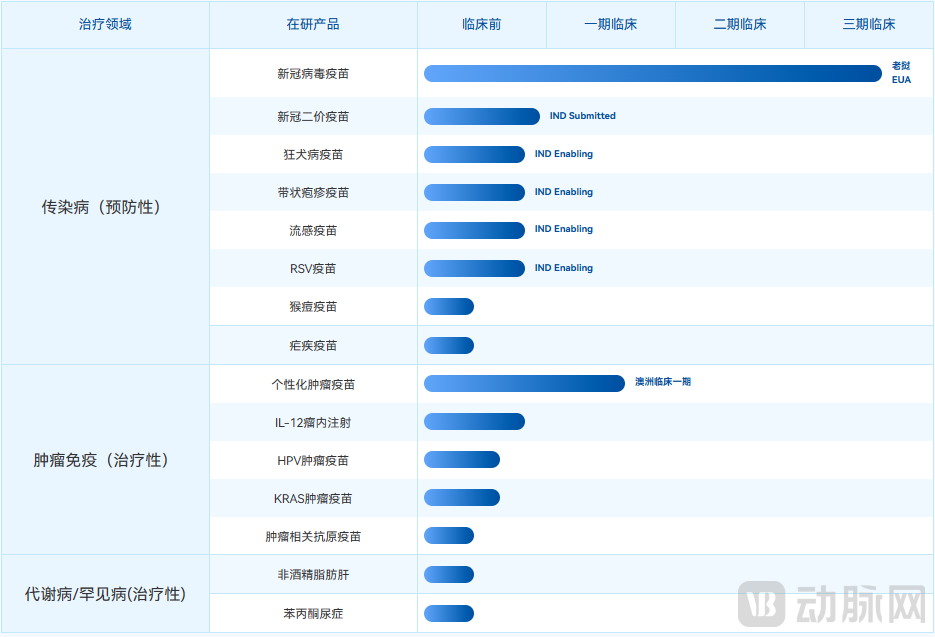
Current Pipeline Progress of Stemirna Therapeutics (Image Source: Stemirna Therapeutics)
Thanks to the global patent barriers of LPP, Stemirna Therapeutics has been making smooth progress in advancing its various pipelines worldwide.
On March 16, the Investigational New Drug (IND) application for SW0715, an mRNA oncology drug independently developed by Stemirna Therapeutics, was accepted by the Center for Drug Evaluation (CDE). SW0715 is the first non-replicating intratumoral mRNA drug in China that encodes the cytokine IL-12. Previously, the company’s COVID-19 vaccine completed Phase III clinical trials and received Emergency Use Authorization (EUA) in Laos, while its bivalent COVID-19 vaccine has also submitted an IND application. Meanwhile, its self-developed mRNA vaccines for infectious diseases, including rabies, herpes zoster, influenza, and RSV, have all advanced to the IND-enabling stage. Its personalized therapeutic cancer vaccine is currently undergoing Phase I clinical trials in Australia.
As a leading mRNA drug platform company, Stemirna Therapeutics has not only developed its own pipeline but also established an mRNA vaccine production base spanning nearly 50,000 square meters in Zhangjiang Hi-Tech Park and the Oriental Beauty Valley Industrial Park in Fengxian District, Pudong New Area, Shanghai. The facility meets the production requirements for plasmids, drug substances, and finished formulations, pioneering the large-scale manufacturing process for mRNA vaccines. By leveraging proprietary technologies for drug substance production and formulation, Stemirna has overcome the industrialization bottlenecks of mRNA COVID-19 vaccines. The base has an annual production capacity of 400 million doses, making itOne of the largest and world-class mRNA vaccine production bases in Asia。
From the patent barriers surrounding LPP’s proprietary technology, to the global advancement of its multi-formulation drug pipeline, and the establishment and operation of large-scale manufacturing facilities, it is evident thatStemirna Therapeutics has gained a first-mover advantage across multiple aspects of the upstream, midstream, and downstream industrial chains, including “technology-driven continuous innovation capability,” “capacity-driven product cost control,” and “patent-driven market expansion advantages.”。
According to PubMed’s assessment data, the overall size of the mRNA drug market could reach $23 billion by 2035, with annual sales of non-COVID preventive vaccines potentially reaching $7–10 billion, mRNA cancer therapeutic vaccines reaching $7–10 billion, and mRNA therapeutics reaching $4–5 billion.
If companies can participate in global market competition without concerns such as “patent restrictions,” a “virtuous cycle” may emerge across various dimensions, including commercial returns, resource integration, product value, and sustainable development.
With the continuous advancement of biotechnology, mRNA drugs are not only used to develop vaccines (such as prophylactic vaccines and cancer vaccines) but also demonstrate excellent performance in a broader range of innovative therapies, including gene editing, protein replacement therapy, antibody therapy, and cytokine therapy. This indicates that a larger market awaits the emergence of new mRNA therapeutics.
Although China’s mRNA industry is still in its early stages of development, innovative mRNA drug R&D enterprises of varying sizes, such as Stemirna Therapeutics, are already developing their own delivery technologies to secure greater initiative in product expansion and market development.
This indicates that a growing number of enterprises recognize that only by addressing patent issues can they cultivate sustainable innovation capabilities, drive the industry toward diversification and fundamental innovation, and spark greater dynamism within the “early-stage” mRNA sector.
“How fast you run” is certainly important, but for businesses, “how far you can go” is even more critical.