

Can Real Estate Giants Succeed in Hard-Tech MedTech? Insights from Recent IPO Filings
Last August, the listing of United Imaging Healthcare sent shockwaves through the entire medical community. Yet little known is that behind this leading contender among high-end medical device companies in the wave of “domestic substitution” lies the shadow of a real estate corporate venture capital (CVC) firm.
In early 2018, Poly Capital, a subsidiary of China Poly Group, planned to enter the medical device sector, with a focus on promoting domestic substitution of high-end medical devices. The strategy involved horizontal expansion into intelligent devices across various clinical departments and vertical integration throughout the entire medical device industry chain. Following the announcement of this plan, the first project targeted by China Poly Group was United Imaging Healthcare, which had just completed its Series A financing round.
Over the following four years, Poly Capital began to make cautious forays into the healthcare sector as an investor. Although the number of completed deals was limited, its portfolio companies—including Edge Medical Robotics and Allway Medical in the surgical robotics space, QiangLian ZhiChuang in AI-assisted diagnosis, and Chengtian Technology in exoskeleton robotics—are all leaders in their respective niche segments. Among them, Edge Medical Robotics has already filed its prospectus, while Allway Medical and QiangLian ZhiChuang have undergone multiple rounds of financing and are now on the verge of an initial public offering (IPO).
Poly Capital’s heavy investment in tech-driven healthcare is a microcosm of how real estate developers are positioning themselves in the sector. In recent years, some companies have moved beyond the traditional “real estate + big health” model, making gradual yet forceful inroads into the field of hard-core medical technologies.
However, real estate’s cross-industry foray differs from that of the home appliance and insurance sectors, where either technological spillover is feasible or existing businesses closely track advancements in medical technology. Can real estate developers, accustomed to a high-turnover model and serving a diverse consumer base, truly succeed in investing in the slow-paced, narrowly focused medtech sector?
Real estate giants have multiple investment rationales for entering the tech-healthcare sector, but not every player can strategize like Poly Capital, backed by a central state-owned enterprise, to focus on the domestic substitution of high-end medical devices. As more real estate companies pivot toward healthcare, they primarily aim to: first, deepen their “medical + general health” ecosystem by integrating small and medium-sized enterprises across the upstream and downstream of the medical industry chain; and second, diversify risks by leveraging the robust growth momentum of the general health sector to hedge against the potential long-term downturn in the real estate industry.
Country Garden is the most aggressive among real estate developers venturing into cross-industry investments. After establishing Country Garden Venture Capital, the firm first led the investment round in the prominent internet healthcare company Penguin Almond (now merged into Medlinker), then took a stake in the tumor immunology biotech firm Heber Bio, and made a strategic investment in New Ruipeng, the undisputed leader in the pet hospital chain sector, seemingly aiming to build a super private equity fund in the medical technology space.
However, after entering 2021, Country Garden Venture Capital underwent a dramatic shift in strategy, deviating from the traditional investment logic of corporate venture capital (CVC). That year, it began casting a wide net in early-stage projects, co-investing with other institutions in numerous angel, Series A, and Series B rounds, and exclusively investing in Jingzhi Future, a company developing exhaled breath VOC technology.
This investment model, which focuses primarily on early-stage and late-stage projects, was once described by Dai Yongbo, Managing Partner of Country Garden Ventures, as “dumbbell-style investing.” He believes that as venture capital firms expand in scale, the mid-stage financing track has become increasingly crowded, whereas competition for early- and late-stage financing projects is relatively less intense.
Guided by a clear investment thesis, Country Garden Venture Capital has steadily increased both the frequency and proportion of its healthcare project investments year over year. Among the 32 projects publicly disclosed in 2021, seven were in the healthcare sector. In 2022, when many major investment firms scaled back their activities, Country Garden Venture Capital completed five investments within just three months, surpassing numerous healthcare-focused funds in both deal count and capital deployed.
Throughout its cross-industry expansion, Country Garden Venture Capital has continuously broadened its scope across niche sectors, spanning cardiovascular devices, microfluidics, synthetic biology, and AI-driven drug discovery. Its investment portfolio encompasses the most cutting-edge medical technologies. Notably, the majority of these healthcare projects are of high quality; when combined with investments in other industries, the firm’s annual return on investment reached 80% in 2021.
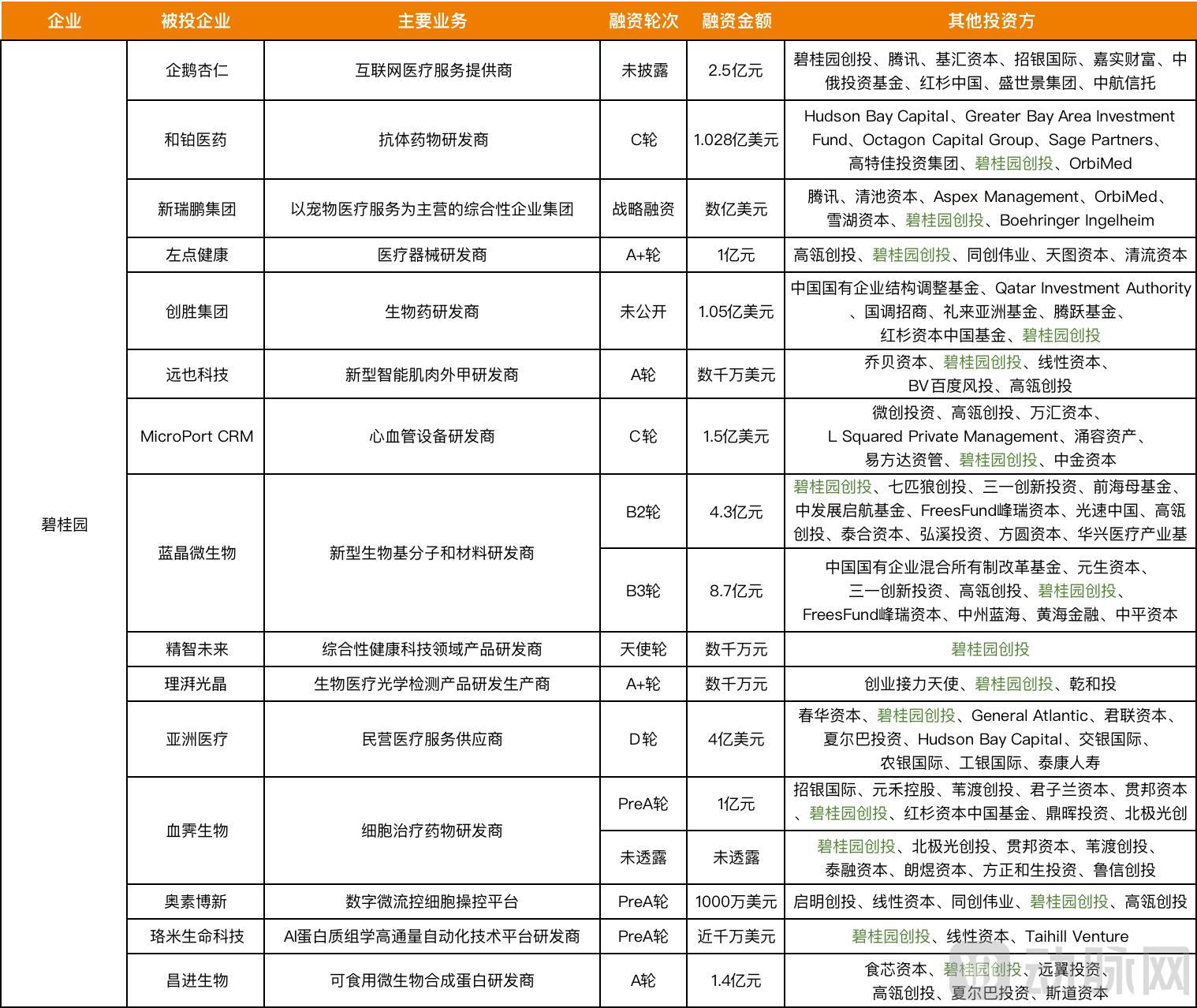 Country Garden’s Healthcare Investment Layout
Compared to Country Garden, Longfor’s investment activities through its corporate venture capital (CVC) arm appear somewhat conservative. Although it has made significant strides in the technology sector, its presence in medical technology is limited to Nuanwa Technology. The latter, operating in the health insurance technology segment, encountered certain headwinds during the pandemic, and Longfor has not pursued further deepening of its involvement in medical tech. After all, by leveraging Chunshan Wanshu and Youyou Baby, Longfor continues to hold a first-mover advantage in the elderly care and maternal-child health sectors.
Overall, the success of Poly Capital and Country Garden Venture Capital has confirmed the feasibility for real estate developers to cross over into the healthcare sector through Corporate Venture Capital (CVC). Guided by the logic of smart healthcare services and the “technology-first” approach in high-end pharmaceuticals and medical devices, and leveraging their inherent financial and industrial advantages, CVC arms are indeed capable of identifying high-value projects and persuading enterprises to accept investment. Can this model be replicated at lower market tiers?
Lured by high investment returns, many real estate developers beyond the industry leaders are also tempted. However, unlike Poly and Country Garden, which enjoy ample financial backing, lower-ranked developers find it difficult to replicate the CVC model for cross-sector expansion. Often, they face a binary choice between tech-driven healthcare and real estate: either remain on the sidelines and stick to property development, or go all-in on healthcare.
Yihua Real Estate (now Yihua Health) is arguably the first real estate company in the industry to attempt a cross-sector expansion into tech-driven healthcare. In 2014, Yihua Real Estate acquired 100% equity interest in Guangdong Zhongan Kang Logistics Group Co., Ltd. for RMB 720 million, entering the market through integrated medical logistics services and specialized medical engineering. Subsequently, it acquired a 20% stake in Shenzhen Youdeyi Technology Co., Ltd. for RMB 120 million, expanding its business scope into medical services and the online hospital medical technology platform market.
Having tasted the benefits, Yihua Real Estate promptly embarked on an ambitious cross-sector expansion. Relying on the same acquisition strategy, it fully acquired Aiaole, a chronic disease management and medical equipment company, and Dazisailekang, a hospital management company. It began collaborating with hospitals to build diagnostic and treatment centers, assisting them in procuring medical equipment and sharing revenue from diagnostic and treatment services. In February 2015, “Yihua Real Estate” was renamed “Yihua Health,” and completely divested its real estate business within the year.
The acquisition of Aiole is particularly noteworthy. Following the completion of the acquisition, Yihua Health’s stock price reached a historical high of 38.60 yuan that year, representing a tenfold increase from the beginning of the year. Viewed from today’s perspective, the business closed loop of “in-hospital information systems + out-of-hospital chronic disease management” devices has already formed the foundational basis for internet-based chronic disease management operations.
However, Yihua Health’s cross-industry journey has been far from smooth, as it issued its fifth delisting risk warning in late March. Two factors contributed to its fall from grace: First, after entering the elderly care sector in 2016, Yihua Health incurred losses, with financing failing to keep pace with its expansion, leading to significant pressure on short-term debt. Second, its informatics products and medical devices for chronic disease management faced intense competition from innovative startups. A lack of sustained R&D output meant that its traditional glucometers and outdated informatics systems could no longer maintain the competitiveness required in the market.
This is also the primary reason why many remain skeptical about real estate companies diversifying into medical technology. Under a long-term, high-leverage operational model, managers struggle to adapt to the healthcare industry’s paradigm of high R&D investment and long payback periods. The slightest misstep can lead to broken capital chains and disjointed R&D efforts.
How to Solve This Dilemma? Many Real Estate Companies Have Chosen a “Curved Cross-Border” Approach.
Guangdong’s Shierong Zhaoye serves as a typical example. Through its wholly-owned subsidiary, Shierong Investment, which contributed RMB 10 million, Shierong Zhaoye acquired an 81% equity stake in Zhuhai Zhihe Property Investment Co., Ltd. (hereinafter referred to as “Zhihe Property”) via a capital increase, thereby securing the rights to invest in, develop, and operate the “Hengqin Zhihe International Life Science Center” project.
Located in the Hengqin New Area, a state-level new district, the Hengqin Zhihe International Life Sciences Center covers a planned land area of approximately 200,000 square meters, with a floor area ratio-based construction area of about 400,000 square meters. The project includes investing in a Grade A tertiary general hospital with no fewer than 1,000 beds; constructing an advanced intelligent health, convalescence, and rehabilitation center; and planning to introduce the most advanced domestic and international gene research institutions to establish a clinical gene R&D and testing center. Additionally, it will develop commercial service facilities such as a medical research center and an international exchange and conference center. Through this approach, Shirong Zhaoye has established another medical hub in Zhuhai following an industrial park model, thereby formally entering the field of technology-driven healthcare.
Suzhou Hi-Tech’s strategy most closely resembles that of Poly and Country Garden. Last month, Suzhou Hi-Tech’s nearly year-long plan to “make a cash capital increase in a medical device industry company” was finally finalized. The company’s wholly-owned subsidiary, Risu Hi-Tech Fund, together with Su Gaoxin Investment and the medical device industry company, jointly signed a partnership agreement to establish the Suxin Emerging Industry Fund, with a total subscribed capital commitment of RMB 500 million.
Suzhou New District Hi-Tech stated in its announcement that the capital increase will drive the company’s transformation and upgrading, aligning it with its strategic positioning as a “cultivator and investment operator of high-tech industries.” This move aims to gradually reduce reliance on traditional real estate development, foster coordinated development of the regional pharmaceutical industry, and accumulate high-quality investment resources in the medical sector. In the long run, leveraging Suzhou’s strong foundation in pharmaceutical and medical device innovation, Suzhou New District Hi-Tech is poised to follow the paths of Poly and Country Garden by deeply engaging in the medical technology field through corporate venture capital (CVC).
In light of this, non-leading real estate companies face significant challenges in crossing over into the technology and healthcare sectors, whether through investment or transformation. They must not only overcome technical barriers but also seek a shift in management logic; a single misstep could lead to total failure. Therefore, a more prudent approach is to establish industrial parks based on real estate principles, set up technology and healthcare investment funds reliant on these parks, and gradually complete the cross-sector transition step by step. Even if failures occur along the way, this strategy allows for room to maneuver.
Despite the numerous pitfalls on the path of cross-industry expansion, there are still areas of synergy between the real estate sector and the tech-driven healthcare industry.
From the perspective of real estate enterprises, years of policy adjustments and financial leverage have accumulated a vast network of social connections and capital within the industry. Today, the consensus supporting investment-driven real estate development on the consumer side shows signs of collapse. Slowing urbanization and declining newborn rates are constraining market growth in the short and long term, respectively. Under the combined pressure of these factors, the real estate sector has entered a downward cycle, with both return on investment and capital utilization rates declining. Consequently, cross-sector expansion into technology and healthcare can be viewed not only as a strategic pathway for high-quality enterprises to diversify risk and identify new growth curves, but also as a means to optimize social capital allocation by redirecting funds from the saturated real estate sector to the urgently needs-based medical technology industry.
From the perspective of healthcare technology companies, as fundraising in the primary market becomes increasingly difficult and exit channels narrow, a growing number of promising medtech startups are turning their attention to well-capitalized, resource-rich, and patient corporate venture capital (CVC) arms of real estate firms. These startups hope to leverage the related industrial chains of the real estate sector to open up new pathways for product sales.
Revisiting Poly Capital and Country Garden Ventures: Significant Differences Between CVC-Backed Firms and IVCs Such as Sequoia and HillhouseInvestment firms with corporate venture capital (CVC) backgrounds, such as Poly Capital and Country Garden Ventures, differ significantly from independent venture capital (IVC) firms like Sequoia Capital and Hillhouse Capital. IVCs primarily raise funds from external investors, focusing on maximizing investment returns to achieve profitability for the firm. In contrast, Poly Capital is funded by Poly Group, and Country Garden Ventures is backed by Country Garden Holdings. Beyond financial returns, these CVCs are also tasked with supporting their parent groups’ overall strategic objectives and upholding their respective business philosophies.
Specifically, Poly Capital’s strategy for the “domestic substitution” of high-end medical devices has the potential to establish a complete ecosystem in the field of surgical robots, leveraging its position as a central state-owned enterprise to help domestic entrants catch up with foreign competitors. Country Garden Venture Capital’s advantage lies in its existing community network. Within its nationwide residential communities, portfolio companies such as New Ruipeng Pet Hospital and Penguin Almond in the healthcare services sector, as well as Hankou Erchang and Chali in the food and consumer goods segment, can deploy their services and products outside traditional channels. As an integral part of Country Garden’s community services, this approach will accelerate their commercialization journey.
However, it is also important to note that an increasing number of players are eyeing the medical technology and broader healthcare market. Beyond real estate, companies from diverse sectors—including home appliances, cosmetics, apparel, and gaming—are seeking to enter the healthcare industry through Corporate Venture Capital (CVC). As a result, it has become increasingly difficult for any single industry to leverage high-quality enterprises to gain a firm foothold in healthcare. The seemingly vast healthcare market may, in fact, offer limited room for maneuver for real estate companies...